What Is GEO? Generative Engine Optimization for Business Blogs
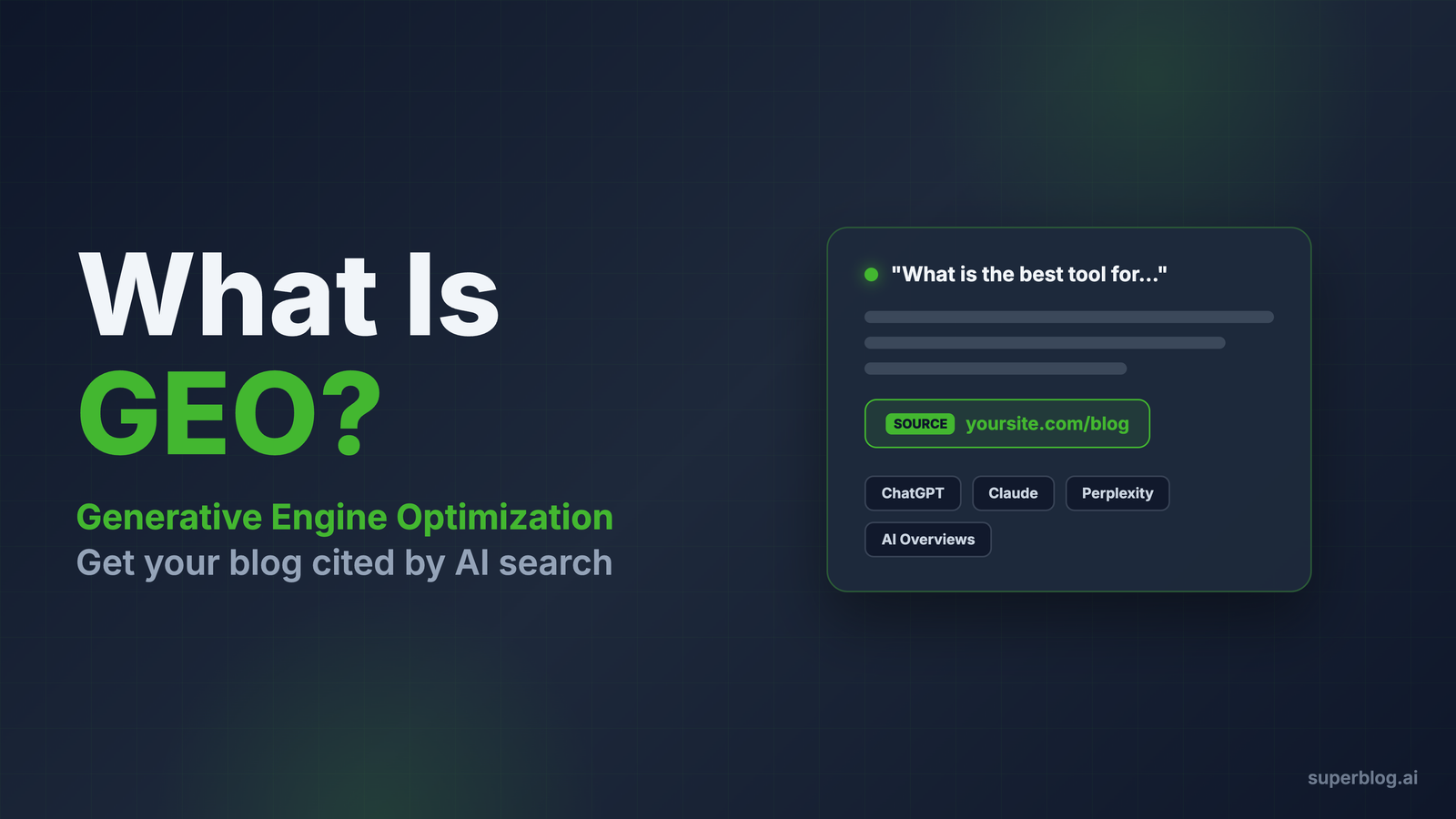
Generative Engine Optimization (GEO) is the practice of structuring your content so AI systems like ChatGPT, Claude, Perplexity, and Google AI Overviews can find it, understand it, and cite it in their answers. Where SEO earns you a ranking, GEO earns you a citation.
Your buyers have changed how they research. They ask an assistant "what should we use for X" and act on the answer without ever seeing a results page. Gartner predicted that traditional search engine volume would drop 25% by 2026 as users shift to AI assistants, and every referral report we see from customers points the same direction.
If your blog is not built to be cited, you are invisible in the fastest-growing discovery channel on the internet. This guide covers what GEO actually is, how it relates to SEO, how each major AI system selects sources, and the concrete work that gets your content into AI answers.
What Is Generative Engine Optimization?
GEO is the discipline of making your content the source an AI engine pulls from when it composes an answer.
The term comes from a 2023 research paper by Aggarwal et al. titled "GEO: Generative Engine Optimization," which tested how different content changes affect visibility inside AI-generated responses. The findings were blunt: adding citations, quotable statements, and statistics increased source visibility in generative engine responses by up to 40%. Keyword stuffing, the old SEO reflex, did almost nothing.
That result defines the field. Generative engines do not rank ten blue links. They retrieve a handful of passages, synthesize one answer, and attribute it to the sources they trusted. Either your page is one of those sources or it does not exist for that user.
The stakes are different from classic search, too. On a results page, position three still gets clicks. In a generated answer, there is no position three. The engine cites two or three sources and the rest of the internet is silent, which makes GEO closer to winner-take-most than anything SEO teams have dealt with before.
Three properties decide whether a passage gets used:
- Retrievability. The engine can crawl, parse, and index your page without friction.
- Extractability. A self-contained block of your content directly answers the question.
- Credibility. The content carries specifics: numbers, named entities, dates, and a clear author, so the model can justify citing it.
GEO vs SEO: Complementary, Not a Replacement
GEO does not replace SEO. It sits on top of it.
Every major generative engine retrieves candidate pages from a search index. ChatGPT search leans on Bing's index. AI Overviews are built directly on Google's ranking systems. Perplexity runs its own crawler and index. If your page cannot rank anywhere, it cannot be retrieved, and content that cannot be retrieved cannot be cited. Strong technical SEO is the entry ticket; GEO decides what happens after retrieval.
| SEO | GEO | |
|---|---|---|
| Goal | Rank a page in results | Get a passage cited in an answer |
| Unit of competition | The page | The paragraph or table |
| Core signals | Links, relevance, Core Web Vitals | Structure, clarity, entity consistency, citable facts |
| Outcome | Clicks from a results page | Citations, brand mentions, AI referrals |
| Failure mode | Page two obscurity | Your competitor becomes the quoted answer |
The practical takeaway: do not build a separate "GEO strategy" team or a separate content library. Run one content operation that satisfies both. Everything in our blog SEO checklist still applies; GEO adds a citation layer on top of it.
How AI Assistants Choose Sources
Each engine works differently, and the differences matter for prioritization.
ChatGPT
ChatGPT answers from two places: what its models learned in training and what its search tool retrieves live. For live answers, it queries a search index (historically Bing's), fetches the top candidates, and cites the pages it used. OpenAI runs separate crawlers for each purpose: GPTBot collects training data, while OAI-SearchBot powers search citations. Blocking GPTBot in robots.txt keeps your content out of training runs, but blocking OAI-SearchBot removes you from ChatGPT search answers entirely. Know which one you are blocking before you edit robots.txt.
Because retrieval runs through a search index, being indexed fast matters. This is where the IndexNow protocol earns its keep: it pings Bing the moment you publish instead of waiting days for a crawl.
Claude
Claude's web search fetches pages at answer time and reads their raw HTML. It does not execute JavaScript, so content that only appears after client-side rendering is invisible to it. Clean semantic markup, real heading hierarchy, and server-rendered text are the difference between being readable and being an empty div. Anthropic's ClaudeBot respects robots.txt, and Claude also reads llms.txt files where publishers provide them.
Perplexity
Perplexity is built around citations: every answer displays its sources inline, which makes it the most transparent engine to optimize for. It maintains its own index with a strong freshness bias and favors pages that answer a question directly near the top, with supporting data close by. Publish dates and updated dates are visible ranking inputs here. Stale content loses citations to newer pages that say the same thing.
Google AI Overviews
AI Overviews sit on top of Google's existing ranking systems. Pages that already rank on page one for a query are the citation pool for its AI summary, which means classic SEO performance is the qualifying round. Structured data helps Google understand what your page claims, and answer-first formatting increases the odds your passage is the one lifted into the overview. The same mechanics that win featured snippets carry over almost unchanged.
Across all four engines the pattern is identical: crawlable, fast, structured, unambiguous, fresh. Optimize for the pattern and every engine benefits.
How to Optimize Your Blog for GEO: 8 Concrete Steps
1. Let AI crawlers in
Audit your robots.txt for GPTBot, OAI-SearchBot, ClaudeBot, PerplexityBot, and Google-Extended. Many sites blocked everything AI-related in 2023 and forgot about it. That decision now silently removes them from AI answers. Decide deliberately: most businesses want search-facing bots allowed even if they restrict training bots.
2. Publish an llms.txt file
An llms.txt file is a machine-readable markdown index of your site that tells AI systems what you publish and where your important pages live. It is the emerging convention for AI discoverability, and it costs you nothing to provide. We covered the spec and setup in our guide to LLMs.txt and AI search. Superblog generates and updates this file automatically on every deploy, so every blog on the platform ships one without configuration.
3. Add structured data
JSON-LD schemas state your page's claims in a format machines parse without guesswork: what the article is, who wrote it, when it was updated, what questions it answers. Article, FAQ, Organization, and Breadcrumb schemas are the core four for a business blog. Our blog schema markup guide walks through each one. On Superblog these are generated automatically for every post; on other platforms you will write or plug them in yourself.
4. Serve clean, static HTML
Most AI crawlers do not run JavaScript. If your blog renders content client-side, an AI crawler sees a skeleton. Server-rendered or statically generated pages with semantic headings, real paragraphs, and proper table markup are fully readable. Tables deserve special mention: engines lift comparison tables into answers constantly because they are pre-structured facts.
5. Write question-shaped headings with answer-first paragraphs
Generative engines match user questions to passages. A heading that mirrors the question ("How much does WordPress maintenance cost?") followed by a direct two-sentence answer is the exact shape retrieval systems reward. Put the answer first and the nuance after, not the other way around.
6. Give the model something to cite
This is the highest-impact finding from the GEO research: passages with concrete statistics, named sources, and quotable sentences get cited dramatically more than generic prose. "Fast pages rank higher" is filler. "Superblog pages score 90+ on Lighthouse automatically" is a citable claim. Audit your key pages and replace vague statements with specifics you can stand behind.
7. Stay fresh and ping engines on publish
Freshness is a visible input for Perplexity and a practical one everywhere else. Update your cornerstone posts on a schedule, show real updated dates, and notify search engines the moment content changes. IndexNow does the notification part automatically on Superblog: every publish sends a ping, no configuration needed.
8. Keep entity signals consistent
Models resolve brands and people as entities. Use one canonical product name, consistent author bios with real credentials, a clear About page, and matching descriptions across your site, LinkedIn, and directories. Conflicting signals make a model less confident about who you are, and low confidence means no citation.
Common GEO Mistakes
Blocking every AI bot and calling it strategy. Blanket blocks made sense as a holding position in 2023. Today they mean your competitors get quoted in the answers your buyers read. Review the block list bot by bot.
Burying the answer under a story. A 400-word anecdote before the definition might work for email subscribers. Retrieval systems skip your page for one that answers in the first paragraph.
Shipping content only a browser can read. If the words appear after JavaScript runs, most AI crawlers never see them. Test by viewing your page source: if the text is not in the HTML, it does not exist.
Publishing volume instead of evidence. Ten generic posts lose to one page with original numbers, named examples, and a clear author. Engines cite evidence, not word counts.
How to Measure AI Referrals
You cannot manage a channel you do not measure. Four practical methods:
Segment AI referrers in analytics. Create a channel group for referrals from chatgpt.com, perplexity.ai, claude.ai, gemini.google.com, and copilot.microsoft.com. This is your baseline AI referral number, and for most businesses it is already growing month over month.
Watch for dark traffic. Many AI-assisted visits arrive with no referrer at all, because users retype a cited URL or the app strips the header. A rise in direct traffic to deep informational pages that nobody types by hand is usually AI traffic in disguise.
Run a citation audit monthly. Ask ChatGPT, Claude, and Perplexity the ten questions your buyers actually ask, and log which sources each engine cites. It is manual, it takes half an hour, and it tells you exactly who owns your category's answers right now.
Check crawler activity in server logs. GPTBot, ClaudeBot, and PerplexityBot hits confirm your content is being read. No crawler visits means a retrievability problem, and no amount of content polish fixes that.
Where Superblog Fits In
Most of the GEO checklist above is infrastructure work, and infrastructure is exactly what a managed platform should absorb. Superblog handles the mechanical layer automatically:
- llms.txt generated at your blog's root path and refreshed on every deploy
- JSON-LD schemas (Article, FAQ, Organization, Breadcrumb) generated per post, no plugins
- IndexNow pings sent automatically on publish
- Static, pre-rendered HTML served from a global CDN, fully readable by every crawler, with 90+ Lighthouse scores
- MCP server so AI agents can create, update, and manage posts directly; see our MCP support announcement
What remains for you is the part no platform can automate: writing content specific and credible enough to be worth quoting.
GEO FAQ
Is GEO replacing SEO?
No. Generative engines retrieve from search indexes, so SEO remains the qualifying layer. GEO determines whether your retrieved content gets cited. Treat them as one discipline with two scoreboards.
Do I need separate content for GEO?
No. You need the same content written with more structure and more specificity: question-shaped headings, answer-first paragraphs, real statistics, and clean markup. Content built this way wins in both channels.
Should I block AI crawlers to protect my content?
For a business blog, usually not. Your content exists to be discovered, and AI answers are now part of discovery. Blocking training bots like GPTBot while allowing search-facing bots like OAI-SearchBot is a defensible middle ground; blocking everything just donates your citations to competitors.
How long does GEO take to show results?
Faster than classic SEO in some engines. Perplexity can cite a well-structured page within days of indexing it. AI Overviews follow your Google rankings, so they move at normal SEO speed. Measure citations monthly and expect meaningful movement within one to two quarters.
Start Earning Citations
GEO is not a trend to monitor. It is the current behavior of your buyers, and the sources being cited today are compounding an advantage while everyone else waits for clarity.
The work splits cleanly in two. The infrastructure half (llms.txt, schemas, IndexNow, static HTML, speed) should be automatic. The content half (specific claims, question-shaped structure, fresh data) is where your effort belongs.
Start a free Superblog trial and get the entire infrastructure half on day one, generated and maintained automatically for every post you publish.