
Enterprise Blog Platform Guide: What Large Teams Should Evaluate
A practical guide to evaluating enterprise blog platforms across governance, SEO, performance, migration risk, and maintenance burden...

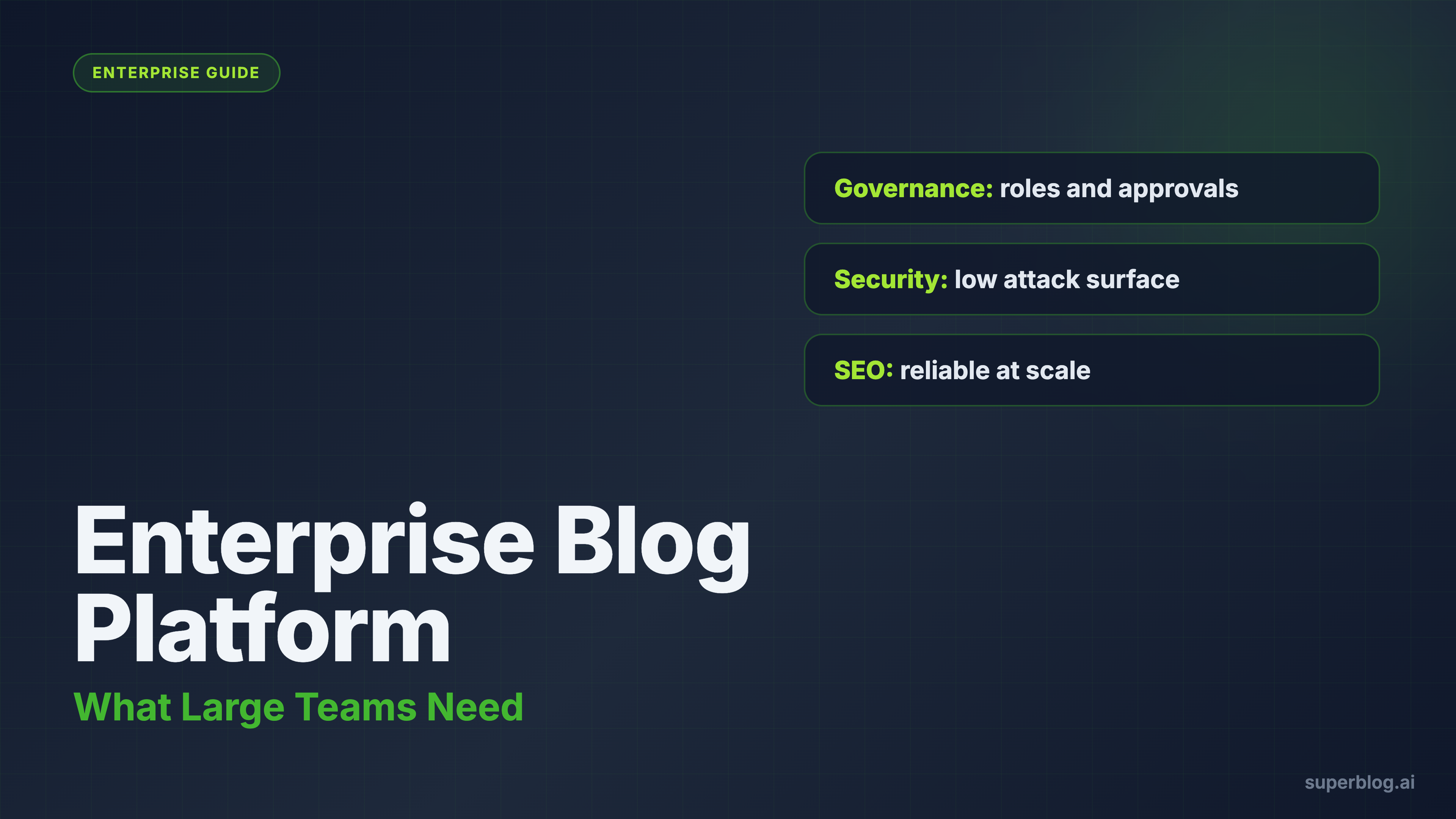
Enterprise teams do not buy a blog platform for the editor alone.
They are buying governance, reliability, SEO consistency, performance, and a system that can support many contributors without turning the blog into a maintenance liability.
That is why enterprise blog platform decisions go wrong so often. The team evaluates surface-level features, but the actual problems show up later in permissions, workflows, migration pain, technical SEO drift, and internal dependence on engineering.
This guide covers what large teams should actually evaluate before committing to an enterprise blog platform.
Why enterprise blogging is a different problem
A small team can survive on workarounds. An enterprise team usually cannot.
At scale, the blog sits between multiple functions: content, growth, SEO, brand, legal, product marketing, regional teams, and often engineering. That means the platform is not only a writing tool. It is a shared operating system for a public acquisition channel.
The result is a different set of requirements:
- Clear permissions across many roles
- Reliable review and scheduling workflows
- Stable SEO output across a large content library
- Performance that holds up under traffic and complexity
- Security that does not depend on constant patching
- Migration support that protects existing search equity
If one of these areas is weak, scale exposes it quickly.
Governance should come before features
Most enterprise buying processes start with feature spreadsheets. That is backward.
The first question should be whether the platform can support how your organization actually works.
Ask questions like:
- Who can publish directly?
- Who can edit metadata, canonicals, and category structures?
- Can multiple teams collaborate without sharing admin access?
- Is there a clear approval path before content goes live?
- Can one team accidentally break another team’s publishing standards?
Large teams need autonomy, but they also need guardrails. The right platform gives both.
If governance is weak, the blog becomes either dangerously loose or painfully slow. Neither outcome works for enterprise publishing.
Technical SEO has to scale without heroics
At enterprise scale, manual SEO operations break down fast.
You cannot rely on editors to remember every canonical detail, schema implementation, or sitemap implication across hundreds of pages. The platform needs to make good SEO the default.
That means enterprise teams should insist on:
- Automatic sitemap generation and updates
- Structured data support without plugin sprawl
- Reliable page-level control over metadata and canonicals
- Clean category and tag architecture
- Strong internal linking workflows
- Subdirectory support if the blog needs to live on the main domain
This is where generic CMS setups often start to show strain. They can support these capabilities, but often only through extra plugins, custom code, or ongoing QA overhead.
That is not real leverage. That is technical debt with a nicer interface.
If you want the broader landscape, pair this with our blog platform comparison.
Performance should be evaluated as a system property
Enterprise teams should not ask whether a platform can be made fast. They should ask how easy it is to keep it fast as publishing volume, embeds, scripts, and stakeholder requests increase.
This is a critical distinction.
Many platforms can look fast in a controlled demo. Fewer remain fast after six months of real use.
Questions worth asking:
- How many moving parts are involved in serving a normal page?
- What happens to page speed as the content library grows?
- Does the stack depend on many plugins or runtime services?
- How much performance variance appears during traffic spikes?
Performance matters because it affects rankings, crawl efficiency, and conversion. It also affects internal trust. Once stakeholders believe the blog platform is fragile or slow, every launch becomes harder.
This is one reason architecture matters so much. Teams evaluating long-term performance often end up comparing delivery models through a JAMstack vs traditional CMS lens.
Security and maintenance are part of total cost
Enterprise buyers usually compare subscription cost carefully. They are often less disciplined about hidden operating cost.
A platform that depends on constant updates, plugin reviews, security patch cycles, and engineering intervention creates ongoing cost that does not show up clearly in the vendor quote.
That cost appears as:
- Recurring engineering support
- Security review overhead
- Incident risk from third-party dependencies
- Publishing slowdowns when something breaks
- Operational burden after migration
The right enterprise platform should reduce risk concentration, not create a new one.
If your team has to constantly defend the platform internally because of maintenance drag, you chose the wrong system.
Editorial usability determines adoption
A technically capable platform can still fail if marketers do not want to use it.
Editors should be able to write, schedule, optimize, and update content without routing routine work through a developer or platform specialist.
That means enterprise teams should test:
- How easy it is to draft and review content
- How metadata and SEO controls are managed
- Whether workflows are understandable for non-technical teams
- How well the system supports multi-author collaboration
- Whether publishing can happen quickly without bypassing governance
This is where many enterprise tools underperform. They satisfy procurement and frustrate the actual users. That usually leads to process debt, off-platform workarounds, and lower publishing velocity.
Migration risk should be part of the decision from day one
Migration is where many enterprise blog platform projects fail.
Moving content is not enough. You need to preserve search equity, protect URL consistency, and minimize editorial downtime.
Before committing, ask:
- Can current URLs and slugs be preserved?
- Can redirects, metadata, images, and taxonomy move cleanly?
- Can the blog live on a subdirectory if needed?
- How quickly can the team resume normal publishing after launch?
- How much vendor support exists for rollout and validation?
These are not implementation details. They are business risk questions.
A platform that looks good before migration but creates organic traffic loss after migration is not a successful choice.
Questions enterprise buyers should force vendors to answer
Demos tend to hide operational reality. Ask questions that surface it.
- What breaks most often in real customer deployments?
- What work still requires engineering after launch?
- How are metadata and schema handled at scale?
- How are redirects managed during migration?
- What is the expected maintenance burden six months after rollout?
- How does the platform handle a large editorial team with different roles?
These questions are more revealing than a polished walkthrough because they expose the cost of owning the platform after procurement is over.
When not to overbuy
Not every company needs a heavyweight enterprise stack.
If your team is small, publishes lightly, and has simple approval needs, buying for future complexity can slow you down and increase process overhead before it creates value.
But the opposite mistake is more common. Teams buy for today's size while ignoring tomorrow's operating model. If the blog is already tied to pipeline, brand, regional publishing, or SEO at scale, underbuying becomes expensive fast.
The right goal is not to choose the most advanced platform. It is to choose the one that matches the level of coordination and control your team will need over the next two to three years.
What enterprise teams usually underestimate
They underestimate maintenance.
The visible platform fee is often smaller than the cost of internal support hours.
They underestimate SEO fragility.
SEO quality that depends on plugins and manual discipline usually degrades over time.
They underestimate workflow friction.
Small inefficiencies become expensive when multiplied across teams and regions.
They underestimate migration complexity.
Preserving search equity is harder than copying content into a new editor.
A practical evaluation checklist
Use a scorecard, not only demos. Every platform should be evaluated across:
- Governance and permissions
- SEO automation and control
- Performance consistency
- Security profile
- Editorial usability
- Migration support
- Total maintenance burden
This is a better decision framework than counting features because it maps to how enterprise content operations actually succeed or fail.
Final takeaway
The best enterprise blog platform is the one that gives large teams autonomy without sacrificing control, speed, SEO quality, or security.
That usually means evaluating the platform as infrastructure for growth, not as a writing tool with enterprise packaging. If the stack cannot scale governance, technical SEO, performance, and publishing workflow together, it will create friction long before you outgrow the editor.
Your blog, without the maintenance
Fast pages, automatic SEO, no plugins to patch. Runs on yoursite.com/blog.
Sai Krishna is the Founder and CEO of Superblog. Having built multiple products that scaled to tens of millions of users with only SEO and ASO, Sai Krishna is now building a blogging platform to help others grow organically.
superblog
Superblog is a blazing fast blogging platform for beautiful reading and writing experiences. Superblog takes care of SEO audits and site optimizations automatically.