
B2B Blog Strategy That Drives Pipeline, Not Just Pageviews
A practical B2B blog strategy framework built around ICP fit, buyer-stage content, topic clusters, distribution, and pipeline influence...

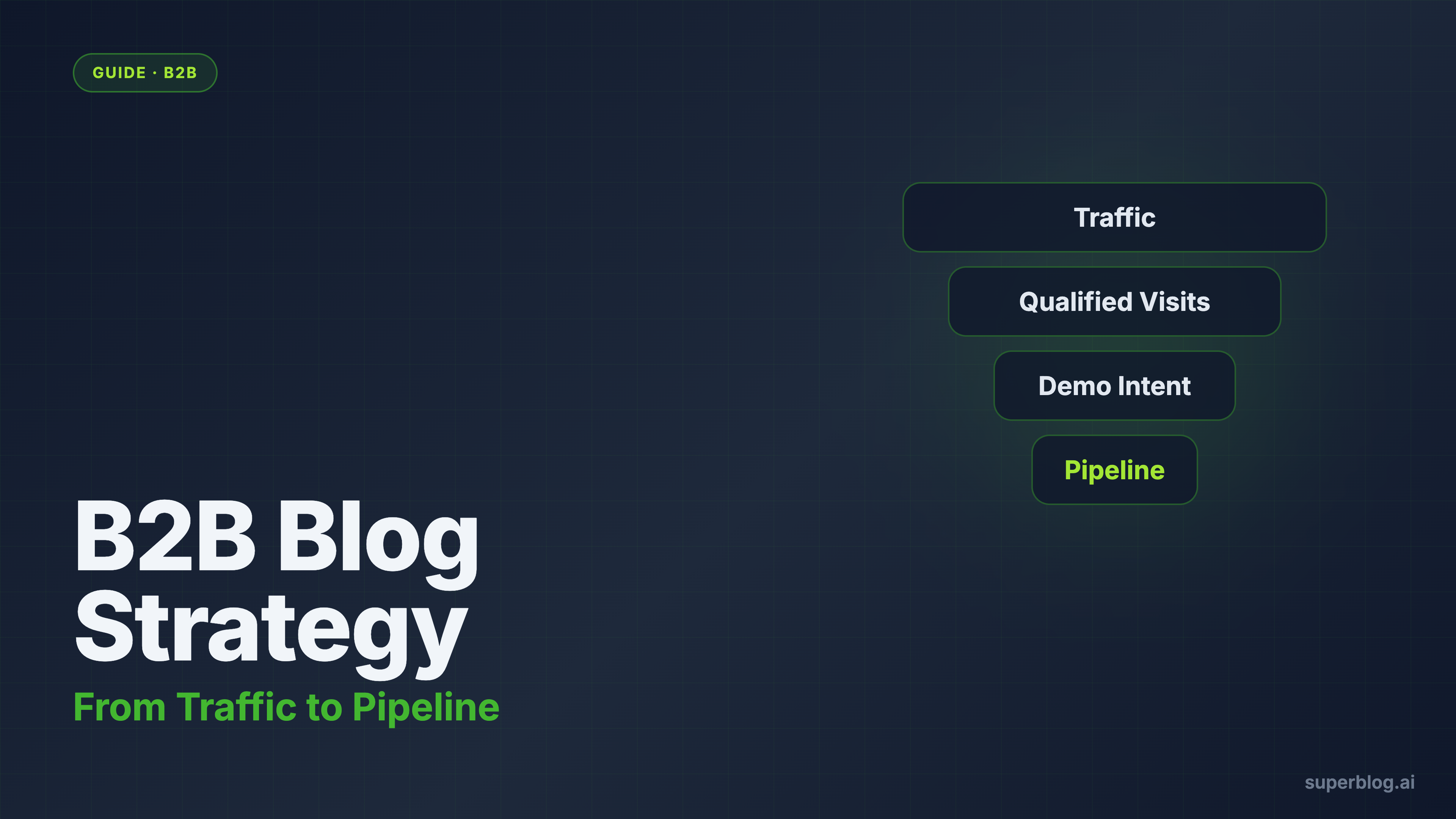

A B2B blog strategy should do more than attract visits. It should create qualified discovery, educate real buyers, and move the right accounts closer to revenue.
That is where many teams get stuck. They publish based on search volume, celebrate traffic growth, and then discover that the blog has almost no effect on pipeline.
The problem is not content volume. The problem is strategy. A B2B blog works only when topic selection, buyer intent, conversion paths, and measurement are designed together.
This guide explains how to build a B2B blog strategy that supports revenue, not just pageviews.
Start with pipeline goals, not publishing goals
Most weak blog strategies begin with an activity metric: publish four posts a month, hit a traffic target, grow impressions.
Those metrics can support discipline, but they are not strategy.
Start with the actual business outcomes the blog is meant to influence:
- Qualified demo requests
- Pipeline sourced or influenced by content
- Category education that expands demand
- Lower acquisition cost on high-intent searches
Once those are clear, your content priorities change. You stop optimizing for generic traffic and start optimizing for the questions buyers ask before they purchase.
This is also why many strong B2B blogs look smaller than expected. They are not trying to publish for everyone. They are trying to publish for the right prospects.
Use ICP fit as the main keyword filter
In B2B, search volume can mislead you.
A keyword with thousands of searches may attract students, freelancers, researchers, or people who will never buy your product. A smaller keyword with clear buyer intent is often worth far more.
Before prioritizing a topic, ask:
- Would a real buyer or evaluator search this?
- Does the topic connect naturally to our product category?
- Can this content move the reader toward a commercial next step?
High-value B2B content often shows up as:
- Comparison and alternative queries
- Implementation and migration topics
- Cost and ROI evaluation content
- Decision frameworks for operators and leaders
These are not always the highest-volume keywords, but they are much more likely to connect content to revenue.
Build topic clusters around buying problems
A strong B2B blog is not a stream of unrelated useful posts. It is a structured system.
Start with the major problems your buyers need to solve. Then build topic clusters around those problems.
For example, if you sell a blog platform for growth teams, one cluster might include:
- Choosing the right blog platform
- Why architecture affects SEO and speed
- WordPress maintenance cost and risk
- How to measure blog ROI
- How enterprise teams should evaluate content infrastructure
This does two things at once.
First, it helps search engines understand that your site has depth on an important commercial topic. Second, it gives buyers a clearer path through your content library.
A single post becomes more valuable when it naturally leads to the next question the buyer is likely to ask.
Map content to the buying journey
B2B blog strategy works best when different stages of the buyer journey have different jobs.
Awareness content helps buyers understand the problem and the market context. It is useful for discovery, but it rarely closes.
Consideration content helps buyers compare approaches, evaluate risks, and understand tradeoffs. This is where many high-intent SEO opportunities live.
Decision content reduces purchase risk. It includes ROI content, migration guides, implementation detail, pricing context, and proof.
The common mistake is publishing awareness content only. That creates more sessions, but it does not give buyers the assets they need later in the journey.
A serious B2B blog needs all three, with a bias toward consideration and decision content if the team is trying to influence pipeline quickly.
Design every article with a next step
A blog post should not be an isolated dead end.
Every strong B2B article should help the reader take a logical next step based on their stage of evaluation.
Examples:
- An educational framework article can lead into a comparison page
- A comparison page can lead into pricing, migration, or ROI content
- An ROI post can lead into a demo, proof point, or buying guide
- An implementation article can lead into product evaluation
This does not mean stuffing every article with aggressive CTAs. It means building a coherent path through the content library.
Internal linking is part of strategy here, not just SEO hygiene. Readers should be able to move from education to evaluation without having to start over with a new search.
Distribution matters as much as publishing
Many B2B teams treat publishing as the finish line. It is not.
A strong B2B blog strategy includes distribution across the channels that already touch your buyers.
That often means:
- Internal linking from older high-authority pages
- Newsletter promotion
- Sales enablement usage
- Founder or team social distribution
- Refresh campaigns for older related content
The best B2B content assets are reused everywhere. Sales sends them. Customer success references them. Founders share them. Marketing uses them to educate the market.
This multiplies the value of every post and improves the odds that content influences pipeline, not just traffic reports.
Measure content influence, not vanity metrics
Traffic matters, but traffic without business relevance is noise.
Your B2B content dashboard should go beyond pageviews and impressions. Track metrics such as:
- Organic assisted conversions
- Demo requests by landing page or cluster
- Pipeline influenced by blog sessions
- Conversion rate by article or topic cluster
- Time lag from first content touch to qualified action
This is where many teams realize the blog is either more valuable than they thought or less aligned than they assumed.
If you want the measurement side in more detail, pair this with measuring blog ROI for B2B, blog analytics that actually matter, and blog attribution models.
The goal is not perfect attribution. The goal is enough clarity to know which themes and article types create commercial value.
Cadence should support quality, not filler
Consistency matters, but publishing quotas create bad behavior when they are disconnected from strategy.
Teams under pressure to hit volume often publish generic filler that brings weak traffic and does not help buyers make decisions.
A better model is:
- Maintain a prioritized backlog based on ICP fit and buyer stage
- Publish on a cadence the team can sustain with quality
- Refresh existing winners regularly
- Merge, improve, or retire posts that do not support the cluster
This turns the blog into a curated commercial asset instead of an archive of disconnected articles.
Common B2B blog strategy mistakes
Mistake 1: Optimizing for traffic instead of buyer intent.
High traffic does not help if the audience is wrong.
Mistake 2: Publishing only top-of-funnel education.
You need consideration and decision content if the blog is supposed to influence revenue.
Mistake 3: Treating posts as isolated assets.
Without cluster design and internal progression, even good content underperforms.
Mistake 4: Using generic CTAs.
The next step should match the reader’s stage, not the marketer’s wish list.
Mistake 5: Measuring pageviews but not pipeline.
If the business outcome is pipeline, the reporting has to reflect that.
Final takeaway
A B2B blog strategy works when content, SEO, and conversion design are treated as one system.
Start with the buyer, build clusters around commercial problems, create clear paths from education to evaluation, and measure the blog against pipeline influence rather than traffic alone.
That is how a B2B blog becomes a growth channel instead of a publishing habit.
Your blog, without the maintenance
Fast pages, automatic SEO, no plugins to patch. Runs on yoursite.com/blog.
Sai Krishna is the Founder and CEO of Superblog. Having built multiple products that scaled to tens of millions of users with only SEO and ASO, Sai Krishna is now building a blogging platform to help others grow organically.
superblog
Superblog is a blazing fast blogging platform for beautiful reading and writing experiences. Superblog takes care of SEO audits and site optimizations automatically.