
12 Successful Business Blog Examples That Prove ROI (2026)

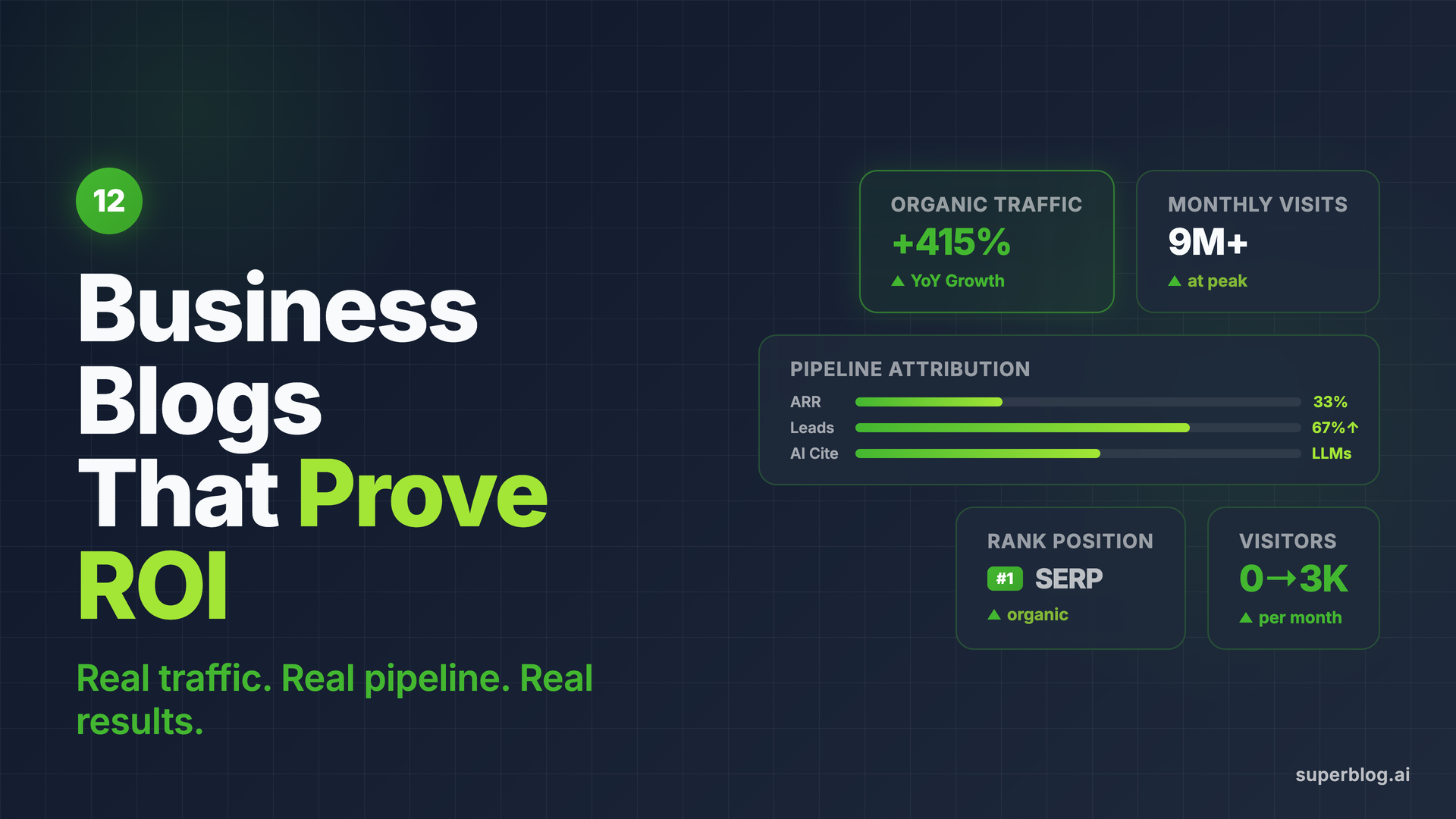
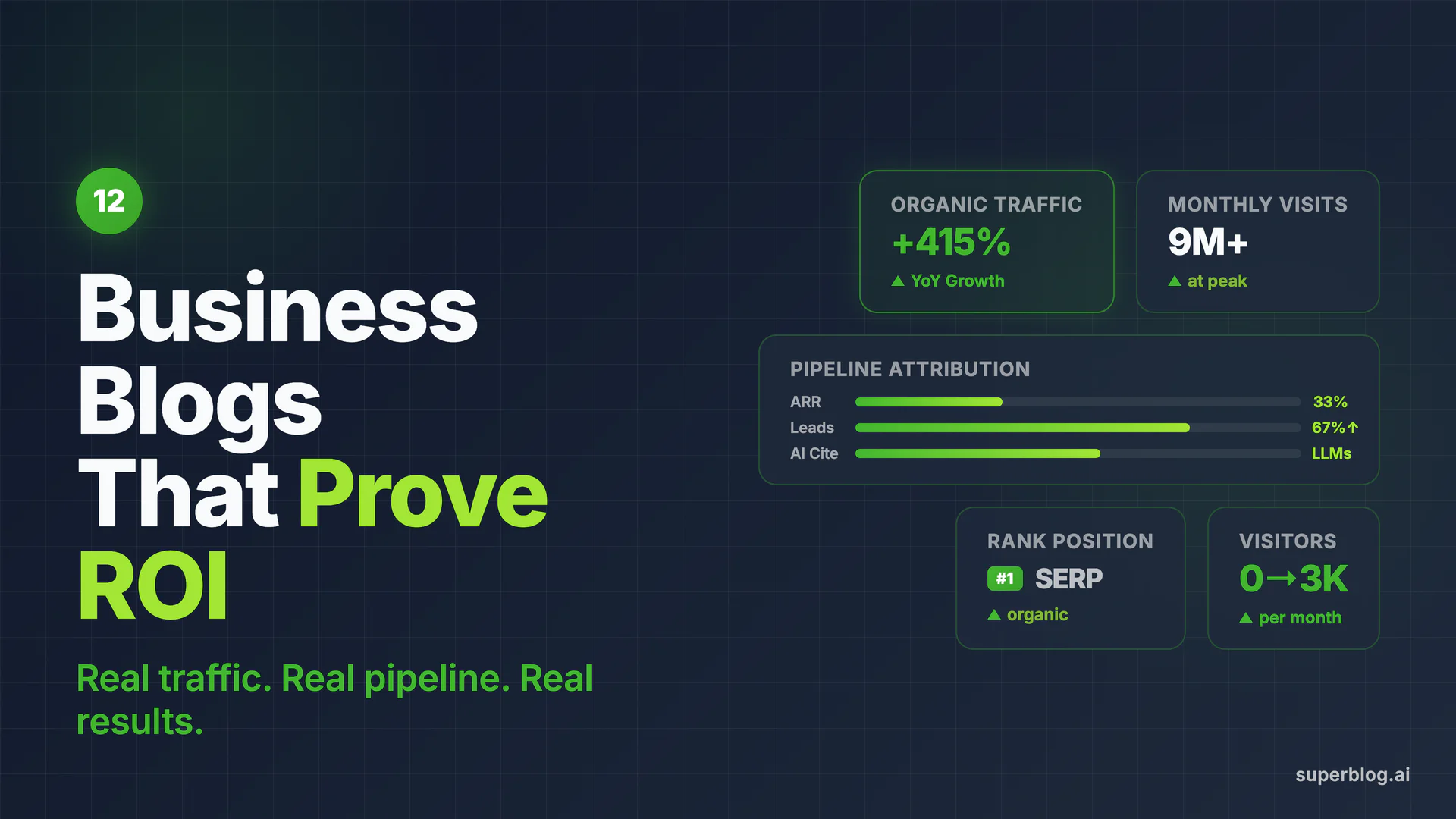
A successful business blog is measured in pipeline, not pageviews. The 12 business blog examples below have traceable connections between publishing and revenue: organic traffic that converts to trials, content that closes deals faster, and posts that surface in AI search results before a buyer ever talks to sales.
This post covers the ROI mechanics, not the surface details. Each example includes what the blog measurably achieves, the strategic pattern making it work, and the specific element worth copying. For a broader look at examples across industries, see our companion post 12 Business Blog Examples That Actually Drive Growth.
Why Most Business Blogs Fail to Generate ROI
Before the examples, the frame: most company blogs fail because they confuse publishing with performance. They measure success by post count and social shares. Successful blogs measure four things instead:
- Organic acquisition: search traffic from buyers, not browsers
- Sales enablement: content that shortens deal cycles or handles objections
- AI citation presence: appearing in ChatGPT, Perplexity, and Google AI Overviews when buyers ask questions in your category
- Retention and expansion: content that keeps existing customers informed and using the product more
Every example below performs on at least two of these dimensions. That is what separates a blog that proves ROI from one that just exists.
The 5 ROI Mechanics Every Successful Business Blog Uses
Before studying the examples, understand the revenue mechanics. Blogs that generate measurable returns do so through five specific channels:
1. Organic acquisition at scale. Blog content ranks for searches buyers conduct before they know you exist. This is how you acquire customers without a sales rep touching them. The cost per acquisition drops the longer the post stays ranked.
2. Sales cycle compression. Prospects who read your content before a call close faster and require less education. Your blog does discovery work ahead of your sales team.
3. AI-citation presence. AI tools like ChatGPT, Claude, and Perplexity now influence purchase decisions. Blogs with structured content and schema markup get cited in these responses. That citation is a warm referral at scale.
4. Hiring and employer brand. High-quality writing signals company capability. The best candidates read your blog before applying. Several of the companies below cite this as an underrated benefit.
5. Retention content. Existing customers who engage with your blog have higher retention rates. Educational content about product use cases and adjacent skills keeps them invested in the category.
12 Successful Business Blog Examples
1. HubSpot
Industry: Marketing software (B2B SaaS)
What the blog measurably achieves: At its peak, HubSpot's blog drew over 10 million monthly organic visits and drove roughly 75% of their total organic traffic: the clearest proof that content marketing works at scale. Ahrefs data from mid-2024 measured 8.2 million monthly visits and declining. By 2025-2026, AI Overviews and multiple algorithm shifts had cut that traffic dramatically. The lesson runs in both directions: HubSpot proved the ROI ceiling of content marketing, and its decline shows what happens when one distribution channel dominates. Diversifying into answer-first content structures and AI-citation surfaces is not optional when that channel shifts.
The strategy: Topic clusters. HubSpot pioneered organizing blog content around pillar pages (comprehensive guides) supported by cluster content (specific supporting posts). Every cluster post links back to the pillar, concentrating domain authority. They also run systematic historical optimization: identifying posts with declining traffic and refreshing them with current data before competitors can outrank.
What to copy: Historical optimization before new content creation. If you have posts that ranked and drifted, refreshing them generates faster ROI than publishing new content. A post that earned authority once can earn it again with updated content. And own your AI-citation presence before you need it.
2. Ahrefs
Industry: SEO software (B2B SaaS)
What the blog measurably achieves: Ahrefs grew its blog traffic by 1,136% and attributes content marketing as one of its two primary customer acquisition channels alongside word of mouth. The blog generates leads that convert to paying customers for an 8-figure ARR business.
The strategy: Product-led content. Every Ahrefs post teaches a concept using Ahrefs tools to demonstrate the method. Readers learn SEO by watching Ahrefs solve the problem they came to learn about. The product earns trust inside the educational content. They target only keywords with clear search potential, measured by monthly volume and existing SERP competition.
What to copy: Show your product solving the problem the post addresses. Not in a sidebar CTA. Inside the tutorial, as the tool that does the work. Readers who see your product in action during the learning process already understand it before they reach your pricing page.
3. Zapier
Industry: Workflow automation (B2B SaaS)
What the blog measurably achieves: Zapier's blog generates over 9 million monthly organic visits. Their content alone is estimated to be worth approximately $3.7 million in monthly traffic value. Zapier reached over $100 million ARR while spending significantly less on paid acquisition than category competitors, with organic content as the primary acquisition lever.
The strategy: Integration-specific pages at massive scale. Beyond editorial blog posts, Zapier built thousands of pages targeting searches like "connect [App A] to [App B]". Each page captures a user with specific intent at the exact moment they are evaluating whether Zapier solves their problem. The blog also covers adjacent automation topics that attract buyers who have not yet discovered Zapier's category.
What to copy: Map every search your buyer makes while evaluating your product category, not just while evaluating you. If someone searches "how to automate [task you solve]" before they know automation tools exist, your blog should answer that question and introduce the category.
4. Intercom
Industry: Customer messaging (B2B SaaS)
What the blog measurably achieves: Intercom's blog reached 200,000 pageviews per month, and content was the primary distribution channel through its $1M-to-$50M ARR run. Blog traffic preceded their sales pipeline in a measurable way.
The strategy: Persona-driven editorial. Intercom built content around specific buyer roles (support leads, growth teams, product managers) using the Jobs-to-be-Done framework to identify what those buyers needed to understand before purchasing. Evergreen content targets medium to high-volume keywords relevant to customer success and product growth, serving as the first touchpoint between a prospective buyer and the Intercom brand.
What to copy: Assign buyer personas to content topics before writing. Content addressed to "a person in role X trying to accomplish goal Y" converts better than content addressed to everyone. The editorial rigor that Intercom brought to persona mapping is reproducible at any company size.
5. Segwise
Industry: Mobile performance analytics (SaaS)
What the blog measurably achieves: Segwise grew their unique blog traffic by 415% year over year. A third of their ARR traces back to blog content, including organic search and AI search citations. The blog now powers LLM visibility across platforms like ChatGPT and Perplexity.
The strategy: Automated content pipeline on a platform that handles the technical layer. Segwise runs a lean team with no dedicated SEO person, so they needed a CMS that would automatically handle meta titles, descriptions, schema markup, and sitemaps without developer intervention. They publish through Superblog's API, which made the pipeline seamless. The content itself targets performance marketing decision-makers: topics specific enough to attract buyers, structured enough to surface in AI-generated answers.
Segwise is a Superblog customer.
What to copy: Separate the content strategy work from the technical blogging work. If your team is spending time on SEO configuration instead of writing, you are optimizing the wrong constraint. Platforms that handle technical SEO automatically free up publishing velocity.
6. MonsterMath
Industry: Educational apps (Consumer SaaS)
What the blog measurably achieves: MonsterMath grew from zero monthly visitors to 3,000 monthly visitors through organic blog content. The blog targets both awareness-stage and decision-stage parents, capturing buyers at different points in their research journey.
The strategy: Dual-intent content architecture. MonsterMath writes comparison posts (MonsterMath vs SplashLearn, MonsterMath vs iReady) that rank when parents are already shopping for math apps and comparing specific options. They also publish educational posts (how to teach number sense, math activities at home) that rank earlier in the journey, when parents are just recognizing their child needs help. The first captures demand; the second creates it.
MonsterMath is a Superblog customer.
What to copy: Build content for both awareness searches and decision searches. "Best math apps for kids" and "MonsterMath vs [competitor]" are not competing posts. They serve different buyers at different moments. You need both to own the full purchase journey.
7. Wistia
Industry: Video hosting and marketing (B2B SaaS)
What the blog measurably achieves: Wistia's blog covers video marketing, production, and distribution in enough depth to rank for competitive keywords in the video category. Their content drives organic traffic from marketers already using or evaluating video, positioning Wistia as the platform behind the category.
The strategy: Category education as demand creation. Wistia does not write primarily about their product. They write about the practice of video marketing: scripts, production quality, distribution, analytics. Buyers who learn video marketing from Wistia naturally associate the category with Wistia's platform. The blog educates buyers into the category and then presents Wistia as the obvious tool.
What to copy: Write about the practice your product enables, not just your product features. A marketer who learns video strategy from your blog is already warm when they evaluate your video tool. Teaching is a conversion mechanism.
8. Notion
Industry: Productivity and collaboration software (B2B SaaS)
What the blog measurably achieves: Notion's content targets high-volume template searches (project management templates, meeting notes templates, weekly planner templates) that attract buyers evaluating productivity tools. Template-related content ranks for terms with clear commercial intent.
The strategy: Template SEO combined with use-case content. Notion surfaces in searches where buyers are ready to use a tool immediately, not just learn about one. Template pages capture bottom-of-funnel intent that other content types miss. Adjacent blog content covers productivity workflows and team collaboration, reaching buyers higher in the funnel.
What to copy: Identify what your buyers search for immediately before signing up. If your product produces templates, frameworks, or outputs that buyers search for directly, those are high-converting content targets with explicit demand.
9. Buffer
Industry: Social media management (B2B SaaS)
What the blog measurably achieves: Buffer's blog openly publishes data about their own business, including revenue, churn, and team decisions. This transparency strategy drives substantial organic traffic from entrepreneurs and business builders researching operations.
The strategy: Radical transparency as content differentiation. Buffer publishes what other companies hide: real revenue numbers, difficult decisions, team structure changes. This content attracts a highly engaged audience that competes for almost no keywords because no one else publishes this type of content. It builds brand authority and hiring appeal while generating organic traffic from searches no competitor targets.
What to copy: Identify what your company can publish honestly that no competitor will. Authentic operational data, real customer outcomes, or transparent decision-making creates content with zero competition and strong trust signals.
10. Elephas
Industry: AI writing assistant (Consumer and B2B SaaS)
What the blog measurably achieves: Elephas chose Superblog over WordPress specifically for the performance and SEO automation, allowing their team to focus on content rather than platform maintenance. The blog targets productivity and AI writing searches with content that positions Elephas in the AI tools category.
The strategy: Fast publishing on a platform that handles technical SEO automatically. Elephas needed to publish consistently without worrying about plugin conflicts, security patches, or Lighthouse score degradation. By eliminating platform overhead, they maintained publishing velocity in a competitive category where ranking before better-known AI tools requires consistent output.
Elephas is a Superblog customer.
What to copy: Publishing velocity matters more than platform complexity. If your team spends time on WordPress maintenance instead of writing, you are paying a tax that compounds over time. Calculate the real cost of your publishing platform before attributing slow growth to content quality.
11. Animalz
Industry: Content marketing agency (B2B services)
What the blog measurably achieves: Animalz's blog ranks for competitive content marketing keywords and serves as the primary lead source for a premium content agency serving venture-backed SaaS companies. Their blog both demonstrates their craft and captures qualified buyers.
The strategy: Proof-of-quality publishing. An agency's blog is their portfolio. Animalz publishes original research (the Content Decay study, the Content Marketing Benchmark Report) that gets cited across the industry. Original data attracts backlinks, builds domain authority, and creates content that remains relevant for years. Every post signals: this is the quality we produce for clients.
What to copy: Publish original research before someone else does. Data from your own customers, industry surveys, or platform-specific analysis is unreplicable. Other sites link to original data, compounding authority without additional content investment.
12. PrintStop
Industry: Business printing and customization (E-commerce)
What the blog measurably achieves: PrintStop runs a Superblog-powered blog covering business printing, branding, and marketing materials. The blog targets print buyers who are researching before purchasing, capturing organic traffic in a category where most competitors do not invest in content.
The strategy: Category education in a content-sparse vertical. Most printing companies do not maintain active blogs. PrintStop's content about branding, business cards, and marketing materials ranks because the bar is low and the intent is commercial. Buyers researching "business card design ideas" or "what to put on company brochures" are close to purchase. Educational content that answers these questions before they reach any competitor's site generates qualified traffic with direct purchasing intent.
PrintStop is a Superblog customer.
What to copy: Content gaps in your category are more valuable than category keywords where ten competitors already dominate. If your vertical has sparse content, you can rank for commercial keywords quickly with consistent publishing.
What These 12 Blogs Have in Common
The Platform Behind Our Featured Customers
Segwise, MonsterMath, Elephas, and PrintStop all run on Superblog. The pattern is consistent: lean teams, no dedicated technical SEO person, needing a platform that handles the infrastructure so the team can focus on writing.
Here is what Superblog handles automatically, without plugins or configuration:
Performance: Every page scores 90+ on Lighthouse automatically. JAMStack architecture serves pre-built pages from a global CDN with 200+ edge locations. First Contentful Paint under one second. This matters because fast pages rank higher and convert at higher rates.
SEO engine: Auto-generated JSON-LD schemas (Article, FAQ, Organization), XML sitemaps updated on every deploy, IndexNow submissions on publish, and LLMs.txt generation for AI search visibility. Segwise's AI citation results come from this infrastructure.
Zero maintenance: No WordPress plugins to update, no security patches to apply, no Lighthouse score that degrades after an update. The PrintStop and Elephas teams write instead of maintaining servers.
Subdirectory hosting: yourcompany.com/blog, not a subdomain. Works with any existing tech stack: Next.js, Webflow, Framer, Shopify, React, or plain HTML.
Superblog starts at $29/month with a 7-day free trial and no credit card required. If you are evaluating platforms, see how it compares to the best blogging platforms for business and read how to measure blog ROI for B2B.
Frequently Asked Questions
Do businesses with blogs actually see better ROI than those without?
Yes, and the gap is measurable. Businesses with active blogs generate 55% more website traffic and 67% more leads than businesses without blogs, according to HubSpot's content marketing benchmark research (figures from their earlier benchmark studies). The caveat: results depend on targeting buyers, not generic audiences. A blog attracting the wrong traffic generates no ROI regardless of volume.
What ROI can a business blog realistically generate?
Depends on the category, the keyword difficulty, and the publishing consistency. The companies in this post range from 415% traffic growth (Segwise) to 10 million monthly organic visits (HubSpot). A reasonable first-year target for a new business blog publishing 4 posts per month in a low-to-medium competition category: 500 to 2,000 monthly visitors by month 12, with conversion rates to trial in the 0.3 to 0.5% range.
How often should a business blog publish to see results?
Consistency matters more than frequency. Four high-quality, buyer-targeted posts per month outperforms 16 thin posts. The businesses in this post that achieve strong ROI publish on a defined cadence rather than in bursts. For a practical framework, see our B2B blog strategy guide.
What is the difference between a business blog and a company news page?
A company news page covers internal announcements: product releases, hires, events. A business blog targets search queries buyers are already typing, regardless of whether those queries mention your company. A company news page has an audience of existing customers and press. A business blog builds an audience of future customers who have never heard of you.
How long does it take for a business blog to generate ROI?
Organic search takes time. Most blog posts take 3 to 6 months to rank competitively. MonsterMath's 0 to 3,000 visitors growth happened over a sustained publishing period, not overnight. The businesses that see the fastest ROI are those who target low-competition keywords in the early months, build domain authority, and then move into more competitive territory. If you need faster results, see how SaaS blog examples handle content marketing for faster-moving competitive categories.
Should a business blog be on a subdomain or subdirectory?
Subdirectory (yoursite.com/blog). Every link and domain authority signal your blog earns stays attributed to your main domain. Subdomains split that authority. The pattern across all 12 examples in this post: the successful ones host their blog as a subdirectory. For the technical and strategic case, see our guide on content marketing for SaaS.
What makes a business blog "successful" versus just active?
Three observable markers: (1) organic traffic that includes buyers, not just readers, visible in traffic source and conversion data; (2) pipeline attribution, meaning sales can point to blog posts that appear in deals; (3) brand presence in AI search results, meaning the blog gets cited when buyers ask questions in your category to ChatGPT or Perplexity. A blog that publishes regularly but lacks all three is active, not successful.
If you are ready to build a blog that performs like the ones above, explore Superblog's customer examples or start a free trial at write.superblog.ai.
Your blog, without the maintenance
Fast pages, automatic SEO, no plugins to patch. Runs on yoursite.com/blog.
Sai Krishna is the Founder and CEO of Superblog. Having built multiple products that scaled to tens of millions of users with only SEO and ASO, Sai Krishna is now building a blogging platform to help others grow organically.
superblog
Superblog is a blazing fast blogging platform for beautiful reading and writing experiences. Superblog takes care of SEO audits and site optimizations automatically.