
Substack vs beehiiv 2026: Is the 10% Cut Cheaper Than a Monthly Plan?

Substack vs beehiiv is a choice between paying with a share of revenue and paying a monthly plan. Substack is free at any list size and keeps 10% of each paid subscription. beehiiv is free up to 2,500 subscribers and keeps 0%. Its paid plans, needed for paid subscriptions, your own domain or a bigger list, run $49 to $869 a month billed yearly by list size.
The plan fee wins once paid revenue passes roughly $950 a month at 5,000 subscribers. Below that, or with no paid tier at all, Substack costs less. Every fact below was checked on Substack's and beehiiv's own pages on November 12, 2026.
Which one wins, by reader type
- A writer starting from zero: Substack. There is no bill before the first paying reader, and Substack's app and recommendations bring in readers.
- A paid newsletter earning more than about $950 a month at 5,000 subscribers: beehiiv. Its flat fee costs less than 10% from that point, and the gap widens as revenue grows.
- A free newsletter that wants to earn from ads: beehiiv. It runs a self-serve ad network on every paid plan. Substack does not.
- A company newsletter on its own email domain: beehiiv. Substack sends from an @substack.com address even after you connect a domain.
- A company whose blog has to win search traffic: neither, as the blog's home. Keep email on either tool and run yoursite.com/blog on a blog platform such as Superblog, as explained in the final section.
Substack and beehiiv compared in one table
What each one costs at 1,000, 5,000 and 25,000 subscribers
Card processing runs through your own Stripe account on both platforms, so it is left out of the math. What differs is Substack's 10% against beehiiv's plan fee. beehiiv prices are from its pricing page under the Free, Lite and Pro names it adopted on October 1, 2026.
1,000 subscribers, no paid tier
- Substack: $0, plus $50 once if you connect a domain
- beehiiv Free: $0 on a beehiiv subdomain
- beehiiv Lite, needed for your own domain: $49 x 12 = $588 a year ($59 x 12 = $708 billed monthly)
Substack wins: $50 once against $588 a year. beehiiv shows no average ad earnings at this size, so there is nothing to offset the fee with.
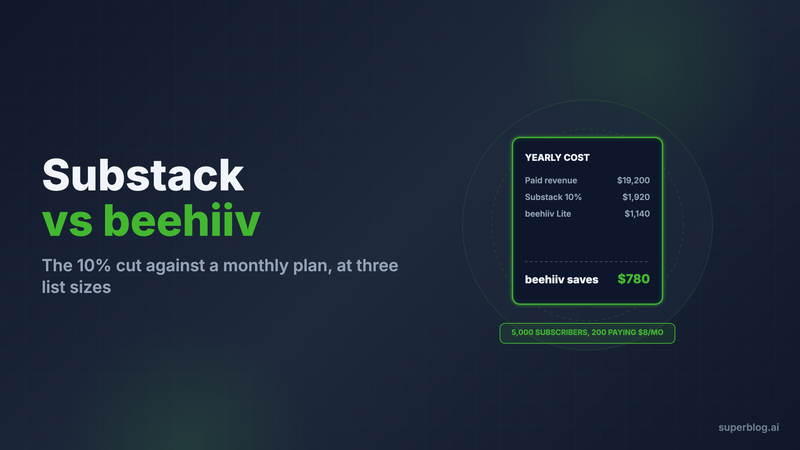
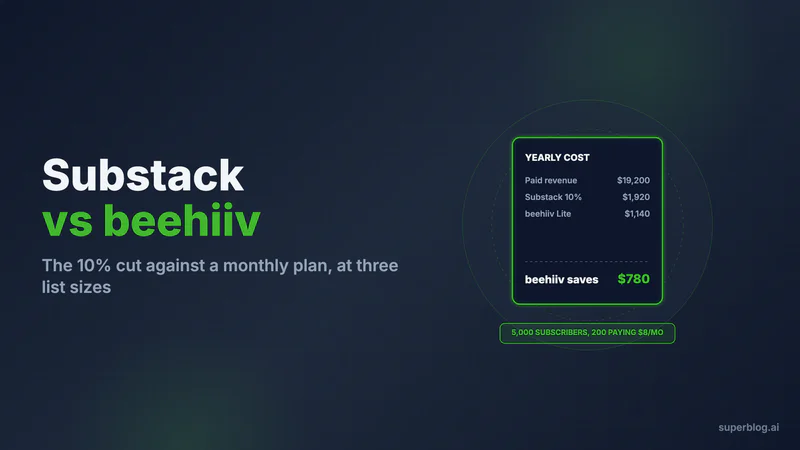
5,000 subscribers, 200 readers paying $8 a month
Paid revenue is 200 x $8 x 12 = $19,200 a year.
- Substack: 10% x $19,200 = $1,920 a year
- beehiiv Lite at the 5,000 tier: $95 x 12 = $1,140 a year ($109 x 12 = $1,308 billed monthly)
beehiiv wins by $1,920 - $1,140 = $780 a year. The break-even is $1,140 / 10% = $11,400 of yearly paid revenue, or $950 a month. At $8 a month, that is about 119 paying readers. Fewer than that, and Substack's cut is the smaller bill.
25,000 subscribers, 1,000 readers paying $10 a month
Paid revenue is 1,000 x $10 x 12 = $120,000 a year.
- Substack: 10% x $120,000 = $12,000 a year
- beehiiv Lite at the 25,000 tier: $169 x 12 = $2,028 a year
- beehiiv Pro at the 25,000 tier, for more than one paid tier or more than two seats: $299 x 12 = $3,588 a year
beehiiv saves $8,412 to $9,972 a year. At this size the 10% is the largest single cost a newsletter pays.
The same 25,000 list with no paid tier flips the result in a different way. Substack still costs $0. beehiiv Lite costs $2,028 a year, and beehiiv's pricing page shows average ad earnings of $180 a month at that size: $180 x 12 = $2,160. At that average, ads would cover the fee with $132 left over. beehiiv says estimates are not guaranteed, so treat it as a target, not income.
The full tier tables are in our beehiiv pricing and Substack pricing breakdowns.
Growth tools: referrals and recommendations

Substack gives its referral tools away. beehiiv charges for them but adds paid growth.
Substack runs two referral programs at no cost. Subscriber referrals reward any reader for bringing in free signups. Paid publications start with comped paid subscriptions at 2, 10 and 25 referrals, and any publication can set custom rewards. A separate gift program lets paid subscribers send up to five one-month gifts.
beehiiv's Referral Program needs a paid plan. Lite allows 3 reward milestones and Pro allows unlimited. Rewards can be physical goods, promo codes, digital files or paid subscription gifts.
Both platforms let publications recommend each other. On Substack, up to 3 recommendations appear right after a reader subscribes, plus a homepage sidebar and digest emails. beehiiv's free recommendations run on every plan, with up to four shown at once. beehiiv also sells growth: paid recommendations, formerly called Boosts, let you pay other publishers per verified subscriber they send. That option needs a paid plan.
Ad income: beehiiv's network, Substack's sponsorships
beehiiv wins for any newsletter that wants ads.
The beehiiv Ad Network is available on every paid plan, as long as the publication is actively sending. You browse a marketplace of up to seven offers, refreshed hourly, and place the ones you want. CPM campaigns pay per 1,000 unique opens. CPC campaigns pay per payable click, the quality-checked click count beehiiv also bills advertisers on, counted within 72 hours. Pro adds a storefront for selling sponsorships directly.
Substack takes the opposite position. Its help center says its business model "relies solely on subscriptions instead of revenue from advertisers." You may run sponsored content you sell yourself. Substack's native sponsorship program uses Creator Kits, open only to Bestseller publications or those with at least 100 paid subscribers. Substack's team then contacts you if a brand fits.
Discovery: an app network or an email tool
Substack wins. Readers find Substack publications inside Substack.
Substack runs a reader app and a social feed called Notes. On its own comparison page, Substack claims that over half of its new subscribers are found inside the platform itself. That claim is Substack's, not an audited figure, but no beehiiv feature matches the app.
beehiiv's discovery is the recommendations network above. It works between publishers, at signup and inside posts. It is not a place where readers browse. If you already have an audience, this gap matters less. If you start with nobody, Substack's network is the main reason to choose it. Medium is the other platform with built-in readers, and our Medium vs Substack comparison weighs the two.
Custom domain and sending address
beehiiv gives you more of your brand, but it costs a plan.
Substack charges $50 once. It asks for a subdomain such as www, with an optional redirect from the root. The newsletter keeps sending from an @substack.com address.
beehiiv includes custom domains on Lite and up. Its domain FAQ covers three: the website address, the sending address (such as hello@yourbrand.com) and a branded link domain for tracked clicks. When the root domain already hosts your company website, beehiiv says to use a subdomain, since one domain cannot serve beehiiv and your existing site at the same time.
Neither tool can put posts at yoursite.com/blog next to your product pages.
Website and search controls
beehiiv gives you more controls. Neither builds authority for your main domain.
beehiiv includes a website builder on every plan. Custom pages are 1 on Free, 10 on Lite and unlimited on Pro. Redirects are 10 on Lite and unlimited on Pro. The SEO settings let you choose whether posts are marked up as Article, News Article or Blog Post, and Pro and Enterprise plans can add custom structured data such as FAQ or Recipe to a single post. A custom robots.txt and AI crawler controls need Pro.
Substack keeps SEO in its own hands. Per its help center, a publication has to grow before it unlocks a sitemap and Google Search Console verification. Each post also has its own SEO options, including an editable URL slug.
Analytics
Substack gives everyone the full dashboard. beehiiv limits history by plan.
Substack's metrics guide covers four areas: Home, Posts, Stats and Sources. Each post shows views, open rate, new subscribers it brought in and traffic sources. Substack's comparison page puts it this way: "On Substack, you get the same tools whether or not you turn on paid subscriptions."
beehiiv keeps 30 days of analytics history on Free, 12 months on Lite and unlimited history on Pro. Polls, surveys and advanced analytics start on Lite.
Moving between them
Both directions work, and the list moves more cleanly than the posts.
beehiiv's Substack migration guide pulls free posts from your Substack URL. Paid posts need Substack's export file, and a paid tier set up in beehiiv first, or paywalled posts arrive fully visible. Subscribers come over as a CSV. Paid subscribers move by copying customers between Stripe accounts. One catch: signup dates show the import date unless you ask beehiiv support to add the originals.
Going the other way, Substack's post importer accepts a beehiiv URL, and the mailing list uploads as a CSV, XLSX or ODS file. For other ways out, see our lists of Substack alternatives and beehiiv alternatives.
Pick Substack when
- You have no audience yet and want the app and recommendations working for you.
- Paid revenue sits below the break-even for your list size (about $950 a month at 5,000 subscribers), or you charge nothing.
- You want referrals and full analytics without a plan fee.
- An @substack.com sending address is fine.
Pick beehiiv when
- Paid revenue has passed the break-even for your list size.
- You want an ad marketplace, or paid growth through recommendations.
- Email has to come from your own domain.
- You need automations, A/B tests or publishing to segments, which start on Lite.

The company-blog option: email on either, the blog on your domain

Many companies comparing Substack and beehiiv want two things: a newsletter and a blog that ranks for buyer searches. Both tools put the posts on a separate host, so links they earn do not strengthen the domain your pricing page sits on. Our Substack vs blog guide explains why that costs rankings.
You do not have to give up either email tool to fix it. Keep sending from Substack or beehiiv, and run yoursite.com/blog on Superblog. Superblog is a managed blog platform. It cannot send email or run a paywall, so it works alongside either tool instead of replacing it. It runs the blog half:
- The /blog path on your domain. Every paid plan includes subdirectory hosting. A company site built on Wix, Squarespace or Webflow gets there through a Cloudflare Worker (free) placed in front of the domain. It routes /blog to Superblog, and Superblog's dashboard generates the Worker for you. The subdirectory docs walk through setup.
- Schema and indexing on every post. Every post gets JSON-LD schema, an IndexNow ping on publish, a place in the XML sitemap, a canonical URL and Open Graph tags, and llms.txt updates on each deploy. No growth threshold has to unlock any of it.
- Speed. Static pages from a 200+ location CDN, with 90+ Lighthouse scores.
- Signup capture. Built-in lead and newsletter forms appear after the article, next to it, or as a pop-up. With Super, a Zapier zap can add each signup to beehiiv through its Create Subscriber action, or a lead webhook can send it to any endpoint.
- Bringing posts over. Superblog has no Substack importer, so Substack's export zip goes through the file importer, which takes 300 posts at a time. beehiiv's posts CSV goes through Spreadsheet import on Super, where you map the columns.
What the pair costs: beehiiv Free plus Superblog Pro is $0 + $530 = $530 a year, and the posts live at yoursite.com/blog. On Super, so signups flow to beehiiv automatically, it is $1,070 a year. Pricing: $49/month (Pro) for up to 1,000 posts and five seats, or $99/month (Super) for up to 10,000 posts and ten seats. Superblog comes with a 7-day free trial, no credit card required. Connecting yoursite.com/blog requires an active paid plan.
Substack vs beehiiv questions
Is beehiiv cheaper than Substack?
Only with paid revenue above the break-even, about $950 a month at 5,000 subscribers.
Does beehiiv take a cut like Substack?
No. beehiiv takes 0%; Substack takes 10% of each subscription payment.
Which has better growth tools, beehiiv or Substack?
beehiiv for paid growth and ads; Substack for free referrals and in-app discovery.
Can I move from Substack to beehiiv?
Yes. Posts, free subscribers and paid subscribers all move.
Can Substack or beehiiv host yoursite.com/blog?
No. Both run on a subdomain when your root domain hosts a company site.
Your blog, without the maintenance
Fast pages, automatic SEO, no plugins to patch. Runs on yoursite.com/blog.
Sai Krishna is the Founder and CEO of Superblog. Having built multiple products that scaled to tens of millions of users with only SEO and ASO, Sai Krishna is now building a blogging platform to help others grow organically.
superblog
Superblog is a blazing fast blogging platform for beautiful reading and writing experiences. Superblog takes care of SEO audits and site optimizations automatically.