
Substack Review 2026: Is Substack Worth It for Writers, and for a Business Blog?

The short Substack review: it is a strong home for a writer selling a newsletter and a weak home for a company blog. It is free to publish, its network sends new subscribers your way, and it takes 10% only when readers pay. What it cannot do is put your posts at yoursite.com/blog or hand you full control of search settings and design.
Verdict in one line: Substack is worth it when the newsletter itself is what you sell, and the wrong tool when the goal is ranking your company's own domain in search.
Every Substack fact in this review comes from substack.com or Substack's help center, checked on November 12, 2026.
Who publishes on Substack in 2026

Substack is a publishing network for independent writers, podcasters and video creators who earn from their audience. On its About page, Substack says it has "5 million paid subscriptions and counting" and that "tens of millions" of people read, watch and listen on it every week.
The product is built around one transaction: a reader subscribes for free, then pays. Posts are emailed, shown in the Substack app and published on a web page. Podcasts and live video sit on top of the same subscriber list.
Businesses use Substack too, usually for a founder's newsletter. That is where this review splits in two. A newsletter that sells itself and a company blog that sells a product have different jobs, so each section below says which reader it applies to.
What a Substack publication costs
Substack has no plans and no tiers. The full fee list fits in one table.
Source: support.substack.com, checked November 12, 2026.
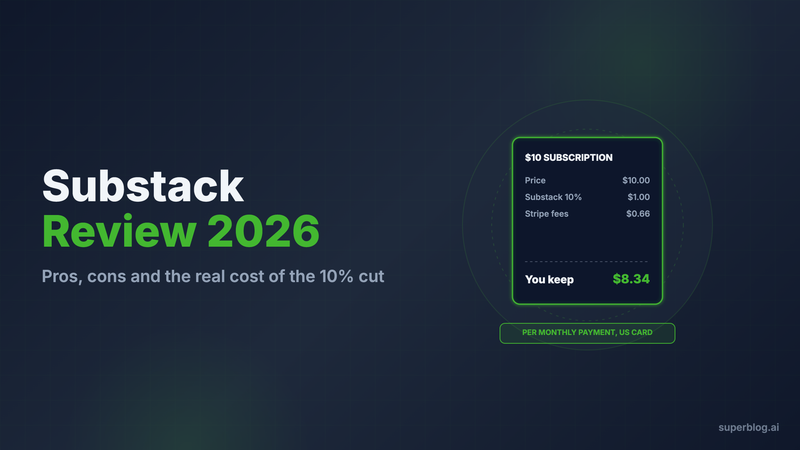
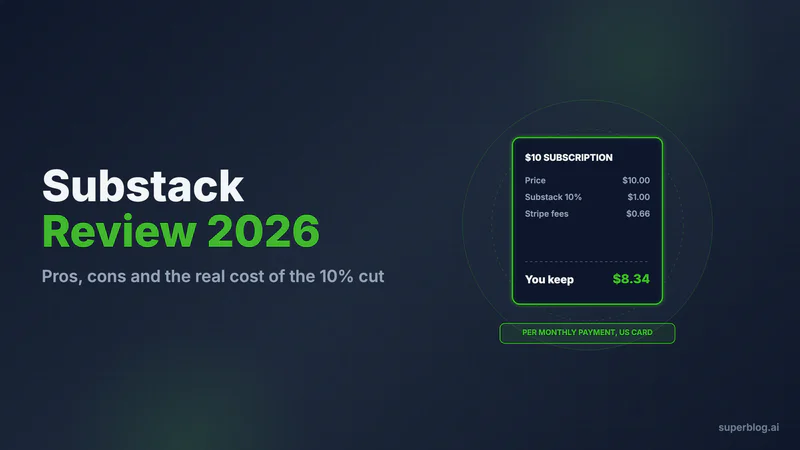
On a $10 monthly subscription, Substack keeps $1.00 and Stripe keeps about $0.66, so the writer nets about $8.34. A company that never charges readers pays nothing at all, or $50 once for a domain. Our Substack pricing breakdown works through the fee math at several revenue levels.
Substack pros and cons in one table
What Substack gets right for writers
For a writer building a paid audience, Substack gets the important things right.
- It costs nothing until it works. There is no plan to pick and no card to enter. Substack's own line is "free to start and free to leave".
- Growth comes from the network. Writers recommend each other, and those recommendations appear right after a reader subscribes (up to three, one click each), in your homepage sidebar and in occasional digest emails. Substack says more than half of new subscribers come from its built-in network, and that 30%+ of paid subscriptions start inside it.
- Paid publishing is fully built. Connect Stripe, set monthly, yearly and founding member prices, and turn payments on. Paywalls, a free-subscriber "freewall", and a metered paywall (3 free paid posts a month by default, adjustable from 1 to 50) are all settings, not plugins.
- The app keeps readers close. The free Substack app pairs a reading queue with a discovery feed. Notes are public short posts that can surface to readers of writers who recommend you. Chat gives subscribers a private space, with up to 16 chats per publication.
- It goes past text. Podcast hosting is free and distributes to Apple Podcasts, Spotify and YouTube. Live video can stream to YouTube at the same time. Bestsellers and publications with at least 100 paid subscribers can build a Creator Kit, which Substack's team uses to match them with sponsors.
- Leaving is supported. The Exports page builds a zip with your posts, subscriber list and stats. Substack also imports from WordPress, Ghost, Medium, beehiiv and others when you arrive.
So, is Substack good? For this reader, yes. Few platforms let a writer go from zero to paid subscriptions with no upfront cost.
A company has a different job for its content. If the aim is to rank for buyer searches on your own domain, a managed blog platform such as Superblog runs that half, and an email tool sends the newsletter.
Where Substack falls short for a company blog
The limits below are design choices. They suit a personal newsletter. They cost a marketing team traffic.
Your posts never sit under your main site
A Substack publication lives at yourname.substack.com or on a custom domain. Substack's help center says the publication must be "hosted by a subdomain such as www", with the bare domain forwarded by a 301 redirect. There is no route to yoursite.com/blog, so every post builds authority for a separate hostname instead of the site that sells your product. The $50 domain fee and its catches are covered in our Substack custom domain guide.
Search controls arrive with growth, not on day one
Each post has SEO Options: an SEO title, an SEO description, a social preview image and an editable URL slug of 2 to 48 characters. Beyond that, Substack's help article says "Some SEO features, such as sitemaps and Google Search Console verification, become available as your publication grows." Publishing regularly, growing your list and turning on paid subscriptions all help unlock them. Until then, a new publication has no sitemap from Substack and no Search Console verification in its settings. Our Substack SEO guide covers what a newsletter-first setup costs in search.
URL changes need care too. Changing the publication's subdomain "will break all of your links", and the option that keeps old links working can be used only once.
The design is a theme, not your brand system
Substack's website editor sets colors, title and body fonts, a logo, a wordmark, one of four header layouts and text or button navigation. There is no font size control. Substack states that it does "not currently support custom CSS or HTML in the post editor", and raw iframe embeds are blocked. Your blog cannot reuse your site's templates, components or stylesheet, so readers who click through from search land on a page laid out like every other Substack.
The reader relationship runs through Substack
Substack's homepage says you "always own your intellectual property, mailing list, and subscriber payments", and the export backs that up. Day to day, though, newsletters send from a substack.com address even on a custom domain, and readers are steered toward Substack's app and feeds. That works for growth inside the network. For a company, it means its readers meet Substack's brand next to its own.
Complaints from Substack readers and writers
On Hacker News, the sharpest criticism targets the reader experience, not the fees. Each quote below is copied word for word.
- The generic look. One commenter wrote: "When I visit a site and see that it's a Substack I don't want to stay and explore. It feels generic and that hurts the writing." (cookingoils, July 29, 2026)
- Pushes to the app. Readers object to prompts that move them off the web. One reply in full: "'Continue reading this post for free in the Substack app'. Ugh, no." (sasaf5, October 15, 2026)
- What stays behind. Another user wrote: "Substack notes is non exportable" and that "subscriptions started in the app pay Substack through Apple and Google and you can't export them." (rsingel, July 28, 2026)
- The subscribe popup, with a fix. Not every complaint is permanent. One writer pointed out that the popup is a setting: "Go to dashboard -> settings, and then it's 'Enable subscribe prompts on post page' under 'Growth.'" (skybrian, May 30, 2026)
Fairness matters here too. The same forum has writers who see the upside clearly: "Substack in general is great just to build the email list though." (brightball, April 25, 2026). The full list of issues for a business is in our post on Substack problems.
Is Substack worth it? Who it suits
Substack is worth it when most of these are true:
- Your writing is what readers pay for. The 10% buys payments, delivery and a network with no monthly bill.
- You are starting with a small audience. Recommendations and Notes put new writers in front of readers they could not reach alone.
- You publish under your own name. A subdomain or a www domain is fine, and the house style of the platform suits a personal voice.
- You want audio, video and community in one place. Podcasts, live video and Chat share one subscriber list.
When to look past Substack
Choose another platform when the content exists to bring a company search traffic and leads. The signs:
- You want posts at yoursite.com/blog so they build authority for your main domain.
- You need a sitemap and full metadata control from the first post.
- Your blog has to match your site's design and brand.
- You want lead forms that feed sales, not only email signups.
Substack against a blog you run is compared factor by factor in Substack vs blog, and Medium gets the same treatment in Medium vs Substack. For a ranked list of other platforms, see our best Substack alternatives.
Superblog: the business blog on your own domain

Superblog is a managed platform built only for company blogs. It is not a Substack replacement for paid newsletters. Superblog does not send newsletters and has no paywall or subscriber billing. It runs the blog on your domain, and you keep an email tool (or Substack itself) for sending.
What you get on the blog side:
- /blog on any paid plan. Subdirectory hosting comes with every plan. If your site is built with Wix, Squarespace or Webflow, Superblog's dashboard writes a free Cloudflare Worker for your domain. It sends /blog to Superblog and leaves every other path on the builder.
- SEO handled at publish time. Each post goes out with JSON-LD schemas, an XML sitemap entry, a canonical URL, Open Graph tags, an IndexNow ping and an llms.txt listing.
- Speed. Every page is prebuilt as static HTML on a global CDN and scores 90+ on Lighthouse.
- Capturing readers. Native lead forms and a newsletter signup form collect emails on the blog itself. The Super plan passes each new lead to Zapier or a webhook, so it lands in the email tool you already use.
Pro costs $49/month ($530 a year) and covers 1,000 posts with a team of 5. Super costs $99/month ($1,070 a year), raises the limits to 10,000 posts and 10 members, and adds multilingual SEO and custom form fields.
There is no Substack importer, so an archive comes across through Superblog's file imports. You can test Superblog with a 7-day free trial, no credit card required. The /blog route needs an active paid plan.
Final verdict on Substack
Substack is one of the strongest platforms a writer can choose for a paid newsletter. It is free to start, the network brings in subscribers, and the app keeps them reading. As a company blog, it gives up the things search depends on: a home under your main domain, a sitemap from the first post, and a design that matches your site. Keep Substack for the newsletter if it works for you, and run the blog on your own domain.
Substack review FAQ
Is Substack good for writers?
Yes. It is free to publish, and paid subscriptions, a reader app and recommendations are built in.
Is Substack worth it for a business blog?
No. Posts cannot live at yoursite.com/blog, and design and SEO controls are limited.
How much does Substack take?
10% of each subscription payment, plus Stripe's 2.9% + $0.30 and 0.7% Billing fee.
Can you use custom CSS on Substack?
No. Substack does not support custom CSS or HTML.
Does Substack have a sitemap?
Yes, once the publication has grown enough to unlock it.
Does Superblog send newsletters?
No. It runs the blog; pair it with an email tool for sending.
Your blog, without the maintenance
Fast pages, automatic SEO, no plugins to patch. Runs on yoursite.com/blog.
Sai Krishna is the Founder and CEO of Superblog. Having built multiple products that scaled to tens of millions of users with only SEO and ASO, Sai Krishna is now building a blogging platform to help others grow organically.
superblog
Superblog is a blazing fast blogging platform for beautiful reading and writing experiences. Superblog takes care of SEO audits and site optimizations automatically.