
Strapi Pricing 2026: The CMS Is Free, So What Will You Actually Pay?

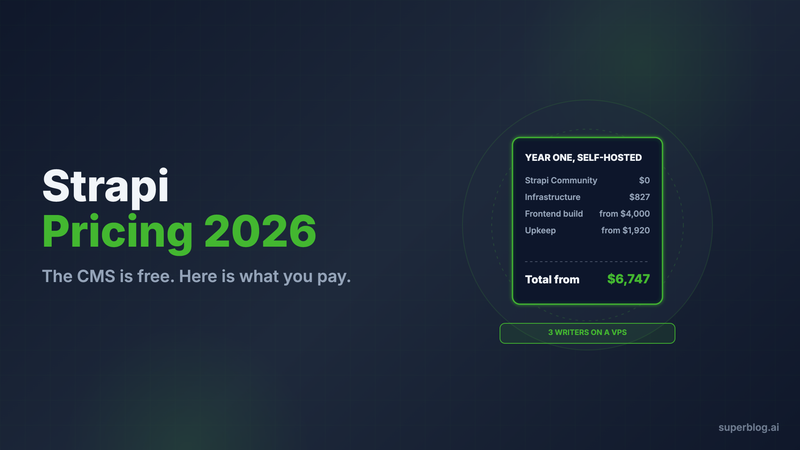
Strapi pricing starts at $0: the Community edition is open source under the MIT license, with unlimited users and content, and you host it yourself. Paid plans add features or hosting on top. Growth is $45 a month for 3 users, Strapi Cloud is $35 to $450 per project a month, and Enterprise is quoted. For a company blog, the license is a small line: our three year-one budgets run from about $6,400 to $26,300 once hosting, the frontend build and upkeep are counted.
Every price below was checked on strapi.io, docs.strapi.io and DigitalOcean's pricing pages on November 13, 2026.
Every Strapi plan in one table
Strapi sells two things. CMS plans (Community, Growth, Enterprise) set the admin panel's features. Cloud plans (Starter, Pro, Business) are hosting. Strapi's support docs say it plainly: "Cloud plans provide hosting infrastructure, not CMS features." A Cloud project without a CMS license runs Community.
Three things the table does not show:
- A Cloud plan and a CMS plan stack. Live Preview on Strapi Cloud means paying for Cloud Pro and a Growth license.
- Seats count everyone who logs in. Strapi's seat article says any admin panel user takes a seat "regardless of their role." Developers working in staging or development environments are not counted.
- SSO is extra on Growth. It is a $150/month add-on plus $50/month per user.
Is Strapi free?
Yes. Community is free forever, with no cap on users, entries, locales or API calls.
Free covers the software, not the running of it. On Community you supply:
- A server. Strapi's deployment docs list 2GB of RAM as the minimum and 4GB as recommended, with a process manager such as PM2 to keep Node.js running.
- A database. PostgreSQL, MySQL, MariaDB or SQLite. MongoDB is not supported.
- File storage for images.
- Upgrades and support. Community comes with community support only. Strapi v4 reached end of life on April 30, 2026, so every v4 project now faces a major upgrade.
Self-hosted projects can try Growth features for 30 days, no credit card required.
What the paid CMS plans unlock

Growth: $45 a month for 3 seats
Growth is a license key added to a Community project, so nothing is rebuilt. It adds:
- Live Preview, to edit content and see the page beside it.
- Releases, to group entries and publish them together. Unlimited on Growth.
- Content History, kept for 14 days.
- Strapi AI Growth, with 1,000 credits a month and extra credits at $1.50 per 100.
Three seats are included and are the minimum. Each extra seat is $15 a month, and Growth is billed monthly only.
Enterprise: annual contract, quoted price
Enterprise has no public price. Strapi's FAQ says it is a 12-month subscription paid annually. It adds SSO, Review Workflows, Audit Logs and custom Content History retention, with a SOC 2 report, offline licensing and Premium Support sold as add-ons. Review stages for drafts start here, not on Growth.
For a point of comparison, Superblog's Pro plan is $49/month and includes the CMS, the blog frontend and hosting for 5 team members.
Strapi Cloud: what the hosting tiers include
Strapi Cloud runs the server, database and CDN for one project. Yearly billing saves up to 17%, and you can switch billing cycles in project settings.
Starter sleeps when idle and has no backups, so a production blog starts at Pro. Overage is charged monthly, in full: $1.50 per 25,000 API requests, $0.60 per GB of storage and $30 per 100 GB of bandwidth. A frontend that fetches from Strapi on every page view uses up Starter's 100,000 requests quickly.
The line items behind a Strapi blog
Strapi serves posts as JSON. The blog your readers see is a separate app. These are the costs a company blog pays:
Developer time is priced at Codeable's published $80 to $120 an hour for vetted freelancers. Swap in your own rate. Vercel's free Hobby plan is for personal, non-commercial use, so a company blog needs Pro.
In those hours, someone renders Strapi's Rich Text (Blocks) field as HTML, builds the post and listing pages, and wires up a draft preview. Every search-facing output is also written by hand: title and description tags, canonical links, JSON-LD, an XML sitemap and an RSS feed. Self-hosting adds server setup on top. Our guide to headless CMS for business blogs breaks that work down piece by piece.
What a Strapi blog costs in year one
Each budget sums year one, then the yearly cost after the build. Hours are our estimates.
Budget 1: Community on a VPS, 3 writers
The lowest-license route: free Strapi on a DigitalOcean Droplet sized to Strapi's recommended 4GB of RAM.
- Strapi license: $0
- Droplet: $24 x 12 = $288
- Weekly backups: $4.80 x 12 = $57.60
- Managed PostgreSQL: $15.15 x 12 = $181.80
- Spaces for media: $5 x 12 = $60
- Vercel Pro, 1 developer: $20 x 12 = $240
- Build, including server setup, 50 to 100 hours: $4,000 (50 x $80) to $12,000 (100 x $120)
- Upkeep, 2 to 4 hours a month: $1,920 (24 x $80) to $5,760 (48 x $120)
Infrastructure: $288 + $57.60 + $181.80 + $60 + $240 = $827.40.
Year one, low: $827.40 + $4,000 + $1,920 = $6,747.40.
Year one, high: $827.40 + $12,000 + $5,760 = $18,587.40.
From year two: $2,747.40 to $6,587.40 a year. Upkeep is higher here because the server, Node.js, the database and Strapi upgrades are yours.
Budget 2: Strapi Cloud Pro with Growth, 5 writers
Hosting handled by Strapi, plus Live Preview and Releases. Five writers and one developer make 6 seats, because the developer also works in the production admin panel.
- Cloud Pro: $900 (yearly) to $1,080 (monthly, $90 x 12)
- Growth: ($45 + 3 x $15) x 12 = $1,080
- Vercel Pro, 1 developer: $240
- Frontend build, 40 to 80 hours: $3,200 (40 x $80) to $9,600 (80 x $120)
- Upkeep, 1 to 3 hours a month: $960 (12 x $80) to $4,320 (36 x $120)
Year one, low: $900 + $1,080 + $240 + $3,200 + $960 = $6,380.
Year one, high: $1,080 + $1,080 + $240 + $9,600 + $4,320 = $16,320.
From year two: $3,180 to $6,720 a year.
Budget 3: Self-hosted Growth, 10 writers and 2 developers
A larger team on its own servers that wants Releases and Live Preview. Twelve people log in, so 12 seats: the two developers also work in the production admin panel.
- Growth: ($45 + 9 x $15) x 12 = $2,160
- Droplet, backups, database and Spaces: $587.40
- Vercel Pro, 2 developers: $480
- Build, 60 to 120 hours: $4,800 (60 x $80) to $14,400 (120 x $120)
- Upkeep, 3 to 6 hours a month: $2,880 (36 x $80) to $8,640 (72 x $120)
Year one, low: $2,160 + $587.40 + $480 + $4,800 + $2,880 = $10,907.40.
Year one, high: $2,160 + $587.40 + $480 + $14,400 + $8,640 = $26,267.40.
From year two: $6,107.40 to $11,867.40 a year.
What Strapi users say about the cost
Both quotes are verbatim, from a GitHub issue where Strapi asked users for their main pain points.
- Per-seat fees on your own servers. GitHub user ancashoria (December 8, 2025) wrote: "Your pricing for Self-Hosted is absolutely bonkers. How can you charge per month AND per seat in a selfhosted environment?"
- Major upgrades are expensive. GitHub user quinnlangille (December 8, 2025) described the move from v4 to v5: "The migration has taken months, involved multiple teams (technical and non), and cost tens of thousands of dollars."
Budgets miss the second point. Strapi v4 reached end of life on April 30, 2026, and 4.26.2 (June 9, 2026) was its final release. A blog still on v4 carries an upgrade project that none of the budgets above include.
Teams Strapi fits well
Strapi is a strong choice when:
- You want to own the backend and the data. Community runs on your servers and your database, under the MIT license.
- Developers will customize it. Custom fields, plugins, controllers and lifecycle hooks are all code you control.
- The blog is one of several content consumers. The same REST or GraphQL API can feed a website, an app and internal tools.
- Users grow faster than budget. Community has no seat fee at all, however many people log in.
Red flags for a blog on Strapi
Strapi stops paying for itself once the blog is the only thing it serves. Look for these:
- Writers wait for developers to change a template or fix a meta tag.
- A frontend release can drop the JSON-LD or break the sitemap, and no one is assigned to check.
- The upkeep hours cost more than the hosting.
- A major upgrade is coming and the blog is the only thing that needs it.
You can move the blog and keep Strapi for everything else. Our list of Strapi alternatives compares 12 options. For other headless tools, see Sanity pricing and Contentful pricing. If WordPress is on your list, our WordPress pricing guide adds up that stack the same way.
Superblog: one plan, no frontend to build
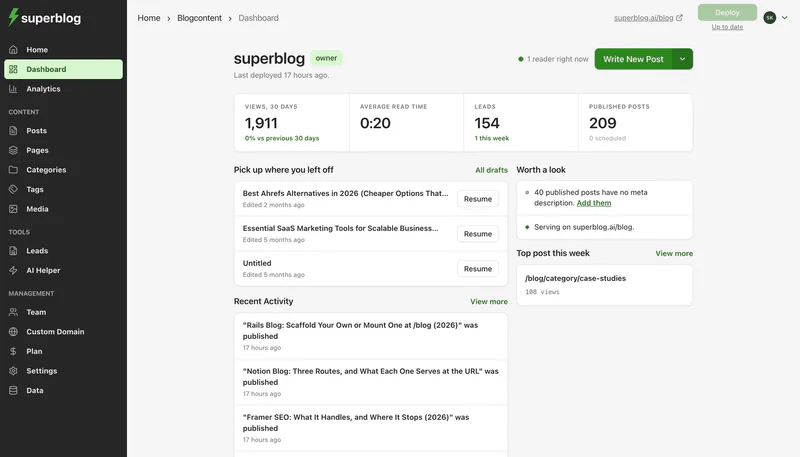
On Superblog, the blog is a subscription, not an app your team builds. One plan pays for the writing editor, the public blog pages, hosting on a global CDN, free SSL and automatic SEO. There is no Node.js server, database or frontend repo to look after.
Superblog figures use yearly billing. Strapi figures include the frontend build and upkeep, which the Superblog plan replaces.
The gap per budget, with Superblog billed yearly:
- Budget 1: $6,217.40 to $18,057.40 more than Pro ($530).
- Budget 2: $5,850 to $15,790 more than Pro ($530).
- Budget 3: $9,837.40 to $25,197.40 more than Super ($1,070).
Both plans list 100,000 pageviews a month. Going over does not cap or slow the blog, and a blog that keeps growing moves to a larger plan.
The Strapi costs above, set against Superblog:
Your domain. Readers reach the blog at yoursite.com/blog. On a Next.js site, the routing lives in next.config.js; copy the rules from our blog for Next.js setup guide.
Moving the posts is a developer task, because Superblog has no Strapi importer. The route is the JSON importer: pull the posts out of Strapi's REST API into one JSON file, turn each Rich Text (Blocks) body into HTML, and map the slug field on upload so every post keeps its slug. If the old frontend used a different path than /blog/{slug}, add redirects. One upload holds 300 posts, so a bigger archive goes in batches. There is a 7-day free trial, no credit card required. A paid plan is needed before /blog can point at Superblog.
Strapi pricing: the short verdict
Pick Strapi when developers want to own the backend and the content feeds more than a blog. That control is what the money buys. Budget for it honestly, though: across our three teams, year one came to between $6,380 and $26,267.40, and most of that was developer time and hosting, not the license. The license itself runs from $0 (Community) to $45 a month (Growth) to a quote (Enterprise), with Strapi Cloud at $35 to $450 a month per project on top. A team that only wants its blog ranking at yoursite.com/blog pays $49/month (Pro) on Superblog and skips the build.
Quick answers on Strapi pricing
Is Strapi free?
Yes. Community is free under the MIT license, with unlimited users and content.
How much does Strapi Cloud cost?
$35, $90 or $450 per project a month (Starter, Pro, Business), or $348, $900 or $4,500 a year.
How much is the Strapi Growth plan?
$45 a month for 3 seats, plus $15 a month per extra seat.
How much does Strapi Enterprise cost?
Strapi does not publish it. Enterprise is quoted and billed annually.
Does Strapi Cloud include Growth features?
No. Growth is a separate license added to the Cloud project.
Does Superblog undercut Strapi on a year-one blog budget?
Yes. Superblog Pro is $530 billed yearly, and the lowest Strapi budget above starts at $6,380.
Your blog, without the maintenance
Fast pages, automatic SEO, no plugins to patch. Runs on yoursite.com/blog.
Sai Krishna is the Founder and CEO of Superblog. Having built multiple products that scaled to tens of millions of users with only SEO and ASO, Sai Krishna is now building a blogging platform to help others grow organically.
superblog
Superblog is a blazing fast blogging platform for beautiful reading and writing experiences. Superblog takes care of SEO audits and site optimizations automatically.