
Storyblok Review 2026: Is a $99 Visual Editor Worth It for Your Blog?

Our Storyblok review in short: Storyblok is worth it when it already runs your marketing site and the blog is one more route your developers maintain. It is a poor buy when the blog is the main thing you need.
Storyblok is a good headless CMS for teams where developers run a modern frontend and marketers want to build pages themselves. Its visual editor is the real draw: editors click a block on a live preview of the page and change it in place. For a company blog on its own, it is a lot of machinery, because Storyblok only delivers JSON and your developers build the blog pages, the preview and every SEO tag before Growth's $99 a month buys anything a reader sees.
Prices and plan limits below come from storyblok.com, checked on November 13, 2026. When Storyblok's own pages did not state something, we left it out.
Storyblok pros and cons at a glance
Who runs their content on Storyblok
Storyblok sells itself as "The Enterprise CMS Built for AI + Humans", a workspace "that content teams love and dev teams control." That second phrase is an accurate description of the product. Developers define the blocks and build the site. Content teams fill and arrange those blocks.
The homepage shows logos from Adidas, Disney, Netflix, Oatly, TomTom and Virgin Media O2. Its June 2024 funding announcement named Adidas, T-Mobile, Renault and Oatly as customers. The company started in Linz, Austria, and reported a fully remote team of 240 people across 45 countries at the time.
The typical buyer has a frontend team, many page types and marketers tired of filing tickets for landing pages. The blog is one content type in that setup, not the reason for the purchase.
Storyblok plans and prices in 2026

Prices from storyblok.com/pricing, checked November 13, 2026, in USD. Plans are priced per space, and one space is one project.
Three rows on the full comparison table matter for a content team:
- SEO meta tags and story scheduling start on Growth. Starter has neither, and Storyblok calls Starter a "limited plan for testing and personal projects."
- Version history is short. Content versioning retention is 1 day on Starter and 30 days on Growth and Growth Plus.
- Governance sits on Premium. Custom roles, custom workflows, releases, SSO and the GraphQL Content Delivery API are all Premium and Elite features.
Our Storyblok pricing breakdown adds frontend hosting, build hours and upkeep, and puts a 3-writer blog at $5,489 to $15,348 in year one. Superblog, a blog platform with the frontend included, starts at $49/month (Pro) with 5 team members.
What Storyblok gets right

Storyblok's strengths are real, and most of them come from the editor.
- Editing on the page. The Preview mode shows "a draft rendering of your website." Editors switch between desktop, mobile and full-width views, click a block and edit its fields in a side panel. Many headless CMSs start editors in a form. Storyblok starts them on the page.
- Blocks marketers can arrange. Editors add, delete and reorder blocks. Once developers have built a hero, a feature grid and a testimonial block, marketing can assemble a new landing page from them without a developer.
- Any frontend. Storyblok's FAQ puts it plainly: it "only delivers JSON and therefore can be combined with any static site generator you want." Storyblok publishes guides for Next.js and Astro, among others.
- A long trial. Every new space gets 45 days of Growth Plus, with no credit card.
- Enterprise controls when you need them. Premium and Elite add SSO, custom roles, custom workflows, releases and a 99.9% or 99.99% uptime SLA.
Fans are enthusiastic. Zack Plauché wrote on Trustpilot: "I love the tool itself. I think the visual editor is amazing." A Hacker News commenter, stophecom, recommended Storyblok and DatoCMS in September 2025 and added: "From own experience, the developer experience is awesome."
What developers still own on a Storyblok blog
The visual editor makes Storyblok feel like a website builder, but it is not one. Storyblok has no hosted pages. Everything a reader sees comes from a frontend your developers write, deploy and maintain.
Every block needs a component
In Storyblok's Next.js guide, each block name, such as feature or grid, is linked to a React component in a components object that lives in your code. A block without a component renders nothing. The editor can only offer what your developers have built. A new post layout, a pull-quote style or a comparison table block starts as a developer task.
The preview has to be wired up
Storyblok's developer docs say "The Visual Editor loads your webpage in an iframe." To make that work, someone sets a preview URL, connects the frontend through the Storyblok Bridge, adds storyblokEditable attributes to each block and fetches draft content. Storyblok's security policy also requires the preview to be served over HTTPS, even on localhost. Until this is done, the visual editor is a form next to a blank frame.
Meta tags are fields, not output
Storyblok's SEO app adds a field type that holds the meta title, description and Open Graph tags. It does not put them in your pages. Storyblok's own SEO tutorial for Astro says: "To render the field's contents in the front end, render the sb_ai_seo or seo_meta_tags object in your Astro project." The same tutorial builds the Article JSON-LD as a frontend component and gets the sitemap from Astro's own package. Canonical tags, RSS, redirects and IndexNow are also yours to build. For the full set of tags a hand-built frontend must render, see our Next.js SEO checklist.
Scheduling and seats are metered
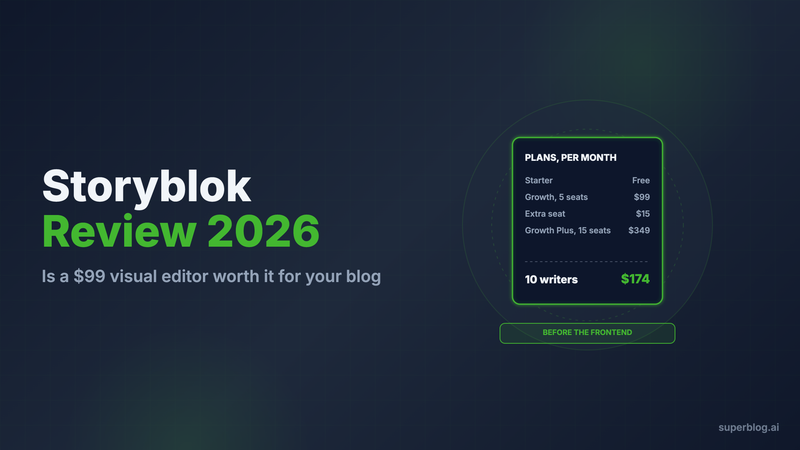
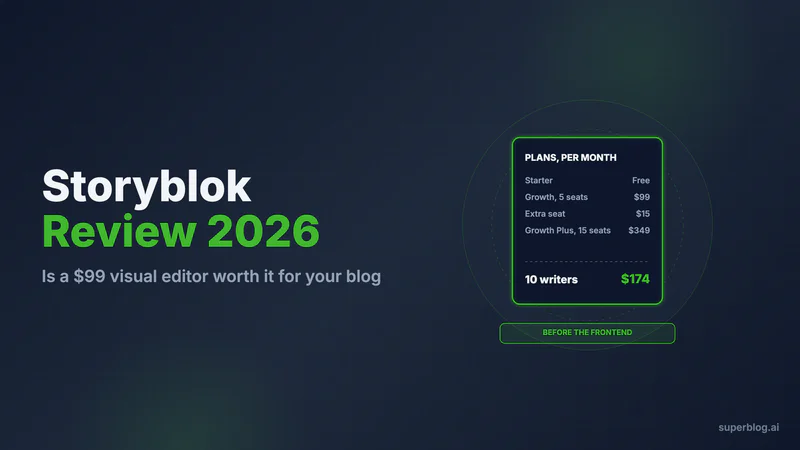
A blog team feels the plan limits before the traffic limits. Growth and Growth Plus hold 2 scheduled stories at a time, so a team that wants a week of posts queued on Monday can schedule only two of them. Ten writers cost $174 a month on Growth (5 included plus 5 at $15), and an eleventh person means Growth Plus at $349.
We go deeper on the build and upkeep hours in headless CMS for business blogs.
What reviewers complain about
On November 13, 2026, Storyblok's Trustpilot page showed a TrustScore of 2.6 from 12 reviews. That is a small sample, and most of it was written after Storyblok changed its plans in April 2025. Storyblok's own pricing FAQ said at the time that "some plans may come at a higher cost." The quotes below are copied from those reviews.
- The 2025 repackaging. Patrik Karlsson (August 10, 2025): "The platform itself is good, but the direction of the pricing model is a dealbreaker."
- Locales that used to be included. Heine (May 26, 2025): "Where plans previously included unlimited languages, they now only offer two".
- Trust in the vendor. Coen (April 9, 2025): "The tool is good, but the company is not reliable."
- Improvements tied to higher tiers. J B (April 28, 2026): "They don't seem to be improving the platform - each improvement comes with more premium pricing."
J B also credits the product and names the buyer it fits: "The core CMS is good for big organisations with lots of marketeers who can't code, and have high velocity of page output." On Hacker News in December 2023, a developer described a 2021 to 2022 evaluation in which they prototyped many CMSs to replace Drupal. The developer, who disclosed paid work for one of the CMS companies, grouped Storyblok with Sanity, ButterCMS and Agility and wrote: "In general they were all 'good enough' and passed most of our criteria." None of the four made the team's list of finalists.
In the reviews posted since the April 2025 change, the complaints are about pricing, not the product. Older reviews from 2022 to 2024 also report bugs and support problems.
When Storyblok is the right call
Choose Storyblok when these are true:
- Marketing builds pages, not only posts. Landing pages, campaign pages and product pages are where the visual editor pays for itself.
- A frontend team already exists. When engineers already own a Next.js or Nuxt codebase, blog templates are a small extension of work they do now.
- The same content feeds more than one place. JSON output means one story can serve the website and anything else you build.
- You need enterprise governance. SSO, custom roles, releases and an uptime SLA are on Premium and Elite.
When to keep the blog somewhere else
The blog is a different job. These signals say it belongs somewhere else:
- Scheduling runs out. Your team plans more than two posts ahead.
- SEO has no owner. No one is responsible for the sitemap, canonical tags or structured data.
- Writers queue behind engineering. A new block, a broken preview or a missing meta tag each becomes a developer ticket.
- The team outgrows Growth. An eleventh writer moves you to Growth Plus at $349.
- The blog is the purchase. It is the main reason Storyblok is on your shortlist.
A split setup is also an option: landing pages stay in Storyblok and only the blog moves. For both routes, Storyblok alternatives compares 11 options, and our CMS for Next.js comparison sets Storyblok against Sanity and Payload.
Superblog for the blog, Storyblok for the pages

Superblog serves the blog at yoursite.com/blog while Storyblok keeps every landing page. On a Next.js site, two rewrites in next.config.js send that path to Superblog (our blog for Next.js page shows them). Nothing on the blog side needs building: Superblog is a managed blog platform, and one plan covers the editor, the blog pages, global CDN hosting and the SEO engine. It is not a page builder. Storyblok components stay on the landing pages your frontend builds from Storyblok, and the blog takes its look from a template with your colors, fonts, menus and custom CSS.
The same blog jobs on each side:
Here is what the blog team gets:
- Seats in the price. Pro is $49/month ($530 a year) for 5 team members and up to 1,000 posts. Super is $99/month ($1,070 a year) for 10 members and up to 10,000 posts, with multilingual SEO in 41 languages and Zapier.
- Publishing without a developer. Drafts are written with slash commands and markdown shortcuts. Before a post goes out, the writer checks the search-result preview, adds FAQ blocks that carry schema and accepts internal link suggestions. On Pro, posts can be scheduled, and collaborative review lets teammates comment on a draft before it publishes.
- SEO with no code. Every deploy writes the structured data (BlogPosting, FAQ, Organization, WebPage and ImageObject schemas), the XML sitemap and the canonical and Open Graph tags. Publishing a post sends an IndexNow ping. Each post also has a markdown copy at its own URL plus
.md, indexed by the blog's llms.txt file. - Forms for leads. Readers sign up through a form under a post, in the sidebar or in a pop-up, with no third-party tool.
Superblog has no Storyblok importer, so a developer moves the posts in three steps:
- Export the blog stories with Storyblok's Content Delivery API.
- Convert the rich text in each story to HTML and collect the posts in one JSON file.
- Upload the file to the JSON importer, up to 300 posts per import, with title, content, date and slug mapped. Mapping the slug keeps each post's slug.
Superblog has a 7-day free trial, no credit card required. The /blog connection is on paid plans.
Storyblok review: the verdict
Storyblok has the strongest visual editing of the headless CMSs we have reviewed, Sanity included (see our Sanity CMS review). Marketers get a clickable page instead of a stack of forms, and developers keep control of the code. That is a good trade for a marketing site with many page types and a frontend team behind it. For a blog, the same design means a component for every block, a preview to wire up, an SEO layer to write, 2 scheduled stories at a time and a pricing history that has made existing customers wary. Keep Storyblok for the pages it does well. If the blog is the part that needs to move faster, run it on a platform that ships the blog finished, from $49/month (Pro).
Storyblok FAQ
Is Storyblok legit?
Yes. It is a venture-backed headless CMS that had raised $138 million by its June 2024 Series C, with customers such as Adidas and Oatly.
How much does Storyblok cost?
Starter is free, Growth is $99/month ($90.75 billed annually), Growth Plus is $349/month, and Premium and Elite are quoted.
Who are Storyblok's main competitors?
Contentful, Sanity, Prismic, Contentstack, Hygraph and DatoCMS.
Who owns Storyblok?
It is a venture-backed company led by co-founder and CEO Dominik Angerer. Brighton Park Capital led its $80M Series C in June 2024.
Is Storyblok good for a company blog?
Yes, if your developers already maintain the frontend; no, if the blog is the only thing you need.
Does Superblog import from Storyblok?
No. Stories come in as one JSON file through the JSON importer, 300 posts per import.
Your blog, without the maintenance
Fast pages, automatic SEO, no plugins to patch. Runs on yoursite.com/blog.
Sai Krishna is the Founder and CEO of Superblog. Having built multiple products that scaled to tens of millions of users with only SEO and ASO, Sai Krishna is now building a blogging platform to help others grow organically.
superblog
Superblog is a blazing fast blogging platform for beautiful reading and writing experiences. Superblog takes care of SEO audits and site optimizations automatically.