
Storyblok Pricing 2026: Plans, Seats, and What a Company Blog Really Costs

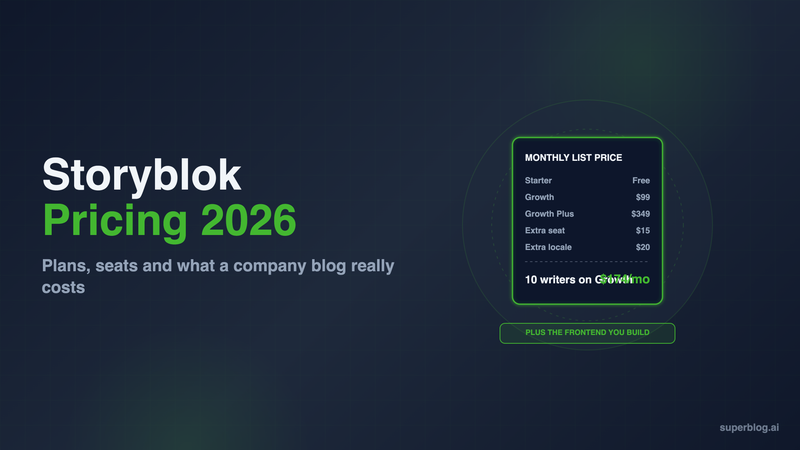
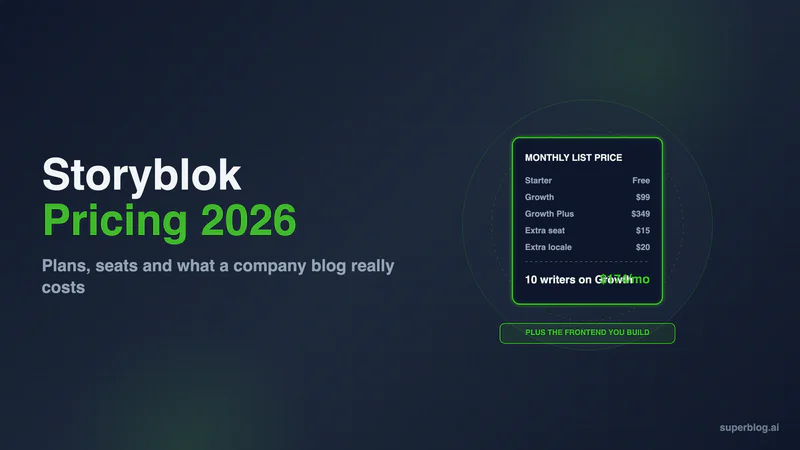
Storyblok pricing starts at $0 on Starter, then $99 a month on Growth ($90.75 billed annually) and $349 a month on Growth Plus ($319.91 billed annually). Premium and Elite are quoted by sales. For a company blog, the license is the small part: Storyblok only delivers JSON, so your developers build and host the blog frontend, and that puts a 3-writer blog at roughly $5,500 to $15,300 in year one.
Every Storyblok figure below was checked on storyblok.com in November 2026. Figures we could not confirm on Storyblok's own pages are left out.
Storyblok pricing at a glance

Notes on the table:
- Prices are from storyblok.com/pricing, in USD. Annual billing works out to one month free.
- Plans are priced per space. One space is one project, so a blog in a separate space is a separate subscription.
- New spaces start on a 45-day free trial of Growth Plus, with no credit card. After that, you pick a paid plan or drop to Starter.
For comparison, Superblog is $49/month (Pro) with 5 team members, hosting and the blog frontend included.
Is Storyblok free?
Yes, for testing. Starter costs $0 and needs no credit card. Storyblok itself calls it a "limited plan for testing and personal projects."
For a company blog, Starter runs short fast:
- Two seats at most. One is included and the second costs $15 a month.
- No scheduled publishing. Single story scheduling starts on Growth.
- No SEO meta tags feature. The pricing table marks it as Growth and above.
- One day of version history. Content versioning and activity log retention is 1 day on Starter and 30 days on Growth.
- You still build the frontend. That cost is the same on every plan.
Storyblok plans: what each tier gets you
The limits that matter for a blog:
Every plan includes the Visual Editor, default workflow stages and AI Translations. Releases, custom roles, custom workflows and SSO are Premium and Elite features.
Seats
Seats are the line that grows with your team. Growth includes 5 seats. Each extra seat costs $15 a month, and the plan stops at 10. Past 10 people, you move to Growth Plus at $349 a month, which covers 15 seats and sells none on top. Past 15, you talk to sales about Premium.
Storyblok's FAQ adds two billing details. Extra users are charged when you add them, and on an annual plan they are billed upfront for the whole year.
Locales
Storyblok counts each language-region pair as a locale, such as en-US and de-DE. Growth includes 2 and charges $20 a month for each one after that, with no maximum. Growth Plus includes 10 and stops there.
AI Translations are available on every plan, but Storyblok's docs say the feature "is part of Storyblok Labs and is still in beta." You switch it on in Settings, and it draws from your monthly AI credits. Translating content is only half the work. Your developers still build the language routing, hreflang tags and per-language sitemaps in the frontend. We compare that work across platforms in our multilingual blog platform roundup.
Scheduled stories
The fact sheet linked from the pricing page lists 2 "Simultaneously Scheduled Stories" on Growth and Growth Plus. That means two posts in the queue at a time. A team that schedules a week of posts on Monday needs Premium, which allows 100.
The real cost: line items beyond the plan
The plan price covers the CMS. A blog needs more:
The hourly rate is a benchmark from Codeable's published $80 to $120 rate for vetted WordPress freelancers. Storyblok developers set their own rates, so swap in yours.
Why the build is real work: Storyblok returns JSON. Someone has to write the post template, map each block type to a component, render rich text, and produce meta tags, canonical URLs, JSON-LD schema, an XML sitemap and an RSS feed. Then someone keeps it working through framework and SDK updates. We go deeper on that trade in headless CMS for business blogs.
What three team sizes pay
The budgets below use the prices verified above. The hours are an assumption and are stated so you can change them. Seats count writers only. Locale counts treat every language, including your main one, as a locale. Storyblok does not say whether the default language counts, so Scenario 2 could run $240 a year lower. If your developer also needs a Storyblok login, add one seat.
Scenario 1: 3 writers, one language
Growth is the floor, because Starter caps at 2 seats and has no scheduling.
- Growth: $1,089 (annual) to $1,188 (monthly, $99 x 12)
- Seats: $0 (3 of the 5 included)
- Locales: $0 (one language fits in the 2 included)
- Vercel Pro: $240
- Frontend build: 40 to 80 hours, so $3,200 (40 x $80) to $9,600 (80 x $120)
- Upkeep: 1 to 3 hours a month, so $960 (12 x $80) to $4,320 (36 x $120)
Year one, low: $1,089 + $240 + $3,200 + $960 = $5,489.
Year one, high: $1,188 + $240 + $9,600 + $4,320 = $15,348.
From year two, without the build: $2,289 to $5,748 a year.
Scenario 2: 10 writers, four languages
A larger team that publishes in English, German, French and Spanish. Growth still fits, at its 10-seat maximum.
- Growth: $1,089 to $1,188
- Extra seats: 5 x $15 x 12 = $900
- Extra locales: 2 x $20 x 12 = $480 (4 languages, 2 included)
- Vercel Pro: $240
- Frontend build with language routing and hreflang: 60 to 120 hours, so $4,800 (60 x $80) to $14,400 (120 x $120)
- Upkeep: 2 to 4 hours a month, so $1,920 (24 x $80) to $5,760 (48 x $120)
Year one, low: $1,089 + $900 + $480 + $240 + $4,800 + $1,920 = $9,429.
Year one, high: $1,188 + $900 + $480 + $240 + $14,400 + $5,760 = $22,968.
From year two: $4,629 to $8,568 a year. Two catches apply here. A developer seat makes 11 people, which Growth cannot hold, so the plan becomes Growth Plus. And 10 writers share 2 scheduled stories at a time.
Scenario 3: 15 writers, one language
Fifteen people is past Growth's 10-seat maximum, so Growth Plus is required.
- Growth Plus: $3,838.92 (annual, $319.91 x 12) to $4,188 (monthly, $349 x 12)
- Seats: $0 (15 included, and no more can be added)
- Vercel Pro: $240
- Frontend build: 40 to 80 hours, so $3,200 to $9,600
- Upkeep: 1 to 3 hours a month, so $960 to $4,320
Year one, low: $3,838.92 + $240 + $3,200 + $960 = $8,238.92.
Year one, high: $4,188 + $240 + $9,600 + $4,320 = $18,348.
From year two: $5,038.92 to $8,748 a year. The 16th person, an editor or a developer, means a Premium quote.
The pricing complaints
Storyblok repackaged its plans in 2025. Its pricing FAQ says the new pricing took effect on April 7 and that "some plans may come at a higher cost." Reviews on Trustpilot show how that landed:
- Large jumps for existing customers. Alex Buge (April 19, 2025) wrote that customers were "suddenly being confronted with a price hike of up to 800% and possibly even more."
- Lower limits on the new plans. Patrik Karlsson (August 10, 2025) wrote that the new Growth plan "now includes fewer assets (2,500) than the old Entry plan (4,000)".
- Per-seat pricing. Zack Plauché (April 13, 2025) wrote: "They charge per user per seat, instead of charging for amount of content on the site."
- Features moving up the ladder. JB (April 28, 2026) wrote that "each improvement comes with more premium pricing."
Two more limits come straight from the pricing page. Scheduling is capped at 2 stories at a time below Premium, and custom workflows and roles are Premium only.
When Storyblok makes sense
Storyblok is a strong product for the right team. It fits when:
- Marketing builds landing pages, not only posts. The Visual Editor lets marketers assemble pages from components your developers built.
- You already have a frontend team. If developers maintain your Next.js or Nuxt site anyway, the blog template is one more route in a codebase they know.
- The blog is one channel among many. Storyblok delivers content as JSON, so the same stories can feed your website and any other frontend you build.
- You need enterprise controls. Premium and Elite add SSO, custom roles, releases and a 99.9% or 99.99% uptime SLA.
Signs Storyblok costs more than it should
Look elsewhere when the blog is the main reason you would buy Storyblok. Then you pay for a page builder, a seat ladder and a frontend build to publish articles. The scheduling cap and the 10-seat ceiling on Growth hit content teams first. We compare 11 options in Storyblok alternatives, and our CMS guide for marketing teams covers who owns publishing on each. If Sanity is also on your list, read our Sanity CMS review.
Superblog: the blog without the build
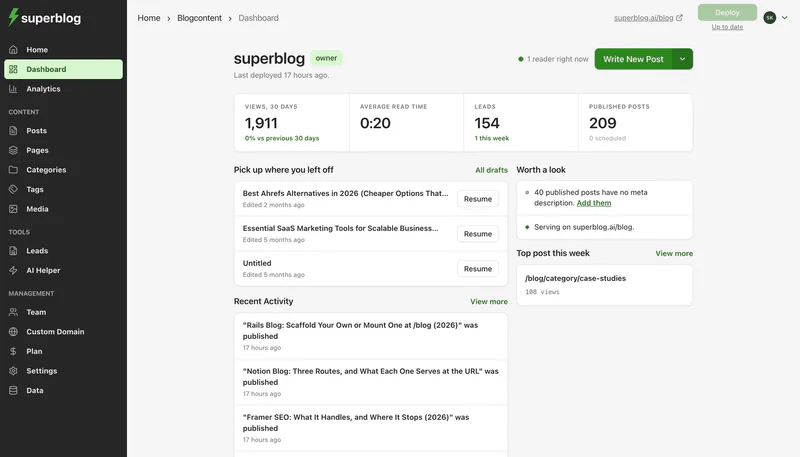
Superblog gives a company blog the whole stack for one monthly price: the CMS, the blog frontend, hosting, CDN, SSL and the SEO engine. Nobody builds a frontend. Your blog lives at yoursite.com/blog beside your current site, and a Next.js site connects it with two rewrites in next.config.js, shown on our blog for Next.js page.
Here are the scenarios set against Superblog:
On yearly billing, Superblog Pro at $530 costs $4,959 to $14,818 less than Scenario 1 in year one. Super at $1,070 costs $8,359 to $21,898 less than Scenario 2. Both plans list 100,000 pageviews a month. Going over does not cap or slow the blog, and a blog that keeps growing moves to a larger plan.
What you get without a build:
- SEO on every page. Each deploy writes JSON-LD schemas, the XML sitemap, canonical and Open Graph tags and llms.txt, and IndexNow pings go out when a post publishes. Every page scores 90+ on Lighthouse.
- Seats in the plan. You get 5 team members on Pro and 10 on Super. Roles are Admin, Editor and Writer.
- Scheduling and review on Pro. Pro adds scheduled posts and collaborative review, so teammates can comment on a draft before it publishes.
- No per-language charge. Multilingual SEO is on Super and above, with 41 languages, hreflang tags and per-language sitemaps. The tenth language costs the same as the first.
Superblog runs your blog and nothing else, so your landing pages stay in your current site builder or codebase. Superblog has no Storyblok importer. Moving over takes a short developer script: fetch your blog stories from Storyblok's API, render each rich text field to HTML, and save the posts as one JSON file. Superblog's JSON import then maps title, content, date and, to keep your URLs, slug. Each import takes up to 300 posts. There is a 7-day free trial, no credit card required. The /blog connection needs a paid plan.
Bottom line
Storyblok's license runs from $0 to $3,838.92 a year on the self-serve plans, plus $15 per extra seat and $20 per extra locale on Growth. For a company blog, the real bill is the frontend: our three scenarios land between about $5,500 and $23,000 in year one once the build, hosting and upkeep are counted. If your team needs a visual page builder and already runs a frontend, that can be worth it. If you only need a fast blog that ranks on yoursite.com/blog, $49/month (Pro) covers it.
FAQ
Is Storyblok free?
Yes. Starter is $0 for 1 seat (2 maximum), with no scheduling.
How much does Storyblok cost per month?
Growth is $99 ($90.75 billed annually), Growth Plus is $349 ($319.91), and Premium and Elite are quoted.
How much is an extra Storyblok seat?
$15 a month on Starter and Growth. Growth Plus sells no extra seats.
How much does an extra locale cost on Storyblok?
$20 a month per locale on Growth, after the 2 included.
How many stories can you schedule on Storyblok Growth?
Two at a time. Premium and Elite allow 100.
Is Superblog cheaper than Storyblok for a blog?
Yes. $530 a year on Pro against $5,489 or more in year one for Storyblok with a frontend.
Your blog, without the maintenance
Fast pages, automatic SEO, no plugins to patch. Runs on yoursite.com/blog.
Sai Krishna is the Founder and CEO of Superblog. Having built multiple products that scaled to tens of millions of users with only SEO and ASO, Sai Krishna is now building a blogging platform to help others grow organically.
superblog
Superblog is a blazing fast blogging platform for beautiful reading and writing experiences. Superblog takes care of SEO audits and site optimizations automatically.