
Semantic SEO for Blogs: Writing for Meaning, Not Keyword Strings (2026)

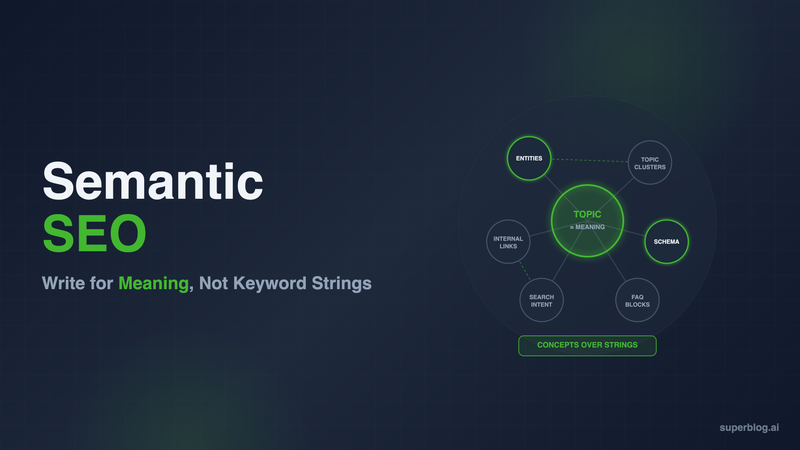
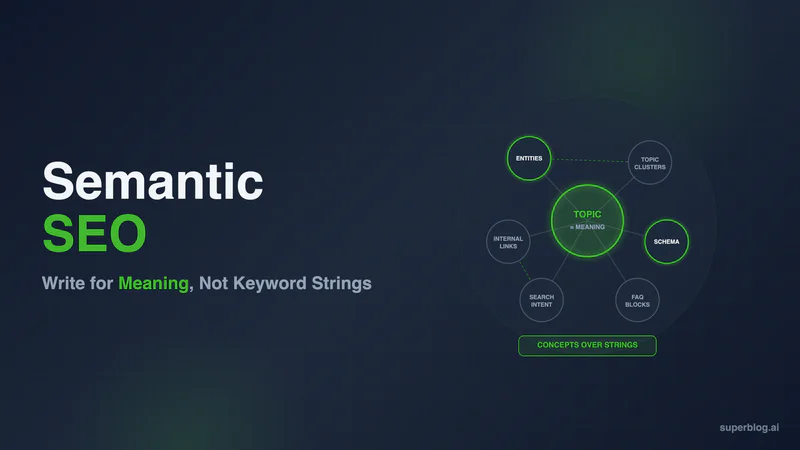
Semantic SEO is the practice of structuring content around meaning, entities, and the relationships between concepts, instead of repeating an exact keyword string as many times as you can fit it. For a business blog, that means writing a post that fully answers a topic and the related questions a reader actually has, rather than fragmenting that same topic into five thin posts each stuffed with one keyword variation.
Google stopped matching text strings a long time ago. It matches meaning. A page ranks for "semantic SEO" not because it repeats those two words forty times, but because Google's systems can confirm the page actually covers the concept: what it means, how it relates to keyword SEO, and how a blog applies it differently. This guide covers what semantic SEO is, how Google builds topic understanding through entities, and the structural changes a blog needs to make: topic clusters, internal linking, structured data, natural language coverage, and FAQ blocks.
What Is Semantic SEO?
Semantic SEO is the discipline of optimizing content for the meaning behind a query and the network of related concepts around it, rather than optimizing for isolated keyword frequency. Where traditional keyword SEO treats a page as a vehicle for one target phrase, semantic SEO treats a page as a source of concepts, entities, and relationships that a search engine can map against what a searcher actually wants to know.
In practice, this shows up as three shifts in how you write and structure a blog:
- Topic coverage over keyword repetition. A post about "semantic SEO" should cover the definition, how it differs from keyword SEO, and how to apply it, not just repeat the phrase in every paragraph.
- Entities and relationships over strings. Google resolves "semantic SEO" as a concept related to entities like the Knowledge Graph, natural language processing, and topic clusters. Content that demonstrates those relationships ranks more durably than content that just matches the string.
- Structure that makes meaning explicit. Headers, internal links, and structured data tell a search engine, and increasingly an AI assistant, what a page is about and how it connects to the rest of your site.
This is not a replacement for keyword research. You still need to know what people search for. Semantic SEO changes what you do once you know that: instead of writing narrowly to a phrase, you write comprehensively to a topic and let the phrase appear naturally within it.
How Google Understands Topics Through Entities
Google's ranking systems moved from string-matching to meaning-matching years ago, largely through updates like Hummingbird and the neural matching systems that followed. The mechanism worth understanding is entities.
An entity is a distinctly identifiable thing (a person, organization, product, or concept) that Google can assign a persistent identity to, with known attributes and relationships to other entities. "Semantic SEO" is an entity in Google's understanding: it relates to "keyword SEO," "topic clusters," "structured data," and "natural language processing." A page that demonstrates fluency across those related entities signals topical depth. A page that only repeats the target phrase signals the opposite.
This is also why single posts that try to rank for many unrelated keywords underperform. Google checks whether the surrounding content coheres into a real topic, backed by genuine expertise on that topic, not just whether a phrase appears. Our guide to entity SEO covers this from the brand side: making your business itself a recognizable entity to Google and AI engines. Entity SEO builds who you are. Semantic SEO builds what your content means, and the two reinforce each other. Google's E-E-A-T guidance ties both together on the trust side; our E-E-A-T for blogs guide covers what that means in practice.
Internal site structure is part of this signal too. A blog that covers a topic cluster coherently, linking related posts together, reads as a topically authoritative source. A blog with the same word count spread across disconnected, one-off posts does not.
Topic Clusters and Internal Links as Semantic Structure
The most direct way to apply semantic SEO to a blog is structural: build topic clusters instead of standalone posts, and use internal links to make the relationships between them explicit.
A topic cluster has one pillar page that covers a broad topic comprehensively, and several supporting posts that go deep on subtopics, each linking back to the pillar and to each other where relevant. This is the hub and spoke model covered in detail in our guide to internal linking for blogs. Every internal link is a machine-readable statement that two pieces of content are related. A search engine reading a dense, well-linked cluster on "blog SEO" with spokes on schema markup, internal linking, and crawling can infer the semantic relationships between those subtopics directly from your link graph, not just from shared vocabulary.
Anchor text matters here too. Descriptive, varied anchor text ("our guide to internal linking for blogs" rather than "click here") tells the search engine what the linked page is about and reinforces the relationship between the two pages' topics. Repeating the exact same anchor text everywhere is the internal-link version of keyword stuffing.
This structural work compounds. Each new post in a cluster adds another node of relationship data, and each internal link strengthens the semantic map of the cluster as a whole.
Cover Related Subtopics in One Post, Not Fragmented Across Five
One of the most common semantic SEO mistakes on business blogs is publishing multiple thin posts on nearly identical queries instead of one post that answers the full topic.
If your target keyword is "semantic SEO," readers searching that phrase also want to know how it differs from keyword SEO, whether it affects AI search, and what structured data has to do with it. A genuinely authoritative page on "semantic SEO" touches all of that, because that is what the topic actually contains. Splitting those subtopics into five separate 400-word posts dilutes topical depth on any single URL and creates near-duplicate content competing against itself in the same SERP.
The fix is answer-first, topic-complete writing. Cover the primary definition up front, then work through the related questions and subtopics a reader would naturally have next, in the same post. This is also why the blog SEO checklist treats search intent matching, not keyword density, as the first thing to validate before writing. A post that fully resolves a topic is a stronger semantic signal than five posts that each half-resolve it.
This doesn't mean every post needs to be exhaustive. It means the scope of a post should match the scope of the topic, not the scope of a single keyword phrase.
Structured Data as Explicit Semantic Markup
Semantic SEO isn't only about prose. Structured data (JSON-LD schema) is the most literal form of semantic markup available to a blog: it tells a search engine exactly what a page is, in a vocabulary the machine doesn't have to infer.
Article schema declares that a page is a blog post with a title, author, and publish date, removing ambiguity a crawler would otherwise have to resolve from context. FAQ schema declares that specific question-and-answer pairs on the page answer specific, real questions, which is precisely the kind of explicit relationship semantic SEO depends on. Organization schema declares who published the content, connecting the page to a brand entity. Breadcrumb schema declares where the page sits in your site hierarchy, reinforcing the topic cluster structure described above.
None of this replaces well-written, topic-complete content, but it removes the guesswork. Where natural language leaves some ambiguity for a machine to interpret, schema states the relationship directly. Our blog schema markup guide covers the specific JSON-LD implementations for Article, FAQ, Breadcrumb, and Organization schema, with examples you can adapt directly, and the free JSON-LD Schema Generator produces valid markup you can inspect and reuse.
Natural Language Variation vs Exact-Match Stuffing
A tell-tale sign of pre-semantic SEO writing is a page that repeats one exact phrase dozens of times, avoiding synonyms out of fear of "diluting" the keyword. This works against you, not for you.
Semantic SEO rewards natural language variation because it demonstrates topical fluency. If a post about "semantic SEO" also naturally uses phrases like "search intent," "topical authority," "entity SEO," and "structured data" in context, that variation itself signals that the content genuinely covers the topic rather than gaming a single phrase. Google's language models recognize synonyms, related concepts, and paraphrases; forcing an exact-match phrase into every sentence reads as unnatural to both the algorithm and the reader.
The practical rule: use your primary keyword where it belongs naturally (title, one H2, the opening paragraph), and let the rest of the content use whatever phrasing communicates the idea most clearly. This is also table stakes for does blogging help SEO style evergreen content: writing that reads well for a human tends to score well semantically, because both readers and search systems are evaluating whether the content actually says something useful.
FAQ Blocks: Answering the Semantic Neighborhood of a Topic
FAQ sections are one of the simplest ways to demonstrate semantic completeness on a page. A well-built FAQ block doesn't repeat the main topic in different words; it answers the adjacent questions a reader has after reading the main content, which is exactly the "related concepts" layer that semantic SEO is built on.
For a post about semantic SEO, that means covering the definitional question, the comparison to keyword SEO, and the AI search angle, not just restating the intro in Q&A format. Done well, an FAQ block keeps a reader on the page longer by resolving their next question, and gives a search engine or AI assistant a clean, structured answer to lift directly. Combined with FAQ schema, this is one of the most impactful additions a blog post can make for both featured snippets and AI citation.
Semantic SEO vs Keyword SEO
These are not opposing strategies. Keyword SEO tells you what topic to target and confirms there is real search demand for it. Semantic SEO tells you how completely and coherently to cover that topic once you've chosen it.
A keyword-only approach optimizes a page for one phrase, often at the expense of covering the topic in full. It can rank short term, particularly for low-competition terms, but loses ground as competing pages that cover the topic more completely catch up. A semantic-only approach with no keyword research risks writing content nobody is searching for.
The durable approach: use keyword research to confirm demand and identify the primary term, then write to the full topic it represents, structured with clear internal links, explicit schema, and natural language that covers the semantic neighborhood rather than one isolated phrase.
Does Semantic SEO Matter for AI Search?
Yes, and arguably more than it matters for traditional search. AI assistants like ChatGPT, Perplexity, and Google's AI Overviews don't just match a query to a single page. They synthesize an answer by pulling from content that resolves cleanly into a topic, often combining information across multiple related questions in one response.
Content that is semantically complete, covering a topic's core definition plus its natural follow-up questions in one place, is easier for an AI system to lift and cite than content fragmented across many thin, single-keyword pages. A model assembling an answer about "semantic SEO" benefits from a source that already connects the concept to keyword SEO, entities, and structured data.
Worth being precise about the crawlers involved here, since the taxonomy gets muddled often. GPTBot is OpenAI's training crawler; it feeds future model training and has no direct connection to what ChatGPT cites in a live search answer. OAI-SearchBot is the separate crawler behind ChatGPT's live search citations, the one that actually matters if your goal is to be quoted in a ChatGPT Search response today. Google-Extended controls whether Google can use your content for AI model training; it does not control whether you appear in Google's AI Overviews, which draw from the normal Googlebot-crawled index and standard ranking systems.
How Superblog Builds Semantic Structure Automatically
Semantic SEO is mostly writing and architecture work, but a few pieces are structural, and a blogging platform can handle those automatically instead of leaving them to manual configuration.
Superblog generates Article, FAQ, and Organization JSON-LD schema on every post without any code. When you build an FAQ block in the editor, the FAQ schema generates automatically, so the explicit semantic markup described above ships the moment you publish, not after a developer adds it later. The internal link suggestion engine analyzes your post content, matches it against related posts by category, tag, and title keywords, and suggests anchor text phrases you can insert with one click, the fastest way to build the hub-and-spoke link structure that topic clusters depend on. None of this replaces the writing itself. It removes the technical debt that usually stops semantic structure from ever getting implemented.
FAQ
What is semantic SEO?
Semantic SEO is the practice of optimizing content for meaning, entities, and the relationships between concepts, rather than for exact-match keyword repetition. It treats a site as a network of related topics that a search engine can interpret, rather than a container for one target phrase.
What is semantic SEO vs keyword SEO?
Keyword SEO targets a specific search phrase and confirms there's real demand for it. Semantic SEO determines how completely you cover the topic that phrase represents, including related entities, subtopics, and natural language variation. Keyword research tells you what to write about; semantic structure determines how well you cover it.
Does semantic SEO matter for AI search?
Yes. AI assistants synthesize answers from content that resolves cleanly into a full topic, often combining several related questions into one response. Content that is semantically complete, covering a definition plus its natural follow-up questions in one place, is easier for an AI system to cite than content fragmented across many single-keyword pages.
How do topic clusters relate to semantic SEO?
Topic clusters are the structural expression of semantic SEO on a blog. A pillar page covers a broad topic, and supporting posts go deep on subtopics, all linked together. The internal link graph itself becomes a machine-readable map of how your content's concepts relate to each other.
Does structured data help with semantic SEO?
Yes. JSON-LD schema states relationships explicitly instead of leaving a search engine to infer them from text alone. FAQ schema in particular declares that specific text on the page directly answers a specific question, exactly the kind of explicit semantic relationship this approach is built on.
Should I still do keyword research if I'm focused on semantic SEO?
Yes. Semantic SEO doesn't replace keyword research; it changes what you do with it. You still need to confirm real search demand and identify a primary term, then write to the full topic that term represents rather than narrowly targeting the phrase itself.
How many related questions should a semantic SEO post cover?
Enough to resolve the topic's natural neighborhood without padding. For most B2B topics, that's the core definition, one comparison question, and the practical "does this matter for X" question your audience is actually asking. Our blog SEO checklist is a useful gut check for whether a post's scope matches its topic before you publish.
Your blog, without the maintenance
Fast pages, automatic SEO, no plugins to patch. Runs on yoursite.com/blog.
Sai Krishna is the Founder and CEO of Superblog. Having built multiple products that scaled to tens of millions of users with only SEO and ASO, Sai Krishna is now building a blogging platform to help others grow organically.
superblog
Superblog is a blazing fast blogging platform for beautiful reading and writing experiences. Superblog takes care of SEO audits and site optimizations automatically.