
Sanity Pricing 2026: Free, Growth at $15 a Seat, and the Two-Year Bill for a Blog

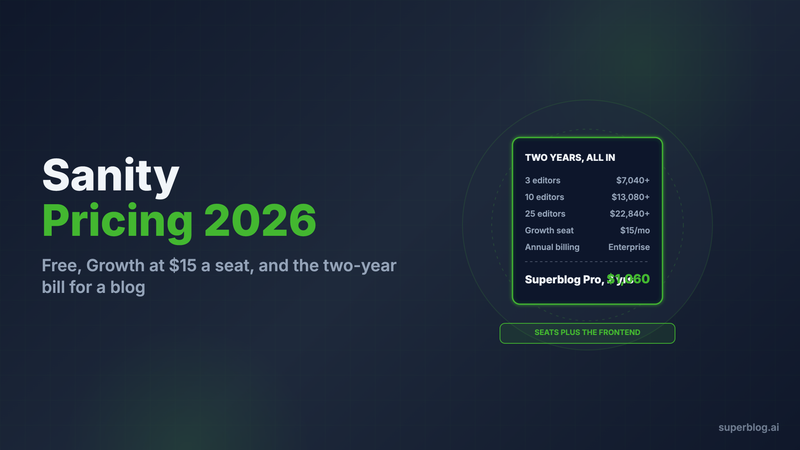
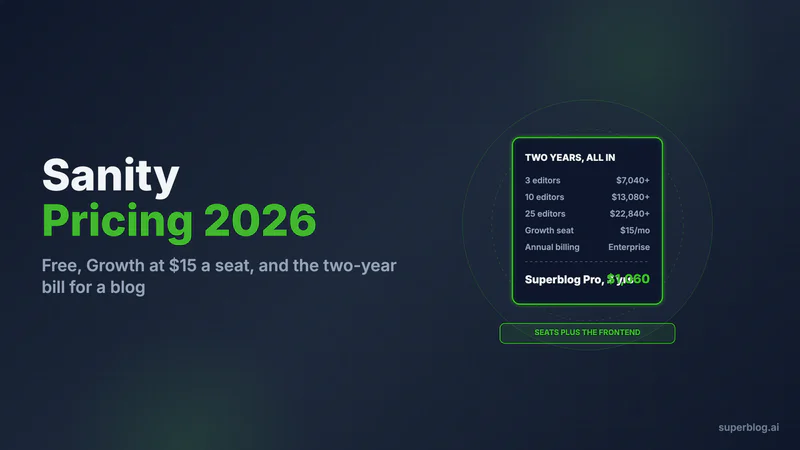
Sanity pricing has three plans: Free at $0, Growth at $15 per seat each month, and Enterprise at a quoted price. Growth bills every editor and developer who is not a Viewer, and Sanity offers no annual billing outside Enterprise. On a company blog, seats are the small line, because Sanity ships no blog frontend: over two years, our three team sizes land between about $7,000 and $42,000 once the build, hosting and upkeep are added.
Every Sanity price and limit below was checked on sanity.io/pricing and in Sanity's documentation on November 12, 2026.
Sanity's plans side by side
How to read the table:
- Viewers are free. Every other role takes a paid seat on Growth, developers included. Service tokens do not count.
- The seat caps are limits, not allowances. Growth charges from the first seat, not from seat 21.
- There is no annual discount. Sanity's FAQ says only monthly payments are supported for self-serve plans. Annual billing comes with Enterprise.
For a reference point, Superblog costs $49/month (Pro) for 5 team members, and that one price includes the blog frontend and hosting.
Is Sanity free for a company blog?
Yes, the Free plan costs $0 forever and allows 20 seats. It works for a prototype. A company blog runs into five limits:
- Every writer is an Administrator. Free has two roles, and Viewers cannot edit, so each writer gets full access to project settings.
- No scheduling. Scheduled drafts are a Growth feature, so posts go live when someone clicks Publish.
- Public datasets only. Anyone can query the published content without a token.
- Hard usage caps. Free allows no overage. When the project uses 100% of its API, API CDN or bandwidth quota, Sanity blocks public API access and, in the words of its docs, "Sanity content will fail to load in your production application or website."
- 10,000 documents, drafts included. A post with unpublished changes counts as two documents.
New projects start on a Growth trial with Free's usage limits. If it ends without an upgrade, private datasets turn public and non-admin members become viewers.
What Free, Growth and Enterprise include

Free: room to build, not to run a team
Free includes the hosted Studio, live preview, visual editing and unlimited content types and locales. Developers can build the whole blog on it. The gaps are team features: two roles, no draft comments and no scheduling.
Growth: $15 per seat, billed each month
Growth is the plan a team blog needs. It adds the Editor, Developer and Contributor roles. Contributors can write drafts but cannot publish them, which suits freelance writers. Growth also unlocks draft comments, tasks, scheduled drafts, AI Assist and private datasets, and raises the document limit to 25,000.
Billing works like this, per Sanity's plans and payments docs:
- You pay in advance for each calendar month, by card, in USD.
- Plan changes take effect at once and are prorated for the rest of the month.
- Usage above the quota is added to the next invoice. Documents are the exception: Growth stops new documents, including new drafts, at 25,000.
Enterprise: quoted by sales
Enterprise has no public price. It adds custom seats and roles, SSO with SAML, dedicated support, an uptime SLA, an onboarding program and custom quotas. It is also the only way to pay annually or by invoice.
Add-ons, quotas and overage rates
Growth has three paid add-ons. Over a two-year budget they are large numbers:
Free and Growth include the same monthly usage: 1M API CDN requests, 250k API requests, 100GB of assets and 100GB of bandwidth. Growth then bills overage at these rates:
- $1 per 250k API CDN requests
- $1 per 25k API requests
- $0.50 per GB of assets
- $0.30 per GB of bandwidth
Sanity's own community answer says that for a small business site serving published content from the API CDN, the costs to model are seats and image bandwidth. The document cap is the one to watch: past 50,000 documents, a Growth project with the add-on has to move to Enterprise.
The Startup Program and other discounts
The Sanity Startup Program gives 1 year of Growth free, which Sanity values at $9,000. It is open to startups with fewer than 20 employees and less than $5 million raised that do not already pay Sanity, through partner investors such as Sequoia, Accel and Y Combinator.
After 12 months, the project moves to Growth at $15 per seat. The program covers the license only, not the frontend. Sanity also offers a non-profit plan for eligible organizations.
What the plan price leaves out
Sanity stores posts and serves them as JSON. The blog readers see is an app your team writes. Costs outside Sanity's invoice:
The hourly rate is Codeable's published $80 to $120 range for vetted freelancers. Swap in your own.
The build covers post and archive templates, Portable Text rendering, previews and the SEO layer (meta tags, canonical URLs, JSON-LD, sitemap, RSS). Upkeep covers dependency updates, new fields writers ask for and fixes. Each part of that work is broken down in headless CMS for business blogs.
Two-year totals for 3, 10 and 25 editors
All three budgets assume Growth, because a team blog needs scheduling and editor roles. Seats include the developers who keep a Studio login. Two years of Growth is 24 monthly payments, since there is no annual plan.
3 editors and 1 developer
- Growth seats: 4 x $15 x 24 = $1,440
- Vercel Pro, 1 seat: $20 x 24 = $480
- Build, 40 to 80 hours: 40 x $80 = $3,200, up to 80 x $120 = $9,600
- Maintenance, 1 to 3 hours monthly for 24 months: $1,920 (24 x $80) to $8,640 (72 x $120)
Two-year low: $1,440 + $480 + $3,200 + $1,920 = $7,040.
Two-year high: $1,440 + $480 + $9,600 + $8,640 = $20,160.
On the Startup Program, the first year of seats is free, which takes $720 off both figures.
10 editors and 1 developer
- Growth seats: 11 x $15 x 24 = $3,960
- Vercel Pro, 1 seat: $480
- Build, 60 to 100 hours: $4,800 (60 x $80) to $12,000 (100 x $120)
- Maintenance, 2 to 4 hours monthly: $3,840 (48 x $80) to $11,520 (96 x $120)
Two-year low: $3,960 + $480 + $4,800 + $3,840 = $13,080.
Two-year high: $3,960 + $480 + $12,000 + $11,520 = $27,960.
25 editors and 2 developers
- Growth seats: 27 x $15 x 24 = $9,720
- Vercel Pro, 2 seats: $40 x 24 = $960
- Build, 80 to 120 hours: $6,400 (80 x $80) to $14,400 (120 x $120)
- Maintenance, 3 to 6 hours monthly: $5,760 (72 x $80) to $17,280 (144 x $120)
Two-year low: $9,720 + $960 + $6,400 + $5,760 = $22,840.
Two-year high: $9,720 + $960 + $14,400 + $17,280 = $42,360.
A team this size drafts a lot. If drafts and posts pass 25,000 documents, the Increased quota add-on adds $7,176 over two years.
What Sanity users ask about the bill
The clearest pricing questions come from Sanity's own community archive. Both quotes below are verbatim.
- Usage is hard to predict. One developer wrote: "i'm evaluating CMSs for a project and i like the look of sanity but am a bit wary of the pricing." Sanity's answer is fair to note: editing in Studio does not count toward API usage. Your own frontend's requests do.
- Every seat is billed. A team moving off Free asked: "will we be paying 5*$15=$75/month when upgrading to the growth plan or does the pricing only counts for specific user roles?" Sanity's answer: yes, every seat that is not a Viewer is billed from the first.
Who gets good value from Sanity
Sanity's price is fair for teams that use what it does well:
- Developers already run your site on Sanity. The blog becomes one more document type in a frontend they maintain anyway.
- Your content is structured. Product data, docs and localized pages share one content model and one API.
- Your writing team is small. Four seats come to $60 a month.
- You qualify for the Startup Program. A year of Growth at no cost covers the license while you build.
Our Sanity CMS review covers the product itself: Studio, GROQ and Portable Text.
When the blog should leave Sanity
The numbers shift once the blog is why you pay for Sanity at all. Signs:
- Seats grow every quarter as you add writers and freelancers.
- Blog changes wait in the engineering queue.
- Nobody owns the sitemap, structured data or canonical tags.
- The frontend upkeep line costs more than the license.
You do not have to move everything. Product content can stay in Sanity while the blog moves. Our list of Sanity alternatives compares the options, and our CMS comparison for Next.js covers both headless and managed routes. If Storyblok is also on your list, see our Storyblok pricing breakdown.
How Superblog prices the same blog
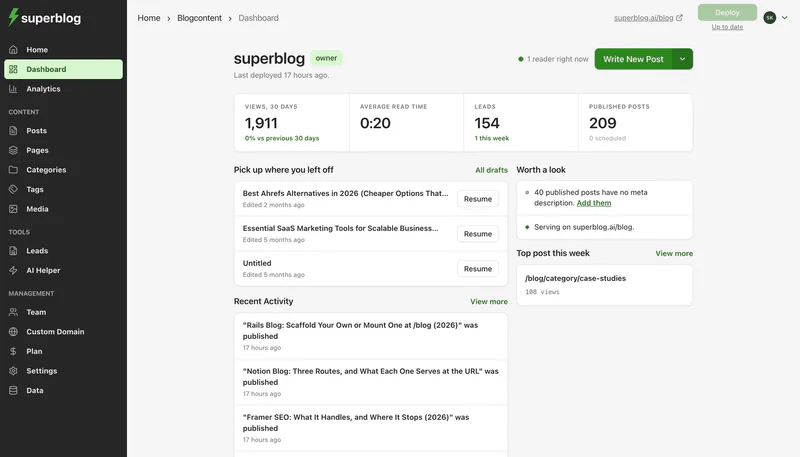
Superblog is a managed blog platform. The editor, blog frontend, hosting, CDN, SSL and SEO engine come in one plan, with team members included. Nobody maintains the blog's code.
The math, on yearly billing: Pro at $1,060 over two years costs $5,980 to $19,100 less than the 3-editor budget. Super at $2,140 costs $10,940 to $25,820 less than the 10-editor budget. Both plans list 100,000 pageviews a month. Going over does not cap or slow the blog, and a blog that keeps growing moves to a larger plan.
What the plan covers without a build:
- Automatic SEO. JSON-LD schemas, an XML sitemap, canonical URLs, Open Graph tags and llms.txt are generated on every deploy. New posts trigger an IndexNow ping. Pages score 90+ on Lighthouse.
- Team roles in the price. Pro includes 5 team members and Super includes 10, with Admin, Editor and Writer roles.
- Scheduling from Pro. The Pro plan brings scheduled posts plus collaborative review, meaning teammates comment on drafts.
- Languages at no extra charge. Super and above add multilingual SEO in 41 languages with hreflang tags.
Two rewrites in next.config.js, one for /blog and one for /blog/:slug*, send the blog to Superblog while your Next.js app serves every other path. The blog for Next.js page has both rules. Superblog does not import from Sanity directly. A developer exports the posts with a GROQ query, turns each Portable Text body into HTML, and uploads a JSON file to Superblog's JSON importer, which accepts 300 posts per import and keeps any slug you map in. There is a 7-day free trial, no credit card required. Connecting /blog needs a paid plan.
The short version
Sanity is $0 on Free and $15 per seat each month on Growth, with Enterprise quoted. For a company blog, the bigger cost is the frontend: our two-year totals run from $7,040 for 3 editors to $42,360 for 25. If developers already run your site on Sanity, that can be money well spent. If the goal is a fast blog on yoursite.com/blog that earns search traffic, start at $49/month (Pro).
Sanity pricing FAQ
Is Sanity free?
Yes. The Free plan is $0 with 20 seats, two roles and 10,000 documents.
How much is the Sanity Growth plan?
$15 per seat each month, for up to 50 seats.
Can you pay for Sanity annually?
No. Self-serve plans bill monthly; annual billing needs Enterprise.
Do developers need a paid Sanity seat?
Yes, unless they only have the Viewer role.
What does the Sanity Startup Program include?
One year of Growth free for startups under 20 employees and $5 million raised.
Is Superblog cheaper than Sanity for a company blog?
Yes. $1,060 over two years on Pro against $7,040 or more for Sanity with a frontend.
Your blog, without the maintenance
Fast pages, automatic SEO, no plugins to patch. Runs on yoursite.com/blog.
Sai Krishna is the Founder and CEO of Superblog. Having built multiple products that scaled to tens of millions of users with only SEO and ASO, Sai Krishna is now building a blogging platform to help others grow organically.
superblog
Superblog is a blazing fast blogging platform for beautiful reading and writing experiences. Superblog takes care of SEO audits and site optimizations automatically.