
SaaS Content Strategy: A Framework Built Backward From Revenue

A SaaS content strategy is a plan for sequencing what you publish, in what order, so content produces signups instead of just traffic. Most SaaS teams get the sequence backward: they start with broad, top-of-funnel education because it feels like "real" content marketing, then wonder why six months of publishing produced page views and no pipeline. The fix is writing in the right order, structuring around your product's themes instead of a random keyword list, and building the technical layer that lets any of it get found.
This isn't a list of content types to try. It's a framework: what to publish first, how to organize it so it compounds, who writes it as you scale, and what to measure to know it's working.
Defining a SaaS Content Strategy: Answer-First, Then Invert the Funnel
A SaaS content strategy is the deliberate sequencing of content by buyer intent and product fit, prioritizing pages that convert readers who are already evaluating a purchase before investing in pages that build awareness among readers who aren't shopping yet.
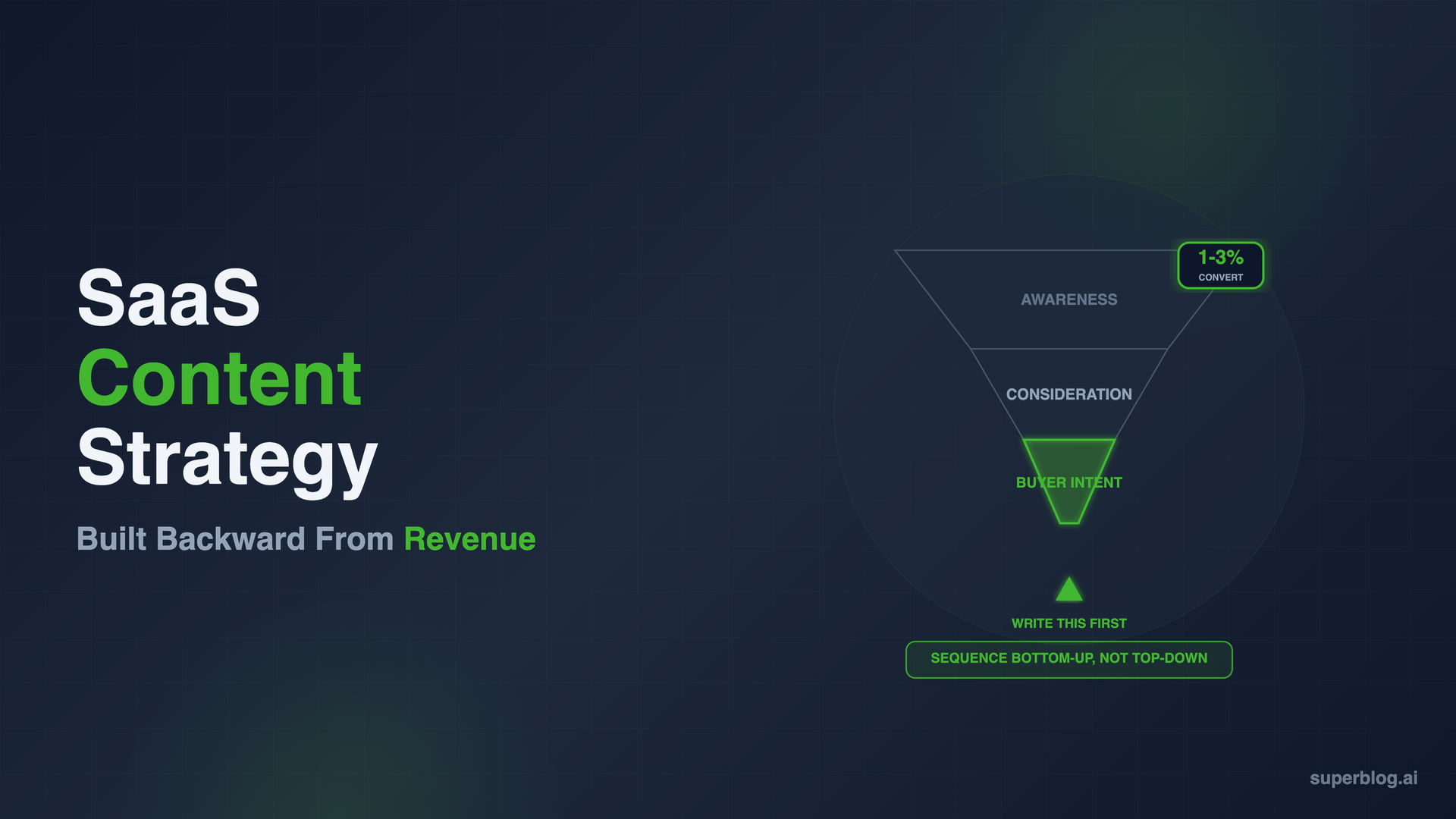
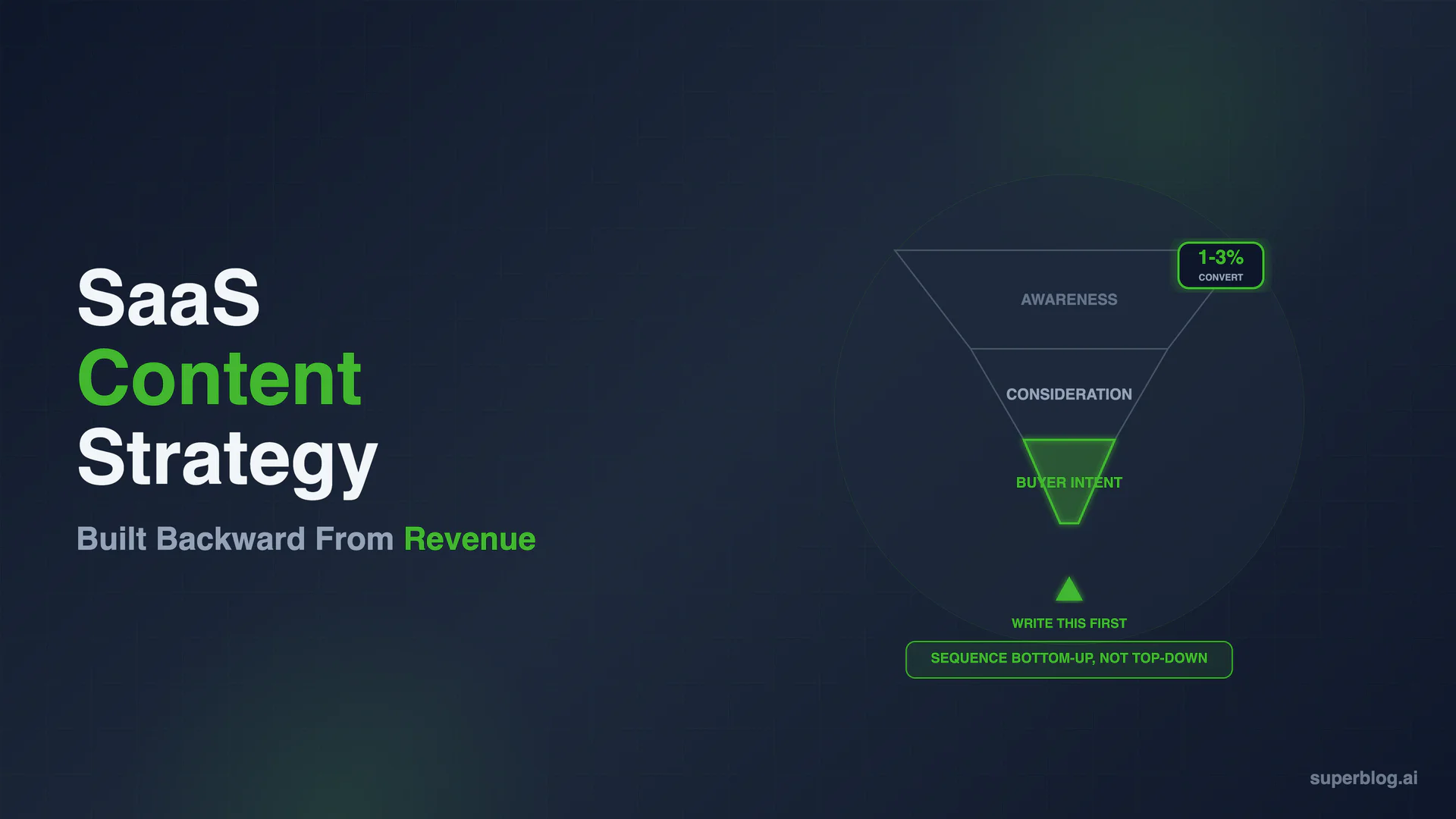
Most playbooks tell you to build a funnel top-down: awareness content first, then consideration content, then conversion content last, because "you need traffic before conversions." That order feels intuitive and it's wrong for a resource-constrained SaaS team.
Buyer-intent content, comparison posts, "X alternative" pages, use-case pages that show your product solving a specific searched problem, typically converts in the range of 1 to 3% of visitors into trials or demos. That's industry-typical for high-intent content, not a guarantee, but a consistent pattern because the reader has already decided they need a tool like yours. Blended top-of-funnel content, the "what is X" and "10 tips for Y" posts, typically converts around 0.05% or low single-digit fractions of a percent, because most of that traffic isn't shopping yet.
Run the math on a lean team publishing 8 posts a quarter. Split them evenly across the funnel the traditional way, and your highest-converting pages arrive last, if at all. Flip the order instead. Write comparison, alternative, and use-case pages first. They rank slower, commercial-intent keywords are competitive, but every visitor is closer to buying. Top-of-funnel content still matters; it's what you add once the bottom-funnel foundation exists, not what you lead with.
That's the core of a working SaaS content strategy: sequence bottom-up, converting the traffic you can already earn before chasing the traffic that needs a large audience to pay off.
Build Pillar-and-Cluster Architecture Around Product Themes, Not Keywords
Once you've sequenced priority correctly, you need an architecture that keeps growing without becoming an unstructured pile of posts. Pillar-and-cluster architecture is that structure, organized around what your product does, not a keyword list a research tool spat out.
Pick 3 to 4 pillars mapped to your product's core themes. A notification infrastructure platform might use: system architecture, deliverability, integration patterns, and build-vs-buy decisions. Every post ladders up to one of these pillars.
Each pillar gets a cluster: one comprehensive pillar page covering the topic broadly, and narrower cluster posts that each answer one specific question within it, linking back to the pillar and to each other. A pillar page on "notification system architecture" might cluster with posts on retry logic, multi-channel routing, rate limiting, and webhook design.
This builds topical density fast, since every new post reinforces an existing theme instead of starting one from scratch, and it gives you an internal linking structure for free: publish post 15 in a cluster and posts 1 through 14 are already there to link to. Structure isn't an afterthought you retrofit at 50 posts. It's the plan from post one.
Product-Led Content: Show the Product Solving the Problem That Was Searched
A specific pattern deserves its own place in a SaaS content strategy because it consistently outperforms generic educational writing: product-led content. Take a problem your ICP searches for, and instead of writing about the problem in the abstract, show your product solving it.
"How to reduce churn" is generic advice content. "How we reduced trial-to-paid drop-off using [feature]" demonstrates the same knowledge while making the product the mechanism, not a footnote CTA bolted onto an otherwise generic post. A reader who searches "how to build a scalable notification system" and finds a post that walks through the architecture, then shows how your platform handles retries, multi-channel routing, and rate limiting natively, gets real value and sees your product as the answer in the same motion.
This does two jobs at once: it ranks for a real searched problem, and moves the reader toward your product without a hard sales pitch. It's also easier to sustain than pure thought leadership, since your own product usage generates specific, defensible examples instead of hypotheticals.
Distribution Beyond Google: Structure for AI Citability Too
A SaaS content strategy that only optimizes for Google is optimizing for last year's distribution model. AI assistants, ChatGPT, Perplexity, Claude, and others now browse and cite blog content directly in conversational answers, and that citation traffic is growing as a share of how prospects discover vendors.
Getting cited requires structuring content so it's fast to extract and quick to trust: clear headings that state a specific claim, direct answers near the top of a section rather than buried in narrative, and FAQ sections with genuinely useful questions. llms.txt is an emerging standard for machine readability, a markdown file at your domain root, similar in spirit to how robots.txt guides traditional crawlers. It won't replace ranking in Google, but it's low-cost to publish, and good practice for human readers too.
Content Surfaces SaaS Teams Forget
Most SaaS content strategy discussions stop at the blog. Three other surfaces generate compounding search traffic and get ignored because they don't feel like "content marketing."
Documentation. Every doc page answering "how do I configure X" or "why does Y happen" can rank for exactly that query. Prospects and existing customers both search this way. Treat docs like content: clear titles, real explanations, not just parameter lists.
Changelogs. Every shipped feature is a keyword opportunity nobody assigns to content because it feels like an engineering artifact, not marketing. "Introducing [feature]" targets long-tail searches from prospects looking for that exact capability, and serves existing users who want to know what's new. The announcement already needs to be written; the only decision is whether to write it for search or just a release-notes email.
Community and Q&A. If your product has an active user base, the questions they ask each other are a live list of content topics, pre-validated by demand. A thread that gets asked repeatedly is a signal to turn that answer into a permanent, indexable page.
None of these require a dedicated content hire to start. They require someone deciding that a doc page, a changelog entry, or a support answer is also an SEO asset.
Team Shape at Each Stage
A SaaS content strategy has to match the team executing it, or it stays a document nobody follows.
Pre-seed to early seed: founder writes. The founder or an early generalist hire writes because nobody else understands the product or ICP well enough yet. Output is low, one to two posts a week at most, but every post should be bottom-funnel: comparison and use-case pages that convert traffic you can already reach through communities and outbound. Don't hire a content person yet. Prove the mechanism with a founder's time first.
Series A, first dedicated hire. Once a handful of pages prove the model, a channel owner who can write, understands SEO basics, and can brief freelancers makes sense. This is when pillar-and-cluster architecture starts paying off, because someone now owns thinking in clusters instead of one-off posts.
Growth stage, content pod. Once content is a proven revenue channel, a small pod, a strategist/editor, one or two writers, and someone owning distribution and measurement, can sustain weekly-or-better publishing across multiple pillars at once. This is also where product-led content pays off most, since a larger team pulls examples from more of the product.
The mistake at every stage is hiring ahead of proof. A content strategy earns its next hire by showing a working conversion mechanism on a small number of posts, not by a plan on a slide.
Measure Signups by Landing Page, Not Pageviews
A SaaS content strategy is only as good as what you measure, and pageviews are close to useless as a primary metric. A post can pull 20,000 monthly visitors and produce zero trials if it's ranking for a term with no purchase intent behind it.
Track signups, trial starts, or demo requests attributed to each landing page, not just sessions. Segment by funnel stage so you're judging content fairly: bottom-funnel pages on conversion rate, top-of-funnel pages on whether they're feeding return visits and email signups that convert elsewhere later. Judging a "what is X" post by trial-signup rate alone makes it look like a failure even when it's doing its job of building an audience.
Set up UTM parameters or landing-page-level goals from the first post you publish, not after fifty posts you can no longer cleanly attribute. Superblog's built-in analytics and lead generation forms make this easier by capturing signups directly against the post that produced them.
Worked Example: Segwise
Segwise, a mobile analytics and attribution platform, is a useful example because the mechanism is documented, not inferred. Segwise ran its blog as a lean team with no dedicated SEO hire and needed to keep publishing at a steady pace without adding headcount to manage the technical side. It built its blog on Superblog, which handled schema generation, image compression, and the structured markup search engines rely on to crawl and rank a page, then ran a consistent, largely automated publishing pipeline on top of that foundation.
The result: Segwise grew unique blog traffic by 415% over about a year. The transferable lesson isn't a secret content trick. A technically sound platform removed the busywork, broken schema, slow pages, manual formatting, that normally stalls a lean team's cadence, so consistency could compound. Sporadic publishing on a fragile stack doesn't, no matter how good the strategy underneath it is.
That's the piece of a SaaS content strategy that has nothing to do with what you write and everything to do with whether your writing has a chance to work.
The Technical Layer Underneath the Strategy
Every part of this framework assumes your content gets crawled, indexed, and served fast enough to rank. That assumption fails constantly on platforms not built for it. Page speed affects rankings directly, and most WordPress installs with page builders and a stack of plugins load in the 4 to 6 second range, which loses to faster competitors regardless of content quality. Schema markup for articles and FAQs has to be generated correctly for rich snippets to show up, and doing it by hand across dozens of posts is exactly the maintenance work that stalls a lean team.
Superblog handles this layer automatically: 90+ Lighthouse scores on every page, auto-generated JSON-LD schemas, XML sitemaps, IndexNow submission on publish, and llms.txt for AI citability, all without configuration. Subdirectory hosting keeps your blog at yoursite.com/blog instead of a separate subdomain, so the content you publish builds authority on your main domain. None of that is the strategy itself. It's the floor the strategy stands on, and a shaky floor is why disciplined teams with good editorial plans still underperform.
Pricing starts at $29/month, with a 7-day free trial and no credit card required to start.
FAQ
What is a SaaS content strategy?
A SaaS content strategy is a plan for what content to publish, in what order, and how to structure it so it converts readers into trials and customers rather than just accumulating traffic. The core decision is sequencing: prioritizing high-intent, bottom-funnel content before broad educational content, because the former converts at a meaningfully higher rate.
Should SaaS content start with blog posts or comparison pages?
Start with comparison, alternative, and use-case pages. They target readers who are already evaluating a purchase, which means they convert at a higher rate than general educational posts, even though they take longer to rank due to competition on commercial-intent keywords. Broad educational content is worth adding once that foundation exists.
How many content pillars should a SaaS company have?
Most SaaS companies get the most value from 3 to 4 pillars that map directly to the product's core themes or use cases. More than that spreads a lean team too thin to build real depth in any one cluster; fewer than that under-represents what the product actually does.
What is product-led content?
Product-led content demonstrates your product solving the exact problem a reader searched for, instead of discussing the problem generically with a bolted-on CTA. It works because it ranks for a real query and moves the reader toward the product in the same motion, using specific examples drawn from how the product actually works.
Do AI assistants like ChatGPT actually cite blog content?
Yes. AI assistants increasingly browse and cite web content, including blog posts, when answering conversational queries. Structuring content with clear, direct answers near the top of each section improves the odds of being cited, alongside standard SEO practices. A machine-readable llms.txt file is a low-cost addition worth publishing too.
Who should write content at an early-stage SaaS company?
At pre-seed and early seed stages, the founder or an early generalist hire should write, focused on bottom-funnel pages, because nobody else understands the product and ICP well enough yet. Dedicated content hires make sense once a handful of posts have proven the conversion mechanism works.
Related Reading
- SaaS blog examples worth studying for how these principles play out across real, live blogs
- Content marketing KPIs for SaaS for the full metric breakdown by funnel stage
- Startup content marketing for execution tactics specific to lean, early-stage teams
- Content marketing for SaaS for the complete channel-by-channel playbook, distribution, content types, and measurement in full
- Blog for SEO for the technical and on-page mechanics behind ranking any of these pages
- Editorial calendar template for turning this strategy into a schedule you can actually run
- SEO case studies for more documented growth stories, including Segwise's, with the strategy behind each
Ready to build your SaaS content strategy on infrastructure that ranks?Start a free Superblog trial, 7 days, no credit card required.
Your blog, without the maintenance
Fast pages, automatic SEO, no plugins to patch. Runs on yoursite.com/blog.
Sai Krishna is the Founder and CEO of Superblog. Having built multiple products that scaled to tens of millions of users with only SEO and ASO, Sai Krishna is now building a blogging platform to help others grow organically.
superblog
Superblog is a blazing fast blogging platform for beautiful reading and writing experiences. Superblog takes care of SEO audits and site optimizations automatically.