
Perplexity Pages vs Blog Posts: Where Should Your Content Live? (2026)

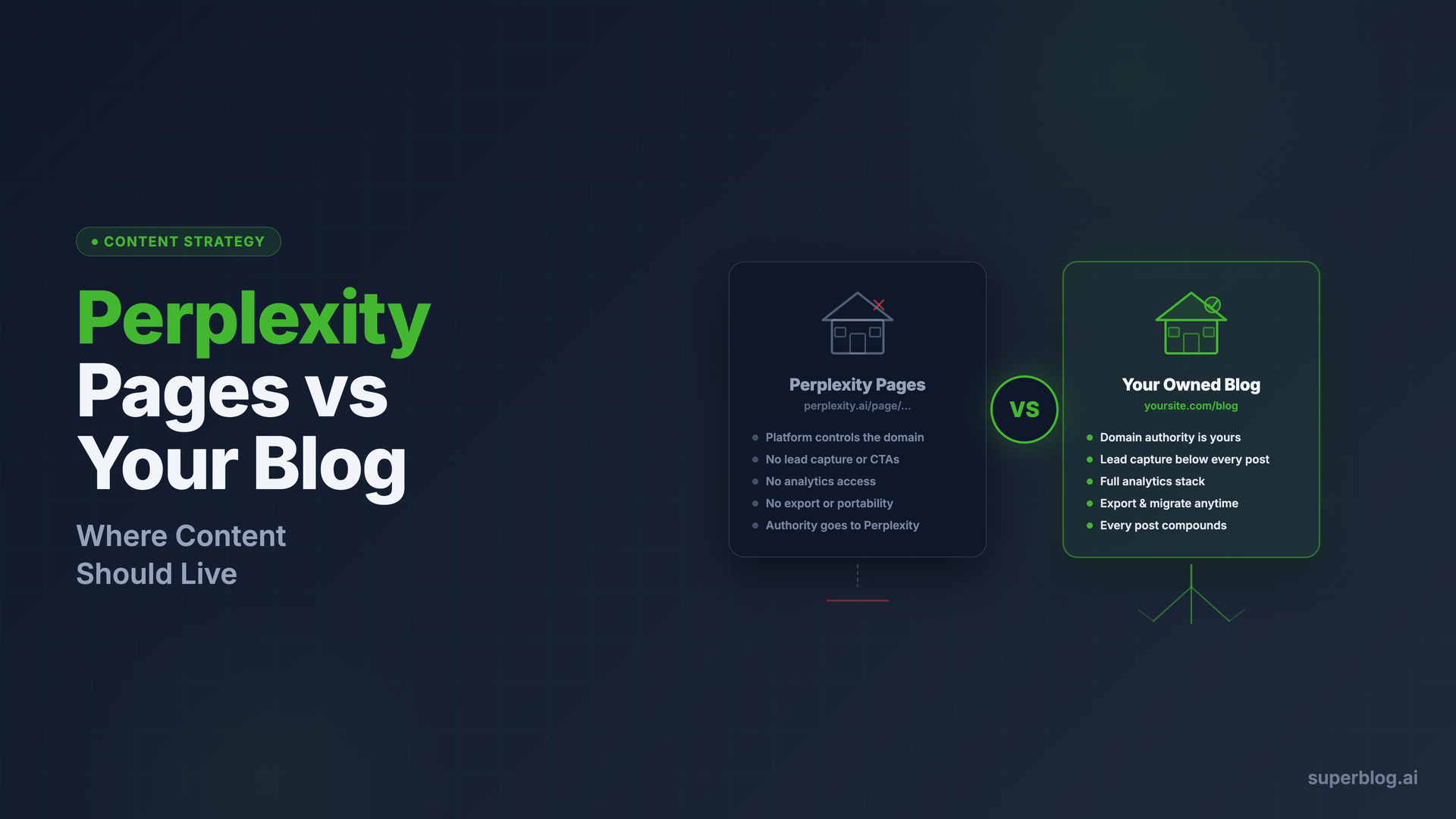
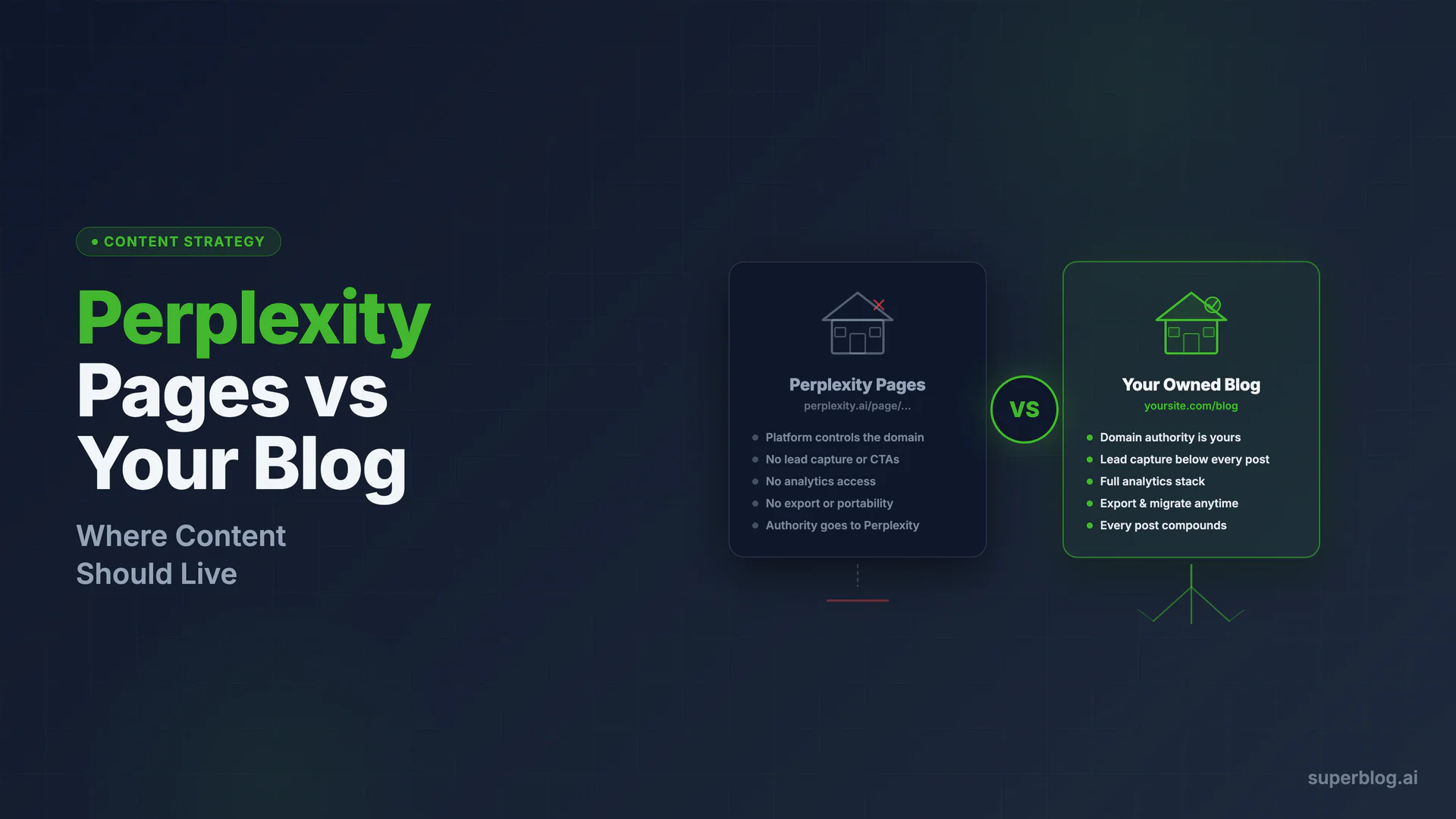
Perplexity Pages is a publishing feature that turns a Perplexity research thread into a formatted, cited article hosted on a perplexity.ai URL. That raises a reasonable question for marketers: if you can publish content directly inside Perplexity, why maintain a separate blog at all?
The answer has real trade-offs, and it is not "ignore Pages." Perplexity Pages is a real feature with genuine uses. But the decision about where your content lives has consequences that compound over months, not days. This guide gives you an honest framework for making that call.
What Perplexity Pages Actually Is
Perplexity Pages is a publishing feature that converts a Perplexity research thread into a structured, shareable article. You start a query, refine the results, then publish the output as a formatted page hosted on Perplexity's domain. The result lives at a perplexity.ai URL and is discoverable by anyone using Perplexity.
What the feature does well:
- Converts research threads into formatted, cited articles in minutes
- Adds images, custom headers, and structured sections
- Produces content with in-line citations already attached
- Shares via a single public link with no setup required
What the current feature does not offer (as of mid-2026, based on published documentation and user reports):
- Export to WordPress, Markdown, or any other format (no download, no API)
- Analytics on who reads your Pages or where they come from
- Lead capture forms or CTAs that route to your funnel
- Private or unlisted publishing (Pages are publicly searchable once published)
- SEO metadata control (no custom title tags, meta descriptions, or canonical URLs)
- Embed code to place the content anywhere outside Perplexity
Note: Perplexity has been actively rebuilding the Pages feature. The "Create a Page" button was temporarily retired in early 2026 while the team developed an enhanced "Convert to Page" workflow. Capabilities may evolve; verify current feature status before building a strategy around any specific capability.
What You Give Up When Content Lives Only on Perplexity
Publishing exclusively on Perplexity Pages is equivalent to publishing exclusively on Medium in 2016 or on Facebook Instant Articles in 2017. Both looked like distribution wins. Both turned out to be platform bets that left publishers exposed when the platform changed its terms, algorithm, or business model.
Here is what stays on the platform when you publish only to Perplexity Pages:
Domain equity. Links, citations, and traffic go to perplexity.ai, not to your domain. Every piece of content that lives there builds Perplexity's authority, not yours.
Lead flow. No form, no CTA, no path from reader to trial signup. Perplexity's goal is to keep users inside Perplexity. That goal is not compatible with routing them to your pricing page.
Analytics. You cannot measure who read your content, where they came from, or what they did next. Content strategy built on invisible data is guesswork.
Control. Perplexity can change the Pages feature, adjust its discovery algorithm, or remove content at any time. The research thread your article came from is not yours to export.
Search indexability. Pages published to perplexity.ai may appear in Google search results, but any ranking they earn belongs to Perplexity's domain. Your site gets no benefit.
The pattern here is consistent across every publishing platform that has existed before Perplexity. Medium pivoted away from publisher partnerships in 2017, stranding businesses that had built their content strategy there. Facebook Instant Articles delivered reach and then quietly declined into irrelevance. HubSpot, which published aggressively across topics outside its core expertise, watched roughly 75-80% of its organic traffic disappear after Google's late-2024 and 2025 algorithm updates. The platform risk is not theoretical; it is documented history.
What Perplexity Pages Does Well
None of the above means Pages is useless. It has specific, real advantages:
Speed. A formatted, cited document can go from a research thread to a shareable link in minutes. For internal briefings, investor updates, or team knowledge bases, this is a genuine productivity tool.
Citation structure. Perplexity builds source citations into the output automatically. For research-heavy content aimed at technically sophisticated readers, that citation layer can add credibility.
Discovery inside Perplexity. Published Pages are indexed and surfaced in Perplexity's own search results. If a user searches for your topic inside Perplexity and your Page appears, that is a visibility signal. Whether that visibility translates to anything measurable for your business is a separate question.
Low friction for one-off content. A one-time analysis, a conference summary, or an explainer you want to share with a specific audience costs nothing to produce and requires no publishing infrastructure.
The Decision Framework
Two questions determine whether Perplexity Pages is appropriate for a given piece of content:
1. Does this content need to generate leads, build domain authority, or rank in Google?
If yes, publish it on your owned blog. Full stop. Pages cannot do any of these things at your domain.
2. Is this content a research artifact or a one-time share?
If the content is an internal briefing, a research summary, or something you want to share once with a specific group, Pages is a reasonable low-friction option.
The clearest use cases for Pages:
- Internal team research you want in a readable format
- A one-time explainer for a non-technical audience
- Supplementary content that points back to your owned hub
The clearest cases where Pages fails you:
- Any content in your editorial calendar
- Content targeting specific search terms
- Content designed to capture leads or demo requests
- Evergreen content you plan to update over time
- Content where you need to measure performance
The Pattern That Captures Both: Owned Blog as Hub, Pages as Satellite
The practical approach for 2026 is not a choice between Pages and your blog. It is a hierarchy.
Your owned blog is the canonical home for everything that matters to your business. It holds the content Google indexes under your domain. It captures leads through forms placed below posts. It feeds your analytics stack so you know what works. It builds the topical authority that generative engine optimization depends on.
Pages, where useful, is a satellite. You create a Page for a specific, bounded use case. You include a clear link back to your owned article or your product. The Page may surface in Perplexity queries and deliver a citation signal; your owned blog gets the traffic and the lead.
This mirrors what AI visibility strategy looks like more broadly: owning your primary publishing layer while participating in AI-native surfaces selectively, without surrendering control.
Why Your Owned Blog Is the Citation Source That Compounds
When Perplexity answers a question in its main search interface, it draws on indexed web content. Pages hosted on perplexity.ai do not automatically appear as preferred sources over your actual website. PerplexityBot, Perplexity's crawler, indexes the open web. It has indexed Superblog's blog, along with millions of other websites. What your owned blog can do that a Perplexity Page cannot is build the kind of structured, authoritative content that PerplexityBot cites repeatedly.
The signal pattern that influences AI citation is consistent: structured content, clear authorship, topic depth, and technical signals like schema markup. We covered this in detail in how to get cited by ChatGPT, and the logic applies across AI search engines. Perplexity cites pages it finds authoritative. Authority accumulates on your domain, not Perplexity's.
This is why AI SEO strategy starts with your owned publishing layer. JSON-LD schemas, structured headings, and clear factual statements give AI crawlers exactly the signals they need to cite you. Superblog also publishes an LLMs.txt index of that content. None of those technical investments are possible on a Perplexity Page.
The Blog Platform Question Underneath This Decision
The "Perplexity Pages vs blog" question is, at its core, a question about what kind of blog platform you need.
If you are publishing on a platform that already handles performance (90+ Lighthouse scores), SEO signals (auto JSON-LD schemas, sitemaps, IndexNow, LLMs.txt), and lead capture in one place, the case for offloading any of that to Perplexity Pages is thin. Your owned blog does everything Pages cannot.
If you are on a platform that is slow, hard to update, or missing the SEO infrastructure that AI engines need, you might be tempted by Pages as a shortcut. It is not. A faster shortcut is a blog platform that ships with those capabilities built in, so you are not making trade-offs between speed and ownership.
Superblog is built for this. Superblog plans include:
- Automatic JSON-LD schemas (Article, FAQ, Organization) that structure content for AI crawlers
- LLMs.txt generation, for AI discovery tools including Perplexity
- IndexNow integration, which notifies search engines within hours of publishing
- Lead generation forms built into the post layout, below every article
- Privacy-friendly analytics (Pirsch) so you know exactly which posts drive signups
- 90+ Lighthouse performance scores on every page, automatically
All of this runs at your domain, on your subdirectory (yoursite.com/blog), building your domain authority with every post you publish.
The comparison is not "Superblog vs Perplexity Pages." It is "owning your content infrastructure vs renting space on someone else's platform." The history of every publishing platform that came before Perplexity shows what renting leads to.
What to Actually Do With Perplexity in 2026
The practical recommendation for most marketing teams:
Use your owned blog as the primary publishing surface. Every piece of content that matters to your business should live there. That is where your SEO equity accumulates, your leads convert, and your analytics track performance.
Use Perplexity Pages sparingly, for bounded use cases. Internal research summaries, one-time explainers for a specific audience, or supplementary content that explicitly links back to your owned articles. Not as a substitute for editorial content.
Optimize your owned blog to be cited by Perplexity's main search. Structure your content clearly. Use schema markup. Generate an LLMs.txt (our free LLMs.txt Generator builds one from your sitemap). Publish with technical signals that PerplexityBot can act on. This is where the citation leverage actually lives.
Track your Perplexity visibility. Monitor whether your domain appears in Perplexity answers for your target queries. That is a more durable signal than publishing Pages, because it reflects how Perplexity values your owned content.
FAQ: Perplexity Pages and Your Content Strategy
What is Perplexity Pages?
Perplexity Pages is a feature that converts a Perplexity AI research thread into a formatted, citable article hosted on Perplexity's domain. The result is a shareable public link. As of mid-2026, the feature is being rebuilt with a "Convert to Page" workflow replacing the earlier "Create a Page" button.
Does publishing on Perplexity Pages help my Google rankings?
No. Content published on Perplexity Pages lives at a perplexity.ai URL. Any Google rankings or domain authority that content earns goes to Perplexity, not to your domain.
Can I capture leads from Perplexity Pages?
No. Pages does not support lead capture forms, CTAs, or any mechanism for routing readers to your product or website beyond a manual link you include in the text.
Can I export my Perplexity Pages content?
Based on current documentation and user reports, export is not supported. There is no PDF download, no Markdown export, no API, and no WordPress integration. Content published to Pages stays on Perplexity's platform.
What is PerplexityBot?
PerplexityBot is Perplexity's web crawler. It indexes the open web to power Perplexity's answer engine, pulling from websites like yours. Getting PerplexityBot to cite your owned blog is a more durable visibility strategy than publishing on Pages.
Should I use Perplexity Pages for my marketing content?
Not as your primary publishing surface. Pages is appropriate for research artifacts, internal briefings, and one-time shares where portability and lead capture do not matter. For editorial content, use your owned blog.
How does Perplexity decide which content to cite?
Perplexity draws on indexed web content that appears authoritative for a given query. Observable signals include structured content with clear headings, topic depth, technical SEO signals (schema markup), and consistent publication patterns. Owning your publishing infrastructure lets you control all of these signals in ways that a Perplexity Page does not.
Your blog, without the maintenance
Fast pages, automatic SEO, no plugins to patch. Runs on yoursite.com/blog.
Sai Krishna is the Founder and CEO of Superblog. Having built multiple products that scaled to tens of millions of users with only SEO and ASO, Sai Krishna is now building a blogging platform to help others grow organically.
superblog
Superblog is a blazing fast blogging platform for beautiful reading and writing experiences. Superblog takes care of SEO audits and site optimizations automatically.