
Medium vs Substack 2026: Which One Builds a Business Audience You Keep?

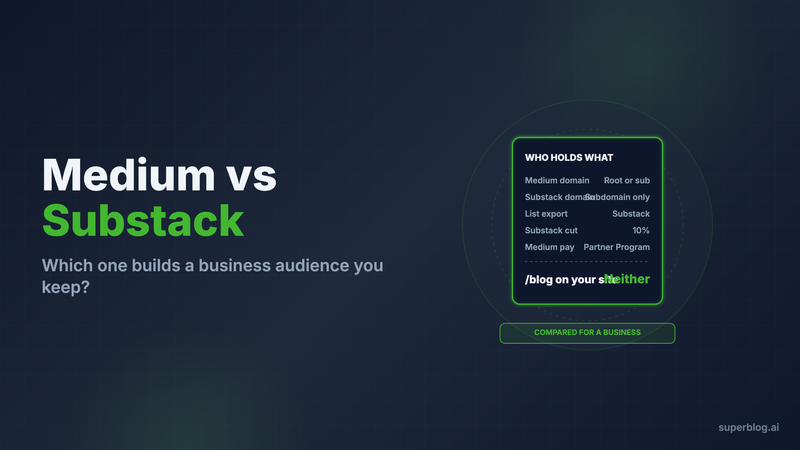
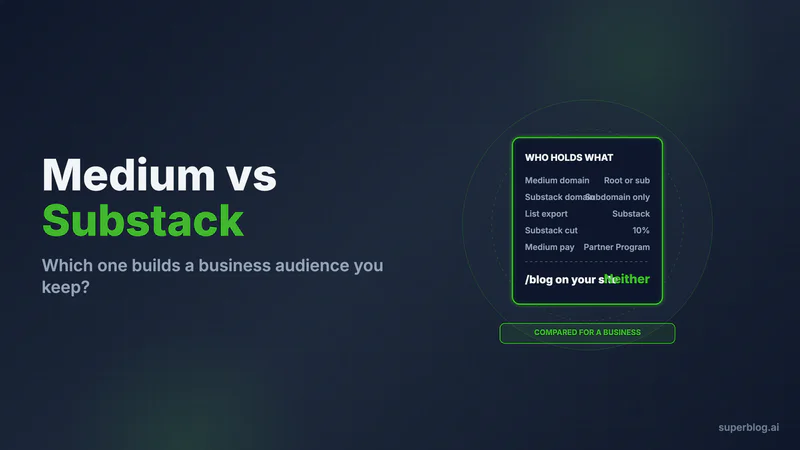
Medium vs Substack comes down to who holds the reader. Medium lends you its audience, but your stories sit on its terms, and email subscribers who joined after April 2025 cannot be exported. Substack hands you an exportable email list and takes no cut until readers pay, but your posts can never sit at yoursite.com/blog.
For a company or a professional publishing to win customers, that makes Substack the stronger of the two. It is still a newsletter platform, not a home for a company blog. Every Medium and Substack fact below comes from the two companies' own help centers as of November 2026.
The short verdict
Pick neither as the main channel if what you want is search traffic to your own site. Both keep the posts off yoursite.com/blog. A business in that position runs the blog on its own domain, on a platform such as Superblog (covered below), and uses Medium or Substack as an outlet. Otherwise:
Pick Substack if the audience you want is an email list you own, you write under a person's name, and you are happy with an address like newsletter.yoursite.com.
Pick Medium if you want reach before you have readers, your posts are ideas rather than pitches, and you are fine renting both the audience and the address.
Medium vs Substack side by side
Factor 1: Whose domain the work builds
Medium connects more domain shapes. Substack costs less to keep.
Medium's custom domain article lists an active membership as a requirement. Membership is $5 a month or $50 a year, so the address stays attached only while someone keeps paying. You can connect a root domain or a subdomain, one per profile or publication, and Medium states that a folder such as yourdomain.com/blog cannot be connected. The same page says Medium does not support Google Analytics and allows no code on the page. Our Medium custom domain guide covers the DNS setup.
Substack charges $50 once and asks for a subdomain such as www or newsletter. You can turn on a redirect that sends visitors from the bare root domain to that subdomain. Emails still go out from an @substack.com address after the domain is live.
For a business, the shared limit matters more than the differences. Neither platform can put your posts at yoursite.com/blog, so links your posts earn build a separate host instead of the domain that carries your pricing page. That /blog path is what Superblog serves, with Medium or Substack free to republish from it.
Factor 2: Getting found by new readers
Medium shows posts to readers who do not follow you. Substack grows you through other writers.
Medium sorts stories into distribution tiers, with human curators picking stories for Boost. Its Distribution Guidelines list what does not qualify for General Distribution, the tier that reaches readers by interest. The low-value list includes this entry:
Sponsored content, content marketing, PR pieces
The same list also rules out stories written mainly to collect signups, drive traffic or sell. That covers most of what a company publishes.
A founder writing a useful essay can still reach Medium readers. A product team publishing buyer guides mostly reaches its own followers. Our Medium for business blog analysis goes through the other limits.
Substack's growth runs through other writers. Its help center says the most powerful engine for growing on Substack "is ongoing recommendations from fellow creators", and that a creator who recommends others is 3x more likely to receive a recommendation. Recommendations can appear to new subscribers right after they sign up (up to three, each a one-click free subscription), in the recommending publication's homepage sidebar, and in occasional digest emails. A professional with peers on Substack can grow fast this way. A company account with no peer network gets less from it.
Factor 3: Search engines and SEO
Substack gives you more to work with. Medium gives you a canonical tag for cross-posting.
Medium is open about filtering what search engines see. Its SEO article says Medium holds back some content from third-party search engines, judged by internal signals about whether your use of Medium is above board. New writers can wait "days to weeks" to cross that threshold. You do not control whether a given story gets indexed.
What Medium does offer is a canonical link per story. If the original post lives on your site, tick "This story was originally published elsewhere" and paste its URL. That tells search engines your page is the original. Medium's import tool sets the link for you. Done by hand, only the story's author can set it.
Substack's SEO help page says a publication has to grow before it gets a sitemap and the option to verify the site in Google Search Console. It names inbound links as the main ranking lever. Each post has SEO options in its settings, including a URL slug of 2 to 48 characters. Our Substack SEO page covers the rest of what you can and cannot change.
If search traffic to your own domain is the goal, both platforms are working against you, which is why a company blog usually sits on the company site.
Factor 4: How the money works
The two models point in opposite directions, and neither fits a company blog.
Medium pays writers through the Partner Program. To enroll you need an active membership, one published story, a complete profile, age 18 or over, and a bank in an eligible country. A story earns only when you mark it eligible, which puts it behind the paywall so non-members see a preview. Earnings come from member reading time (a read counts after 30 seconds), claps, highlights and replies. A Boost raises the rate, reads from outside Medium get a 5% bonus, and reads from search engines earn more again. When a non-member upgrades to read your story, the story earns a one-time amount.
Substack lets you sell subscriptions directly. Publishing is free, and once you charge, Substack keeps 10% of each payment, with Stripe taking 2.9% + $0.30 on a US card and 0.7% for recurring billing. Our Substack pricing breakdown works the numbers at several revenue levels.
For a creator, the choice is clear: Substack scales with a loyal paying audience, and Medium rewards volume and read time. For a business, both reward the wrong thing. Medium pays you to hide the post from prospects who are not members. Substack charges you only when readers pay for content, and most companies give their content away to win customers. So a company running a free Substack newsletter spends $50 for the domain, one time, and nothing more.
Factor 5: Taking the list and the posts with you
Substack wins clearly. This is the factor a business should weigh most, because the list is the asset.
Medium's Audience stats page shows the subscriber list in the dashboard, but the export contains only emails you imported plus readers who subscribed before April 2025. Medium's own wording: "If your list only includes users who subscribed after April 2025, the export will be empty." You can import up to 25,000 addresses per file, so the list goes in but not back out. Story emails also carry only a short preview that sends the reader to Medium to finish.
Substack exports the list as a CSV, with all columns or only the visible ones. Names cannot be exported. The Exports page in settings builds a zip with posts, the subscriber list and related statistics.
Medium's account export is a zip of HTML files, sent by email link. Both exits work for posts. Only one gives you every subscriber's email.
Choose Medium if

- You are an individual expert and want readers before you have a list.
- Your posts are essays and opinion, not product content or signup drives.
- You already publish on your own site and want to republish with a canonical link back.
- You accept that subscribers who join through Medium stay on Medium.
Choose Substack if

- The newsletter is the product, or a person's byline is the brand.
- You want every subscriber's email in a CSV you can take anywhere.
- You may charge readers later and can live with a 10% cut.
- A subdomain is fine and search traffic to your main site is not the goal.
For other options in each lane, see the best Substack alternatives and the 12 best Medium alternatives.
Where Superblog fits: the blog on your domain, an email tool beside it
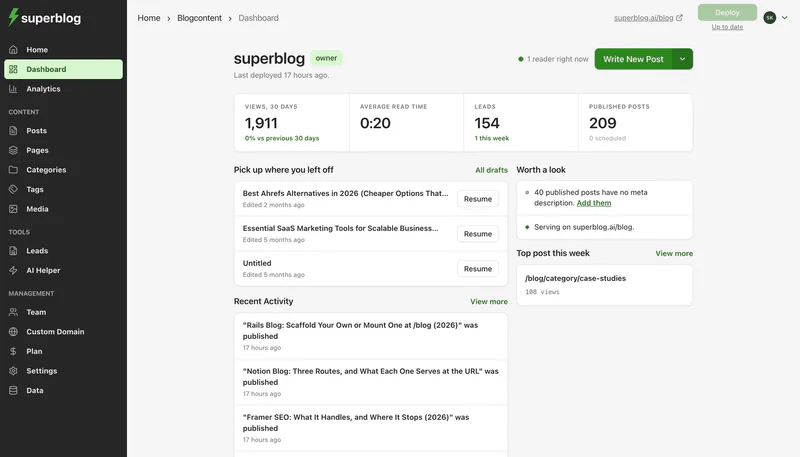
Many businesses reading a Medium vs Substack comparison need neither as the home base. They need posts that rank for buyer searches on their own domain and a way to turn readers into contacts. That job splits in two: a blog at yoursite.com/blog, and an email tool to send. Superblog is the blog half. Superblog sells no subscriptions and sends no newsletters, so keep the email tool you already use. Our Substack vs blog guide walks through the split.
What the blog side covers, against the factors above:
- Domain. Every paid plan includes subdirectory hosting, so links to your posts strengthen your main domain, the one your product pages sit on. A site built on Wix, Squarespace or Webflow can still serve /blog: a free Cloudflare Worker in front of the domain sends that path to Superblog, and the dashboard writes the Worker code. Trial sites cannot connect /blog, so pick a plan before setting up the route.
- SEO. Every post ships with JSON-LD schema, a place in the XML sitemap, an IndexNow ping on publish, a canonical URL and Open Graph tags, with no indexing threshold to earn. Each deploy also regenerates llms.txt and a plain-markdown copy of every post, which gives AI assistants a clean version to read and cite.
- Speed. Pages are static, served from a 200+ location CDN, and score 90+ on Lighthouse.
- Email capture. Signup and lead forms are built in and can appear under the article, beside it, or in a pop-up. On Super, Zapier and lead webhooks pass new signups to your email tool.
- Moving in. For Medium, the import reads Medium's ZIP export: request it from Medium, upload it, and choose which posts to import. Slugs, titles and publish dates are read from the exported files. Substack has no direct importer on Superblog; its export comes in through the file import route instead.
You can keep Medium or Substack as a distribution outlet afterward. The original goes up at yoursite.com/blog; a Medium copy carries a canonical link pointing home, and a Substack issue sends readers to the full article.
On Pro ($49/month) you get 1,000 posts and five seats. Super ($99/month) lifts the cap to 10,000 posts and adds multilingual SEO. Trying it first costs nothing: 7-day free trial, no credit card required. Connecting /blog unlocks once a paid plan is active.
FAQ
Which is better for a business, Medium or Substack?
Substack, because the email list is exportable; neither puts posts on yoursite.com/blog.
Can you export subscribers from Medium?
Only imported emails and readers who subscribed before April 2025.
Does Substack take a cut if I do not charge readers?
No. The 10% applies only to paid subscriptions.
Can Medium or Substack host a blog at yoursite.com/blog?
No. Medium allows a root domain or subdomain; Substack requires a subdomain.
Do I need to pay to earn on Medium?
Yes. The Partner Program requires an active Medium membership.
Can I publish on both?
Yes. Post on your own site first and give the Medium copy a canonical link.
Your blog, without the maintenance
Fast pages, automatic SEO, no plugins to patch. Runs on yoursite.com/blog.
Sai Krishna is the Founder and CEO of Superblog. Having built multiple products that scaled to tens of millions of users with only SEO and ASO, Sai Krishna is now building a blogging platform to help others grow organically.
superblog
Superblog is a blazing fast blogging platform for beautiful reading and writing experiences. Superblog takes care of SEO audits and site optimizations automatically.