
Medium Pricing 2026: Is $50 a Year Worth It for a Business Blog?

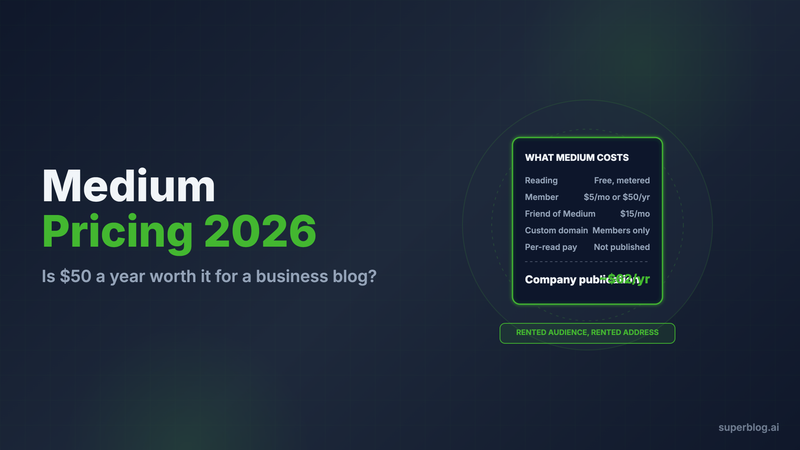
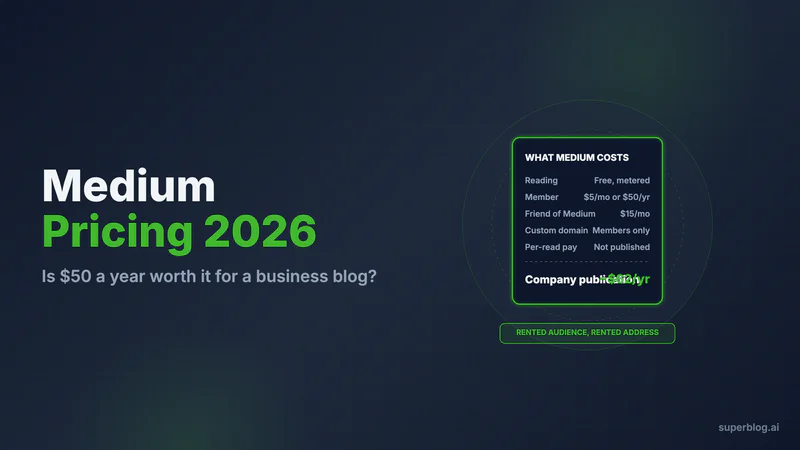
Medium pricing has three levels. Reading and writing are free on a basic account, Medium Member runs $5 a month or $50 a year, and Friend of Medium costs $15 a month or $150 a year. For a business, the $50 matters because it unlocks the two publisher features a company needs: a custom domain and a publication.
The invoice is small. The bigger costs for a company blog are the features Medium leaves out, and those are covered below. Every Medium fact here comes from Medium's own help center, checked in November 2026.
Medium's price list, November 2026
How to read this table:
- Prices are from Medium's Become a Medium Member help article. They are in USD, and Medium adds taxes, bank fees and currency costs where they apply.
- Students with a .edu or similar address get 30% off the first year on any plan, including Friend of Medium, on web checkout only.
- There is no business tier. A company pays what an individual pays.
Is Medium free?
Yes, for writing. Any account can draft and publish stories.
For reading, Medium is free with a limit. Readers without a membership "may encounter a paywall," in Medium's words. They can read every story an author publishes outside the paywall, but member-only stories show only a preview. Medium's privacy policy calls this a "metered paywall." The help center does not publish a fixed number of free member-only stories per month, so we do not print one. Any figure you see elsewhere is a third-party report, not Medium policy.
Friend Links are the other free route: a writer can share a link to their own paywalled story that anyone can open, and Friend of Medium members can do the same for any paywalled story.
What the membership unlocks for a publisher
For a company, the $5 buys publishing features more than reading. Three are members-only.
A custom domain
Connecting your own domain to a profile or publication needs an active membership. Medium accepts a root domain (yourdomain.com) or a subdomain (blog.yourdomain.com). Its help article says plainly that "you cannot connect a custom URL that's a subdirectory (folder), for example yourdomain.com/blog." Proxies must be off, so you cannot route around that with a Cloudflare Worker or a reverse proxy. Each profile or publication takes a single custom domain, and verification can take up to three days. The full setup, and why it fails, is in our Medium custom domain guide.
A publication
Creating a publication also needs a membership. Medium lists "a company blog" as one of the intended uses. A publication has its own homepage layout, editor and writer roles, a newsletter to followers and a stats page. Each member can own up to seven.
Two ownership rules matter for a business:
- A publication is owned by one personal user account and has no login of its own. If that owner account is deleted, Medium takes the publication offline.
- Stories show the individual author by default. To publish under the company name, you create a separate user account named after the brand and add it as a writer.
The Partner Program
Earning money from stories requires a membership too. Here you pay $5, and Medium may pay you back.
If the company blog is a lead channel rather than a writing hobby, the cost question becomes what the blog can do on your own domain, and Superblog prices that at $49/month (Pro). We come back to the comparison further down.
How Medium's Partner Program pays writers
To enroll, Medium lists seven requirements. You need an active membership, at least one published story and a complete profile. Your bank and tax residence must be in a supported country (Medium lists 118), and you must be 18 or older. You also agree to the Partner Program Terms and the paywall content policy.
There is no published per-read rate
Medium does not publish a rate per read, per clap or per 1,000 views. Earnings are a share of a member-funded pool, and the formula has several moving parts:
- Member reading time. Reading and listening time from paying members. A read counts at 30 seconds or more. Reads from free accounts and logged-out visitors earn nothing.
- Engagement points. Claps, highlights and replies from members, counted once per action type per member.
- Boost bonus. Stories picked by Medium's curators earn engagement points at a higher rate.
- External traffic bonus. A 5% bonus on member reads from outside Medium, a larger share for reads that come from search engines like Google, and a higher rate for reads from your email notifications.
- New member conversions. A one-time amount when a non-member joins to read your story. From 2021 to 2025, Medium paid a recurring share of that member's fee instead.
- Read ratio adjustment. Stories with a below-average share of members who read past 30 seconds are adjusted down, and stories above average are adjusted up.
Friend of Medium members generate four times the earnings of a regular member. Medium also says its "earnings model is updated periodically." Any per-view dollar figure online is one writer's result at one point in time, not Medium's rate.
Payout rules
- Minimum payout: $10. Below that, the balance rolls over to the next month.
- Schedule: monthly, typically by the 10th business day, for the previous month's earnings.
- Requirements: a connected Stripe account and verified tax information.
- Taxes: no withholding for US taxpayers on a W-9. Non-US writers on a W-8 have US royalty tax withheld at a rate set by country and treaty.
- Forfeiture: if your enrollment stays inactive for 180 consecutive days, Medium forfeits the entire balance.
What a company can expect to earn
Usually nothing. Earnings come from paywalled member reads, but a company post belongs outside the paywall where prospects can read it. The Partner Program rewards independent writers, not brand blogs.
What a year on Medium adds up to
The cash side is short. A .com domain starts at $11.81 a year at Porkbun.
A reader
- Medium Member: $5 x 12 = $60 billed monthly, or $50 billed yearly
- Friend of Medium: $15 x 12 = $180 billed monthly, or $150 billed yearly
A company publication on blog.yoursite.com
One employee holds the membership, owns the publication and connects the subdomain.
- Medium Member, yearly: $50
- .com domain: $11.81 (skip it if you already own the domain)
Total: $50 + $11.81 = $61.81 a year. On monthly billing it is $60 + $11.81 = $71.81.
A team of 11 on group gifting
A marketing team of 11 that wants to read member-only research uses group gifting, the replacement for Medium for Teams.
- 11 annual gift memberships at $50 each: 11 x $50 = $550 a year
There is no group discount, and gifts do not renew. Medium's membership terms also limit Member Services to "personal, non-commercial use."
On price alone, Medium is one of the cheapest places to publish. The rest of the cost does not show up on the invoice.
Where Medium's terms bite
These are the pricing and payout terms people run into most, all taken from Medium's own help articles:
- No refunds. Fees are "final and nonrefundable, unless otherwise determined by the Medium." Cancelling stops renewal, but you get nothing back for the days left in the period.
- No price protection. Medium "does not provide price protection or refunds in the event of a price reduction or promotional offering."
- The pay formula moves. The 2021 to 2025 recurring referral share became a one-time amount.
- Balances can disappear. 180 days of inactive enrollment forfeits everything, even above the $10 minimum.
- Some topics cannot earn. Stories about Medium itself, and mostly AI-written stories, are not eligible for the paywall.
What a company gives up on medium.com
The trade for a $50 bill is control. A company blog on Medium accepts these limits:
- No yoursite.com/blog. Only a root domain or a subdomain, with no proxy allowed. The search authority the posts build stays on medium.com or on a subdomain, apart from your main site. Our subdomain vs subdirectory guide explains why that matters for rankings.
- No analytics or code. Medium's help center says it does not support Google Analytics and lets you add no code to the page. That means no conversion tracking, no retargeting pixel and no signup form in the post.
- Indexing is Medium's call. Medium limits what it shares with Google based on internal trust signals, and a new account can take days to weeks to reach the threshold.
- The feed filters out marketing. Medium's distribution guidelines exclude "Sponsored content, content marketing, PR pieces" along with stories whose main point is "gathering signups/traffic, selling something" from General Distribution.
- One account holds the keys. A publication belongs to one person's account and goes offline if that account is deleted.
- Leaving takes a project. Medium's export arrives by email as a .zip of HTML files, not a format another CMS reads directly.
We go deeper on each of these in Medium for a business blog and on platform risk in is Medium reliable.
Who Medium is worth $50 for
Medium is a fair deal for these readers and writers:
- Readers. $50 a year for an ad-free library with audio and offline reading is good value.
- Independent writers. A built-in audience and a share of member revenue, with no hosting to run.
- Founders writing as themselves. Personal essays and technical posts can find readers through Medium's feed and digests.
- Companies syndicating. Publish on your own blog first, then republish on Medium with a canonical link back. Medium's import tool sets it automatically.
When the company blog should move to its own domain
Move the blog off Medium when it has a commercial job. Signs:
- You want it at yoursite.com/blog, so the posts build your domain's authority.
- You need to measure visits, signups or demo requests from posts.
- You want forms, CTAs or a newsletter signup inside articles.
- More than one person writes, and the account setup has to survive staff changes.
For options, see our roundup of Medium alternatives.
Superblog for a company blog
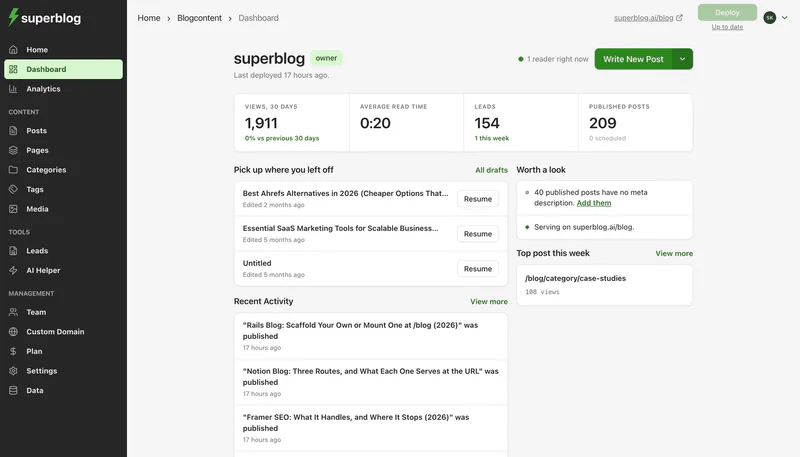
Superblog runs company blogs end to end: editor, hosting, CDN and the SEO layer, on your own domain. It is a different product from Medium: there is no reader network and no Partner Program. You pay for a blog that runs on your own domain.
Medium is cheaper in cash: $61.81 a year against $530. The $530 buys ownership of the blog and its SEO. Every Superblog plan includes subdirectory hosting, auto JSON-LD schemas, XML sitemaps, IndexNow and llms.txt. Every page ships as static HTML from a global CDN and scores 90+ on Lighthouse. Pro adds scheduled posts, privacy-friendly analytics and collaborative review. Super brings multilingual SEO, Zapier, lead webhooks and custom form fields.
Moving from Medium works from Medium's own export. Request the .zip from Medium (it can take hours to arrive), upload it to Superblog, and choose which posts to import on a preview screen. Titles, publish dates and slugs usually come across, read from the exported files. If an exported post has no canonical link, its slug is generated from the title instead, so check those before you set up redirects.
Start with a 7-day free trial, no credit card required. A paid plan is what switches on yoursite.com/blog. Superblog also offers a 30-day money-back guarantee. Plans are on the pricing page.
The short answer
Medium costs $0 to write, $5 a month or $50 a year to read past the paywall, and $15 or $150 for Friend of Medium. A company publication on its own subdomain runs about $62 a year. That is a good price for a writer, and for a company that only syndicates. A company blog meant to rank and convert pays in other ways: no /blog subdirectory, no analytics, no forms, and a feed that filters out marketing. For that job, a blog on your own domain at $49/month (Pro) costs more and does what Medium cannot. For a three-way view, see Medium vs WordPress vs Superblog.
Medium pricing questions
Is Medium free?
Writing is free. Reading member-only stories needs a $5/month or $50/year membership.
How much is a Medium membership?
$5 a month or $50 a year. Friend of Medium is $15 a month or $150 a year.
How much does Medium pay per read?
Medium publishes no per-read rate.
What is the minimum Medium payout?
$10.
Does a Medium custom domain cost extra?
No. It comes with the $5/month membership.
Does Superblog cost more than Medium?
Yes. Superblog Pro is $530 a year; Medium is about $62.
Your blog, without the maintenance
Fast pages, automatic SEO, no plugins to patch. Runs on yoursite.com/blog.
Sai Krishna is the Founder and CEO of Superblog. Having built multiple products that scaled to tens of millions of users with only SEO and ASO, Sai Krishna is now building a blogging platform to help others grow organically.
superblog
Superblog is a blazing fast blogging platform for beautiful reading and writing experiences. Superblog takes care of SEO audits and site optimizations automatically.