
What Does LLMO Mean? LLM Optimization Explained (2026)
LLMO means large language model optimization. See how it differs from GEO and SEO, plus 8 steps to get your content cited by AI...

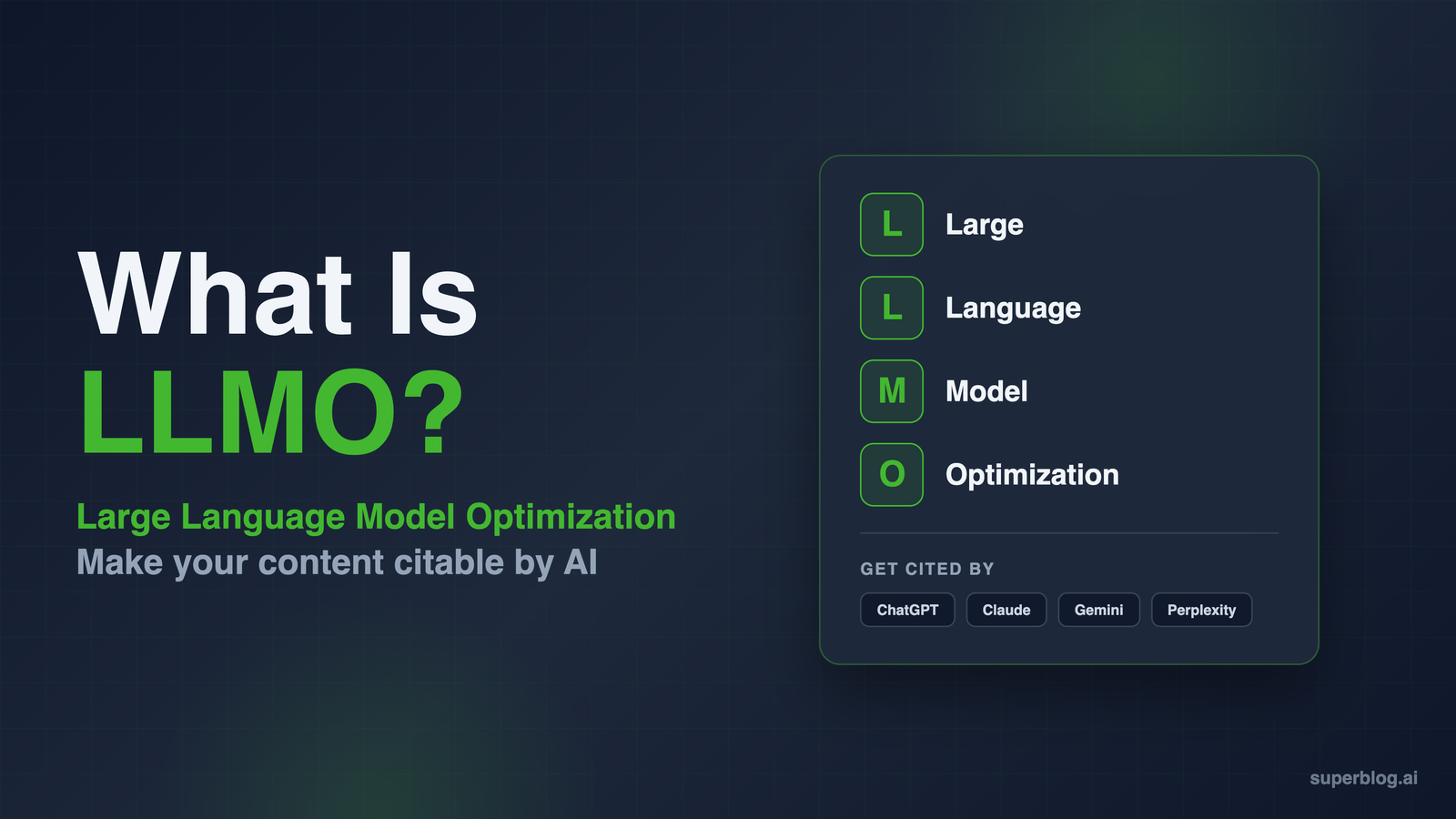
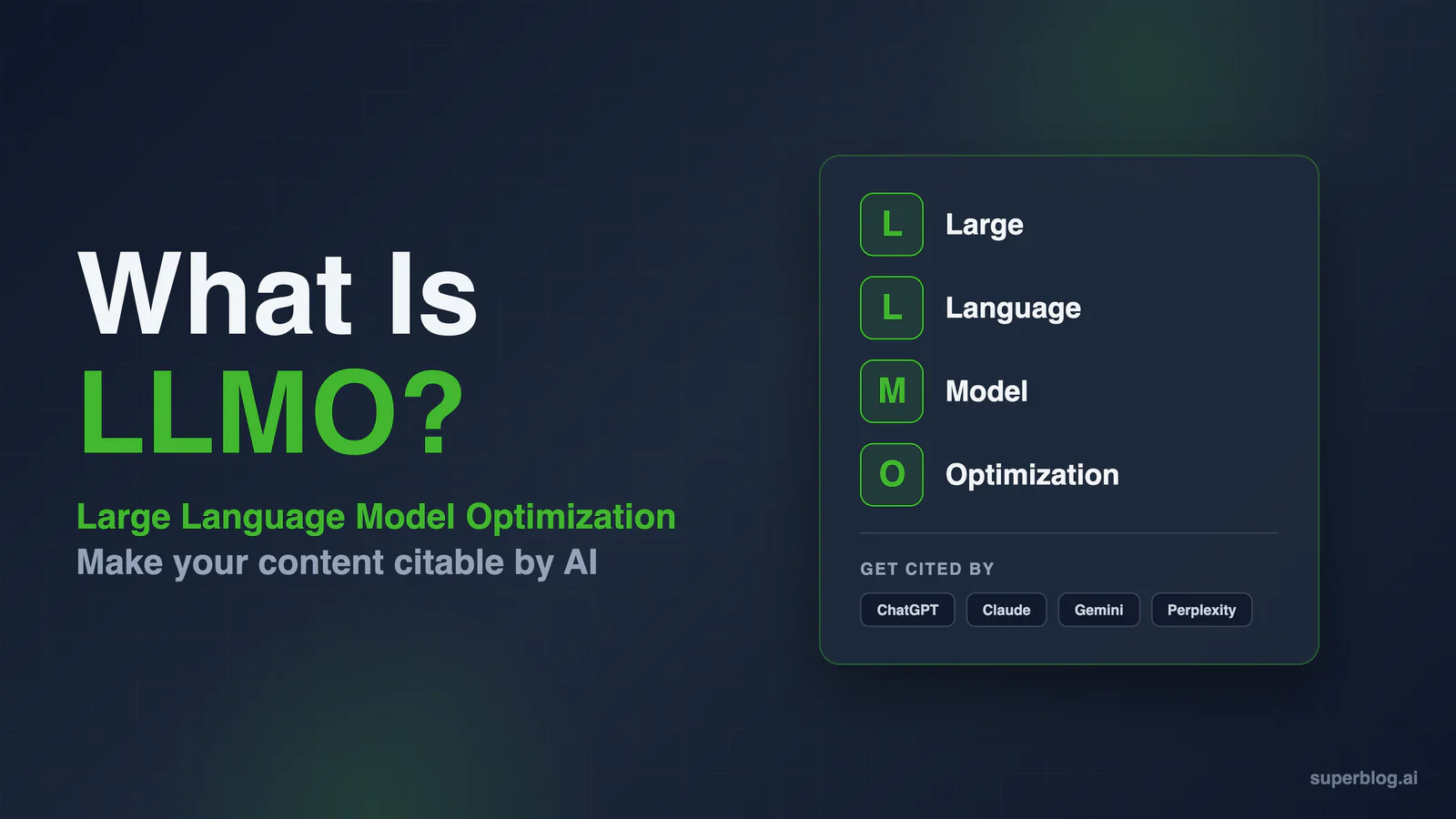
LLMO stands for large language model optimization: the practice of structuring your content so AI models like ChatGPT, Claude, Gemini, and Perplexity can find it, understand it, and cite it in their answers. Where SEO earns you a ranking on a results page, LLMO earns you a mention inside the answer itself.
The term matters because the way people find information has split in two. Google still processes billions of searches a day, but a growing share of research now starts in a chat window. ChatGPT passed 800 million weekly users in late 2025, and Google reports that AI Overviews reach more than 1.5 billion people every month. If an AI assistant answers a question in your niche and your content is not part of that answer, you are invisible to that searcher.
This guide covers the full LLMO definition, how it differs from GEO, AIO, and classic SEO, how language models actually pick their sources, and eight concrete steps you can apply to your blog this week.
What does LLMO mean, exactly?
LLMO (large language model optimization) is the set of techniques that increase the odds of your content being retrieved, quoted, and linked by AI systems. That includes:
- Retrieval: making your pages accessible to AI crawlers like GPTBot, ClaudeBot, and PerplexityBot, and machine-readable once they arrive
- Comprehension: structuring content so a model can extract clear claims, definitions, and data points without guessing
- Citation: writing answers worth quoting, so the model links back to you as the source
LLMO is not a replacement for SEO. The two share most of their foundations: crawlable pages, fast load times, structured data, and content that actually answers questions. LLMO extends that work to a new set of consumers. The reader is no longer only a person scanning a results page. It is also a model deciding, in milliseconds, which three or four sources deserve a citation.
LLMO vs GEO vs AIO vs SEO
Marketing has produced four overlapping acronyms for AI-era visibility. They describe the same shift from slightly different angles.
| Term | Stands for | Optimizes for | Where you show up |
|---|---|---|---|
| LLMO | Large language model optimization | The models themselves: ChatGPT, Claude, Gemini, and the crawlers and files (like LLMs.txt) that feed them | AI chat answers and citations |
| GEO | Generative engine optimization | Generative search engines that combine retrieval with AI answers, like Perplexity and Google's AI Mode | AI-generated answers with source links |
| AIO | AI optimization | Umbrella term for all of the above, sometimes used specifically for Google AI Overviews | AI Overviews and assistant answers |
| SEO | Search engine optimization | Traditional ranking algorithms: crawling, indexing, links, relevance | Classic search results pages |
In practice, LLMO and GEO are near-synonyms. GEO comes from a 2023 Princeton research paper that coined the term and measured which tactics increase visibility in generative engines. LLMO emphasizes the model side, GEO emphasizes the engine side, and both cash out to the same working checklist. If you want the deeper strategy behind the acronym, our pillar guide to generative engine optimization covers it end to end. For a full side-by-side of how GEO differs from classic SEO, see our GEO vs SEO comparison.
The practical takeaway: do not pick one acronym to "do." Build content and infrastructure that both search engines and language models can consume, and every version of the acronym is covered.
How LLMs choose and cite sources
To optimize for language models, you need to know how they gather information. There are three distinct pipelines, and each one favors different signals.
1. Training data
Models learn from massive web crawls collected months before release. Content that is widely referenced, consistently described, and long-lived has more influence here. You cannot inject yourself into a finished model, which is why the next two pipelines matter more for marketers.
2. Live retrieval (RAG)
When you ask ChatGPT or Perplexity a current question, the assistant runs a live search, fetches a handful of pages, and composes an answer from them. This is where most citations come from, and it behaves like a compressed version of search: the model retrieves candidates, then quotes the sources that give it clean, direct, verifiable statements.
3. Dedicated AI crawlers
OpenAI's GPTBot, Anthropic's ClaudeBot, and PerplexityBot crawl the web continuously to refresh what their systems know. If your robots.txt blocks them, or your pages only render with client-side JavaScript, these crawlers see little or nothing.
Across all three pipelines, research and log analysis point to the same preferences. Language models favor:
- Direct answers near the top of the page. Models quote passages, not pages. A crisp two-sentence definition beats a meandering intro.
- Statistics and specifics. The Princeton GEO study found that adding citations, quotations, and statistics improved source visibility in generative engines by 30 to 40 percent.
- Structured, semantic HTML. Headings, lists, and tables give models clean extraction targets.
- Fresh, dated content. Retrieval systems weight recency, especially for topics that change.
- Consistent entities. Sites that clearly state who they are, what they do, and how their claims connect get matched to queries more reliably.
8 practical LLMO steps
Here is the working checklist, ordered roughly by effort-to-impact ratio.
1. Publish an LLMs.txt file
LLMs.txt is a proposed standard: a markdown file at the root of your site that gives AI systems a clean, structured index of your content, stripped of navigation, scripts, and clutter. It is the fastest way to make your entire blog machine-readable in one file. You can build one by hand with our free LLMs.txt generator, or read the full breakdown of the format in our LLMs.txt guide. Superblog generates and updates this file automatically on every deploy, so every post you publish is instantly indexed for AI tools.
2. Allow AI crawlers in robots.txt
Check that GPTBot, ClaudeBot, PerplexityBot, and Google-Extended are not blocked. Blocking them is a legitimate choice for some businesses, but if AI visibility is a goal, an accidental block in robots.txt silently removes you from every answer.
3. Add structured data
JSON-LD schema (Article, FAQ, Organization, Breadcrumb) labels your content in a vocabulary machines already understand: who wrote this, when it was updated, what question it answers. Search engines use it for rich results, and AI retrieval systems use it to disambiguate entities. Our blog schema markup guide shows the exact markup to use. On Superblog, all four schema types are generated automatically for every post.
4. Lead with quotable answers
Open every post, and every major section, with a direct answer a model could lift verbatim. Definition first, nuance second. This mirrors how you win featured snippets, and it is exactly the shape of text that AI answers quote.
5. Include citable statistics
Models prefer sources that let them make concrete claims. Add real numbers with dates and sources: benchmarks, survey data, your own customer results. Original data is the strongest play, because when only your page can support a claim, every answer built on that claim points at you.
6. Serve clean, server-rendered HTML
Most AI crawlers execute little or no JavaScript. If your blog renders client-side, models may see an empty shell. Pre-rendered static pages with semantic headings, lists, and tables are the ideal input. This is a structural advantage of JAMStack blogs: Superblog pre-builds every page as static HTML on the server, which is the same architecture that produces its 90+ Lighthouse scores.
7. Use question-shaped headings
People ask assistants full questions, and retrieval matches question-shaped content well. Turn key H2s into the questions your buyers actually ask ("What does LLMO stand for?", "Is GEO different from SEO?") and answer immediately below.
8. Keep content fresh and push updates fast
Recency is a retrieval signal. Update your high-value posts on a schedule, show visible dates, and notify engines when something changes. The IndexNow protocol pushes your URLs to supporting search engines the moment you publish instead of waiting for a recrawl. Our guide to IndexNow for blogs explains the setup; on Superblog it fires automatically on every publish, no configuration needed.
How to measure LLMO
LLMO measurement is younger than rank tracking, but four methods work today:
- Referral traffic from AI domains. Segment analytics traffic from chatgpt.com, perplexity.ai, gemini.google.com, and claude.ai. This is your hardest conversion evidence: people who clicked through from an AI answer.
- Manual citation checks. Ask the major assistants the 10 to 20 questions your buyers ask, monthly, and record which sources they cite. Track your share of citations like you track rankings.
- AI crawler activity in logs. GPTBot, ClaudeBot, and PerplexityBot hits in your server logs confirm your content is being ingested. Rising crawl frequency usually precedes rising citations.
- Branded search lift. Many AI mentions do not produce a click, but they produce a name. A climb in branded searches alongside AI visibility work is the signal showing up one step downstream.
Set a baseline before you start, because citation checks are only meaningful against a "before" snapshot. If your target is Google's AI answers specifically, our guide to AI Overviews optimization covers the measurement side in more depth.
Where Superblog fits
Most LLMO tactics are infrastructure, and infrastructure is exactly what a managed blogging platform should own. Superblog ships the technical half of this checklist by default:
- LLMs.txt generated at your blog's root and refreshed on every deploy, with a toggle in Settings and separate control for blocking GPTBot if you prefer
- JSON-LD schemas (Article, FAQ, Organization, Breadcrumb) on every post, no plugins
- IndexNow pings on every publish, so engines learn about new content in seconds
- Server-rendered static pages served from a global CDN, fully readable by AI crawlers, with 90+ Lighthouse scores
- MCP integration on the Super plan, so AI agents like Claude can manage your blog directly
That leaves you with the half machines cannot do: writing answers worth citing.
FAQ
Is LLMO the same as GEO?
Functionally, yes. LLMO (large language model optimization) and GEO (generative engine optimization) describe the same discipline from different angles: LLMO names the models you are optimizing for, GEO names the engines built on top of them. The tactics, from LLMs.txt to citable statistics, are identical.
Does LLMO replace SEO?
No. LLMO builds on SEO. AI assistants retrieve their sources through search-like systems, so pages that rank well are also the pages most likely to be cited. Treat LLMO as an extension of your SEO program: same foundations, one additional audience.
What is an LLMs.txt file?
LLMs.txt is a markdown file served at your site's root (yoursite.com/llms.txt) that lists your pages with short descriptions in a format built for language models. It gives AI tools a clean index of your content without HTML clutter. Platforms like Superblog generate it automatically; on other stacks you can create one with a free generator tool.
How long does LLMO take to show results?
Retrieval-based visibility can move within weeks, since assistants pull live sources on every query. Expect crawler activity first, citations second, referral traffic third. Influence on the models' underlying training data is slower, on the scale of model release cycles, which is why consistent publishing beats one-off campaigns.
The bottom line
LLMO means making your content legible to language models: retrievable by their crawlers, parseable by their systems, and quotable in their answers. The work splits cleanly in two. The infrastructure half (LLMs.txt, schema, server-rendered HTML, IndexNow) can and should be automatic. The editorial half (direct answers, original statistics, question-shaped structure) is where you compete.
Superblog handles the first half out of the box, on your own domain, at yoursite.com/blog. Start a free trial and your next post ships with LLMs.txt, full JSON-LD, and IndexNow already working.
Your blog, without the maintenance
Fast pages, automatic SEO, no plugins to patch. Runs on yoursite.com/blog.
Sai Krishna is the Founder and CEO of Superblog. Having built multiple products that scaled to tens of millions of users with only SEO and ASO, Sai Krishna is now building a blogging platform to help others grow organically.
superblog
Superblog is a blazing fast blogging platform for beautiful reading and writing experiences. Superblog takes care of SEO audits and site optimizations automatically.