
Hashnode Review 2026: What It Is, What It Costs, and Should Your Company Blog Use It?

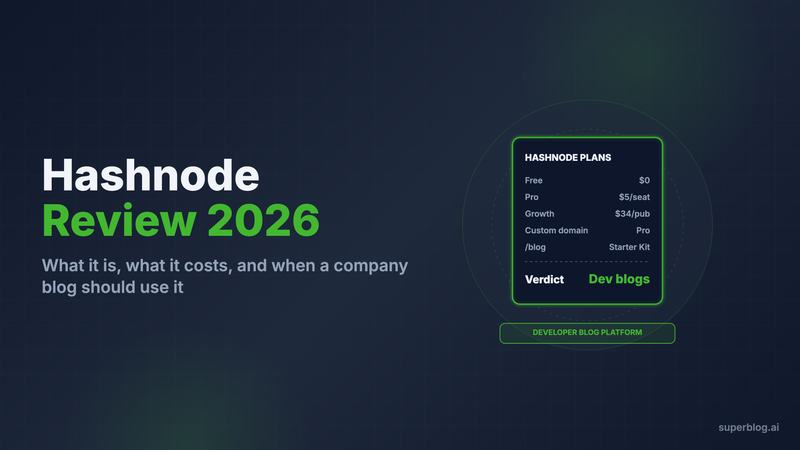
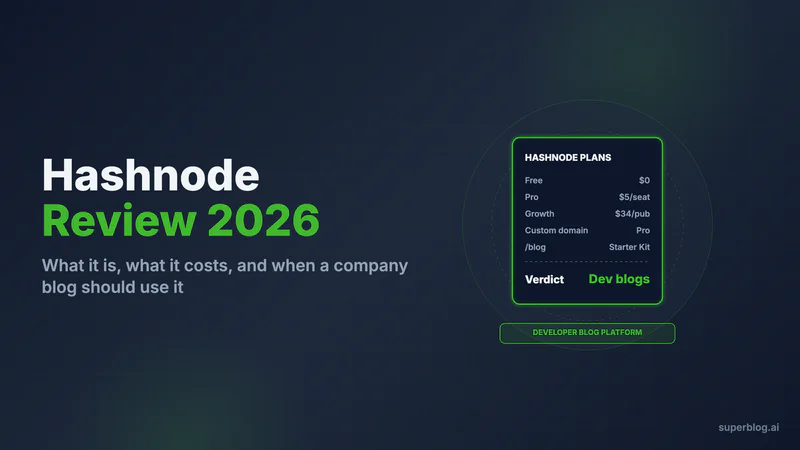
Hashnode is a blogging platform for developers. You get a free blog on a hashnode.dev address with unlimited posts and a Markdown editor, and Pro adds your own domain, the GraphQL API and AI writing tools for $5 a month per seat. It suits a personal developer blog well. It fits a company blog poorly when that blog needs to live at yoursite.com/blog.
Verdict in one line: use Hashnode for an individual or devrel blog where the developer feed matters, and use a platform built for company blogs when the blog has to sit on your main domain and bring in leads.
Every Hashnode fact below was checked on hashnode.com, its changelog and its GitHub in November 2026. The API went paid in May 2026 and Pro launched in June, so older reviews are out of date.
What is Hashnode, and who uses it?
Hashnode is two products in one: a blog host, and a community feed at hashnode.com/feed where developers discover posts from every Hashnode blog.
Hashnode says 1.3M+ blogs have been started on it, with 10M+ posts published and 2M+ members. Its homepage carries a line from Guillermo Rauch, CEO of Vercel: "It's amazing to see how fast devs go from 0 to Blog under a domain they own on Hashnode."
Companies use it too, usually for an engineering or developer-relations blog. The README of Hashnode's Blog Starter Kit lists MindsDB, Pangea Cloud, Outerbase, Fern and Fix as company blogs built on Hashnode's headless mode.
Hashnode pricing at a glance
Hashnode has three plans. Pro is priced per seat. Growth is a flat add-on per publication, on top of the Pro seats.
Prices from hashnode.com and hashnode.com/pro, checked November 10, 2026, in USD.
What a team actually pays:
- One developer, own domain: Pro at $5 a month, or $50 a year.
- A five-person devrel team on Pro: 5 seats x $5 = $25 a month.
- The same team on Growth: $34 + 4 extra seats x $5 = $54 a month.
Pro applies per publication, not per account. If you run a company blog and a separate changelog blog, each one needs its own upgrade to get Pro features. Publications that set up a custom domain, webhooks or GitHub backup before Pro launched in June 2026 keep those features for free.
Is Hashnode free?
Yes. The Free plan is $0 with unlimited posts, and Hashnode compresses images, converts them to WebP and serves them from its CDN on Free too.
What Free leaves out matters for a business. The blog lives at yourname.hashnode.dev, not on your domain, so the links you earn build authority for Hashnode's address. Free blogs show a "Powered by Hashnode" footer, a floating Write button and the Hashnode logo. Free accounts get one publication. And since May 2026, the GraphQL API does not work on Free at all. Our free blogging platforms comparison shows how that free tier stacks up against seven others.
What Hashnode does well
- A writing tool built for technical posts. The editor writes in Markdown or rich text, highlights code in 25 languages, and renders LaTeX and Mermaid diagrams. You can embed CodePen, CodeSandbox, Replit, YouTube and Loom.
- Content you can take with you. Every post exports as Markdown. Pro adds GitHub backup, which syncs every post and draft to a repository as Markdown, and any article can be read as Markdown by adding
.mdto its URL. - Agent and terminal workflows. On Pro, an MCP server lets Claude Code, Codex, Copilot or Cursor create, edit and publish posts after you approve the connection over OAuth. A CLI (Node.js 20 or later) publishes a Markdown file in one command, and an agent skill teaches coding agents the GraphQL API.
- Real team publishing. Team roles and review are on Free. Contributors can submit a draft for review, and admins or owners approve it or send it back. Invite links can carry a capacity limit and an expiry date.
- Core SEO out of the box. Sitemaps, RSS, JSON-LD structured data and social cards come on every plan.
- A built-in audience. Posts can surface in the Hashnode feed. A new personal blog gets readers it would not reach on its own domain from day one.
- AI tools that fit the editor. Pro includes an AI assistant whose suggestions change with the draft, plus generators for outlines, rewrites and summaries. Growth adds a live AEO score with eight checks and citation tracking across four AI assistants, including ChatGPT, Claude and Gemini.
What Hashnode does not do for a company blog
The hosted blog does not live at /blog
Most companies want posts at yoursite.com/blog, so every link a post earns strengthens the domain that sells the product. Our subdomain vs subdirectory guide covers why.
A hosted Hashnode blog runs on hashnode.dev or, on Pro, on your own domain or a subdomain such as blog.yoursite.com. For a subpath, Hashnode points you to its Blog Starter Kit. The README says the kit is a Next.js and Tailwind frontend that "can be deployed anywhere, including a subpath of a custom domain". You fork it, deploy it (Vercel is recommended), set NEXT_PUBLIC_BASE_URL=/blog, and add a rewrite or a Cloudflare Worker on the main site.
That route has three costs:
- Pro is required. The kit reads posts through the GraphQL API, and since May 13, 2026, "Every API request, queries and mutations, now requires a Pro plan on your publication."
- Your team owns a frontend. Hosting, upgrades and design changes for the kit are yours.
- The kit is not actively updated. Its last commit on GitHub is from January 13, 2025, and the hashnode.com/headless page its README links to no longer loads a product page.
Some Hashnode features also stop at the hosted blog. AI traffic tracking does not populate for headless publications. The llms.txt file and crawler toggles apply only to publications Hashnode hosts. The cookie consent banner does not apply to a headless frontend.
Superblog takes the opposite approach: the blog is hosted at yoursite.com/blog on every paid plan, and nobody on your team runs the frontend.
llms.txt and AI search tools cost extra
Hashnode serves Markdown copies of posts on every plan. The llms.txt index, the per-bot crawler switches and FAQ blocks with FAQPage schema are Growth features, at $34 a month per publication. Hashnode's llms.txt lists your recent 100 posts.
No lead capture for sales
A company blog usually needs demo requests and gated content that flow to a CRM. Hashnode's plan pages list no lead or demo-request forms on any plan, so you would embed a third-party form tool.
Your domain depends on a paid seat
If a Pro subscription lapses, Hashnode says "Pro-only features like a custom domain, webhooks, and headless mode switch off." Your posts stay, but your domain stops serving the blog. For a company blog, a billing problem becomes an SEO problem.
The common complaints
Three themes come up in Hashnode's own changelog, its forum and developer write-ups.
- The API paywall. Hashnode moved all API access behind Pro in May 2026, citing scrapers and spammers. A post on DEV by The Free Tier described the effect on automated setups: "those workflows silently broke when the change landed, and the fix is a credit card."
- Automoderation. Hashnode's automoderation can remove posts it judges off-topic. On Pro, off-topic posts are hidden from public feeds instead of deleted. One forum thread is titled "This content is flagged and removed by AUTOMOD, how can I publish the blog".
- Feed spam. Hashnode said in February 2026 that it built an AI spam filter that checks every new post, so "the feed is usable again."
Who Hashnode is right for
- An individual developer building a public profile. A free blog, Markdown export, and readers from the Hashnode feed.
- A devrel or engineering team that writes for developers. Team roles with submit-for-review, code highlighting, and an audience of engineers, for $5 a seat.
- A team that wants agents to publish. MCP, a CLI and the GraphQL API on Pro cover terminal and agent workflows.
- A company with frontend engineers who want a headless CMS. Pro plus the Starter Kit or your own Next.js or Astro frontend, if you are happy to own the code.
For a wider view of the developer options, see our comparison of blogging platforms for developers.
Signs Hashnode is the wrong fit
Look elsewhere when the blog exists to win customers for the company:
- The blog must live at yoursite.com/blog, and no engineer wants to own a Next.js frontend for it.
- Marketers, not engineers, write most posts, and the Hashnode feed adds little for buyers.
- Sales wants demo requests captured on the blog itself.
- You want llms.txt and FAQ schema without a separate $34-a-month tier.
Our Hashnode alternatives roundup compares 11 options for exactly this case.
Superblog: a company blog at /blog with nothing to maintain
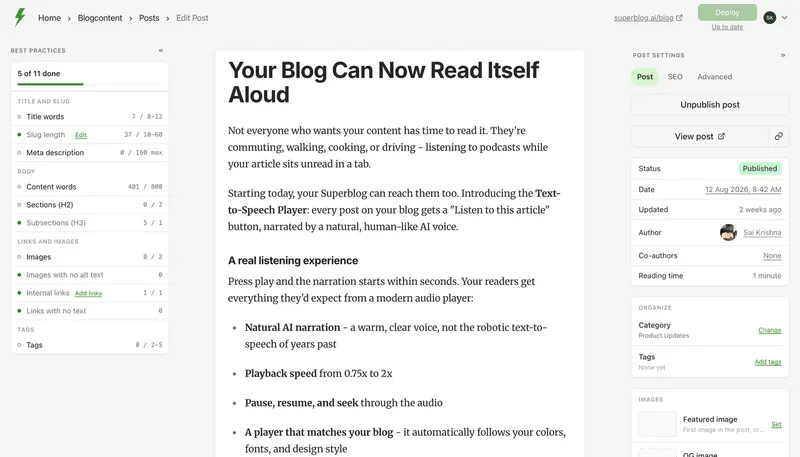
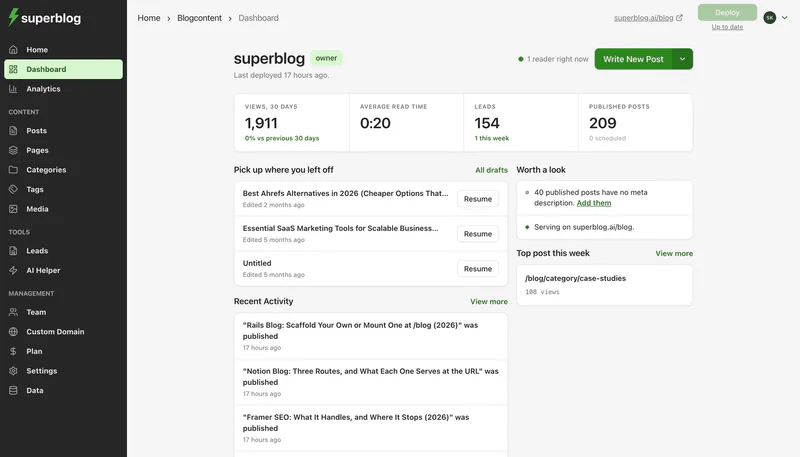
Superblog runs the whole company blog for you: editor, blog design, CDN hosting and SEO in one subscription. It covers the job Hashnode hands to the Starter Kit and your engineers.
Hashnode is cheaper per seat, and its review step lets an admin approve a draft before it goes live. Superblog's review is comments on a draft, not an approval gate. What Superblog gives you instead is the part Hashnode leaves to your engineers: the blog runs at /blog on your domain through a rewrite rule on a Next.js site (see our Next.js blog setup), a Cloudflare Worker, or a proxy rule on Vercel, Netlify, Nginx and other stacks.
Pages score 90+ on Lighthouse. Superblog writes the JSON-LD, the XML sitemap, the llms.txt index and canonical tags for you, submits new URLs through IndexNow, and mirrors each post as Markdown when you add .md to its URL. Code blocks use Prism (45+ languages) and carry a copy-to-clipboard button.
Pro ($49/month, or $530 a year) includes 5 team members and 1,000 posts. Super ($99/month, or $1,070 a year) raises that to 10 members and 10,000 posts, and adds multilingual SEO, the REST API, MCP, Zapier and lead webhooks. For the agent workflow, read how to run a blog from Claude Code or Codex over MCP.
Switching from Hashnode: Superblog has no Hashnode-specific importer. The route is Hashnode's Markdown export, zipped and uploaded through Superblog's ZIP import, which picks up the title, slug, date, tags and meta fields from each file's YAML front matter. Confirm the slug field is present in your export before you upload. ZIP import runs on paid plans only, 300 posts at a time.
Start with a 7-day free trial, no credit card required. Paid plans carry a 30-day money-back guarantee.
Our verdict on Hashnode
Hashnode is a strong platform for developers who write. The free tier is generous, Pro is $5 a seat, posts export as Markdown, and the MCP and CLI tools are ahead of most blog hosts. For a personal or devrel blog, it is hard to argue with.
For a company blog that has to rank at yoursite.com/blog and capture leads, Hashnode asks you to deploy and maintain a Next.js starter kit last updated in January 2025, pay for Pro to reach the API, and add Growth for llms.txt. A managed blog platform does that job for $49/month (Pro) with no frontend to own.
FAQ
What is Hashnode?
A blogging platform for developers, with free hosted blogs and a community feed.
Is Hashnode free?
Yes. The Free plan is $0 with unlimited posts on a hashnode.dev address.
How much does Hashnode Pro cost?
$5 a month per seat, or $50 a year per seat.
Does Hashnode support a /blog subdirectory?
Not on its hosted blog. You need Pro and a frontend you deploy yourself.
Can I export my posts from Hashnode?
Yes. Every post exports as Markdown.
Your blog, without the maintenance
Fast pages, automatic SEO, no plugins to patch. Runs on yoursite.com/blog.
Sai Krishna is the Founder and CEO of Superblog. Having built multiple products that scaled to tens of millions of users with only SEO and ASO, Sai Krishna is now building a blogging platform to help others grow organically.
superblog
Superblog is a blazing fast blogging platform for beautiful reading and writing experiences. Superblog takes care of SEO audits and site optimizations automatically.