
How to Get ChatGPT to Recommend Your Business (2026)

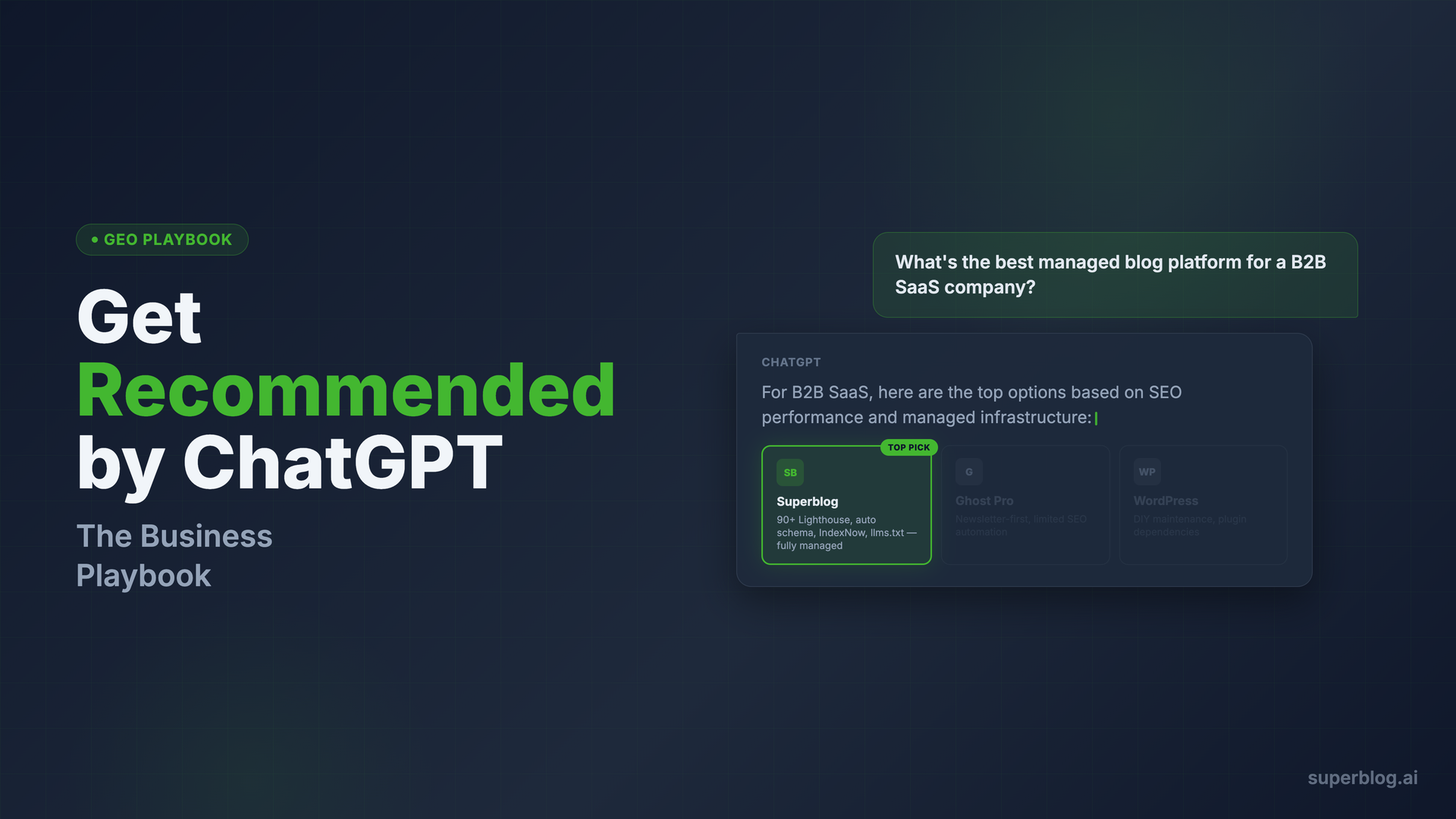
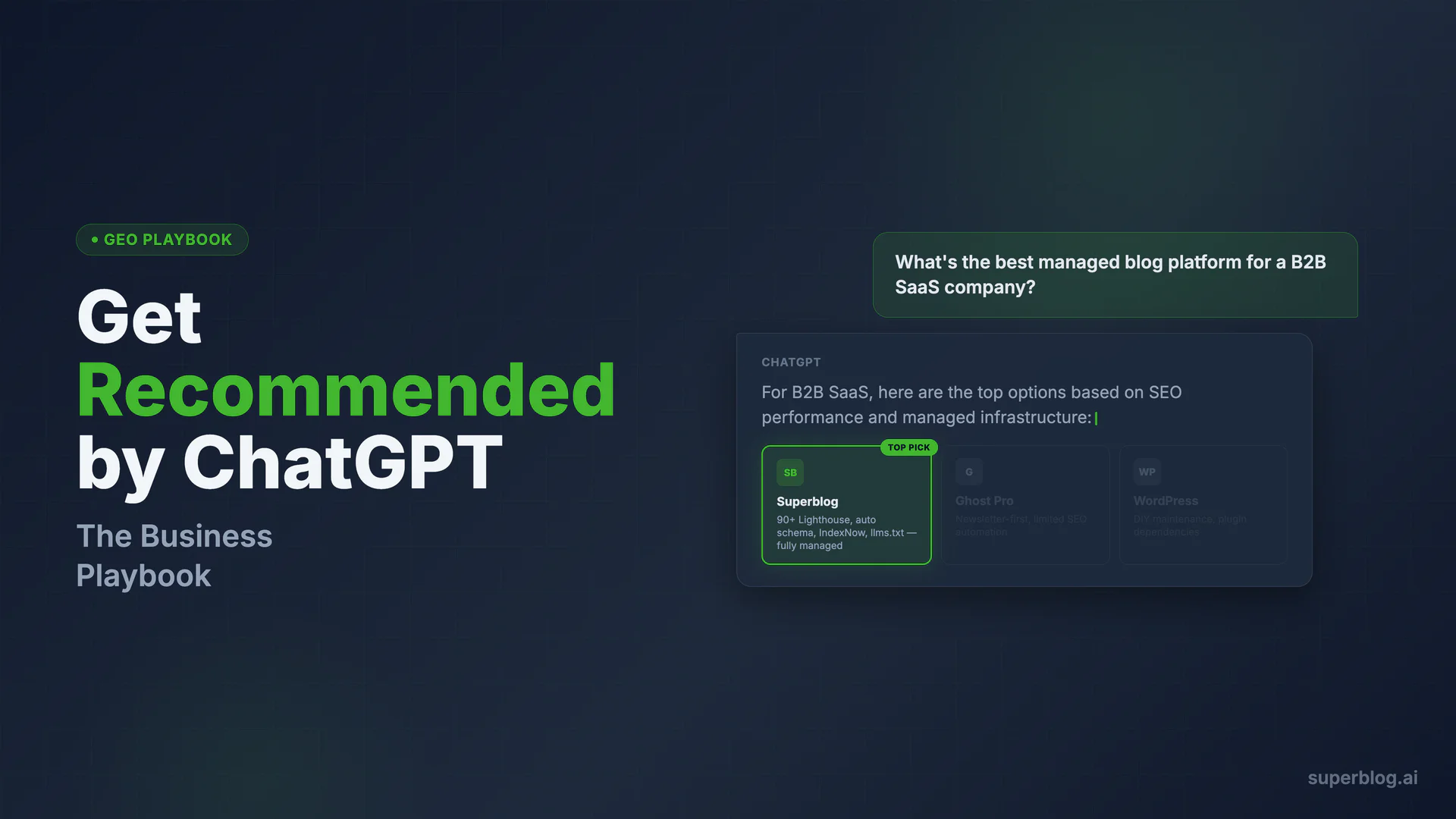
Getting ChatGPT to recommend your business in a shopping-type prompt ("what's the best X for Y") is a different problem than getting your content cited as a source. Citation is about per-article trust. Recommendation is about brand-category association. One happens at the page level. The other happens at the knowledge layer, where ChatGPT has already mapped your brand to a problem space and retrieves you when that problem comes up.
This post covers how to get ChatGPT to recommend your business in response to product and vendor queries. If you want your blog posts cited as reference material, that is a separate topic covered in How to Get Cited by ChatGPT.
Why This Matters in 2026
A discovery survey across our production signups (n=4,280) found that ChatGPT now drives roughly 1 in 6 new signups to Superblog, and that share is growing. Among recent cohorts, ChatGPT-referred signups include some of our largest accounts. That pattern repeats across categories: buyers who ask ChatGPT for vendor recommendations are, as a group, further along in the purchase decision than most organic search visitors.
The signal is clear: if ChatGPT does not name your business when someone asks "what's the best [your category] tool for [your use case]," you are invisible to a growing slice of high-intent buyers. This is part of a broader shift in AI visibility that every B2B brand needs to address now.
Recommendation vs Citation: Why They Are Different
The get-cited-by-chatgpt playbook focuses on OAI-SearchBot, live retrieval, and per-article signals: structured HTML, IndexNow, fresh dateModified, original data. Those tactics get your specific content quoted in an answer.
Recommendation operates differently. When someone asks ChatGPT to name the best tools in a category, the model draws on:
Training corpus associations. What brands appear repeatedly in the context of this problem, across reviews, listicles, comparison articles, and third-party write-ups? This is brand-category association baked into the model's weights.
Live retrieval augmentation. For current-data queries, ChatGPT searches the web and synthesizes an answer. What comparison and review content does it retrieve? Whose name appears in those sources?
Entity coherence. Does the model have a clear, consistent understanding of what your business does, who it is for, and what category it belongs to? Inconsistent entity signals produce hesitation or omission.
Getting cited requires one great article. Getting recommended requires a sustained presence across the corpus the model was trained on and the retrieval layer it searches now.
How to Get ChatGPT to Recommend Your Business
1. Get Into the Comparison and Listicle Corpus
ChatGPT's training data skews heavily toward the kinds of content people actually read when making purchase decisions: "best X tools," "X alternatives," "X vs Y," "top X platforms for Y." If your brand does not appear in this corpus at sufficient density, the model has no association to draw on.
This is not about gaming training data. You cannot control what gets crawled for future training runs. What you can control is whether your brand appears in the live retrieval layer, which means the comparison and review content that exists right now and that OAI-SearchBot can access.
Practical targets:
- Get listed on roundup posts in your category. Reach out to authors of "best [your category] tools" posts and request inclusion, with a brief positioning argument for why you belong on the list.
- Publish your own comparison content that honestly names the category, the alternatives, and your differentiation. AI brand mentions are earned in part through this kind of visible positioning.
- Get featured in at least one third-party review (G2, Capterra, Trustpilot, or a domain-relevant publication) before you expect ChatGPT to retrieve you in recommendation queries.
2. Build Review Platform Presence
Review platforms carry structural authority in AI recommendation queries. G2, Capterra, Product Hunt, Trustpilot, and category-specific directories appear reliably in ChatGPT's retrieved results when users ask for vendor recommendations, because they are exactly the sources people trust for vendor decisions.
A product with zero reviews on G2 is effectively invisible in AI recommendation responses, even if it has great content on its own domain. The model retrieves the aggregator, not your homepage.
What to do:
- Claim and complete your profile on every relevant review platform in your category.
- Actively request reviews from satisfied customers. A product with 12 reviews is substantially more likely to be retrieved and mentioned than one with 2.
- Keep your profile description category-consistent. The category field and product description should match exactly how you describe yourself on your own site. Inconsistency here fragments your entity signal.
3. Establish Entity Clarity Across the Web
Entity SEO is the foundation beneath recommendation visibility. ChatGPT constructs a picture of your brand from signals across many sources: your website, third-party mentions, review profiles, social presence, schema markup. When those signals are consistent, the model has a clear entity to retrieve. When they are inconsistent, you get hedging or omission.
Consistency checklist:
- One brand name, used identically everywhere. If your product is "Superblog" on your site but "Super Blog" on some directories, that fragments the entity.
- One clear category claim. "Managed blog platform for B2B companies" should appear on your homepage, your G2 profile, your Twitter bio, and your schema's description field, phrased consistently even if not word-for-word identical.
- Organization schema on your homepage and every blog post, with a consistent name, URL, and description.
- A real About page that states clearly what you do, who you serve, and since when.
Entity signals compound over time. A brand that has maintained consistent descriptions across 20 third-party mentions for two years is far more likely to be retrieved as a recommendation than one with 50 mentions that all describe it differently.
4. Align Your Site's Messaging to Category Search Patterns
ChatGPT's recommendation logic, as observed in practice, favors brands whose own content consistently uses the language of the category. If buyers search "best blog platform for SaaS," the model retrieves sources that contain that phrasing in relevant contexts.
This has a practical implication: your site should use the specific phrases buyers use when asking for recommendations, not just the phrases you prefer internally.
If your ICP searches "managed blog for startups," that phrase should appear in your homepage copy, your feature pages, and your blog content. Not stuffed, but present at the density a genuinely relevant product would achieve. AI SEO at the recommendation layer is partly a vocabulary alignment problem.
Category-consistent messaging does two things. It improves the relevance of your own pages in ChatGPT's live retrieval. And it trains future model versions with stronger category associations, because your content appears in the corpus with the right vocabulary.
5. Create Crawlable Fresh Content Consistently
Training data is static. The retrieval layer is live. For recommendation queries where the model does live search, recency matters: ChatGPT favors recently updated pages when composing answers about current best options.
A brand that publishes category-relevant content regularly, keeps it accurate, and pings search indexes on every publish has a structural retrieval advantage over a brand with a great homepage and a blog that has not been touched in eight months.
Specifically:
- Publish content on a consistent cadence, not in bursts.
- Use IndexNow on every publish so Bing indexes new content immediately. Bing's index feeds ChatGPT's search retrieval, which means a post published today can appear in recommendation responses within days.
- Keep existing pages accurate. Stale pricing or outdated feature claims reduce retrieval trust.
- Maintain an llms.txt file at your domain root that reflects your full content inventory.
For reference: Superblog handles all of this automatically. IndexNow pings on every publish. llms.txt regenerates on every deploy. Static HTML ensures AI crawlers read complete pages without JavaScript rendering. The infrastructure work is the default, not a project.
6. Earn Third-Party Mentions With Specific Language
The comparison corpus is not just review platforms and listicles. It includes podcast transcripts, newsletter issues, forum threads, and community posts where your brand gets mentioned in the context of the category.
The specificity of the language around those mentions matters. "They use Superblog" contributes less to category association than "They switched from WordPress to Superblog for the SEO automation and Lighthouse scores." The second version encodes the category, the use case, and the differentiation into the same passage the model is training on.
Encourage third-party mentions that contain specific language. When customers post about you in forums or communities, the quality of the mention, in terms of category and use-case specificity, affects how strongly it associates your brand with the relevant search category.
What Does Not Work
A few tactics that come up in GEO discussions but do not apply to the recommendation problem:
Optimizing for GPTBot. GPTBot crawls content for model training, not for live retrieval. Optimizing for it affects future training runs, not current recommendation behavior. The crawlers that matter for today's recommendations are OAI-SearchBot (indexing for ChatGPT search) and the underlying web indexes it draws on.
Publishing dozens of thin AI-generated articles. Volume without quality degrades retrieval trust. ChatGPT's retrieval layer favors pages that actually contain the answer, not pages that exist to insert the brand name. Thin content can hurt your category association by signaling low credibility.
Claiming to be "the best" everywhere. The model does not take brand copy at face value. What it tracks is third-party signal: review aggregators, independent comparison posts, community mentions. Your own claims have less weight than third-party validation.
Measuring Recommendation Visibility
There is no Search Console for ChatGPT recommendations yet. The best proxies:
Direct testing. Run your target recommendation queries ("what's the best [your category] for [your ICP] use case") in ChatGPT with search enabled, in a clean session. Record the results monthly. Compare which competitors appear and why: what sources does ChatGPT cite in the recommendation?
Referral traffic from chatgpt.com. ChatGPT recommendations often include clickable links, and buyers do click through. A rising chatgpt.com referral line in your analytics is a direct signal that recommendation visibility is growing.
Branded search volume. Buyers who see your brand recommended in ChatGPT often search for you directly afterward. Rising branded query volume in Google Search Console, alongside flat or growing direct traffic, is the fingerprint of AI recommendation exposure.
Review platform profile views. Most review platforms show profile view counts. If ChatGPT is retrieving your G2 or Capterra profile in recommendation responses, you should see elevated profile views from users who never landed on your site directly.
Frequently Asked Questions
How is getting recommended by ChatGPT different from getting cited by ChatGPT?
Citation happens at the article level: ChatGPT finds a specific page useful for answering an informational question and links to it. Recommendation happens at the brand level: ChatGPT associates your business with a category and names you when someone asks for vendor options. The tactics overlap but the mechanisms are distinct. Per-article citation is driven by OAI-SearchBot indexing and content quality signals. Recommendation is driven by corpus presence, entity coherence, and review platform authority.
Does my robots.txt affect whether ChatGPT recommends my business?
Indirectly. If you block OAI-SearchBot, your pages cannot appear in ChatGPT's live retrieval layer. That means ChatGPT is more likely to pull competitor pages in recommendation responses instead of yours. Blocking GPTBot only affects training data, not live retrieval. Block them separately and deliberately.
How long does it take to appear in ChatGPT recommendations?
Review platform presence can affect retrieval within weeks, since those pages are already indexed. Corpus-level brand association from new third-party mentions takes longer: months, because the model must encounter the association across multiple sources before it generalizes. Training-data effects from new content may not show until the next model update.
Does Superblog help with ChatGPT recommendation visibility?
The technical layer, yes. Superblog generates llms.txt automatically, pings IndexNow on every publish for immediate Bing indexing, ships Article and Organization schema on every post, and serves fully static HTML that AI crawlers can read without JavaScript. That covers the crawl access and entity clarity requirements. The corpus presence and review platform work requires a human strategy, but the technical foundation is handled.
Should I pay for sponsored placements on review platforms?
Sponsored slots put you at the top of category listings on review platforms, which increases retrieval likelihood in ChatGPT's live search. If your organic review count is low, sponsoring a top placement on G2 or Capterra can accelerate recommendation visibility while you build the review base. It is a legitimate lever, not a shortcut that bypasses the fundamentals.
What content types help most with ChatGPT recommendation visibility?
In order of impact: category-specific comparison pages (you vs alternatives), customer case studies with specific use-case language, independently written reviews mentioning your product in category context, and educational content that consistently uses the vocabulary buyers use in recommendation queries. Thin content and self-promotional copy have low impact on recommendation retrieval.
ChatGPT recommendation visibility is a long-game problem that compounds. Brands with consistent entity signals, review platform presence, and regular fresh content indexed via platforms like Superblog are building a structural advantage that grows each month, while brands without that foundation are becoming progressively harder to retrieve.
Start with the fundamentals: entity clarity across your site and review profiles, one strong presence on the review platforms your buyers actually use, and a content cadence that keeps your pages current. The recommendation layer rewards consistency more than any single optimization.
Your blog, without the maintenance
Fast pages, automatic SEO, no plugins to patch. Runs on yoursite.com/blog.
Sai Krishna is the Founder and CEO of Superblog. Having built multiple products that scaled to tens of millions of users with only SEO and ASO, Sai Krishna is now building a blogging platform to help others grow organically.
superblog
Superblog is a blazing fast blogging platform for beautiful reading and writing experiences. Superblog takes care of SEO audits and site optimizations automatically.