
ChatGPT SEO: How to Get Your Blog Cited by ChatGPT

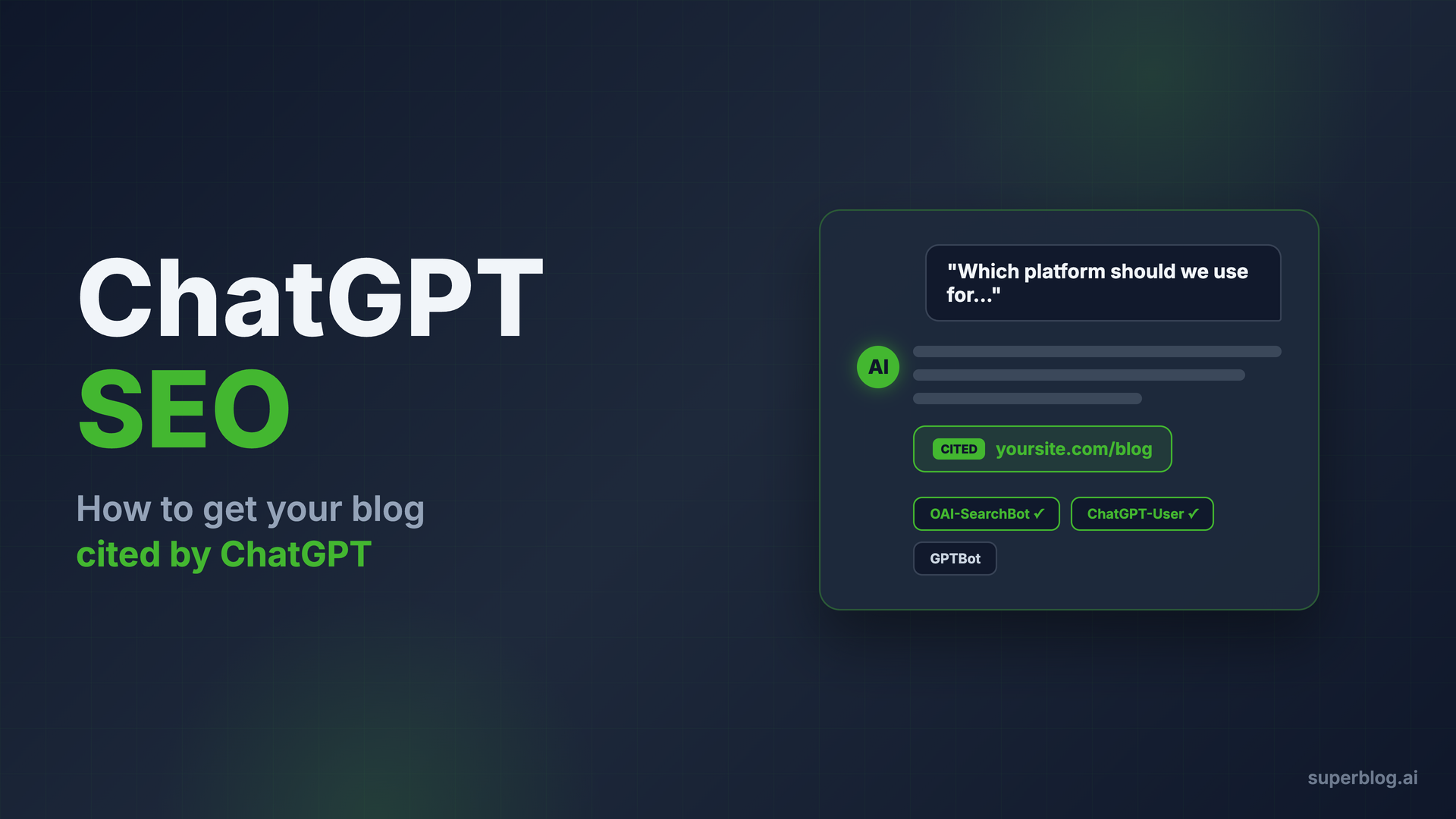
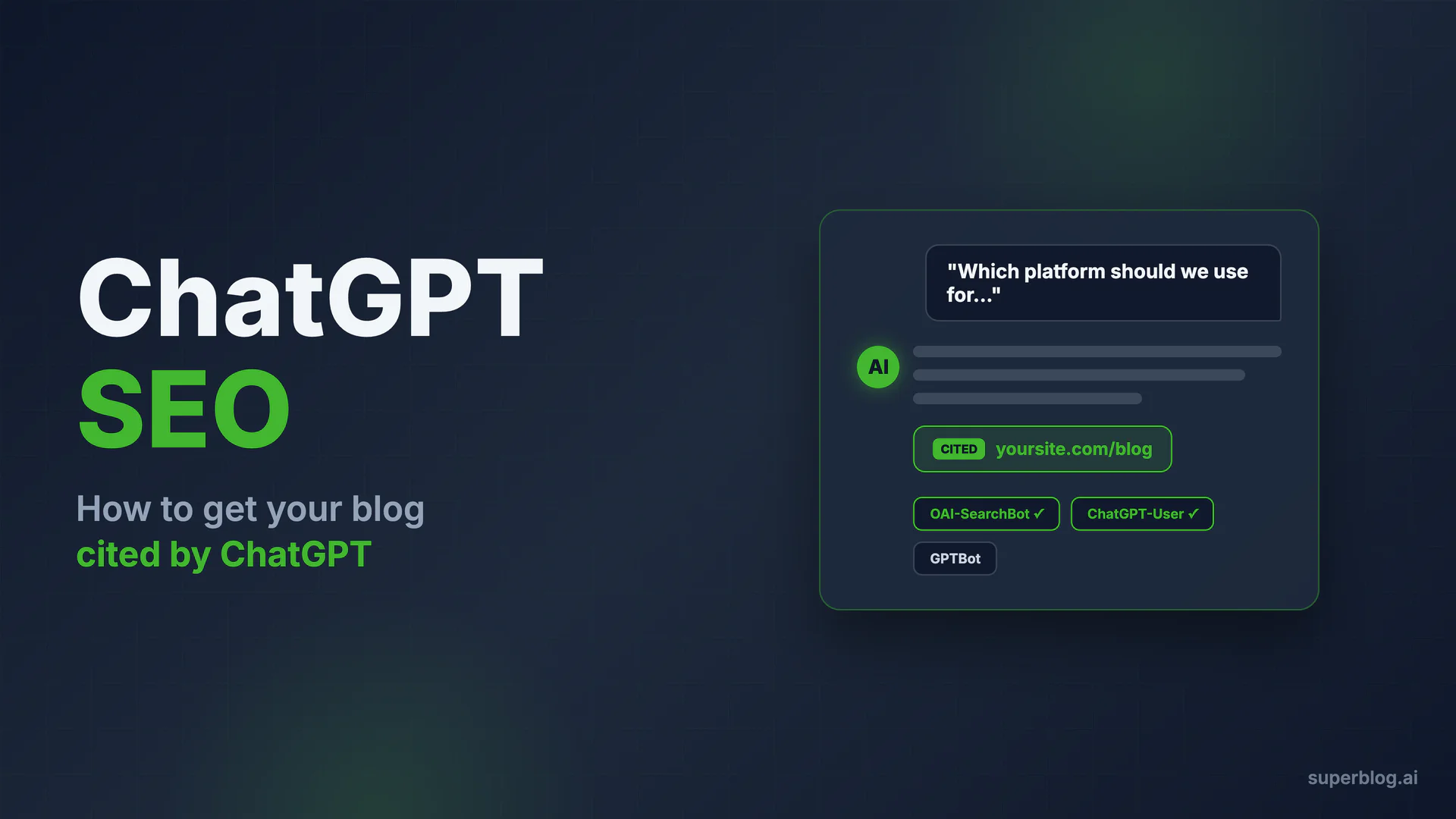
ChatGPT cites content it can crawl, parse, and trust. That means five things must be true about your blog: AI crawlers can access it, the content is structured for machines to extract answers, it is clear who published it, it is current, and it says something worth quoting. Miss any one of these and ChatGPT quietly uses a competitor instead.
This guide covers how ChatGPT actually selects sources and how to influence that selection. It is part of our generative engine optimization cluster: the pillar explains the discipline, this post goes deep on the engine your buyers use most. For how GEO differs from classic SEO, see our GEO vs SEO comparison.
How ChatGPT finds and cites sources
ChatGPT answers questions from two places, and only one of them can send you traffic.
Training data. The model's baked-in knowledge from its training corpus. If your content was crawled by GPTBot before a training cutoff, the model may know about you, but it answers from memory and rarely cites. You cannot optimize your way into a model that has already been trained.
Live search. When a question needs current information, ChatGPT searches the web, reads a handful of pages, and composes an answer with citation links. This is where citations come from, and it is the part you can influence this quarter.
Three OpenAI crawlers matter, and they do different jobs:
The common mistake: teams block "AI bots" in one sweep and cut off OAI-SearchBot and ChatGPT-User along with GPTBot. That is deleting yourself from the answer layer to make a point about training data. Decide each crawler separately.
See our full crawler-by-crawler breakdown, AI Crawlers Explained, for how to configure robots.txt for each one individually.
ChatGPT search also draws on established web indexes, including Bing's. Content that indexes quickly and ranks in Bing has a head start in ChatGPT answers. This is why the IndexNow protocol, which pings Bing the moment you publish, has become an AI search feature rather than a nice-to-have.
Factor 1: Crawl access
Check your robots.txt right now. Many WordPress security plugins, CDN "bot protection" presets, and copy-pasted robots.txt templates block AI crawlers by default.
What to verify:
yoursite.com/robots.txtdoes not disallow OAI-SearchBot or ChatGPT-User- Your CDN or firewall does not challenge these user agents with CAPTCHAs or JavaScript checks
- Your blog pages return complete HTML without requiring JavaScript execution
That last point eliminates more blogs than any robots.txt rule. ChatGPT reads the HTML your server returns. If your blog is client-side rendered and the initial response is an empty shell that JavaScript fills in later, there is nothing to read. Server-rendered or static HTML is a hard requirement for reliable citations.
Factor 2: Machine-readable structure
A language model reading your page has a token budget and no patience. It extracts answers from pages where the structure does the work.
Publish an llms.txt file. An llms.txt file is a markdown index at your site root listing which pages matter, with one-line descriptions. It is the AI-search counterpart to sitemap.xml. Our LLMs.txt guide covers the specification in detail, and our free LLMs.txt generator builds the file from your sitemap in about a minute.
Answer first, elaborate second. Put a direct 40 to 60 word answer immediately under each question-shaped heading, then expand. Models lift these passages nearly verbatim. This is the same discipline that wins featured snippets, which is not a coincidence: both systems reward extractable answers.
Use real structure. One H1. Descriptive H2s phrased the way people ask questions. Tables for anything comparative. Lists for anything sequential. A model deciding between your 2,000 words of unbroken prose and a competitor's structured comparison table will quote the table.
Factor 3: Entity clarity
ChatGPT attributes claims to sources it can identify. "According to Superblog's migration guide" requires the model to know what Superblog is, what the page is, and who wrote it.
- Ship Article, Organization, and Breadcrumb schema on every post, so the publisher, author, and page type are machine-readable facts rather than guesses. Our schema markup guide shows exactly what these look like.
- Use one consistent brand name everywhere: site title, schema, about page, social profiles.
- Maintain a real about page. Models cross-reference who is making claims before repeating them.
- Host the blog on your main domain, at
yoursite.com/blog, so every citation reinforces one entity instead of splitting your identity across domains.
Factor 4: Freshness
Ask ChatGPT a question and watch which sources it picks: recently updated pages win, because the model is specifically searching for current information when it reaches for the web.
- Keep
dateModifiedin your Article schema accurate, and update it only when you actually change the content - Refresh your highest-value posts on a schedule instead of letting them decay
- Get new content indexed fast. IndexNow notifies Bing the moment you publish, and Bing's index feeds ChatGPT search
Stale content creates a compounding penalty in AI search: the model skips it today, so it is not reinforced as a reliable source, so it is more likely to be skipped tomorrow.
Factor 5: Say something worth citing
ChatGPT does not cite pages for existing. It cites pages that contribute something to the answer it is building.
- Original numbers. Benchmarks, pricing tables you keep current, survey results, your own traffic data. Models love specific figures with clear sources.
- Direct claims. "Static blogs score 90+ on Lighthouse without optimization work" is citable. "Performance is important for user experience" is filler.
- Complete comparisons. Head-to-head tables with real limitations on both sides get lifted whole into answers.
- Definitions. If you define a term cleanly in two sentences, you become the source for that definition.
Ten mediocre posts produce zero citations. One post with the only real benchmark data on a topic produces citations for years.
The ChatGPT SEO checklist
- Confirm OAI-SearchBot and ChatGPT-User are not blocked in robots.txt
- Confirm your CDN and firewall pass AI crawler user agents
- Verify your pages render complete HTML without JavaScript
- Publish llms.txt at your site root (generate one free)
- Add a 40 to 60 word direct answer under every question-shaped H2
- Ship Article, Organization, and Breadcrumb schema on every post
- Add FAQ schema where you answer common questions
- Keep dateModified honest and refresh key posts quarterly
- Submit new posts via IndexNow so Bing indexes them immediately
- Publish at least one asset with original data in your niche
The automation gap
Every item on that checklist is a maintenance task somewhere: a robots.txt edit, a schema plugin to configure and update, an llms.txt file to regenerate every time you publish, an IndexNow integration to build.
This is the gap Superblog closes. Blogs on Superblog get the full stack automatically:
- LLMs.txt generated and refreshed on every deploy, one toggle in settings
- JSON-LD schemas for Article, FAQ, and Organization on every post, no plugin
- IndexNow pings on every publish, so Bing and ChatGPT search see new content immediately
- Static HTML served from a global CDN, fully readable by every AI crawler, with 90+ Lighthouse scores
- Per-crawler control, including a separate GPTBot block if you want to stay out of training data while remaining citable in search
Your writers produce the citable content. The platform handles every machine-facing requirement around it, at yoursite.com/blog, on your domain. That is the entire premise: SEO and GEO that work while you sleep.
How to measure ChatGPT citations
There is no Search Console for ChatGPT yet, but you can track three signals:
- Referral traffic from
chatgpt.comin your analytics. ChatGPT citations are clickable links, and users do click through on decision queries. - Direct interrogation. Ask ChatGPT the questions your buyers ask, in a fresh session with search enabled, and record which sources it cites. Repeat monthly. This is the closest thing to rank tracking for AI search.
- Branded search growth. Users who see your brand in an AI answer often search for you directly afterward. A rising branded-query line in GSC alongside flat non-branded clicks is the signature of AI answer exposure.
Start before the pattern locks in
AI engines develop source habits. The blogs getting cited today are being reinforced as reliable sources for tomorrow's answers, the same way early schema adopters locked in rich snippets while everyone else debated whether structured data mattered.
The checklist above is a weekend of work on most platforms. On Superblog, the machine-facing half of it is the default configuration, and the trial takes one minute to start.
Next in this cluster: AI Overviews optimization, because Google's answer engine plays by different rules than ChatGPT, and it is already sitting on top of your search results.
Your blog, without the maintenance
Fast pages, automatic SEO, no plugins to patch. Runs on yoursite.com/blog.
Sai Krishna is the Founder and CEO of Superblog. Having built multiple products that scaled to tens of millions of users with only SEO and ASO, Sai Krishna is now building a blogging platform to help others grow organically.
superblog
Superblog is a blazing fast blogging platform for beautiful reading and writing experiences. Superblog takes care of SEO audits and site optimizations automatically.