
GEO vs SEO: What's Actually Different (And What Isn't)

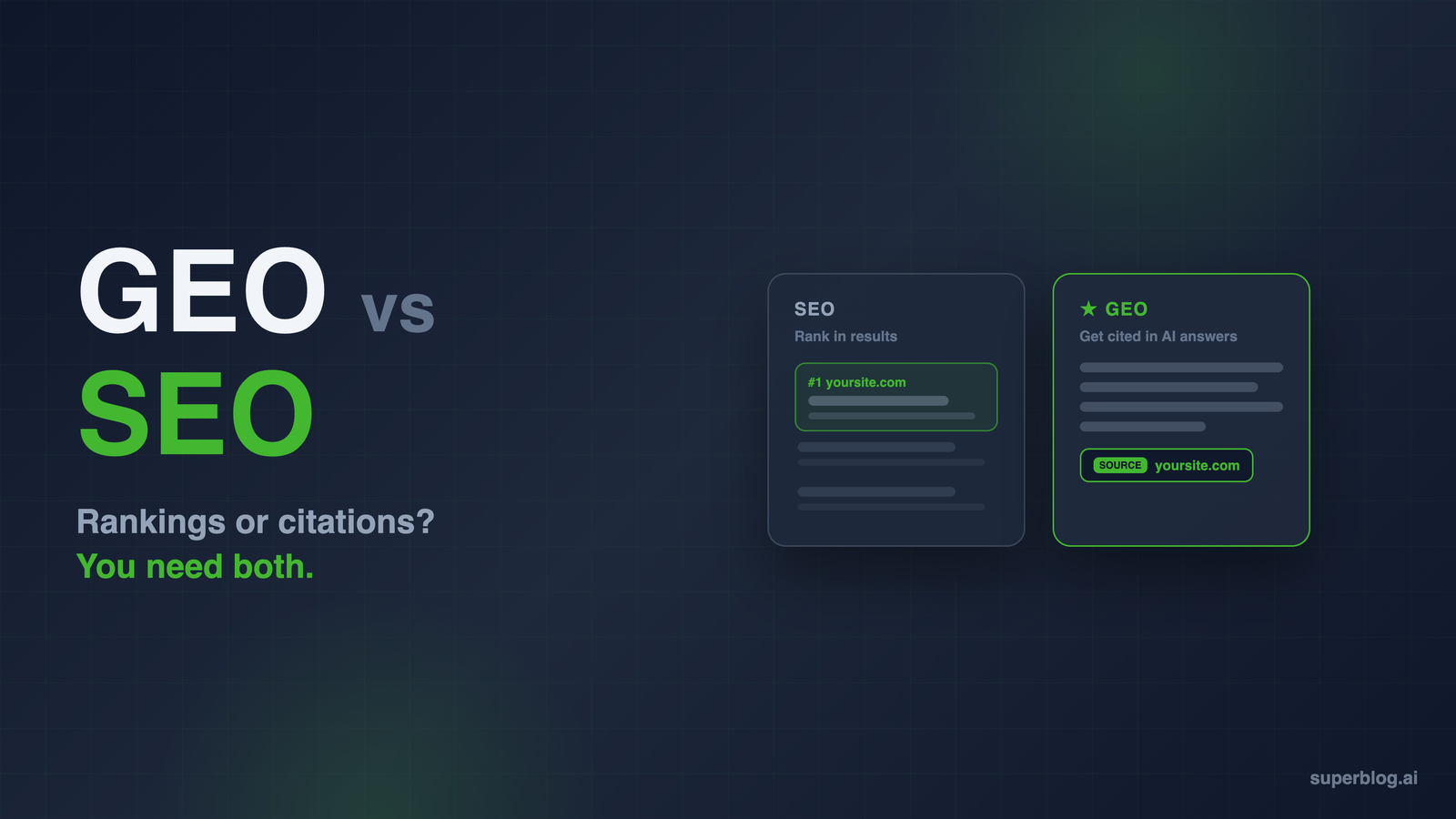
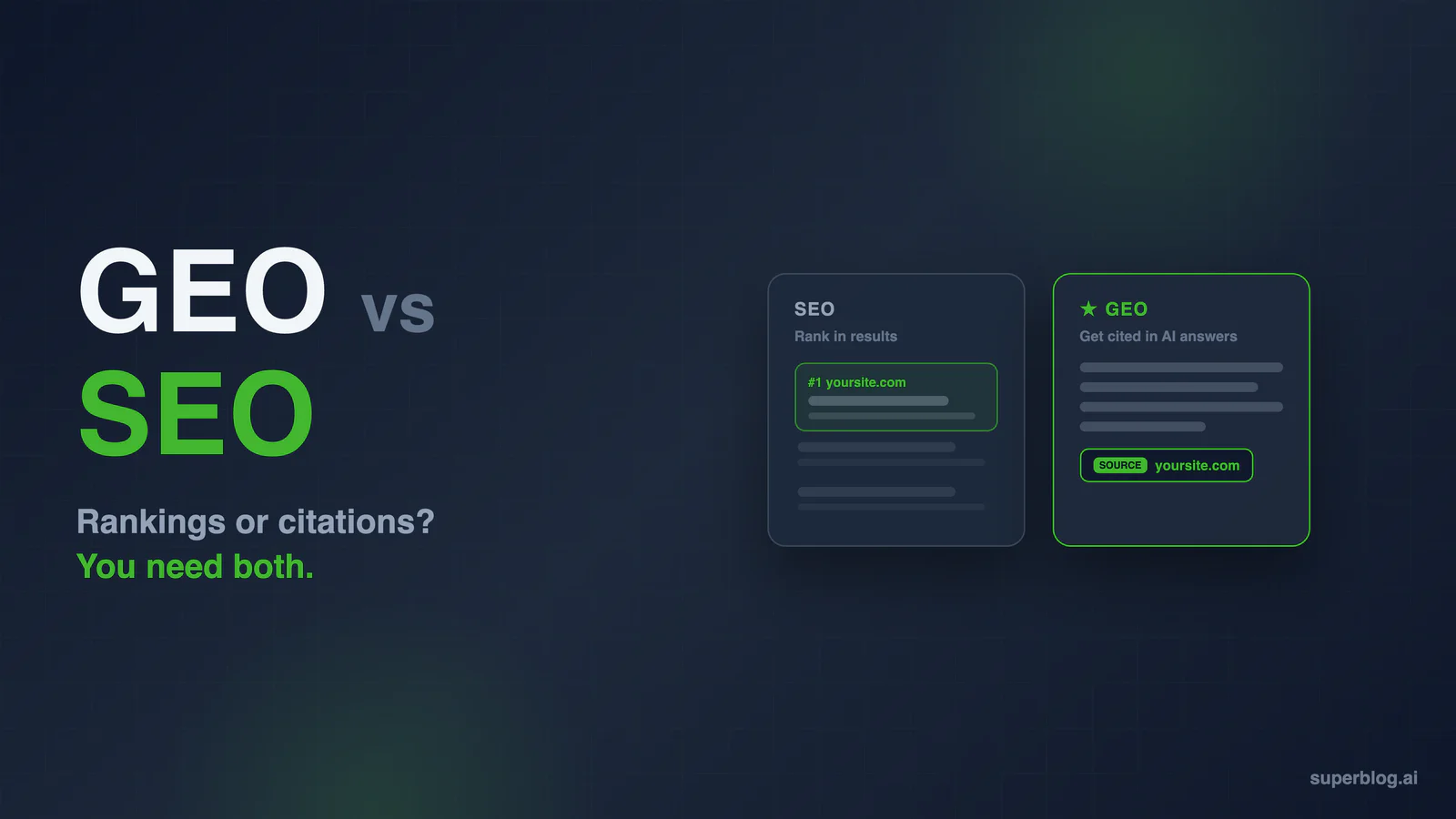
GEO (generative engine optimization) is the practice of getting your content cited in AI-generated answers from ChatGPT, Perplexity, and Google AI Overviews, while SEO is the practice of getting your pages ranked in traditional search results. GEO does not replace SEO. It sits on top of it, and roughly 80 percent of the work overlaps.
That two-sentence answer hides a lot of nuance, though. The two disciplines share a foundation, but they reward different behaviors at the margins: SEO rewards pages that earn clicks, GEO rewards passages that earn citations. This guide breaks down exactly what changes, what stays the same, and how to run one workflow that wins in both.
GEO and SEO in one minute
SEO (search engine optimization) is the discipline of earning visibility in search engine results pages. You target keywords, publish content that satisfies the intent behind them, build technical health and authority, and climb the rankings. The payoff is clicks: someone searches, sees your page, and visits your site.
GEO (generative engine optimization) is the discipline of earning visibility inside AI-generated answers. When someone asks ChatGPT, Perplexity, Claude, or Google's AI Overviews a question, the engine synthesizes an answer from sources it retrieves and trusts. GEO is about becoming one of those sources, getting quoted, cited, and recommended inside the answer itself.
The term comes from a 2023 research paper, "GEO: Generative Engine Optimization" by Aggarwal et al. (Princeton, Georgia Tech, IIT Delhi, and the Allen Institute for AI). The researchers tested nine content optimization methods across thousands of queries and found that adding quotations, citing sources, and including statistics improved a page's visibility in generative engine responses by up to 40 percent. Notably, traditional keyword stuffing performed near the bottom. That single finding explains most of what genuinely separates GEO from old-school SEO tactics. For the full playbook, read our guide to generative engine optimization. This article focuses on the comparison: where the two disciplines diverge and where they are the same job.
GEO vs SEO: the side-by-side comparison
| SEO | GEO | |
|---|---|---|
| Goal | Rank in search results and earn clicks to your site | Get cited, quoted, or recommended inside AI-generated answers |
| Unit of success | A ranking position for a page | A citation for a passage |
| Who evaluates you | Search engine ranking algorithms | Retrieval systems plus a language model deciding what to quote |
| Core signals | Relevance, links, technical health, page experience, E-E-A-T | All of the above, plus citability: clear claims, statistics, quotable passages, structured formats |
| Content shape | Comprehensive pages that satisfy search intent | Answer-first passages that stand alone when extracted |
| Crawlers to serve | Googlebot, Bingbot | GPTBot, ClaudeBot, PerplexityBot, Google-Extended, plus the search crawlers AI engines piggyback on |
| Measurement | Rankings, impressions, clicks in Google Search Console | AI referral traffic, citation frequency, brand mentions in answers |
| Tooling | GSC, Ahrefs, Semrush, rank trackers | Analytics referrer reports, AI visibility trackers, manual prompt testing, LLMs.txt |
| Payoff curve | Compounding traffic from stable rankings | Brand authority and high-intent visits from answer citations |
Read the table as layers, not rivals. Every row on the GEO side assumes the SEO row underneath it is already handled. A passage cannot be cited if the page it lives on was never crawled, indexed, and judged credible in the first place.
What stays the same
Most of GEO is SEO wearing a new badge. If your blog already ranks, you have already done the majority of the work AI engines care about.
Content quality and depth
Generative engines retrieve before they generate. Perplexity runs on a search index. ChatGPT browses with Bing. Google's AI Overviews pull from Google's own index, and pages that rank in the top organic results are far more likely to be cited. Thin content that could not rank in 2019 will not get cited in 2026. Original research, specific numbers, and first-hand experience win in both games.
E-E-A-T
Google's framework of experience, expertise, authoritativeness, and trustworthiness maps almost perfectly onto what language models are trained and instructed to prefer: credible, attributable, consistent sources. Author bylines, credentials, and a track record of accurate content feed both systems.
Structured data
JSON-LD schema markup tells search engines what your content is: an article, an FAQ, a how-to, an organization. That same machine-readable clarity helps retrieval systems classify and extract your content. Schema was an SEO tactic first, and it transfers to GEO at full value. Our blog schema markup guide covers which types matter and how to implement them.
Technical fundamentals
Crawlability, clean URL structures, fast pages, canonical tags, and XML sitemaps matter to every bot that visits your site, whether it feeds a ranking algorithm or a language model. A page that Googlebot struggles to render is a page GPTBot struggles to read.
What genuinely changes
Four things are actually new. This is where GEO earns its own name.
1. Citability becomes its own optimization target
In SEO, the page is the unit that ranks. In GEO, the passage is the unit that gets cited. The GEO paper's strongest tactics, adding statistics, quoting named sources, and citing references, all work because they make individual passages verifiable and safe for a model to repeat. Practical translation: state claims in single, self-contained sentences. "JAMStack blogs serve pre-built static pages from a CDN, which removes servers and databases from the request path" is citable. Three paragraphs of wind-up before the point is not.
2. Answer-shaped content
AI engines answer questions, so content structured as questions and answers gets extracted more reliably. Lead every article and every major section with a direct answer, then expand. Use question-formatted H2s and H3s. Add a genuine FAQ section. This mirrors the approach that wins featured snippets, but the stakes are higher: in an AI answer, the extracted passage often is the entire impression your brand makes. The same structure is what gets pages pulled into Google's AI Overviews, which now sit above the traditional results for a large share of informational queries.
3. LLMs.txt and machine-readable access
LLMs.txt is a proposed standard: a markdown file at your site's root that gives AI systems a clean, structured index of your content, stripped of navigation, scripts, and layout noise. Search engines never needed it because they render pages. Token-constrained AI systems benefit from it. It is the first piece of infrastructure that exists purely for generative engines, which makes it the clearest technical dividing line between the two disciplines. We covered the standard in depth in our post on LLMs.txt and AI search.
4. Crawler access decisions
SEO never asked whether you should let Googlebot in. GEO does. GPTBot, ClaudeBot, PerplexityBot, and Google-Extended each have their own user agents, and blocking them in robots.txt removes you from those engines' answers. For a business blog built for organic growth, the math is straightforward: block AI crawlers and you forfeit citations, mentions, and the growing share of buyers who research inside chat interfaces. Audit your robots.txt, your CDN bot rules, and your firewall settings, because plenty of sites block AI crawlers by accident.
Does GEO replace SEO? No, and here's why
Anyone selling GEO as the replacement for SEO is selling you a rebrand. The two are complementary, and the dependency runs one way: GEO needs SEO underneath it.
The reasons are structural, not sentimental:
- AI engines retrieve from search indexes. Perplexity, ChatGPT search, and AI Overviews all ground their answers in web indexes. Pages that rank get retrieved. Pages that get retrieved get cited. Your organic rankings are the pipeline that feeds your AI visibility.
- Search still drives the traffic. AI referrals are growing fast, but Google search still sends orders of magnitude more visits to the average business blog than every AI engine combined. Abandoning SEO to chase GEO means trading your largest channel for your newest one.
- The signals overlap. Authority, structured data, crawlability, and content quality feed both systems. Work done for one compounds in the other.
The confident take: treat GEO as a required extension of SEO, not a successor to it. Teams that pit the two against each other will lose both games. Teams that run one workflow with a citability layer on top will show up in the rankings and in the answers.
A combined GEO + SEO workflow
Here is the workflow we recommend, step by step. It is one process, not two.
- Start from keyword and question research. Target keywords as usual, then collect the conversational questions around them. Ask ChatGPT and Perplexity your target queries and note what gets cited and what the answers miss.
- Write answer-first. Open every post with a direct two or three sentence answer to the core question. Structure H2s around subquestions. This wins featured snippets, AI Overviews, and chat citations with the same words.
- Make passages citable. Add statistics with sources, quote named experts, and state claims in self-contained sentences. This is the tactic the GEO research measured at up to 40 percent visibility gains.
- Ship structured data automatically. Article, FAQ, and Organization schema on every post. If you are on Superblog, this happens without you touching code: JSON-LD schemas are generated automatically for every post.
- Open the gates. Verify AI crawlers can reach your content, and publish an LLMs.txt file. Superblog generates LLMs.txt for your blog automatically and updates it on every deploy, with a separate toggle if you want to block GPTBot specifically.
- Get indexed fast. Fresh content cannot be cited if engines have not seen it. Superblog pushes every new post to search engines via the IndexNow protocol the moment you publish.
- Interlink your clusters. Internal links help crawlers map your expertise on a topic, which supports rankings and retrieval alike.
Notice that steps one, two, and seven are just competent SEO. Steps three through six are the GEO layer. The overhead of adding GEO to an existing SEO practice is a few habits, not a second team.
How to measure GEO and SEO together
SEO measurement is mature: track rankings, impressions, and clicks in Google Search Console, and watch organic sessions in your analytics.
GEO measurement is younger, but three methods work today:
- AI referral traffic. Segment your analytics by referrer for chatgpt.com, perplexity.ai, claude.ai, copilot.microsoft.com, and gemini.google.com. This is the hardest signal that GEO is producing visits.
- Citation spot checks. Run your 20 to 30 most important queries through the major AI engines monthly. Log whether you are cited, who is cited instead, and what claims the answers make about your category. We break down the tactics that move this number in our guide to getting cited by ChatGPT.
- Branded search lift. Many people see your brand in an AI answer, then Google you. A rising branded search trend alongside flat rankings often means AI visibility is working.
Expect different curves. SEO gains build gradually as rankings climb. GEO citations can appear within days of publishing when a page gets retrieved for an underserved question, and they can also churn as models and indexes update. Judge SEO quarterly and GEO monthly.
Where the platform does the work
Most of the GEO checklist is infrastructure, and infrastructure is exactly what a blogging platform should handle for you. Superblog ships the technical half of both disciplines automatically: JSON-LD schemas (Article, FAQ, Organization, Breadcrumb) on every post, XML sitemaps regenerated on every deploy, IndexNow pings on publish, LLMs.txt generation with per-crawler controls, and pages that score 90+ on Lighthouse without tuning. That leaves your team with the half machines cannot do: writing content worth citing.
FAQ
Is GEO the same as AEO or LLMO?
Functionally, yes. GEO (generative engine optimization), AEO (answer engine optimization), and LLMO (large language model optimization) all describe optimizing content for AI-generated answers, with minor differences in emphasis. GEO is the term with academic backing from the 2023 Princeton paper and has become the most widely used label.
Can you do GEO without SEO?
Not effectively. Generative engines retrieve sources from search indexes, so pages with no organic visibility rarely enter the answer pool. The practical path is to build SEO fundamentals first, then add the GEO layer: citable passages, answer-first structure, LLMs.txt, and open crawler access.
How is GEO measured differently from SEO?
SEO is measured in rankings, impressions, and clicks, mostly through Google Search Console. GEO is measured in citations and AI referral traffic: referrer segments in your analytics, recurring prompt tests across ChatGPT, Perplexity, and AI Overviews, and branded search lift.
Do I need separate content for GEO and SEO?
No. One well-structured article serves both. Write an answer-first opening, use question-based headings, include sourced statistics and quotable claims, and mark it up with schema. The same page ranks in Google and gets cited in AI answers. Separate "GEO content" is wasted effort.
Your blog, without the maintenance
Fast pages, automatic SEO, no plugins to patch. Runs on yoursite.com/blog.
Sai Krishna is the Founder and CEO of Superblog. Having built multiple products that scaled to tens of millions of users with only SEO and ASO, Sai Krishna is now building a blogging platform to help others grow organically.
superblog
Superblog is a blazing fast blogging platform for beautiful reading and writing experiences. Superblog takes care of SEO audits and site optimizations automatically.