
GEO Strategy: How to Build a Generative Engine Optimization Program (2026)

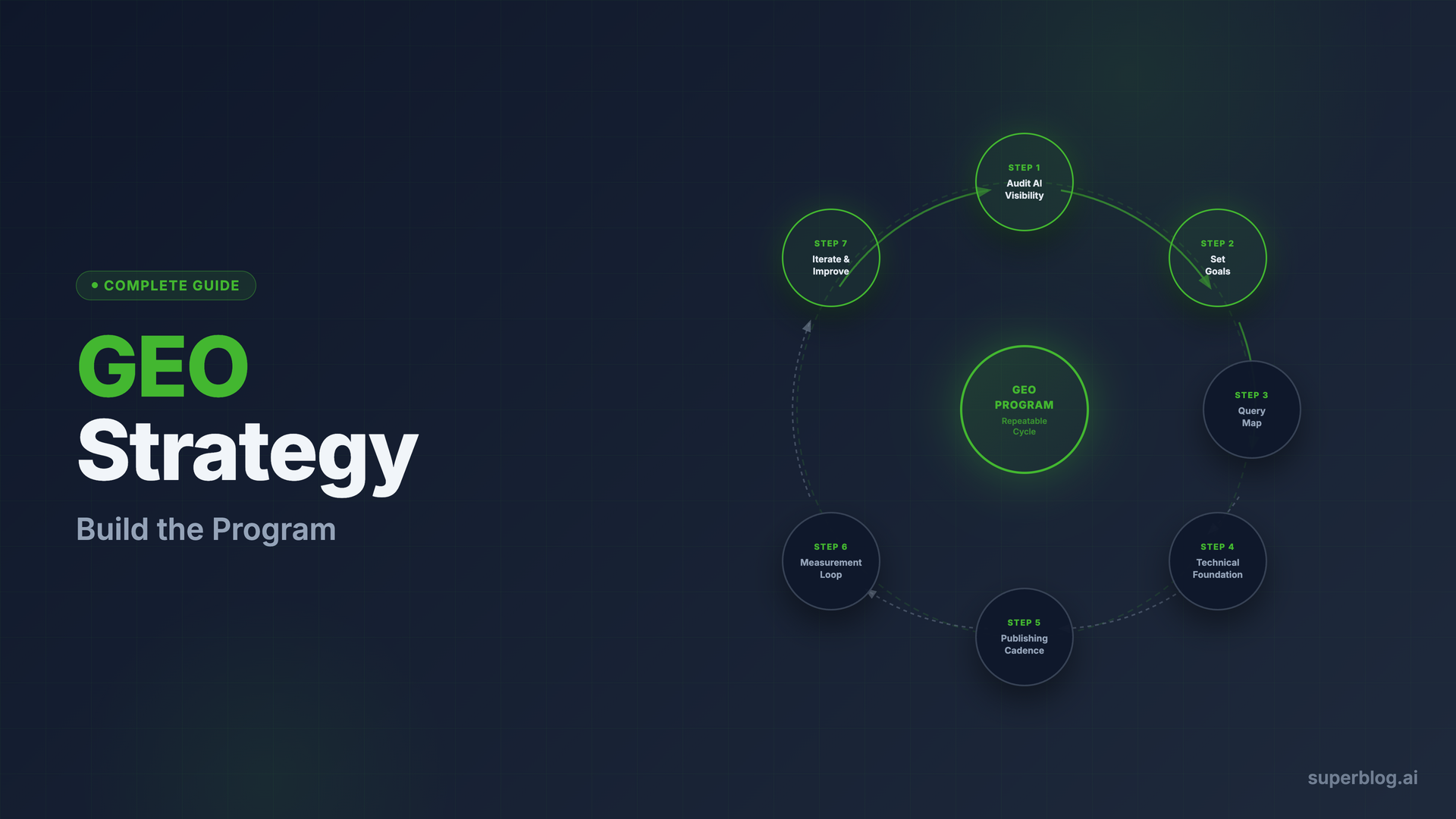
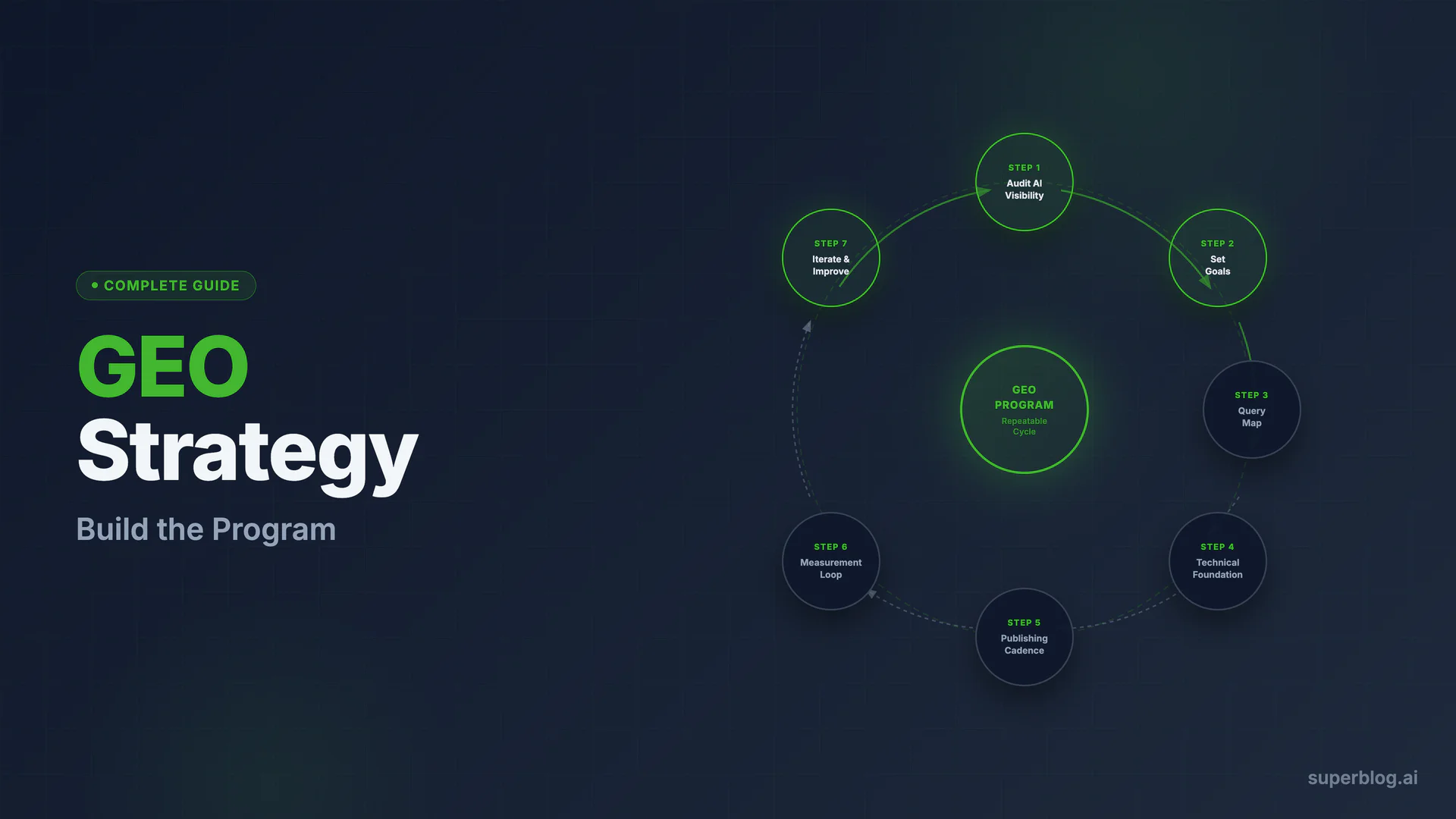
A GEO strategy is a marketing team's operating plan for earning citations inside AI-generated answers. Where traditional SEO asks "how do we rank in Google?", a GEO strategy asks "how do we become the source AI systems quote when our buyers ask questions?"
The tactics for getting cited, such as answer-first writing and FAQ schema, are well-documented. See our answer engine optimization guide for a full seven-tactic playbook and our AI SEO hub for the broader category. What most teams lack is not the tactics but the program layer: a repeatable process that connects audit to goals to content decisions to measurement and back.
This post covers that program layer. It is aimed at marketing managers, heads of growth, and content leads who need to move from "we should be doing GEO" to an actual operating plan their team can run.
What Makes a GEO Strategy Different from Tactical GEO Tips
Most GEO content lives at the tactics level: write clearer definitions, add FAQ blocks, check your robots.txt. That advice is correct and worth following. But tactics without program structure produce scattered effort.
A GEO program does four things a list of tactics cannot do on its own.
It defines a baseline. Before you can improve AI visibility, you need to know where you stand now. Most marketing teams have no idea whether AI systems are citing their content, for which queries, or at what rate.
It prioritizes. You cannot optimize every page for every AI engine simultaneously. A program identifies the highest-value queries, the pages with the most leverage, and the technical gaps that block everything else.
It creates accountability. A list of tactics is a wishlist. A program assigns owners, sets timelines, and checks whether things actually happened.
It closes the feedback loop. A program defines what metrics matter, how often to review them, and what decisions to make based on what you see.
The rest of this post walks through each layer of a GEO program in sequence.
Step 1: Audit Your Current AI Visibility
You cannot set meaningful goals without knowing your starting point. An AI visibility audit covers three areas.
Citation check
Query your target topics in ChatGPT, Perplexity, and Google AI Overviews. For each, note:
- Is your domain cited at all?
- If cited, for which queries?
- Which specific page is being pulled?
- What text is being quoted or paraphrased?
This is manual work and takes 60 to 90 minutes for a focused topic set. There is no reliable automated tool that covers all three platforms consistently as of mid-2026, though SE Ranking and Semrush both have beta citation tracking features worth watching. Do the manual check first, then layer in tooling as it matures.
Crawl access audit
AI systems cannot cite content they cannot read. Check your robots.txt for blocks on the following crawlers:
- OAI-SearchBot (governs ChatGPT search citations, distinct from GPTBot which is OpenAI's training crawler only)
- GPTBot (OpenAI training; does not affect ChatGPT search, but blocking it removes you from future training data)
- PerplexityBot (Perplexity's crawler)
- ClaudeBot (Anthropic)
- Google-Extended (Google AI training data only; does not affect AI Overviews eligibility, which draws from normal Googlebot ranking)
If any of these are blocked, fix that before anything else. It is the single fastest way to unlock AI visibility.
Technical foundation audit
Review your highest-value content for:
- Schema markup: does Article schema, FAQ schema, and Organization schema exist on each post?
- LLMs.txt: does your domain have one? Is it comprehensive and current?
- Page speed: are Lighthouse scores above 90? Slow pages rank lower in Google, and Google ranking is the prerequisite for Google AI Overviews inclusion.
- Static HTML rendering: can AI crawlers read a fully rendered page on first request, or does your CMS rely on client-side JavaScript rendering?
Document the gaps. This list becomes your technical workstream.
For a deeper comparison of how GEO intersects with traditional SEO fundamentals, see GEO vs SEO: What's Actually Different.
Step 2: Set Goals That Are Actually Measurable
GEO is young enough that goal-setting is still imprecise. That is not a reason to skip it. Vague goals ("improve our AI visibility") produce vague effort. Specific goals produce specific plans.
Useful GEO goals for 2026
Citation count by platform. Set a baseline from your audit and a target to reach by a fixed date. Example: "Appear as a cited source in Perplexity for 5 of our 20 target queries within 90 days."
Google impression trends. Google Search Console does not break out AI Overview impressions as a separate report or filter; they are folded into your standard Performance data, so you cannot isolate them directly. What you can do is watch overall impression trends on pages that already rank in positions 1 to 10, since those are the pages most likely to be pulled into AI Overviews, and treat a rise there as a reasonable proxy.
Referral traffic from AI platforms. Your analytics platform should show direct referrals from chat.openai.com, perplexity.ai, and gemini.google.com. Track this as its own acquisition channel. Superblog's own signup data shows AI assistants accounting for approximately 1 in 6 new signups, consistent with the growing weight of this channel for B2B content.
Content coverage score. Map your target queries against your published content. What percentage of high-priority queries have at least one well-optimized page targeting them? This is a leading indicator: coverage drives citations, and citations drive traffic.
Keep goals to two or three per quarter. Tracking more dilutes focus.
Step 3: Choose Your Content Types and Prioritize the Query Map
GEO performance is not uniform across content types. Some formats earn citations at much higher rates than others.
Content types that earn AI citations
Definitional content. Posts that clearly define a term or concept are heavily cited because AI systems need clean, attributable definitions. Every pillar concept in your space should have a dedicated page with a tight, liftable definition in the first paragraph.
Comparison content. "X vs Y" posts and comparison tables are frequently surfaced by AI systems when users ask comparative questions. These pages should open with a clear answer to the comparison, not a preamble.
How-to and process content. Step-by-step instructions with numbered lists get parsed and extracted reliably. AI systems reproduce numbered steps more often than prose explanations because the structure maps to a user's action plan.
FAQ-format content. FAQ blocks with schema markup are one of the highest-signal formats for AI citation. The machine-readable structure makes extraction unambiguous. Every substantial post should include an FAQ section.
Data and original research. AI systems prioritize citing sources that contain specific statistics, survey data, or proprietary findings. If you have original data, it belongs in a dedicated piece that can be cited by name.
Building your query map
A query map is the strategic core of a GEO program. It lists:
- Every query your buyers ask during their research process
- The current page on your site targeting that query (if any)
- Whether that page is optimized for AI citation
- The AI citation rate for that query (from your audit)
- The priority tier (high, medium, low) based on business value and gap size
Start with your top 20 to 30 queries. For each with no page, you need new content. For each with a page that lacks citation optimization, you need a refresh. For each with a page and citations, you need to protect and expand.
This map is a living document. Update it each quarter as you add content and as your audit data improves.
For a full breakdown of how GEO fits into your broader search strategy, see our AI visibility guide.
Step 4: Build the Technical Foundation
No amount of good writing overcomes a broken technical foundation. The technical layer of a GEO program has six components.
1. Crawl access
Confirmed above in the audit step. If AI crawlers are blocked, fix that first. Allow OAI-SearchBot, PerplexityBot, ClaudeBot, and GPTBot at minimum.
2. Schema markup
Every post needs Article schema (author, publisher, publish date) and Organization schema (company entity). Posts with Q and A content need FAQPage schema on every FAQ block. Without schema, AI systems have to infer what your content is and who produced it, which reduces trust and citation rates.
The most efficient way to handle this at scale is to use a platform that generates schema automatically rather than configuring it post by post. Superblog generates Article, FAQ, and Organization schema automatically for every post on every deploy, with no developer involvement.
3. LLMs.txt
An llms.txt file at your domain root provides AI agents with a curated, machine-readable index of your most important content. Think of it as a sitemap written for AI consumption rather than human navigation.
Superblog generates and updates LLMs.txt automatically on every deploy. If you are on another platform, use the LLMs.txt Generator to create one from your existing content. This is one of the few GEO signals that directly targets AI discovery rather than traditional search ranking.
4. Static HTML rendering
AI crawlers need to read a fully rendered HTML page on first request. Sites that rely on client-side JavaScript rendering deliver a shell to crawlers, not content. This is a structural disadvantage that no amount of schema or LLMs.txt can fix.
Superblog's JAMStack architecture pre-builds every page as static HTML served from a global CDN. OAI-SearchBot, ClaudeBot, PerplexityBot, and GoogleBot all receive a complete page. WordPress with JavaScript-heavy themes and many headless CMS setups do not.
5. Page speed
Google AI Overviews source from pages already ranking in the top 10. Ranking requires strong Core Web Vitals. A slow site does not rank, and a page that does not rank is not eligible for AI Overview inclusion. Page speed is therefore a GEO prerequisite, not just a user experience concern.
6. IndexNow
Publishing new content and waiting for crawlers to find it creates a freshness gap. IndexNow sends an immediate notification to Bing, Yandex, and other participating engines the moment you publish. Faster indexing means faster entry into retrieval pools. Superblog sends IndexNow pings automatically on every publish.
Step 5: Set a Publishing Cadence That Builds Coverage
AI citation is partly a coverage game. The more queries you have well-optimized pages for, the more surface area you present to AI systems. A publishing cadence that systematically closes coverage gaps compounds over time.
The coverage-first approach
For most business blogs building a GEO program, the first 6 months should prioritize coverage over polish. A solid page targeting a query that AI systems are actively surfacing will earn more citations than a perfectly polished page targeting a query nobody asks.
Map your 20 to 30 highest-priority queries. For each without a page, estimate the writing and optimization effort. Plan one to two new pieces per week, with a monthly refresh pass on existing high-priority pages.
Refresh cadence
AI systems favor fresh content for evolving topics. Any page covering a topic where facts, statistics, or platform capabilities change should be reviewed at least quarterly. Add a "Last updated" signal in your schema's dateModified field. This is a direct freshness signal that AI systems read.
Cluster depth
AI systems cite authoritative sources. Authority, in the AI citation model, correlates with topic depth: do you have one good post on a topic, or do you have a cluster of interconnected posts that signal comprehensive expertise?
For each topic cluster in your content plan, identify the pillar page (broad definition, comprehensive coverage) and 3 to 5 supporting pages (tactical details, comparisons, use cases). Internal links between the cluster members reinforce topical authority. Superblog's internal link suggestions tool surfaces related posts with suggested anchor text automatically, which makes maintaining cluster depth easier as you publish more content.
Step 6: The Measurement Loop
A GEO program without a measurement loop is just a to-do list. Measurement closes the feedback cycle and tells you where to focus next.
Weekly signals (operational)
- New referral traffic from AI platforms (chatgpt.com, perplexity.ai, gemini.google.com)
- IndexNow ping confirmations and new pages indexed
- Any spikes in traffic to specific pages (often the first sign of a new citation)
Monthly review (tactical)
- Impression trends in Google Search Console (AI Overview impressions are folded into standard Performance data, with no separate filter)
- AI platform referral traffic trend versus previous month
- Manual citation check on 5 to 10 high-priority queries
- Schema validation pass on new pages published that month
- Query map update: new pages added, gaps closed, citations earned
Quarterly review (strategic)
- Full citation audit across ChatGPT, Perplexity, and Google AI Overviews for the complete target query list
- Content coverage score update: what percentage of target queries have a citation-optimized page?
- Competitive citation check: are competitors being cited for queries where you are not? What does their content do differently?
- Goal assessment: did you hit the targets set at the start of the quarter? What drove the results?
- Goal reset for the next quarter
The decision framework
Each monthly and quarterly review should end with three decisions:
- What to create: Queries with no current page and confirmed AI surfacing frequency
- What to refresh: Existing pages with traffic or impressions but no AI citations (structure problem, not ranking problem)
- What to protect: Pages already earning citations, which need monitoring for freshness and competitor moves
Step 7: Iterate Based on What You Learn
The fastest-improving GEO programs treat each refresh as an experiment. When you update a page, document what you changed, when you changed it, and what happened in the 30 days after.
Common patterns from optimization experiments
Adding a definition block to the opening paragraph often produces the largest single-page improvement. If a post ranks well but earns no AI citations, the likely cause is a buried or absent definition. AI systems need a liftable sentence in the first 200 words.
Adding FAQ schema to an existing FAQ section is lower effort than rewriting content. If your posts already include Q and A sections but lack FAQPage schema, that is a quick technical win worth prioritizing.
Updating statistics and refreshing the dateModified field tends to improve freshness signals within one to two crawl cycles for AI systems that weight recency.
Adding internal links from the current page to pillar content and from pillar content back to the refreshed page reinforces topical authority without creating new content.
Track these experiments in a lightweight log: URL, change made, date, citation count before and after (at 30 days). Over time, patterns emerge that are specific to your audience and content type, which improves your prioritization in future quarters.
How Superblog Handles the Technical Layer of GEO
The program steps above involve two distinct types of work: strategic decisions (what to write, what to prioritize, how to measure) and technical implementation (schema, LLMs.txt, crawl access, page speed).
Strategic decisions require your team's judgment. Technical implementation does not, and it should not require developer cycles every time you publish.
Superblog is built to automate the technical GEO layer completely:
- Auto JSON-LD schemas on every post and page: Article, FAQ, Organization, all generated and maintained automatically
- LLMs.txt generation updated on every deploy, following the current standard format
- IndexNow pings on every publish, for faster entry into AI retrieval pools
- Static HTML from a global CDN so AI crawlers receive a complete, renderable page on first request, with no client-side JavaScript dependency
- 90+ Lighthouse score automatically on every page, keeping you eligible for Google AI Overview selection
- AI crawler access configured correctly by default (OAI-SearchBot, GPTBot, ClaudeBot, PerplexityBot all permitted)
- Internal link suggestions to help maintain cluster depth as your content library grows
The result is that your team focuses on steps 1 through 7 above, specifically the audit, goal-setting, query mapping, content decisions, and measurement, while Superblog handles the infrastructure that makes any of that effort visible to AI systems.
Plans start at $29/month. All plans include LLMs.txt, auto-schema, IndexNow, CDN hosting, and a free 7-day trial without a credit card.
Frequently Asked Questions
What is a GEO strategy?
A GEO strategy is a marketing team's operating plan for earning citations inside AI-generated answers from platforms like ChatGPT, Perplexity, Google AI Overviews, and Claude. It covers the full program cycle: auditing current AI visibility, setting measurable goals, building a query map, fixing the technical foundation (schema, LLMs.txt, crawl access), setting a publishing cadence, and running a measurement loop that feeds back into the next cycle. GEO is functionally the same discipline as AEO (answer engine optimization); the terms are used interchangeably.
Where do I start if my team has never done GEO before?
Start with the crawl access audit: check your robots.txt for blocks on OAI-SearchBot, PerplexityBot, ClaudeBot, and GPTBot. Blocked crawlers are the fastest source of fixable invisibility. Then run a manual citation check in ChatGPT and Perplexity for your 10 most important queries to establish a baseline. With that data, you can set a realistic first-quarter goal and build a prioritized query map. The generative engine optimization pillar covers the definitional layer; the answer engine optimization guide covers the writing tactics.
How long does it take to see results from a GEO program?
Technical fixes (crawl access, schema, LLMs.txt) can produce citation changes within weeks, because AI retrieval systems update more frequently than traditional Google rankings. Content changes (new pages, refreshes with definition blocks and FAQ schema) typically take 4 to 8 weeks to appear in citation audits. A full program cycle, audit to goal to content to measurement, runs quarterly. Most teams see meaningful citation growth within 60 to 90 days of fixing technical blockers and publishing optimized content.
What is the difference between GEO strategy and GEO tactics?
GEO tactics are individual techniques: write an answer-first definition, add FAQ schema, create an LLMs.txt file. A GEO strategy is the program that coordinates those tactics: which queries to prioritize, in what order, with what resources, measured against which goals, reviewed on what cadence. Tactics without strategy produce scattered effort. Strategy without tactics produces plans that never get executed. Both are required.
Do I need a developer to implement a GEO program?
For content decisions, measurement, and query mapping, no. For technical implementation (schema markup, LLMs.txt, crawl configuration, static HTML rendering), it depends on your platform. WordPress requires plugin configuration and ongoing maintenance. Managed platforms like Superblog handle all technical GEO infrastructure automatically on every deploy. If your current setup requires developer time for schema or LLMs.txt updates, that dependency will slow down your program's iteration speed.
How do I measure GEO performance?
The core measurement stack: (1) Google Search Console impression trends (AI Overview impressions are included in standard Performance data, not separately filterable), (2) referral traffic from AI platforms in your analytics (chat.openai.com, perplexity.ai, gemini.google.com), (3) manual citation audits in ChatGPT and Perplexity for your target query list, (4) content coverage score (percentage of target queries with a citation-optimized page). Review the first two monthly, run the citation audit quarterly, and update the coverage score at each quarterly review. See our AI visibility guide for more on tracking this channel.
What content types earn the most AI citations?
Definitional content (clear answers to "what is X"), comparison content ("X vs Y" with an explicit verdict), step-by-step process content, and FAQ-format content with schema markup all earn citations at higher rates than prose-heavy narrative content. The common thread is extractability: AI systems cite content that can be quoted or summarized without losing meaning. The answer engine optimization guide covers the writing mechanics in detail.
What is LLMs.txt and why does it matter for GEO strategy?
LLMs.txt is a machine-readable file at your domain root that provides AI agents with a curated index of your most important content, formatted for AI consumption. Including LLMs.txt generation in your technical foundation is one of the few GEO signals that specifically targets AI discovery rather than traditional search. Use the LLMs.txt Generator to build one for your current domain, or use Superblog, which generates and maintains it automatically.
Your blog, without the maintenance
Fast pages, automatic SEO, no plugins to patch. Runs on yoursite.com/blog.
Sai Krishna is the Founder and CEO of Superblog. Having built multiple products that scaled to tens of millions of users with only SEO and ASO, Sai Krishna is now building a blogging platform to help others grow organically.
superblog
Superblog is a blazing fast blogging platform for beautiful reading and writing experiences. Superblog takes care of SEO audits and site optimizations automatically.