
9 Generative Engine Optimization Tools Worth Using in 2026
Nine verified GEO tools compared: citation monitoring, content optimization, and infrastructure, with real pricing and honest limitations...

ChatGPT, Perplexity, Gemini, and Google's AI Overviews now answer questions your buyers used to type into a search box. If those answers cite your competitors and not you, you lose deals you never knew existed. That shift created a new software category almost overnight: generative engine optimization tools.
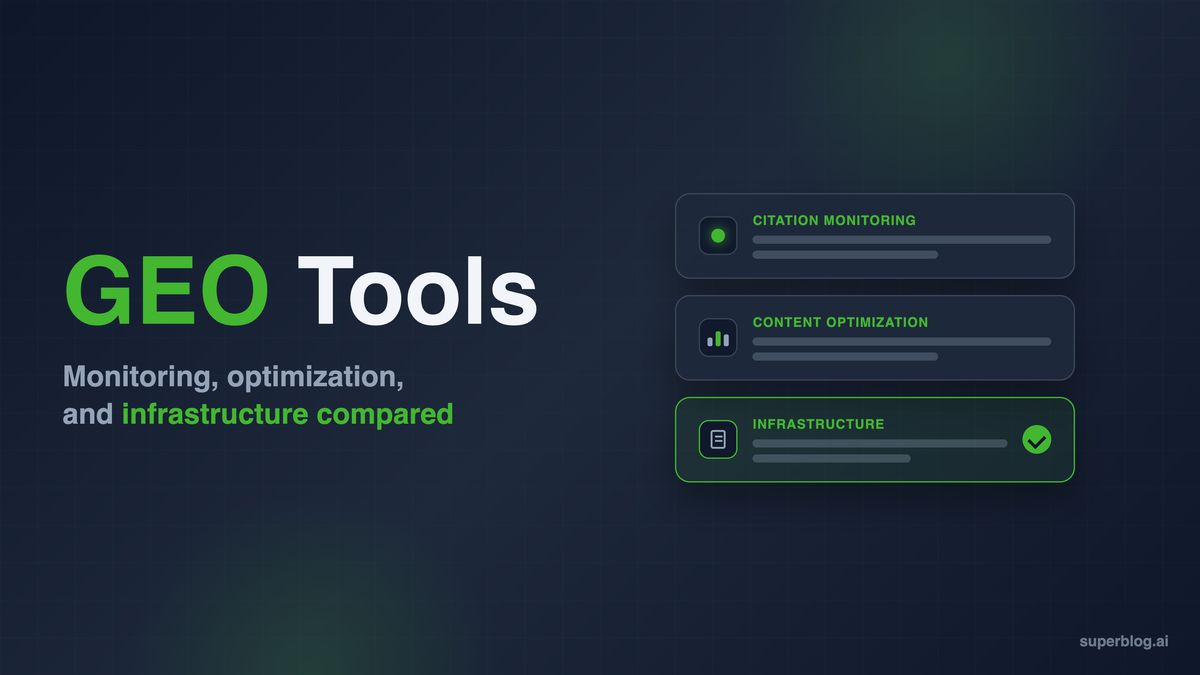
The category is crowded and confusing. Some tools monitor whether AI engines mention your brand. Some help you produce content AI engines want to cite. Some fix the technical plumbing that determines whether AI crawlers can read your site at all. Most vendor comparisons blur these together.
This guide sorts 9 tools into those three categories, with verified pricing (as of July 2026) and an honest limitation for each. One disclosure up front: Superblog, listed in the infrastructure category, is our product. Everything else here is a third-party tool we have no stake in.
New to the discipline itself? Read our generative engine optimization guide first. This post assumes you know why AI citations matter and want to pick tooling.
The three types of GEO tools
Before you spend a dollar, understand what job each category does:
- Citation monitoring: Tracks how often AI engines mention your brand or cite your pages, and against which prompts. This is measurement, not improvement.
- Content optimization: Analyzes AI answers and tells you what to write or restructure so engines cite you more often.
- Infrastructure: Makes your site machine-readable in the first place: LLMs.txt, structured data, fast crawlable HTML, and rapid indexing. Without this layer, the other two categories measure and optimize a site AI crawlers struggle to parse.
Most budgets get this backwards. Teams sign a four-figure monitoring contract, watch a flat citation graph for a quarter, and only then discover their pages render client-side, carry no structured data, and offer AI crawlers nothing to cite. Monitoring is the last thing to buy, not the first. The order that works: make your content parseable, publish content worth citing, then measure. Keep that sequence in mind as you read the list, because the tools below are priced as if monitoring were the whole job.
Quick comparison
| Tool | Category | Starting price | Built for |
|---|---|---|---|
| Profound | Citation monitoring | $99/mo (full platform is enterprise-priced) | Enterprise brands |
| Peec AI | Citation monitoring | $89/mo | Marketing teams and agencies |
| Otterly.AI | Citation monitoring | $29/mo | Small teams and solo marketers |
| Ahrefs Brand Radar | Citation monitoring | $199/mo per AI platform, plus Ahrefs plan | Existing Ahrefs customers |
| Semrush AI Visibility Toolkit | Citation monitoring | $99/mo per domain | Existing Semrush customers |
| Goodie AI | Content optimization | ~$399+/mo, quote-based | Mid-market and enterprise |
| Writesonic | Content optimization | $249/mo for GEO features | Content teams |
| HubSpot AEO Grader | Content optimization (audit) | Free | Anyone starting out |
| Superblog | Infrastructure | $29/mo | Business blogs that want GEO built in |
Citation monitoring tools
1. Profound
What it does: Profound is the heavyweight of AI visibility. It tracks how your brand appears in answers from ChatGPT, Perplexity, Gemini, Google AI Overviews, and other engines, with agent analytics that show which AI crawlers hit your site. The company raised a $96M Series C at a $1 billion valuation in early 2026, which tells you where enterprises are placing bets.
Who it's for: Enterprise brands with dedicated SEO or brand teams and real budget.
Pricing: A $99/mo Starter plan covers ChatGPT only. Growth runs $399/mo. Full enterprise deployments land between $2,000 and $5,000+ per month, quote-based.
Honest limitation: The useful version of Profound sits behind an enterprise sales process. No self-serve signup for full access, no free trial. If you run a 10-person marketing team, this is more platform than you need.
2. Peec AI
What it does: Peec AI tracks brand mentions and source citations across ChatGPT, Perplexity, Gemini, and AI Overviews, with competitor benchmarking and prompt discovery. It separates two signals that matter: when AI names your brand, and when AI uses your content as a source without naming you.
Who it's for: Marketing teams and SEO agencies that want serious tracking without enterprise procurement. Unlimited seats on every plan is a genuine differentiator.
Pricing: Starts at $89/mo for 25 tracked prompts. Pro is $199/mo for 100 prompts, with higher tiers beyond that.
Honest limitation: Pricing scales with tracked prompts, so costs climb as your keyword universe grows. And like every monitoring tool, it tells you where you stand. It does not fix anything.
3. Otterly.AI
What it does: Otterly.AI monitors your brand, links, and content across ChatGPT, Google AI Overviews, Perplexity, and Copilot. You get a Brand Visibility Index, link citation analysis, and GEO URL audits that check whether individual pages are fit for AI consumption.
Who it's for: Small teams and solo marketers. This is the lowest-priced entry point into real AI search monitoring.
Pricing: Lite is $29/mo for 15 prompts. Standard is $189/mo for 100 prompts, Premium $489/mo for 400. There's a 7-day free trial, no card required.
Honest limitation: 15 prompts on the Lite plan runs out fast once you start tracking competitors alongside your own brand. Gemini and Google AI Mode tracking cost extra as add-ons.
4. Ahrefs Brand Radar
What it does: Brand Radar is Ahrefs' add-on for AI visibility, monitoring brand mentions across Google AI Overviews, AI Mode, ChatGPT, Perplexity, Gemini, and Copilot. Its edge is the prompt database: 260M+ prompts derived from real search behavior rather than guesses about what people ask AI.
Who it's for: Teams already paying for Ahrefs who want AI visibility inside a familiar dashboard.
Pricing: $199/mo per AI platform index, or $699/mo for all six. That sits on top of a base Ahrefs subscription starting at $129/mo, so realistic all-in costs run $828+ per month.
Honest limitation: Independent tests found its AI Overviews data directionally solid but its ChatGPT mention counts unreliable, with one test surfacing 3 reported mentions against 123 found manually. If chat assistants matter more to you than Google surfaces, verify before you commit.
5. Semrush AI Visibility Toolkit
What it does: Semrush's AI Visibility Toolkit tracks brand presence, sentiment, and share of voice across major AI engines, and folds those metrics into the reporting stack your team may already use for rankings and backlinks. It pairs naturally with the classic blog SEO tools most content teams already run.
Who it's for: Existing Semrush customers who want one vendor for search and AI visibility.
Pricing: $99/mo per domain as an add-on to a Semrush subscription. The Semrush One bundle, which includes both SEO and AI toolkits, starts at $199/mo. Extra prompt capacity costs $60/mo per 50 prompts.
Honest limitation: Per-domain pricing compounds quickly for agencies or multi-site companies, and the add-on has no standalone free trial.
Content optimization tools
6. Goodie AI
What it does: Goodie goes beyond monitoring into an action layer: it analyzes how AI engines answer prompts in your category, then generates optimization recommendations and content briefs designed to win citations. It also tracks AI crawler activity on your site.
Who it's for: Mid-market and enterprise brands that want monitoring and optimization in one platform, with the budget to match.
Pricing: Quote-based. Reviewers report entry pricing around $399 to $500 per month, with tiers scaling by model coverage and prompt capacity.
Honest limitation: No public pricing page with hard numbers, which means a sales call before you know what you'll pay. Small teams should look elsewhere first.
7. Writesonic
What it does: Writesonic evolved from an AI writing tool into a GEO platform. It tracks visibility across ten AI engines, runs citation gap analysis showing which sources cite competitors but not you, and prioritizes fixes in an Action Center ranked by effort and impact. Bot crawler analytics show which AI crawlers actually visit your pages.
Who it's for: Content teams that want tracking, recommendations, and content production under one login.
Pricing: GEO features start on the Professional plan at $249/mo. The cheaper Lite ($49/mo) and Standard ($99/mo) tiers are writing tools only.
Honest limitation: The plans most people associate with Writesonic don't include any GEO capability. If you only need visibility monitoring, $249/mo buys a lot of content features you may never touch.
8. HubSpot AEO Grader
What it does: HubSpot's AEO Grader is a free checker that queries ChatGPT, Perplexity, and Gemini about your brand and scores the result out of 100 across five dimensions: sentiment, presence quality, brand recognition, share of voice, and market competition. No account required.
Who it's for: Anyone who wants a baseline read on AI visibility before spending money. Run it on your brand and two competitors and you'll learn more in ten minutes than most pitch decks teach.
Pricing: Free, unlimited runs. Ongoing monitoring through HubSpot AEO costs $50/mo, or comes bundled with Marketing Hub Pro and Enterprise.
Honest limitation: It's a snapshot, not a tracker. There's no historical trend, no prompt-level tracking, and the paid upgrade pulls you into the HubSpot ecosystem.
Infrastructure: the layer monitoring tools can't fix
9. Superblog
Disclosure: Superblog is our product. We're including it because infrastructure is the GEO category most tool roundups skip, and it's the one that determines whether the other tools have anything to measure.
What it does:Superblog is a managed blogging platform that ships GEO infrastructure automatically. Every blog gets an auto-generated LLMs.txt file, updated on every deploy, so AI tools can discover and cite your content. JSON-LD structured data (Article, FAQ, Organization, Breadcrumb) generates without plugins, following the same patterns in our schema markup guide. IndexNow pings search engines the moment you publish. Pages ship as static HTML that AI crawlers parse without executing JavaScript, and an MCP server lets AI agents work with your content directly.
Who it's for: Businesses that want their blog citation-ready without maintaining plugins, schemas, and crawler configs by hand.
Pricing: From $29/mo, with a 7-day free trial. If your site runs elsewhere, our free LLMs.txt generator builds a spec-compliant file for any website, no signup needed.
Honest limitation: Superblog is a blogging platform, not a monitoring dashboard. It won't track your brand mentions in ChatGPT, and it covers your blog rather than your entire marketing site. Pair it with one monitoring tool from the list above and you have both halves.
You don't need 9 tools
Here's the pragmatic version nobody selling software will give you:
- Start free. Run HubSpot's AEO Grader on your brand and your top two competitors. That baseline costs nothing and tells you how urgent this is.
- Fix infrastructure before buying dashboards. Monitoring a site that AI crawlers can't parse produces expensive charts of zero. LLMs.txt, structured data, and clean static HTML are the cheapest items on this list and they compound. Generate an LLMs.txt file today, whatever platform you're on.
- Add one monitoring tool when you have citations to track. Otterly.AI at $29/mo or Peec AI at $89/mo covers most teams. Skip Profound and Goodie until AI referral traffic shows up in your analytics with revenue attached.
- Let content do the ranking. AI engines cite pages with direct answers, specific data, and clear structure. No tool substitutes for that.
For most businesses, the winning stack is two tools: a platform that handles the infrastructure automatically and one monitor that tells you whether it's working. Everything else is optional until the traffic proves otherwise.
A concrete example: a 20-person SaaS company running its blog on infrastructure that generates LLMs.txt and schemas automatically, plus Otterly.AI's Lite plan, spends $58/mo total and covers all three categories. The same coverage assembled from enterprise tools runs past $2,500/mo before anyone writes a word. The delta buys a lot of content, and content is what AI engines actually cite.
Frequently asked questions
What do generative engine optimization tools actually do?
They fall into three groups. Citation monitors track how often AI engines like ChatGPT and Perplexity mention your brand or cite your pages. Content optimizers analyze AI answers and recommend what to write to win more citations. Infrastructure tools make your site machine-readable through LLMs.txt files, structured data, and fast crawlable HTML. Most vendors sell monitoring; infrastructure is the layer that determines whether there's anything to monitor.
Do GEO tools replace SEO tools?
No. AI engines pull heavily from pages that already rank in traditional search, so strong SEO remains the foundation of GEO. Treat GEO tools as an extension of your SEO stack, not a replacement. The overlap is why Ahrefs and Semrush shipped AI visibility as add-ons to their existing platforms rather than separate products.
How much should you spend on GEO tools?
Start at zero with HubSpot's free AEO Grader and a free LLMs.txt generator. A small business gets real coverage for under $60/mo by pairing infrastructure that handles GEO automatically with an entry-level monitor like Otterly.AI. Enterprise platforms like Profound and Goodie make sense once AI engines drive measurable pipeline, which for most companies is not yet the case in 2026.
Your blog, without the maintenance
Fast pages, automatic SEO, no plugins to patch. Runs on yoursite.com/blog.
Sai Krishna is the Founder and CEO of Superblog. Having built multiple products that scaled to tens of millions of users with only SEO and ASO, Sai Krishna is now building a blogging platform to help others grow organically.
superblog
Superblog is a blazing fast blogging platform for beautiful reading and writing experiences. Superblog takes care of SEO audits and site optimizations automatically.