
Gemini, Copilot, and Claude SEO: How to Get Cited by Every AI Assistant (2026)

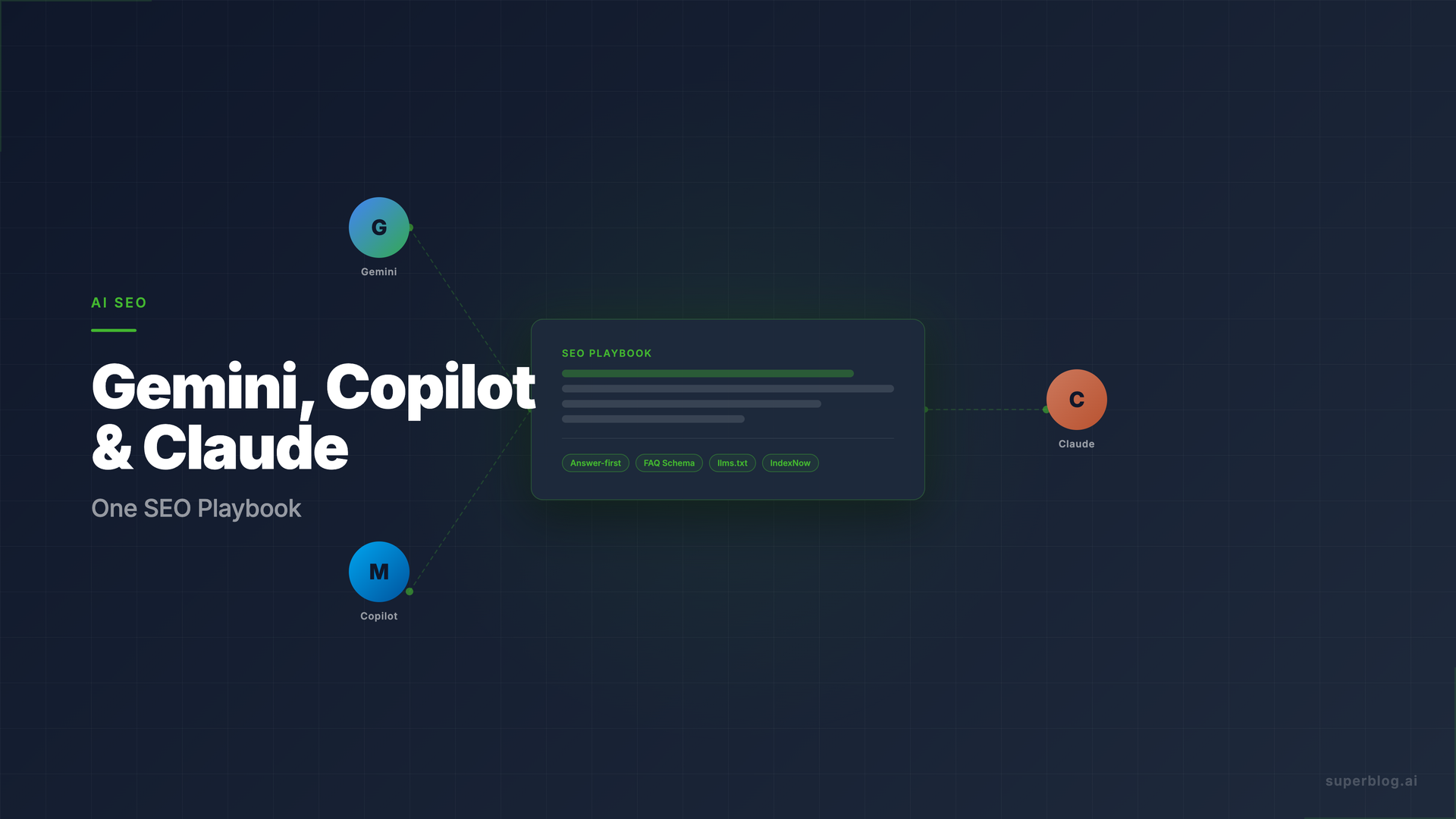
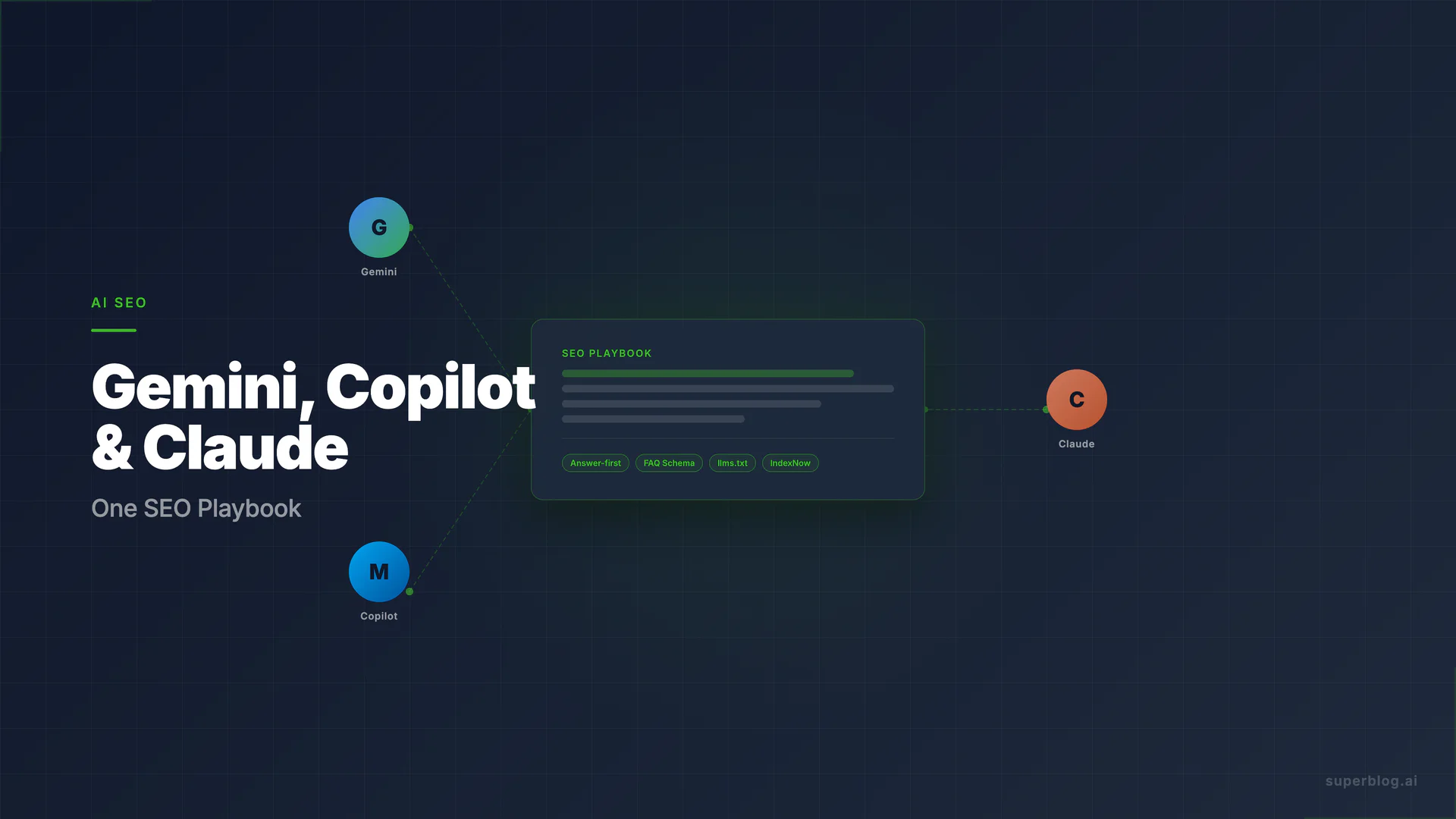
Gemini SEO, Copilot SEO, Claude SEO: three different names, one underlying insight. Each major AI assistant sources its answers from a different index, but the content characteristics that earn citations are nearly identical across all three.
The key difference is where to apply pressure. Gemini draws from Google's search index. Microsoft Copilot draws from Bing. Claude uses its own ClaudeBot crawler plus web search integrations. Understanding those sourcing differences tells you exactly where to invest: strong Google SEO compounds into Gemini presence, Bing indexing is a real but neglected lever for Copilot visibility, and Claude rewards the structural and schema signals that every serious blog should already have.
This guide walks through what makes each assistant tick, then gives you the shared playbook that covers all three at once. If you want the full theory behind optimizing for generative engines, read our complete AI SEO guide. For the tactical mechanics of getting AI assistants to recommend your brand specifically, see how to get cited by ChatGPT.
Why Each AI Assistant Sources Differently
Before writing a single word of "AI-optimized" content, you need to understand what each assistant is actually doing when it generates an answer.
AI assistants are not running a unified search. They each have a retrieval layer that sits between the user's question and the language model's answer. That retrieval layer determines which content gets considered, which gets cited, and which gets ignored entirely.
The three retrieval architectures are:
- Gemini is Google's AI product. Its grounded answers draw from the same pages Google's search engine indexes and ranks. Your Googlebot access and organic rankings directly influence what Gemini sees.
- Copilot is Microsoft's AI product. It draws from Bing's search index. Most business blogs optimize almost exclusively for Google and neglect Bing indexing, making Bing a real arbitrage opportunity for Copilot citations.
- Claude is Anthropic's AI. It uses ClaudeBot, Anthropic's web crawler, for training and context. In its web-connected modes, it also runs live retrieval. Claude also supports Superblog's MCP integration, which is a meaningful structural advantage for Superblog users.
None of these assistants share a common retrieval pool. A page that ranks well on Google will generally do well in Gemini, but may have zero Bing presence and therefore near-zero Copilot presence. Fixing that imbalance requires targeted work on Bing indexing alongside the standard Google SEO foundation.
Gemini SEO: Rank on Google, Show Up in Gemini
Gemini is the most straightforward of the three to optimize for, because the mechanism is well-understood: Google indexes your page, your page ranks in organic results, and Gemini can surface that content when answering relevant queries.
There is one widely misunderstood point worth stating clearly: Google-Extended controls Google AI training data only. It has no effect on AI Overviews or Gemini's search-grounded answers. If you block Google-Extended in your robots.txt, you opt out of Google using your content for model training. You do not affect your visibility in Gemini's search-grounded responses, which draw from the regular indexed and ranked results via Googlebot. Blocking Google-Extended will not help or hurt your Gemini citations. See our AI crawlers guide for the full breakdown of which bots serve which purposes.
What actually drives Gemini citations:
Organic ranking is the primary lever. Gemini tends to surface content from the same pages that appear in the top organic results for a query. If your content does not rank in Google's organic index, it is unlikely to appear in Gemini's grounded answers. The implication is blunt: standard Google SEO is standard Gemini SEO. Technical fundamentals, E-E-A-T signals, high-quality content, and backlinks all apply directly.
Answer-first structure increases extraction probability. Gemini's grounded answers often extract a short, direct passage from a source page. If your key answer is buried in paragraph five, you are a weaker candidate than a page that states its answer in the first two sentences of a section. This structural shift, leading with the answer before supporting it, is the highest-leverage content change most business blogs can make.
Schema markup signals content type. Article schema, FAQ schema, and BreadcrumbList all help Google understand your page structure before it reads a single sentence of prose. FAQ schema is particularly useful: the question-and-answer format maps directly to how Gemini extracts answers, and a page with explicit FAQ markup is a cleaner extraction target than an equivalent page with the same content buried in prose.
Named entities strengthen confidence. Gemini's responses are more likely to cite sources that have established entity authority: a clear organizational identity, bylined authors, and consistent publication on a branded domain. Anonymous or generic-looking blogs score lower on this dimension regardless of content quality.
Freshness matters. Gemini shows preference for recently published or recently updated content on queries where recency is relevant. Keeping your high-value posts updated with current data, reviewed annually at minimum, is a direct lever for AI citation rates.
Copilot SEO: The Bing Opportunity Most Blogs Ignore
Microsoft Copilot sources its answers from Bing's search index. This is well-documented: Copilot is built on Bing's retrieval infrastructure. The implication is direct: if your site is not indexed and ranking in Bing, you have minimal Copilot presence regardless of how well you perform on Google.
Most business blogs neglect Bing. Google dominates search volume, so most teams optimize for Google and check whether Bing is working as an afterthought, if at all. That neglect creates a genuine competitive gap: your competitors are likely underrepresented in Bing too, which means the Copilot citation landscape is less contested than the Gemini landscape.
The actions that move Bing indexing:
Bing Webmaster Tools is non-optional. Submit your sitemap, verify your domain, and monitor your index coverage in Bing Webmaster Tools the same way you do in Google Search Console. Many business blogs have never done this. Bing's index discovery lags Google's by a meaningful margin if you rely on passive crawl; active submission closes that gap.
IndexNow is the highest-leverage Bing signal for blogs. IndexNow is an open protocol that notifies participating search engines, including Bing, of new or updated content via a single API call. When you publish a post, an IndexNow submission tells Bing about it immediately rather than waiting for the next crawl cycle. Bing was one of the earliest major adopters of IndexNow and treats it as a primary freshness signal. For a full implementation guide, see IndexNow for blogs. Superblog sends IndexNow notifications automatically on every publish, with no configuration needed.
Content quality signals translate from Google to Bing. Bing's ranking algorithm differs from Google's, but the inputs overlap substantially: content quality, site authority, backlinks, and structured data all matter. A site that performs well on Google will generally perform adequately on Bing with the additional indexing steps above.
Microsoft Clarity integration builds behavioral signals. Bing's ranking incorporates user engagement signals. Microsoft Clarity (Microsoft's free analytics product) feeds behavioral data back into Bing's quality assessment. It is not a large factor, but it is a Bing-specific signal worth knowing.
The Copilot opportunity is real. Businesses that build Bing indexing into their standard publishing workflow get Copilot presence essentially for free, as a byproduct of doing the indexing work. Most of their competitors have not done this.
Claude SEO: Structure, llms.txt, and a Superblog Native Advantage
Claude operates differently from Gemini and Copilot in two ways that are relevant for content strategy.
First, Anthropic runs its own crawler: ClaudeBot. This crawler indexes content for model training and for informing Claude's context. Allowing ClaudeBot in your robots.txt is a prerequisite for Claude to have direct familiarity with your content. This is distinct from OAI-SearchBot (OpenAI's search-specific crawler) and GPTBot (OpenAI's training-only crawler). Each AI company runs its own crawlers for distinct purposes.
Second, llms.txt is worth having as part of any AI-facing content strategy. The llms.txt file is a machine-readable markdown document at the root of your domain that lists your most important pages and summarizes your site's content for AI consumption. Where robots.txt tells crawlers what to avoid, llms.txt is a proposed convention meant to guide AI systems toward the content you want surfaced. Adoption is still emerging, and no vendor has publicly confirmed exactly how each assistant uses a third-party llms.txt file, but it is low-cost to publish and forward-looking. For the full implementation walkthrough, see our llms.txt for AI search guide.
Third, and most relevant for Superblog users: Claude supports Superblog's MCP integration. MCP (Model Context Protocol) is an open standard that lets AI systems like Claude interact directly with external tools and services. Superblog's Super plan includes MCP support, which means Claude can be configured to manage a Superblog blog natively, including reading post data, creating drafts, and triggering deploys, directly from a Claude conversation. This native integration is covered in detail in the MCP support for Claude Code post. For SEO purposes, the integration means Claude has richer, more current context about Superblog and Superblog-powered blogs than it does about competing platforms.
What drives Claude citations in practice:
Crawl access for ClaudeBot. Verify your robots.txt does not block ClaudeBot. Many blocks are inherited from default templates that were set before AI crawlers existed as a category. Check your current configuration before assuming access is open.
Answer-first writing. Claude's extraction behavior mirrors the other assistants: it favors sources that state their answer directly in the first sentence or two of a relevant section. The structural playbook below applies here too.
Entity clarity. Claude's responses, like Gemini's, reward sources with clear organizational identity: who published this, what company it represents, and what the content is about. Ambiguity works against citation. Your Organization schema, About page, and authorship signals all contribute to this.
llms.txt. Superblog generates and updates your llms.txt automatically on every deploy. If you are on a different platform, build one for your domain and keep it current as you publish new content.
The Shared Playbook: One Structure That Covers All Three
The per-engine differences are real, but the overlap is larger. The following tactics apply to Gemini, Copilot, and Claude simultaneously. Running this playbook gives you broad AI citation coverage without building three separate strategies.
1. Answer-first structure throughout
Every section of every post should open with the direct answer to the implicit question, then support it with evidence, context, and examples. This is not a stylistic preference; it is a retrieval signal. AI systems scan for extractable answers, and the first two sentences of a section are the highest-probability extraction target.
If you are retrofitting existing content, the highest-leverage edit is not adding new sections but moving your key answers to the top of each existing section.
2. FAQ schema on every post
FAQ schema translates your question-and-answer sections into machine-readable JSON-LD that AI systems can parse without inference. A page with FAQ markup removes ambiguity from the extraction process. The question is explicitly labeled as a question; the answer is explicitly labeled as an answer.
Include at least four to six FAQ items per post. Write them as real questions your audience types into search engines, not marketing language. Superblog generates FAQ schema automatically from FAQ blocks in the editor.
3. Entity signals on every page
Your Organization schema should appear on every page, not just the homepage. It should include: your organization name, website URL, logo, and a brief description of what you do. Authorship markup on blog posts (Person schema linked to the article's author) adds additional entity clarity.
This is not about gaming any single algorithm. Entity clarity is a trust signal that all AI systems use to assess source reliability. A blog that looks authoritative and clearly identified is a safer citation target than an anonymous one.
4. llms.txt maintained and current
Publish a llms.txt file at the root of your domain and keep it updated as you add content. The file should list your most important pages with brief descriptions of what each covers. If your most important SEO posts are not listed, they are relying on passive discovery.
5. IndexNow on every publish
IndexNow notifies Bing (and other participating engines) immediately when you publish. For Copilot presence, this is the single most impactful implementation step because it closes the lag between publishing and Bing indexing. For Google-backed Gemini, the equivalent is a well-maintained XML sitemap submitted to Google Search Console. Both should be operating automatically on every publish.
6. Freshness maintenance
AI assistants prioritize current content on queries where the answer can change over time. Set a schedule for reviewing and updating your highest-value posts: update statistics, revise claims that may have changed, and update the review date in your post metadata. A post last touched in 2023 on a rapidly-evolving topic is a weaker citation candidate than an equivalent post updated this quarter.
7. Crawl access audit for all AI bots
Check your robots.txt for inadvertent blocks on AI crawlers. The crawlers you want to allow:
- Googlebot: Standard Google indexing, required for Gemini presence
- Bingbot: Standard Bing indexing, required for Copilot presence
- ClaudeBot: Anthropic's crawler, relevant for Claude
- OAI-SearchBot: OpenAI's search-specific crawler, relevant for ChatGPT Search
- PerplexityBot: Perplexity's crawler
GPTBot is OpenAI's training crawler. Blocking it does not affect ChatGPT search citations. Google-Extended is Google's AI training crawler. Blocking it does not affect Gemini or AI Overviews. These are common misconceptions that lead to misconfigured robots.txt files. Our AI crawlers guide covers the full taxonomy.
How Superblog Handles This Automatically
Running this playbook manually across a large content library is time-consuming. Superblog handles the infrastructure layer automatically so the only remaining work is the content itself.
On every deploy, Superblog:
- Generates and submits your XML sitemap to search engines
- Sends IndexNow notifications to Bing and other participating engines
- Updates your
llms.txtfile with your current content inventory - Generates Article, FAQ, and Organization schema for every post automatically
The FAQ schema generation is worth highlighting. When you add an FAQ block to a post in the Superblog editor, the platform converts it to valid JSON-LD FAQ schema and injects it into the page head. No plugin, no template editing, no code. The same applies to Organization: it is generated from your site settings and applied to every page.
For teams on the Super plan, the MCP integration adds a dimension that no other blogging platform offers. Because Claude can connect to Superblog via MCP, Claude has native awareness of your blog's content structure, categories, and post inventory. That context influences how Claude reasons about your content and your brand when answering user queries, independent of what appears in Bing or Google at any given moment.
The performance layer also contributes to AI citation rates in an indirect but real way: fast pages are more likely to be indexed frequently, and frequently-indexed pages are more current in AI retrieval systems. Superblog's 90+ Lighthouse score and JAMStack architecture mean your pages load quickly from any geographic location, which supports crawl efficiency and freshness.
For teams migrating from WordPress, all structured data, sitemaps, and IndexNow integrations are configured during onboarding. The SEO infrastructure that typically requires 25+ plugins on WordPress is built into the platform.
For a broader view of how AI discovery works across all the major assistants, including ChatGPT and Perplexity, see our AI SEO pillar guide.
FAQ
How do I rank in Gemini specifically?
Gemini's search-grounded answers draw from Google's organic index. Ranking in Google is the primary lever for Gemini visibility. Publish well-structured content with answer-first sections, FAQ schema, and clear entity signals. Technical Google SEO fundamentals apply directly. Blocking Google-Extended in robots.txt affects only Google's AI training data and has no effect on Gemini citations.
Does Bing actually matter for Copilot SEO?
Yes. Copilot is built on Bing's search infrastructure, and its answers draw from Bing's index. If your site is not indexed in Bing, it has no Copilot presence regardless of its Google performance. Submit your sitemap in Bing Webmaster Tools, use IndexNow on every publish, and verify your index coverage. Most business blogs neglect Bing, which makes it a genuine low-competition opportunity for Copilot citations.
How does Claude find and cite content?
Claude uses ClaudeBot to crawl and index content for training and context. In its web-connected modes, it also runs live retrieval against indexed sources. Allowing ClaudeBot in your robots.txt is a prerequisite. Publishing an llms.txt file is a low-cost, forward-looking practice, though how each assistant uses third-party llms.txt files is not yet confirmed. Answer-first structure and entity clarity in your content improve extraction probability once Claude can access your pages.
Do I need three separate SEO strategies for these AI assistants?
No. The shared playbook covers all three: answer-first structure, FAQ schema, entity signals, llms.txt, and IndexNow on every publish. The per-engine differences are about where to apply pressure (Bing Webmaster Tools for Copilot, ClaudeBot access for Claude) rather than requiring fundamentally different content approaches.
What is the difference between Google-Extended and Googlebot for AI purposes?
Google-Extended is the crawler token for Google's AI training data, used for Bard/Gemini model training. Blocking it prevents Google from using your content to train AI models. Googlebot is the crawler for Google's search index. Blocking Googlebot removes your pages from the organic search index entirely, which also removes them from Gemini's search-grounded answers. They serve completely different purposes. Most sites should allow Googlebot and make their own decision about Google-Extended based on their content licensing position.
What is llms.txt and does it actually help?
llms.txt is a machine-readable file at the root of your domain that lists your important pages and summarizes your content for AI consumption. It is the AI equivalent of a sitemap, structured for AI consumption rather than telling crawlers where pages are for indexing. Superblog generates and updates your llms.txt automatically on every deploy. For sites on other platforms, see the full llms.txt guide for implementation steps.
Is there a separate strategy for Google AI Overviews vs Gemini?
In practice, the same content signals that earn Google AI Overviews citations also earn Gemini citations. Both draw from Google's indexed and ranked content. The structural tactics, answer-first writing, FAQ schema, entity clarity, and clean Googlebot access, apply to both surfaces. Treat them as the same optimization target.
Your blog, without the maintenance
Fast pages, automatic SEO, no plugins to patch. Runs on yoursite.com/blog.
Sai Krishna is the Founder and CEO of Superblog. Having built multiple products that scaled to tens of millions of users with only SEO and ASO, Sai Krishna is now building a blogging platform to help others grow organically.
superblog
Superblog is a blazing fast blogging platform for beautiful reading and writing experiences. Superblog takes care of SEO audits and site optimizations automatically.