
Entity SEO: How to Make Your Brand Recognizable to Google and AI Engines (2026)

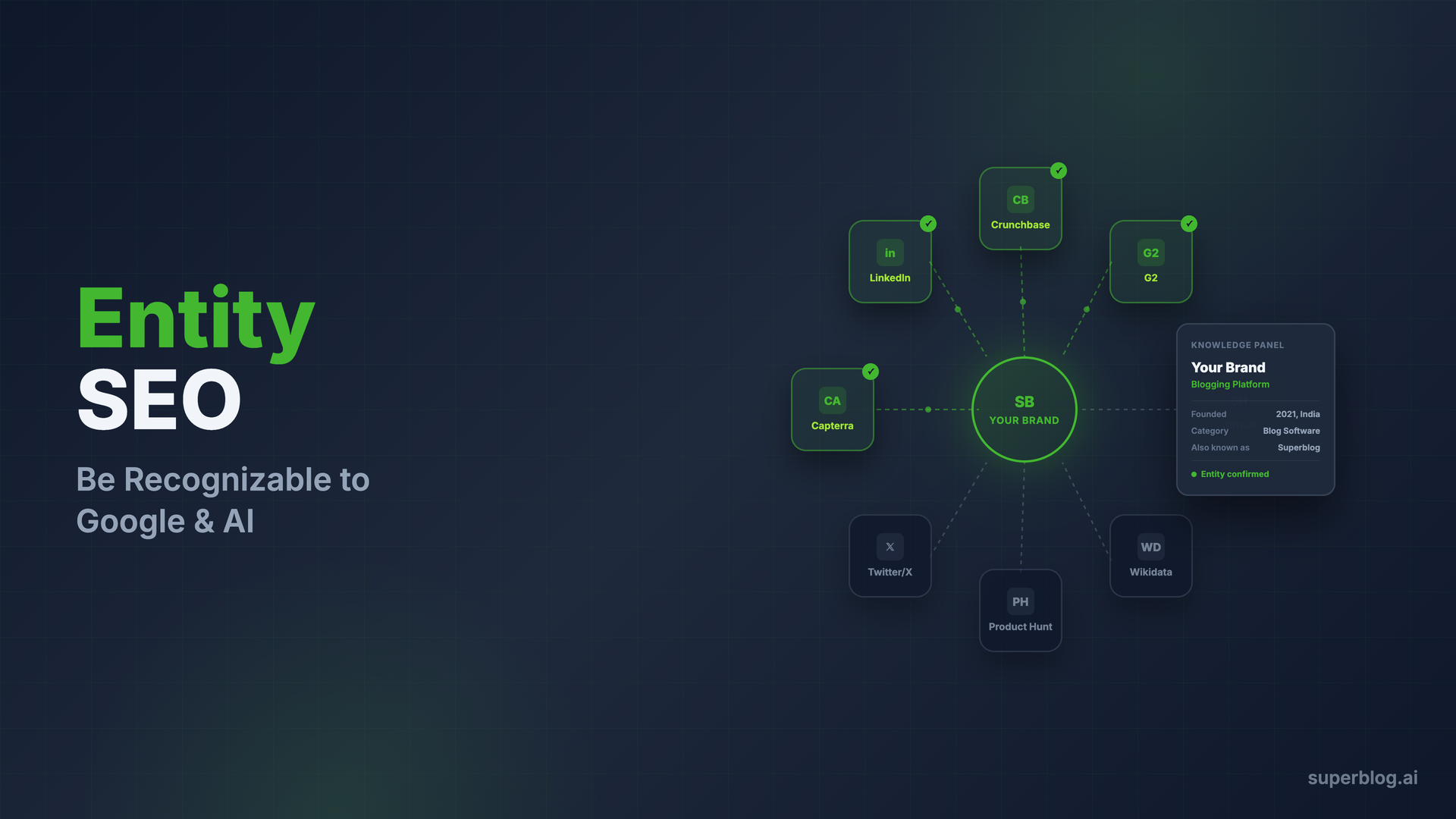
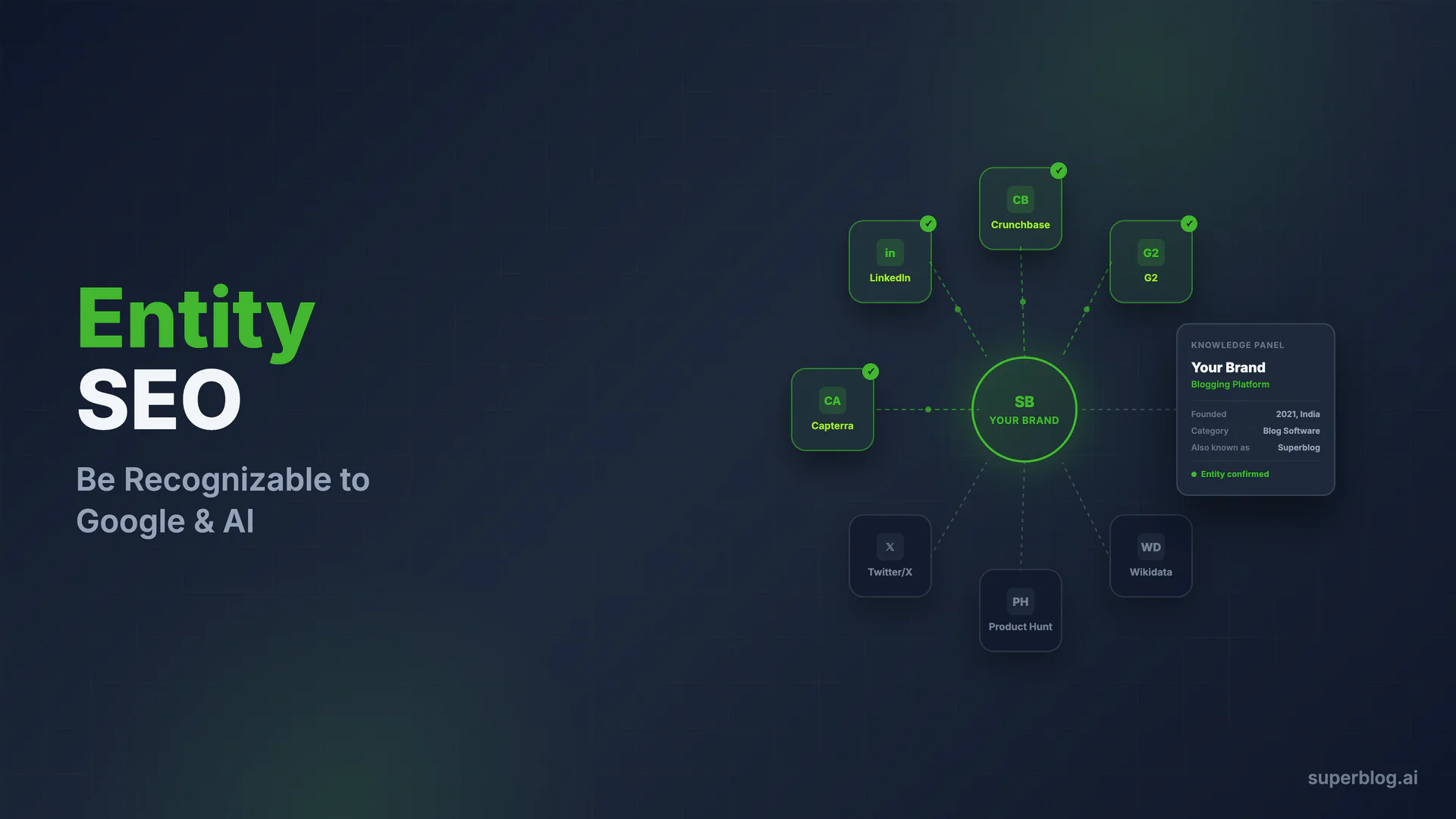
Entity SEO is the practice of making your brand, authors, and content recognizable as distinct, trustworthy entities that search engines and AI language models can confidently identify, categorize, and cite. It sits at the center of two overlapping forces reshaping search: Google's Knowledge Graph (which has organized the web around named entities for over a decade) and the new wave of AI engines that recommend brands they can resolve to a known, consistent identity.
If Google cannot resolve your brand as an entity, it treats every mention of your name as ambiguous text. If an LLM like ChatGPT cannot associate your brand with a clear category and reputation, it will not surface you when a user asks for a recommendation. Entity SEO closes both gaps at once, and in 2026 it is no longer optional for businesses that depend on content for growth.
What Is an Entity in SEO?
In search, an entity is a distinctly identifiable thing: a person, organization, product, place, or concept that can be assigned a persistent identity and described with stable attributes. Google's Knowledge Graph stores billions of these entities and their relationships. When you search for "Marie Curie," Google does not pattern-match on those two words. It resolves the query to a specific entity with known attributes: physicist, two Nobel Prizes, born 1867, associated with radioactivity research.
Brands work the same way. When Google resolves "Superblog" as an entity, it knows: blogging platform, founded in India, category is blog software, associated with SEO and content marketing, competitors include WordPress and Ghost. That entity understanding drives Knowledge Panels, rich results, and AI citation decisions.
An entity is not the same as a keyword. A keyword is a string of text. An entity is a node in a knowledge graph with attributes, relationships, and a persistent identifier. Entity SEO is the work of building and strengthening that node for your brand.
Why Entity SEO Matters More in 2026
The Knowledge Graph effect
Google has been building entity understanding into its ranking systems for years. The Hummingbird update (2013) and the neural matching systems that followed shifted Google from purely keyword-matching to entity-and-intent matching. A page about "entity SEO" ranks not just because it contains those words, but because Google can verify the page is about a recognized concept in its knowledge graph, written by a credible entity, on a trustworthy domain.
Strong entity signals correlate with consistent rankings. Weak entity signals leave your pages vulnerable to algorithmic volatility because Google cannot confidently vouch for who you are.
The LLM recommendation layer
The second force is newer and growing fast. According to Superblog's own discovery survey of how new users found the product (n=4,280), ChatGPT now drives roughly 1 in 6 recent signups, a share that is rising. LLMs recommend brands they can resolve. When a user asks ChatGPT "what's the best blogging platform for SEO?", the model draws on its training data and search-augmented context to recommend brands it has seen consistently associated with that category.
A brand that appears once in a forum post is noise. A brand that appears across multiple authoritative sources, described consistently, with schema markup confirming what it does, becomes a signal strong enough for an LLM to repeat with confidence.
This is the core of generative engine optimization: making your brand legible to AI engines, not just human readers. Entity SEO is the foundation of that legibility. For how this discipline differs from traditional ranking work, see our GEO vs SEO comparison.
For a broader view of optimizing for AI engines specifically, see our guide to AI SEO.
How Search Engines and LLMs Build Entity Understanding
Before running the playbook, understand the inputs. Both Google and LLMs build entity understanding from the same raw material, interpreted differently. That understanding starts with discovery: a page must be crawled and indexed before any entity signal can register. Our guide to crawling in SEO covers that layer in full.
Consistent naming. The brand name must appear identically across all sources: your website, social profiles, press mentions, directory listings, and schema markup. Variations ("SuperBlog," "Super Blog," "superblog.ai") split signals across multiple entities instead of concentrating them on one.
Structured data. JSON-LD schemas, particularly Organization schema with sameAs links and Article schema with author entities, tell Google precisely what your brand is and how to categorize it. This is machine-readable confirmation that validates what Google infers from text.
Co-occurrence with category terms. LLMs build associations from patterns in their training data. A brand that appears alongside "blogging platform," "blog SEO," "JAMStack," and "content marketing" in many different sources gets associated with that semantic neighborhood. A brand that appears in isolation does not.
Authoritative third-party mentions. A mention on your own blog is worth very little for entity building. A mention in a round-up on a high-DR domain, a product review site, a journalist's article, or a tool directory adds weight because it is an independent third-party corroborating your entity's existence and category.
Internal content coherence. When your own site covers a topic cluster consistently (multiple posts on blogging, SEO, content marketing, site performance), Google sees a topically authoritative entity. Scattered content on unrelated topics weakens entity signals.
The Entity SEO Playbook: 7 Tactics
1. Deploy Organization schema on every page
Organization schema is the single highest-leverage structured data addition for entity building. It tells Google: here is the entity that owns this website, here is its name, description, URL, logo, contact information, and here are the same-as links that confirm the entity's identity across other platforms.
At minimum, your Organization schema should include:
name: your brand name, spelled exactly the same way everywhereurl: your canonical domainlogo: a stable URL to your logo imagedescription: a concise sentence describing what you do and for whomsameAs: an array of links to your authoritative profiles (LinkedIn company page, Crunchbase, Twitter/X, G2, Capterra, GitHub)
The sameAs array is the most underused field in Organization schema. Each link tells Google: this entity on your website is the same entity as this verified profile on a trusted platform. Cross-referencing these signals is how Google confirms entity identity.
For a complete guide to implementing schema on blog content, see our blog schema markup guide.
2. Build author entities with Person schema
Your authors are entities too. If your blog content is attributed to a named person who has no schema markup, no author bio page, and no external profile links, Google cannot distinguish them from a pseudonym.
Create an author page for every real author on your blog. Each author page should include:
- Full name and photo
- Brief bio mentioning their professional background and areas of expertise
- Links to their LinkedIn profile, Twitter/X, or other verified professional profiles
- Person schema markup with
name,url,image,sameAs, andknowsAbout
When posts are authored by a named entity with schema markup, Google's E-E-A-T signals improve. The author's entity becomes a trust signal for every post they publish. For the fuller framework on E-E-A-T signals beyond author schema, see our E-E-A-T for blogs guide.
3. Enforce consistent brand data across all touchpoints
This is the NAP-equivalent for digital brands (the name, address, phone number consistency principle borrowed from local SEO). Your brand name must be spelled identically everywhere: your website, meta titles, schema markup, social bios, press releases, partner pages, review sites, and directory listings.
Run a search for your brand name right now. If you find variant spellings or outdated descriptions, correct them at the source. Every variation fragments your entity signals.
Pay particular attention to descriptions. If your LinkedIn page calls you "a content management platform," your Crunchbase entry says "SaaS for bloggers," and your website says "fully-managed blogging platform," those are three different entity descriptions that do not reinforce each other. Pick one description and replicate it.
4. Build your sameAs link graph
The sameAs links in your Organization schema matter only if those profiles are actually populated and authoritative. Work through this list and ensure you have complete, verified profiles on:
- LinkedIn Company Page: full description, logo, website link, industry, employee count
- Crunchbase: company profile with your canonical description, website, and founding details
- G2 or Capterra: a category-verified listing (these are particularly trusted by LLMs for software entities)
- Twitter/X: verified profile with pinned description
- GitHub: if your product has any developer-facing components
- Wikipedia or Wikidata: addressed separately below
Each of these profiles, when populated consistently and linked from your Organization schema, adds a cross-reference node that strengthens Google's confidence in your entity.
5. Create category co-occurrence content
LLMs learn brand categories from patterns, not from declarations. You cannot tell ChatGPT you are "the best blogging platform for SEO." But if your brand appears in dozens of pieces of content that discuss blogging, SEO, content marketing, and site performance together, the model learns that association.
This means your content cluster strategy is directly feeding your entity recognition. A blog that covers only product news has weak entity signals. A blog that covers blogging platforms, blog SEO, schema markup, content marketing ROI, and site performance builds a coherent semantic neighborhood that tells both Google and LLMs what category you belong to.
The posts you write are not just traffic sources. They are entity-building documents that train the understanding of your brand category in every system that ingests them. Our guide on internal linking for blogs covers how topic clustering and internal link architecture reinforce this semantic coherence.
6. Pursue authoritative mentions (be realistic about Wikipedia)
Wikipedia and Wikidata are the most trusted entity sources for both Google and LLMs. A Wikipedia article about your company is worth more for entity building than almost anything else. A Wikidata entity entry (even without a full Wikipedia article) adds a structured, machine-readable identity record that both Google and LLMs ingest.
Be honest about the difficulty. Wikipedia has strict notability requirements, and most businesses do not qualify unless they have substantial press coverage in independent, reliable sources. Attempting to create a Wikipedia article before meeting those standards typically results in deletion and can create a negative signal.
The realistic path: earn press coverage in independent publications (not sponsored content), get reviewed in established software directories, appear in round-up articles on high-DR domains. Once you have several independent, reliable sources, Wikidata becomes achievable even if Wikipedia is not. A Wikidata entry without a Wikipedia article still adds structured entity data that Google and LLMs use.
For smaller brands, the practical goal is a consistent presence in software directories (G2, Capterra, Product Hunt, AlternativeTo) and industry media. These function as the authoritative third-party mentions that anchor your entity.
7. Build internal topic clusters
Entity strength is also a function of topical authority within your own domain. A website with 200 posts across 20 unrelated topics has weak entity signals. A website with 50 posts tightly clustered around 3-4 related topics has strong signals because the content coherence validates the entity's claimed expertise.
For each topic cluster, ensure:
- A pillar page that defines and covers the cluster topic comprehensively
- Supporting posts that link back to the pillar
- Consistent internal anchor text that reinforces the topic association
- Schema markup on posts with appropriate
aboutandmentionsfields
This internal structure is a machine-readable signal of topical authority that both Google and LLMs use when evaluating whether to surface a source.
Measuring Entity Strength
Brand SERP quality check
Search for your brand name and study the results. A strong entity has: your website in position 1, your social profiles in positions 2-5, and a Knowledge Panel on the right side (or a featured snippet with your description if the panel has not triggered yet). Weak entity signals show inconsistent results, competitor pages, or third-party sites you do not control.
Knowledge Panel presence
If you do not have a Knowledge Panel for your brand, that is the clearest indicator that Google has not resolved you as a confident entity. Knowledge Panels appear when Google's entity resolution confidence crosses a threshold. Contributing to the triggers: Organization schema with sameAs links, verified Google Business Profile (if applicable), consistent brand data, and third-party coverage.
You can request a Knowledge Panel update through Google's "Claim this knowledge panel" feature once one appears.
LLM prompt testing
Open ChatGPT, Perplexity, and Claude. Ask each: "What is [your brand]?" and "What are the best tools for [your category]?" Record what comes back. If the model cannot describe your brand accurately, or does not mention you in the category list, you have an entity recognition gap.
Run this test quarterly. Track whether your brand's description improves and whether you appear more consistently in category recommendation prompts over time.
For a framework on tracking and improving AI engine visibility specifically, see our guide on AI visibility.
How Superblog Builds Entity Signals Automatically
For a blogging platform, entity SEO is a compounding advantage: the platform's built-in schema markup does the structured-data work automatically while you focus on content.
Superblog generates three types of JSON-LD schema on every post: Article, Organization, and FAQ (when FAQ blocks are present). The Organization schema includes your site name, URL, and logo automatically. The Article schema attributes each post to a named author, building Person entity signals with every piece of content you publish.
Beyond schema, Superblog's author system lets you create proper author bio pages with profile links, giving Google a named entity to anchor each post's authorship. The internal link suggestion engine recommends links between related posts, which builds the topic cluster coherence that reinforces entity signals.
If you have been running your blog on a platform that does not generate structured data, you are building content without the machine-readable signals that entity SEO depends on. Your content exists. Your entity does not.
For a deeper look at how schema markup works in practice and why it matters for AI citation, see our blog schema markup guide and our guide to getting cited by ChatGPT.
Entity SEO vs Keyword SEO
These are not competing approaches. Keyword SEO tells you what to write about. Entity SEO tells search engines and AI engines who is writing it and whether they can be trusted.
A keyword-only approach targets queries but leaves your brand identity ambiguous. A brand that targets high-volume keywords without building entity signals can rank temporarily, but loses ground as Google's systems increasingly weight entity confidence in ranking decisions.
An entity-only approach with no keyword strategy is also insufficient. Entity strength does not substitute for topically relevant content that matches search intent.
The durable approach combines both: write content that targets real search queries, structured to match SERP intent, while building the entity signals (schema, sameAs links, consistent naming, authoritative mentions) that make your brand legible to every system that touches your content.
FAQ
What is entity SEO?
Entity SEO is the practice of building your brand, authors, and content as distinctly identifiable entities in Google's Knowledge Graph and AI language models. It involves structured data, consistent brand signals, and authoritative third-party mentions that allow search engines and LLMs to confidently identify and categorize your brand.
What is an entity in SEO?
An entity is a distinctly identifiable thing (a person, organization, product, or concept) that can be assigned a persistent identity with stable attributes. In search, entities are the nodes in Google's Knowledge Graph: a brand name becomes an entity when Google can associate it with consistent attributes like category, description, related topics, and confirmed profiles on trusted platforms.
How is entity SEO different from keyword SEO?
Keyword SEO targets specific query strings and match patterns. Entity SEO builds the identity and credibility of the source producing that content. Keywords get your pages in front of searchers. Entity signals tell Google and AI engines whether to trust and resurface your brand consistently. Both are necessary; they operate at different layers of search.
How do I get a Knowledge Panel for my business?
Knowledge Panels appear when Google's entity resolution confidence is high enough to justify a structured display. The main inputs: Organization schema with sameAs links on your site, consistent brand data across directories and social profiles, verified profiles on trusted platforms (LinkedIn, Crunchbase, G2), and independent third-party coverage. There is no direct "apply for Knowledge Panel" mechanism. The panel emerges when entity signals accumulate past Google's confidence threshold.
Does entity SEO help with ChatGPT and other AI engines?
Yes. LLMs build brand associations from patterns in their training data and, for search-augmented models, from live search results. A brand with consistent entity signals across multiple authoritative sources, accurate schema markup, and strong topical clustering is more likely to appear in AI recommendations than a brand with weak or fragmented identity signals. Entity SEO is foundational to the broader discipline of generative engine optimization (GEO).
Your blog, without the maintenance
Fast pages, automatic SEO, no plugins to patch. Runs on yoursite.com/blog.
Sai Krishna is the Founder and CEO of Superblog. Having built multiple products that scaled to tens of millions of users with only SEO and ASO, Sai Krishna is now building a blogging platform to help others grow organically.
superblog
Superblog is a blazing fast blogging platform for beautiful reading and writing experiences. Superblog takes care of SEO audits and site optimizations automatically.