
Does Blogging Help SEO? The Evidence in 2026

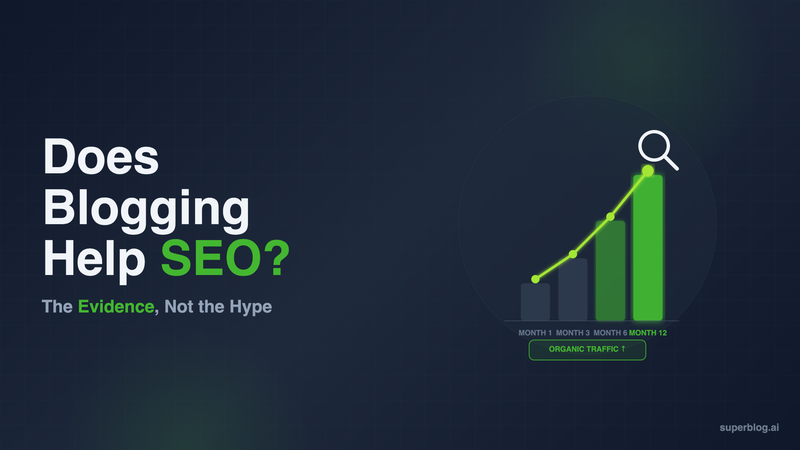
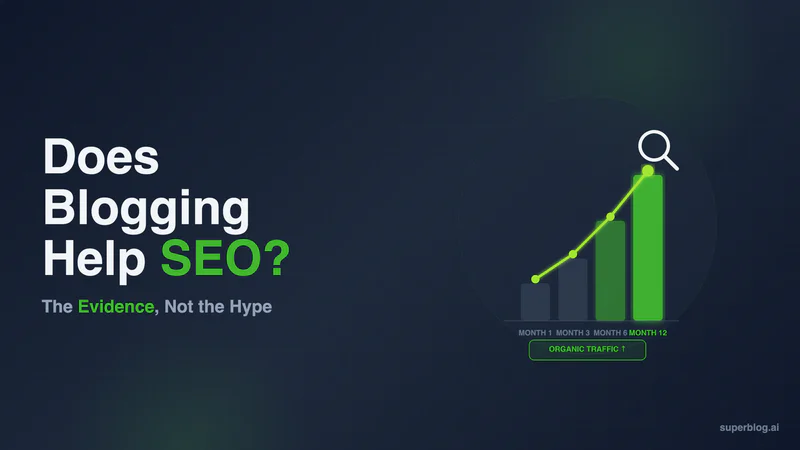
Yes, does blogging help SEO has a clear answer: blogging helps SEO when the content targets real search demand, gets structured for crawlers, and gets linked into the rest of your site. It does not help when posts exist just to hit a publishing quota. The mechanism is not mysterious. Every blog post is a new indexable page that can rank for a keyword your homepage never will, and every published post is a chance to earn a link, get cited by an AI engine, or pull in a reader who becomes a customer.
That said, blogging is not magic. A blog with ten thin, unfocused posts will not outrank a competitor's single well-researched guide. The question isn't really "does blogging help SEO." It's "does this specific blog, written this specific way, help SEO." This article breaks down the mechanisms that make blogging work, the honest limits of what it can do, and real evidence from businesses that have done it well.
How does blogging help SEO
Blogging helps SEO through five concrete mechanisms. None of them are theoretical.
1. Fresh content signals
Search engines crawl your site more often when you publish regularly. A site that hasn't added a new page in eight months gives crawlers no reason to come back frequently. A blog publishing on a consistent schedule gives search engines fresh URLs to discover, index, and re-evaluate. This doesn't mean posting daily guarantees rankings. It means an inactive site has fewer opportunities to be found for new queries, while an active one keeps expanding its footprint.
2. Long-tail keyword coverage
Your homepage can realistically target one or two keywords well. A blog can target hundreds. Long-tail queries, the specific, lower-volume searches people type when they're closer to a decision, are where most blog traffic actually comes from. "Does blogging help SEO" itself is a long-tail, low-competition query: about 140 searches a month, with a keyword difficulty low enough that a focused, well-structured post can compete for it without years of domain authority. Multiply that by every question your buyers ask, and a blog becomes a wide net that a static marketing site can't replicate.
3. The internal link graph
Every blog post is a new node you can link from and to. A post about a specific problem can link to your pricing page, your product page, or a related guide, and that internal link passes relevance and authority through your site. Pages with more internal links pointing to them tend to get crawled more and treated as more important. A blog is the easiest way to keep building that internal link graph without restructuring your core site. For a full breakdown of how to structure this, see our guide on internal linking for blogs.
4. Backlink surface area
You cannot get a backlink to a page that doesn't exist. Every blog post is a page other sites can cite, link to, or reference. A single well-researched guide, a linkable data set, an original take on an industry problem, can earn links your product pages never will, because nobody links to a pricing page. Journalists, other bloggers, and forum participants link to content that answers a question or makes an argument, and a blog is where that content lives.
5. Entity and topical authority
Search engines increasingly evaluate sites on whether they demonstrate depth on a topic, not just whether a single page matches a keyword. A blog that consistently covers one subject area, blog SEO, developer tooling, fintech compliance, whatever your niche is, builds a body of content that signals expertise. This is also how blogs get pulled into AI-generated answers: an assistant synthesizing a response about your category is more likely to reference a site that has published multiple relevant, well-structured pieces than one with a single page. To understand how crawlers discover and evaluate that depth in the first place, see what crawling in SEO actually means.
What blogging does not do for SEO
Here's the part most "does blogging help SEO" articles skip, because it complicates the pitch. Blogging is not a guarantee, and treating it as one wastes time and budget.
Bad content does not help, and can actively hurt. A thin, 400-word post with no original insight, written to hit a word count, does not build authority. It sits unindexed or ranks nowhere, and a site full of that kind of content can drag down how search engines evaluate the whole domain. Volume without quality is not a strategy.
Blogging is not automatic rankings. Publishing a post does not mean it ranks. It has to target a keyword with real demand, match the search intent the SERP is already rewarding, and be structured well enough for a crawler to understand what it's about. A post that answers a question nobody is asking, or answers the wrong question for the query it targets, will not rank regardless of how well it's written.
It doesn't replace technical SEO. A blog full of great content on a site that loads in six seconds, has broken canonical tags, or blocks crawlers entirely will underperform no matter how good the writing is. Content and technical foundation are both required, not one instead of the other.
It's not fast by default. Blogging compounds. A single post rarely moves the needle. The businesses that see results treat it as a sustained practice, not a one-time project. If you're evaluating whether SEO as a channel is even worth the investment in 2026, that broader question is covered in is SEO dead.
It requires promotion, not just publishing. A post with zero internal links, zero outreach, and zero distribution sits in isolation. The mechanisms above (internal linking, backlink surface area, freshness) only work if the post is actually connected to the rest of your site and the wider web.
The honest version of "does blogging help SEO" is: blogging helps SEO the same way exercise helps health. It works, reliably, when done consistently and correctly. It does nothing if you do it once and expect a transformation.
The evidence: what happens when businesses blog well
Mechanisms are one thing. Real outcomes are the proof. Here's what blogging has done for businesses that treated it as infrastructure, not an afterthought.
Segwise, an AI-powered marketing analytics platform, grew unique blog traffic by 415% after focusing their content on mobile growth, attribution, and campaign performance, topics directly relevant to their buyer rather than generic industry news. The lesson isn't just "blog more." It's that staying tightly scoped to what your actual buyer searches for is what turns publishing into traffic.
MonsterMath, a kids' math learning app, went from zero to 3,000 monthly organic visitors by targeting the parents making the purchase decision, not the children using the product. Their blog covers learning gaps, grade-level math expectations, and comparison content against competing apps. Zero to 3,000 didn't happen from one viral post. It happened from sustained, targeted publishing over months.
Neither of these companies got there by blogging about anything. They got there by blogging about the specific questions their specific buyers were already searching for, and by building each post to be crawlable, linkable, and internally connected.
There's a second data point worth including here, because it's about discovery rather than rankings. Superblog runs its own signup survey, asking new customers how they found us. Google search and AI-assistant discovery together account for the majority of Superblog's recent signups, a channel mix that didn't exist in this form even two years ago. That's not a claim about blogging in the abstract. It's what happens when a company runs its own content the way this article describes: targeted, structured, and connected.
How fast do results actually come
This is the question underneath "does blogging help SEO," and the honest answer disappoints people looking for a shortcut.
New content typically needs weeks to get crawled and indexed at all, and months to show meaningful ranking movement, especially on a new domain with limited authority. A blog post published today competing for a moderately difficult keyword is unlikely to rank on page one in its first month. Low-competition, long-tail queries can move faster because there's less competition to out-rank, which is part of why targeting keywords like "does blogging help SEO" (140 monthly searches, low difficulty) makes sense before chasing head terms with thousands of competing pages.
The observed pattern across businesses that blog consistently: early posts targeting low-competition queries start showing up within a few months, while the compounding effect, where each new post makes the ones around it stronger through internal links and growing topical authority, becomes visible over six months to a year. MonsterMath's zero-to-3,000 trajectory happened over a sustained publishing period, not a single quarter. There is no version of this that happens in two weeks.
Why Superblog makes blogging's SEO mechanisms automatic
Everything above works better when the technical execution doesn't depend on someone remembering to do it manually. That's the gap Superblog closes, and it's a meaningful part of why roughly half of Superblog's own signups come from organic search, per our signup survey.
IndexNow on publish. The moment you publish a post, Superblog automatically notifies Bing, Yandex, and other supporting search engines through the IndexNow protocol. No plugin, no manual ping, no waiting for a crawler to stumble onto the new URL on its own schedule.
Auto JSON-LD schema. Article, FAQ, and Organization schema get generated automatically on every post. Rich snippets and structured data that most WordPress blogs need a plugin (and constant plugin updates) to approximate.
Internal link suggestions. The editor analyzes your post content, finds related posts by matching categories, tags, and title keywords, and suggests anchor text with one-click insertion. The internal link graph mechanism described above doesn't depend on a writer remembering to cross-link fifteen old posts by hand.
Auto XML sitemaps, canonical URLs, and Open Graph tags round out the rest, all generated automatically on every deploy. The mechanisms that make blogging help SEO aren't things you do once. They're things that have to happen on every single post, forever, which is exactly the kind of repetitive infrastructure work that should be automatic rather than manual.
FAQ
Does blogging help SEO?
Yes. Blogging helps SEO through fresh content signals, long-tail keyword coverage, a stronger internal link graph, more backlink surface area, and topical authority. It does not help when the content is thin, off-target, or disconnected from the rest of the site.
How many blog posts before I see results?
There's no fixed number, because it depends on competition level and consistency. Low-competition, long-tail posts can start showing modest traffic within a few months. Meaningful, compounding growth (the kind behind results like MonsterMath's zero-to-3,000 trajectory) typically takes six months to a year of consistent publishing, not a handful of posts.
Does blogging still work for SEO in 2026 with AI search everywhere?
Yes, and the mechanism has expanded rather than disappeared. Traditional search rankings still reward fresh, well-linked, topically deep content. AI assistants like ChatGPT and Perplexity also cite and synthesize from blogs when generating answers, particularly ones with clear structure and demonstrated depth on a topic. Crawlers matter here too: GPTBot handles OpenAI's model training, OAI-SearchBot powers ChatGPT's live search citations, and Google-Extended covers Google's AI training specifically, separate from the Googlebot crawler that feeds AI Overviews. Blogging for both traditional and AI-driven discovery is now the same practice, not two separate ones.
How often should I post for SEO?
Consistency matters more than frequency. A predictable schedule, whether that's twice a week or twice a month, sustained for months, outperforms sporadic bursts. What matters most is that every post targets real search demand and gets properly linked into your site, not the raw number published per week.
Do I need a lot of backlinks for blogging to help SEO?
No, not to start. Backlinks help, but a well-targeted post on a long-tail, low-competition keyword can rank without any external links, purely on the strength of matching search intent and being properly structured. Backlinks compound results over time; they're not a prerequisite for a post to rank at all.
Does the length of a blog post matter for SEO?
Length itself isn't a ranking factor, thoroughness is. A 600-word post that fully answers the query can outrank a padded 2,000-word post that doesn't. The right length is however long it takes to answer the search intent completely, matched to what's already ranking for that keyword.
Can a blog hurt my SEO?
Yes, if it's built poorly. Thin content, duplicate posts, broken internal links, and slow-loading pages can drag down how search engines evaluate your entire domain, not just the blog section. A blog is only an asset when it's maintained to the same technical standard as the rest of the site. See the full blog SEO checklist for what that standard looks like in practice.
If you want the complete picture of how to structure a blog for search from the ground up, start with our guide on blog for SEO.
Your blog, without the maintenance
Fast pages, automatic SEO, no plugins to patch. Runs on yoursite.com/blog.
Sai Krishna is the Founder and CEO of Superblog. Having built multiple products that scaled to tens of millions of users with only SEO and ASO, Sai Krishna is now building a blogging platform to help others grow organically.
superblog
Superblog is a blazing fast blogging platform for beautiful reading and writing experiences. Superblog takes care of SEO audits and site optimizations automatically.