
Does That Website Have a Blog? How to Check in 30 Seconds (2026)

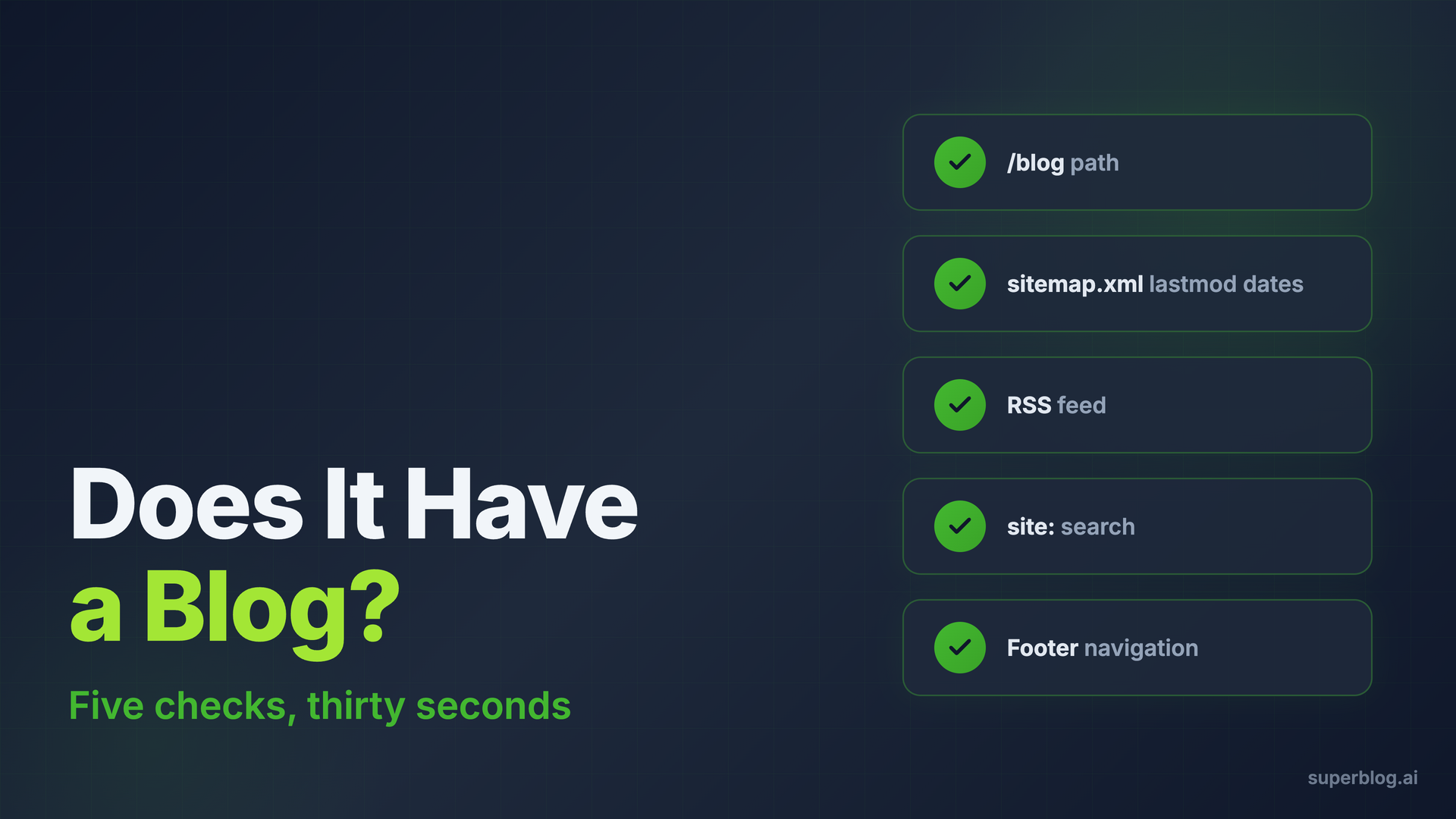
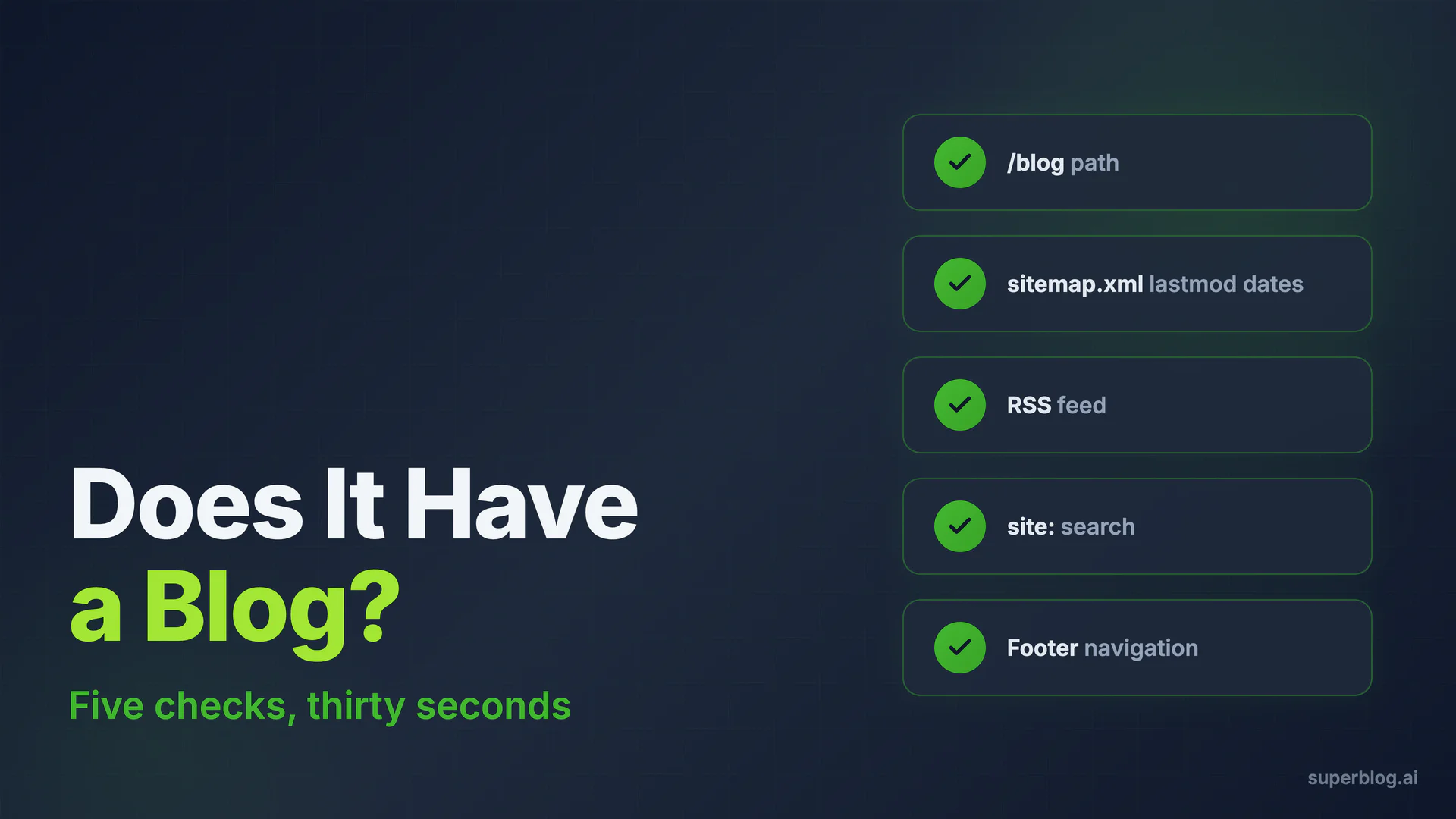
Four requests settle whether a website has a blog, for most sites: example.com/blog, example.com/sitemap.xml, example.com/rss.xml, and a site:example.com blog search. If all four come back empty, the site almost certainly does not have a blog on its own domain.
That word "almost" is carrying real weight. A blog can sit on a subdomain, on a path nobody guesses, or on Medium under the company's name, and each of those returns a clean 404 on the obvious check. Here is the full sequence, what each step proves, and where each one lies to you.
How to check whether a website has a blog: five checks, in order
1. Try the common paths. Request /blog first, then /news, /articles, /resources, /insights, /learn, /guides, /stories. Try the trailing-slash variant if the bare path 404s. What you want to see is an index page listing dated posts with author names.
Failure mode: a 200 response proves less than it looks. /resources is very often a gated-PDF library and /news is often a press-release archive, neither of which is a blog. In the other direction, a 404 proves almost nothing, because the blog may live at blog.example.com or at a path you did not guess.
2. Read robots.txt, then the sitemap./robots.txt usually declares the sitemap location on a Sitemap: line, which saves you from guessing. Otherwise try /sitemap.xml and /sitemap_index.xml. Most CMS-generated sitemaps are indexes that point at child files split by content type, so a post-sitemap.xml or sitemap-post.xml entry is a direct answer: the site has posts, and the child file lists every URL with a lastmod date.
Failure mode: not every site publishes a sitemap, and a blog proxied into a subdirectory sometimes keeps its own sitemap at /blog/sitemap.xml rather than merging into the root one. Check both.
3. Look for a feed. Try /rss.xml, /feed, /feed.xml, /atom.xml, /rss, and /index.xml. Different generators default to different names. Also grep the homepage source for type="application/rss+xml", which is how a site declares its feed to readers.
A feed is the fastest route to the question you actually care about next, which is when did they last publish. The first <pubDate> in the feed answers it in one request.
Failure mode: plenty of modern site builders ship no feed at all, so a missing feed is weak evidence of a missing blog.
4. Run a site: search.site:example.com blog, then site:example.com inurl:blog, then site:blog.example.com. This one query set catches subdomains and unconventional paths that path-guessing misses entirely.
Failure mode:site: results are an approximation of the index, not a dump of it, and a young or thinly linked site may be barely indexed. Absence in site: is not absence on the web.
5. Read the footer and the navigation. Footers are where companies park the blog link when the top nav is reserved for product and pricing. The footer is also where you catch the off-domain case: a "Blog" link pointing at medium.com/@company, company.substack.com, or a LinkedIn newsletter.
The two answers that look like "no" and are not
A blog on blog.example.com is still that company's blog. Path-based checks miss it completely, which is why check 4 exists.
A blog hosted on Medium, Substack, Hashnode, or dev.to is also still that company's blog. It just does not live on their domain, which matters enormously for their SEO and not at all for your question about whether they publish.
Two things that regularly get miscounted as blogs: documentation sites (/docs) and changelogs (/changelog). Both are dated, both are indexed, neither is a content program.
If you are answering this question for someone else, a complete answer names four things: whether a blog exists, where it lives (subdirectory, subdomain, or off-domain), the date of the most recent post, and the rough publishing cadence over the last year.
Why you might be checking
Evaluating a vendor. A blog is the cheapest available read on whether a company understands its own category. Not the design of it, the substance: do they write about the hard parts of the problem they sell into, or do they publish "5 tips" filler?
Auditing a competitor's content program. Which topics they cover, how often they ship, and whether the bylines belong to real staff tells you the size of the machine you are competing with. A sitemap with lastmod dates gives you the whole publishing history in one file.
Due diligence on an agency or a consultant. An agency selling content marketing with a blog that stopped in 2024 has told you something specific about how they allocate their own resources.
That last case generalizes. A maintained blog signals a company that is still investing in being found. A blog whose most recent post is two years old signals a program that lost its owner and was never reassigned, and the archive keeps sitting there saying so to everyone who checks. In the failure cases the dates matter more than the content.
Why AI assistants keep asking this
Our own Search Console data shows roughly ten thousand impressions over the last twelve months, as of August 2026, on queries shaped exactly like "does [specific-domain] have a blog", pointed at individual startup domains, consultancy sites, and portfolio projects on vercel.app subdomains. That is not a query pattern humans type. It is the shape of a research step being executed on someone's behalf.
AI search products fetch the live web when they research a company, and the fetch is done by named agents with distinct jobs. Getting the taxonomy right matters if you plan to control any of this:
GPTBot is OpenAI's crawler for training data collection.
OAI-SearchBot is the crawler behind ChatGPT's search results.
ChatGPT-User fetches a page on demand, when a user or an agent action triggers a retrieval right then.
Google-Extended is a robots.txt token that controls whether your content is used for Gemini and Vertex AI grounding and training. It does not control Google Search, and blocking it does not remove you from the index.
The practical consequence is blunt. When an assistant researches a company and finds no published content, it reports what it found, which is nothing. Your product pages describe what you sell. Your posts are the only pages that demonstrate you understand the problem, and they are the pages that get quoted back to a buyer who never visited your site.
If the answer for your own site is no
Then you are invisible in two channels at once. Organic search has nothing of yours to rank for the questions your buyers ask before they know your product exists, and AI assistants researching your company have nothing of yours to cite.
The fix is a blog at yoursite.com/blog, on your domain, in a subdirectory. Subdirectory rather than subdomain, because every post then accumulates authority to the same domain your product pages live on. We cover the routing mechanics for Next.js, Vercel, Nginx, Cloudflare, and Netlify in the subdirectory blog hosting guide, and the full set of approaches, including the ones we advise against, in how to add a blog to your website.
This is what Superblog is built to do. A Superblog blog ships the artifacts these checks look for on the day it goes live, without configuration:
It serves at
yoursite.com/blogon any stack, so check 1 returns a real index page.It generates and updates an XML sitemap on every deploy, so check 2 finds your posts.
It publishes a feed at your blog root (
/blog/rss.xmlon a subdirectory setup), so check 3 returns your latest post date.It sends an IndexNow notification the moment you publish, so Bing and the other IndexNow-supporting engines hear about the post immediately.
It generates JSON-LD schemas (Article, FAQ, Organization) automatically, so the pages are machine-readable beyond the raw HTML.
The pages are pre-built static HTML on a global CDN, which is what earns the 90+ Lighthouse score and, more importantly here, what means every crawler and on-demand fetcher gets your full content in the first response instead of an empty shell waiting on JavaScript. Superblog also publishes an llms.txt file at your blog root. What actually gets a page quoted, though, is server-rendered HTML at a real URL, and that is what the build produces.
Pro is $49/mo. There is a 7-day free trial with no credit card, and a 30-day money-back guarantee. If you are still deciding between platforms rather than deciding whether to publish at all, our blogging platform comparison lays the options side by side, and the blog CMS guide covers what to look for in the underlying system.
Answers to the follow-up questions
Is a blog on Medium or Substack still "having a blog"?
Yes. The company publishes, and for the purpose of judging whether they know their subject, that is the whole question. For the purpose of judging their SEO, it is a different answer: every link, every ranking, and every unit of authority those posts earn accrues to medium.com or to their Substack subdomain, not to the company's domain. They are renting an audience and building someone else's asset.
Does a blog on a subdomain count?
It counts as a blog. blog.example.com is indexed, crawled, and readable like any other site. But a subdomain builds its own record, while posts at example.com/blog feed the domain your product pages rank on, which is why the subdirectory is the stronger structure.
How recent should the latest post be?
For judging whether a content program is alive, three months is a fair line. Monthly or better means someone owns it. A gap over a year means it was abandoned, whatever the archive looks like. Read the lastmod values in the sitemap rather than the dates printed on the page, since some sites display an "updated" date that reflects a template change rather than a rewrite.
What if the site has a blog but nothing is indexed?
That happens, and it is worth noticing. A blog that returns pages on request but produces no site: results is usually rendering content client-side, blocking crawlers in robots.txt, or sitting on a domain with no crawl history. It exists for a visitor and does not exist for search or for an assistant researching the company, which is functionally the same as not having one.
Your blog, without the maintenance
Fast pages, automatic SEO, no plugins to patch. Runs on yoursite.com/blog.
Sai Krishna is the Founder and CEO of Superblog. Having built multiple products that scaled to tens of millions of users with only SEO and ASO, Sai Krishna is now building a blogging platform to help others grow organically.
superblog
Superblog is a blazing fast blogging platform for beautiful reading and writing experiences. Superblog takes care of SEO audits and site optimizations automatically.