
Sanity vs Contentful: Which Headless CMS Costs Less in 2026?

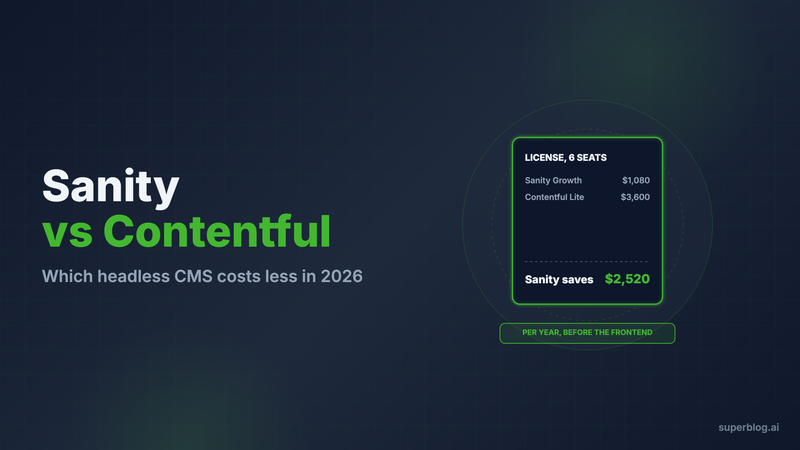
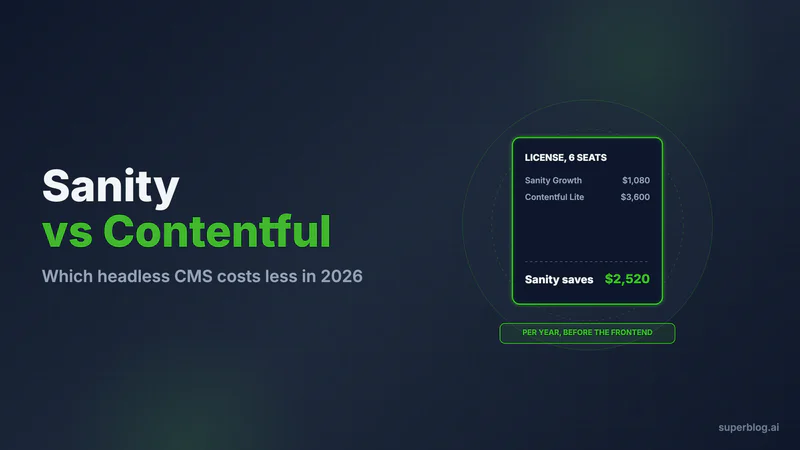
Sanity costs less than Contentful for almost every small team. Sanity Growth is $15 per seat a month, so a 6-person team pays $90, while Contentful's first paid plan, Lite, is a flat $300 a month. Neither one builds your blog pages: both are headless CMSs, so the frontend, the SEO tags and the hosting are your developers' work on either one.
Sanity's prices and plan limits were checked on sanity.io/pricing on November 13, 2026. Contentful's figures were read on contentful.com/pricing in a browser on November 12, 2026, because the page blocks automated requests.
The verdict up front
Choose Sanity if developers own your content, you want the schema in code, and your team is under 20 editors. It wins on price for small teams, on locales and on content types.
Choose Contentful if you want a conventional, form-based CMS that a large organization can govern, and you expect to buy Enterprise terms such as an uptime SLA and unlimited spaces.
Choose neither for the blog alone. If the only thing you need is a company blog at yoursite.com/blog, a headless CMS adds a frontend project you do not need. A managed blog platform such as Superblog includes the pages, hosting and SEO for $49/month (Pro). More on that near the end.
Sanity vs Contentful at a glance
Pricing: seats against a flat fee
Sanity wins for teams under 20. The two vendors bill in opposite ways.
How Sanity bills
- Seats. Growth costs $15 for every seat that is not a Viewer, developers included. Viewers are free.
- Usage. Free and Growth both include 1M API CDN requests, 250k API requests, 100GB of assets and 100GB of bandwidth a month. On Growth, overage is $1 per 250k CDN requests, $1 per 25k API requests, $0.50 per GB of assets and $0.30 per GB of bandwidth. On Free, Sanity blocks public API access when a quota runs out.
- Documents. Free holds 10,000 and Growth 25,000, and drafts count as separate documents. The Increased quota add-on raises the limit to 50,000 for $299 a month.
- Billing. Self-serve plans are monthly only, by card. Annual billing needs Enterprise.
How Contentful bills
- A flat plan fee. Lite is $300 a month for up to 20 users, with no listed annual price. Contentful's user totals also cover its Personalization, Studio and AI Actions products.
- Usage. Free has hard caps of 100K API calls and 50 GB of bandwidth a month. Lite includes 1M API calls and 100 GB, then charges $5 per extra 1M calls and $0.15 per extra GB.
- Records and spaces. Every plan includes one Starter Space: 25 content types, 2 environments and 10,000 records. A Lite Space holds 50,000 records, 4 environments and up to 5 workflows, for $850 a month, one per account.
Where the lines cross
Sanity's seat bill reaches Contentful's $300 at exactly 20 seats (20 x $15). Below that, Sanity is cheaper every month. At 21 users, Contentful Lite is full and the next step is an Enterprise quote, while Sanity Growth keeps adding $15 seats up to 50.
The bigger jumps on Contentful are structural. A fourth locale, a 21st user or a second Lite Space all move the account to Enterprise. On Sanity, the steep add-ons are the $299 quota add-on and the $999-a-month extra dataset.
Each vendor's full plan breakdown is in our Sanity pricing and Contentful pricing guides.
On Hacker News in 2023, toddmorey named both vendors among CMSs that "charge $400/mo+ just for a team to be able to edit their own website." A small Sanity team pays less today. The frontend cost, covered below, remains on both.
Editor experience
Contentful is more predictable out of the box. Sanity is more flexible once a developer shapes it.
Contentful gives editors a form-based web app. Each content type is a set of fields, and editors fill them in. Lite adds comments and tasks, scheduled publishing and live collaboration. Its three Lite roles are Admin, Editor and Author.
Sanity Studio is an open-source React app. It can run on a free sanity.studio address, be self-hosted, or be mounted inside your Next.js app. Editors see each other in the same document in real time. Visual editing and the Presentation tool are included on every plan, once developers wire them into the frontend. Growth adds the Contributor role, which can write drafts but not publish them, plus comments, tasks and scheduled drafts.
Two editor gaps matter for a team blog:
- Sanity Free has only Administrator and Viewer roles, so every writer gets full project access until you pay for Growth.
- Previews are a build on both. Contentful serves drafts through its Content Preview API, and Sanity's visual editing needs client setup, draft mode and overlays. Writers only see a draft as it will look after a developer builds that.
Developer experience and content modeling

Sanity wins for developers who want control. Contentful wins for teams that want guardrails.
On Sanity:
- Schemas are code. Content types live in your repo as TypeScript and deploy with the app. Content types are unlimited on every plan, within the unique-attribute limit per dataset (2,000 on Free, 10,000 on Growth).
- GROQ returns only the fields a page needs, joins included, in one query. GraphQL is also available.
- TypeGen generates TypeScript types from your schema and your GROQ queries.
- Rich text arrives as Portable Text, a JSON format your frontend serializes. Sanity ships serializers for HTML, React and other frameworks, and each custom block needs its own renderer.
On Contentful:
- Content types are defined in the web app, each with up to 50 fields. Teams that want model changes in version control script them with Contentful's
contentful-migrationtool. - APIs include the REST Content Delivery and Content Preview APIs and a GraphQL Content API whose schema is generated from your content model. The JavaScript SDK is written in TypeScript.
- Rich text arrives as structured JSON, which Contentful's own renderer converts to HTML. Embedded entries and assets still need your rendering code.
- Limits shape the model. The Starter Space allows 25 content types, and 50 on a Lite Space. A large model can run out of types before it runs out of records.
SEO: your frontend decides
A tie, because neither one renders pages. Search engines never see Sanity or Contentful. They see the site your developers build.
On both, the frontend has to produce:
- Title and description tags, canonical URLs and Open Graph tags for every post.
- JSON-LD structured data.
- An XML sitemap that updates when an editor publishes.
- An RSS feed and a publish webhook that triggers a rebuild.
- Fast pages. Both serve content from a CDN, but page speed comes from how you render and cache.
Sanity's own SEO course for Next.js teaches developers to build metadata, a dynamic sitemap and JSON-LD in the app. That is the right approach for a headless stack. It also means a marketer cannot fix a missing tag alone. Our Next.js SEO checklist lists every tag a custom frontend has to output, and headless CMS for business blogs covers the upkeep.
Localization
Sanity wins. Sanity does not charge for locales. You can create as many as you want, within a limit on unique attributes per dataset (2,000 on Free, 10,000 on Growth).
Contentful counts locales by plan: 2 on Free and 3 on Lite. A fourth language means Enterprise.
On both, hreflang tags, language routing and a sitemap per language are frontend code.
AI features
Sanity publishes its AI pricing. Contentful sells AI separately.
Sanity includes Content Agent and Agent Actions on every plan, with 1,000 AI credits a month on Free and Growth and 5,000 on Enterprise. Growth can buy extra credits at $0.05 each. AI Assist is on Growth.
Contentful's pricing page says AI Actions is priced separately from the plans and gives no figure. Users of AI Actions count toward the plan's user total.
Total cost for a small team, year one
Five writers, one developer, one language, a few hundred posts. Both setups need a frontend, so we use the same build and upkeep assumptions for each: 50 to 90 hours for the first build and 2 to 3 hours a month of upkeep, at $80 to $120 an hour (the range Codeable publishes for its freelance developers). Hosting is one Vercel Pro seat at $20 a month.
Sanity Growth, 6 seats:
- Seats: 6 x $15 x 12 = $1,080
- Hosting: $240
- Build: 50 hours at $80 ($4,000) to 90 hours at $120 ($10,800)
- Upkeep: 24 hours at $80 ($1,920) to 36 hours at $120 ($4,320)
Low: $1,080 + $240 + $4,000 + $1,920 = $7,240. High: $1,080 + $240 + $10,800 + $4,320 = $16,440.
Contentful Lite:
- Plan: $300 x 12 = $3,600
- Hosting: $240
- Build and upkeep: the same $5,920 to $15,120
Low: $3,600 + $240 + $4,000 + $1,920 = $9,760. High: $3,600 + $240 + $10,800 + $4,320 = $18,960.
The license gap is $2,520 a year in Sanity's favor. The frontend is the larger line on both.
Choose Sanity if
- Developers own your content and want schemas, queries and types in the repo.
- Your team is under 20 editors, so seats cost less than Contentful's flat fee.
- You publish in more than 3 languages.
- You want a Contributor role for freelancers who should not publish.
Choose Contentful if
- You want a form-based editor that works the same way across many teams.
- You plan to buy Enterprise terms: 24/7 support, an uptime SLA of up to 99.99% and unlimited spaces.
- Your model fits in 25 to 50 content types and your editors fit in 20 users on Lite.
- You already run other Contentful products, such as Personalization.
For more options on either side, see our CMS comparison for Next.js and the CMS guide for marketing teams.
Where Superblog fits

A headless CMS gives you an API and no blog pages. That is the right trade for structured content across a website, an app and product surfaces. For that job, Sanity or Contentful is the right tool and Superblog is not.
Many teams compare Sanity and Contentful when all they need is a company blog. For that case, Superblog is a managed blog platform: editor, blog pages, hosting, CDN and SEO in one plan, with nothing for your developers to build.
What comes built in:
- SEO on every deploy. JSON-LD for BlogPosting, WebPage, Organization, ImageObject and FAQ, XML sitemaps, canonical and Open Graph tags, an llms.txt index plus a markdown copy of each post, and an IndexNow ping when a post goes live.
- Team seats in the price. Pro includes 5 team members and Super 10, with Admin, Editor and Writer roles. Pro adds scheduled posts and review comments on drafts.
- Languages without a locale count. Super and above add multilingual SEO in 41 languages with hreflang tags, and Superblog does not charge per language.
You can keep Sanity or Contentful for the rest of the site. On Next.js, two rewrites in next.config.js send /blog to Superblog, as shown on the blog for Next.js page and in our guide to adding a blog to Next.js. Superblog has no Sanity or Contentful importer. A developer exports the posts, converts each rich text body to HTML, and loads a JSON file through the JSON importer, which takes up to 300 posts per import and keeps any slug you map in.
There is a 7-day free trial, no credit card required. Connecting /blog needs a paid plan.
FAQ
Is Sanity cheaper than Contentful?
Yes, for teams under 20 seats: Growth is $15 a seat against Lite's flat $300.
Is Sanity a good CMS?
Yes, for developer-led teams that want schemas in code and GROQ.
Who does Sanity compete with?
Contentful, Storyblok, Contentstack, Strapi, Payload, Hygraph, DatoCMS and Prismic.
What are good alternatives to Contentful?
Sanity, Superblog for a blog alone, Storyblok, Contentstack, Strapi, Payload and Hygraph.
Do Sanity or Contentful build blog SEO tags?
No. On both, your frontend generates meta tags, sitemaps and JSON-LD.
Can you pay for Sanity or Contentful annually?
Sanity: Enterprise only. Contentful: no annual price is listed for Lite.
Your blog, without the maintenance
Fast pages, automatic SEO, no plugins to patch. Runs on yoursite.com/blog.
Sai Krishna is the Founder and CEO of Superblog. Having built multiple products that scaled to tens of millions of users with only SEO and ASO, Sai Krishna is now building a blogging platform to help others grow organically.
superblog
Superblog is a blazing fast blogging platform for beautiful reading and writing experiences. Superblog takes care of SEO audits and site optimizations automatically.