
Content Repurposing: The System for Turning One Post Into More Reach

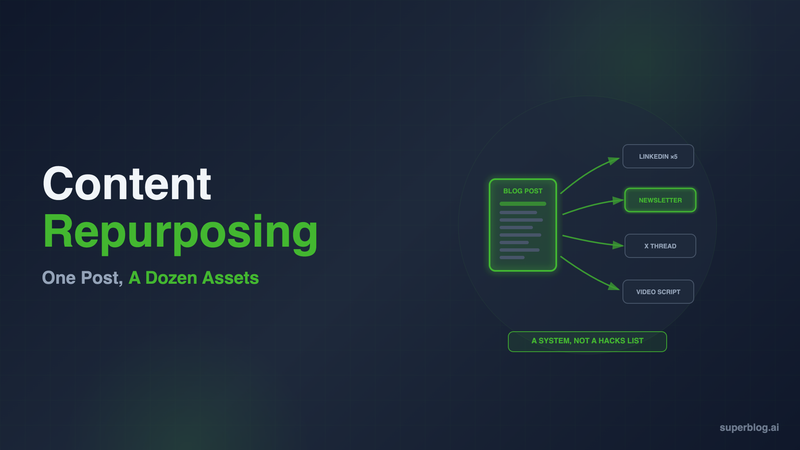
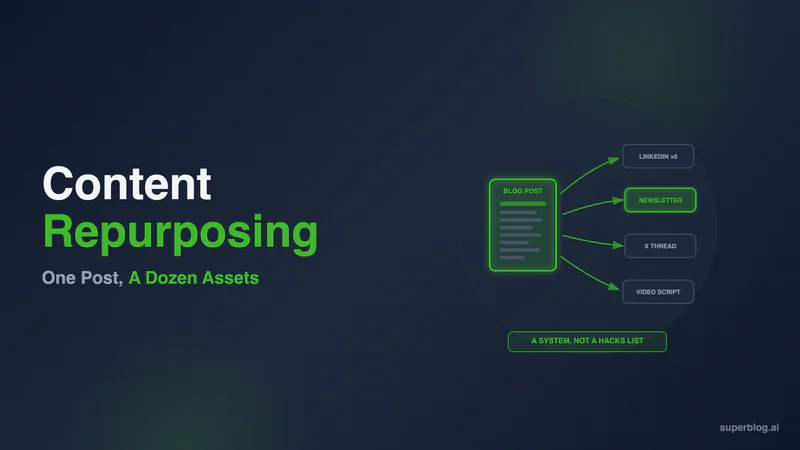
Content repurposing is the practice of taking one piece of existing content, usually a blog post, and turning it into additional formats: social posts, newsletter sections, video scripts, FAQ entries, sales collateral, without starting from a blank page each time. Done as a system rather than a one-off hack, it multiplies the reach of the writing you've already paid for, instead of asking your team to produce more raw content every week.
Most advice on this topic is a list of 20 things you could technically do with a blog post. That's not a system, it's a menu with no ordering logic. This post covers the actual system: which post to source from, what to source into, who owns the handoff, and how to avoid creating duplicate-content problems while you do it.
If you're here because your existing posts are losing rankings rather than reach, that's a different problem with a different fix. See our guide on content decay and when to refresh old posts. This post is about getting more distribution out of content that's already working, not restoring content that's slipping.
The Blog Post as Source of Truth
The system starts with a decision most teams skip: pick one canonical version of the idea, and make every other format a derivative of it, not a parallel original.
For most lean marketing teams, that canonical version should be the blog post. Here's why the blog wins the "source of truth" role over other formats:
- It's indexed and owned. A blog post on your domain builds your site's authority. A LinkedIn post or a tweet builds someone else's platform.
- It's the most complete version of the argument. A 1,500-word post has room for nuance, examples, and structure that a 280-character post or a 60-second video script doesn't.
- Everything else compresses cleanly from it. It's straightforward to cut a long post down into a tighter LinkedIn post or a thread. Going the other direction, expanding a tweet into a full argument, means writing the long version anyway.
Once you have the source-of-truth post, content repurposing becomes a compression and reformatting exercise, not a research exercise. A single deep post can become:
- 3-5 LinkedIn posts, each pulling one sub-argument, one stat, or one contrarian claim from the post and standing alone
- An X/Twitter thread that mirrors the post's structure: hook, numbered points, close
- A newsletter section, usually a summary plus a link back to the full post
- A video script outline, using the post's H2s as the scene/segment breakdown
- Internal FAQ blocks, pulling the post's most specific claims into standalone Q&A pairs your team can reuse in sales conversations or support docs
None of this requires new research. It requires someone spending 30-60 minutes turning existing arguments into a different shape.
Repurposing Into the Blog, Not Just Out of It
Repurposing runs in both directions. Most teams only think about taking a blog post and spreading it outward. The move that pays off more for lean teams is often the reverse: taking content you already created for another purpose and turning it into a blog post.
Sources of blog content that already exist inside your company:
- Webinars and recorded demos. A 45-minute webinar has a transcript. Structure it into H2s around the questions asked, cut the filler, and you have a post with zero net-new writing hours.
- Podcast episodes. Same logic. If your founder or head of growth did a podcast interview, the recording is source material for a post built around the best 3-4 answers.
- Sales call questions. Sales teams field the same objections and questions on every call. Those questions, verbatim, are FAQ post candidates, and proof of real search intent from people close enough to a purchase decision to ask.
- Support tickets. Questions your support team answers repeatedly are validated demand. If ten customers asked the same question this quarter, that's a post, not a coincidence.
This direction of repurposing is underused because it requires someone to notice the raw material exists. Put "review last month's webinar/podcast/top sales questions for post ideas" on someone's calendar monthly, or it won't happen on its own.
Content Repurposing Priority: Repurpose Winners, Not Everything
The mistake most teams make once they adopt content repurposing is treating every post as equally worth repurposing. It isn't. Repurposing effort should follow demand, not the publishing calendar.
Before repurposing anything, check what's actually working:
- Pull your top posts by organic traffic from Google Search Console or your analytics tool. Posts already getting clicks and impressions have proven demand. Our guide on blog analytics that actually matter covers which metrics signal real demand versus a pageview count that looks good and means nothing.
- Check engagement, not just traffic. A post with high time-on-page or a strong scroll depth is holding attention, which usually means the argument is repurpose-worthy. A post people bounce off of usually isn't fixed by putting it on LinkedIn too.
- Look for posts with durable claims. A post built around a stat, a framework, or a strong opinion repurposes better than a post that's mostly a list of links. The stronger the single core claim, the easier it compresses into a social post or a thread.
- Skip thin or outdated posts. If a post needs a refresh before it's accurate, refresh it first. Repurposing outdated information just distributes the outdated version further. Our guide on content decay covers how to spot posts that need updating before you spend distribution effort on them.
Superblog's built-in analytics (Pro and Super plans) show per-post traffic and engagement without needing a separate tool, which makes this triage step something you can run in minutes instead of exporting data into a spreadsheet.
The rule in one sentence: repurpose the posts that are already proving themselves, and leave the rest in the archive until they've earned the extra effort.
The Workflow: Ownership and Cadence
A system needs an owner and a cadence, or it becomes a good idea that happens twice and then stops. Here's a workflow that holds up for a lean team:
- Trigger: A post crosses a traffic or engagement threshold you define (for example, top 10 posts by organic traffic in the last 90 days), or a new post is published that ties to a current campaign.
- Owner: One person is responsible for repurposing, not "whoever has time." This can rotate, but the row needs a name attached, the same rule that applies to any editorial calendar.
- Cadence: Tie repurposing to your existing publishing rhythm. If you're publishing weekly, repurpose last week's best-performing post the following week. Don't let it become a separate, unscheduled project competing with new content for attention. If you haven't settled on a publishing rhythm yet, our guide on how often to blog covers the frequency ranges that work by goal, which repurposing cadence should follow.
- Output tracking: Log which formats came from which post in the same calendar you use for planning new content, so coverage gaps (a post with no LinkedIn treatment, a webinar never turned into a post) are visible at a glance.
This is the same discipline that makes an editorial calendar work: one owner, one cadence, tracked in one place, instead of ad hoc effort depending on someone remembering to do it.
Repurposing vs. Duplication: Don't Paste the Same Text Everywhere
Content repurposing done carelessly turns into content duplication, which creates real problems instead of solving them. The distinction matters:
Repurposing changes the format and, usually, the length and structure, to fit the destination. A LinkedIn post pulls one argument from a longer piece and stands alone. A newsletter section summarizes and links back.
Duplication is pasting the same paragraphs into a second location and calling it a new asset. This causes two concrete problems:
- Canonical confusion. If you publish the same long-form text on your blog and, say, syndicate it word-for-word to Medium or a partner site without a canonical tag pointing back to your original, search engines have to guess which version is the "real" one. That guess doesn't always go your way.
- Diluted SEO value. Even when a canonical tag is set correctly, duplicated long-form content earns backlinks and shares that accrue to the syndicated copy instead of your domain. Every share of the Medium version is a share your blog didn't get credit for.
If you syndicate to Medium or a partner blog, set the canonical URL back to the original post where the platform supports it: Medium's import tool does this automatically. LinkedIn articles do not support canonical tags at all, so publish only a shortened summary there with a link back to the original. Better still, syndicate a reframed version everywhere with a clear "originally published on [yourblog]" link, rather than the full text.
Repurposing that only rewords a paragraph and republishes it in full on another domain isn't reach. It's a copy sitting on someone else's real estate.
The Effort Math: Why Repurposing Is Cheaper Than New Content
The case for building a repurposing system instead of only commissioning more original posts comes down to time.
Writing a new 1,500-word post from scratch involves research, outlining, drafting, and editing: several hours of focused work before it's publishable.
Repurposing an existing post into a LinkedIn post, a thread, or a newsletter section is a compression task on material that's already researched and argued. That's a fraction of the time, typically well under an hour per derivative asset, because the thinking is done. The work left is picking the strongest fragment and reshaping it for the destination's format and length.
For a lean marketing team without headcount to spare, that math is the entire argument. Our guide on content marketing for lean startup teams covers the same constraint from the production side: repurposing is one of the highest-payoff moves available when you can't add writers. The same hour spent repurposing a proven, high-traffic post produces more total reach than that hour spent starting a new post from zero, because the repurposed asset inherits an argument already validated by real traffic and engagement data instead of a hypothesis about what might resonate.
Where Superblog Fits
Content repurposing is a distribution problem as much as a writing problem, and the mechanics of publishing and syndicating fast matter as much as the reformatting itself.
A few things make the workflow above easier to run in Superblog:
- Fast publishing. No plugin updates, no page builder delays. A repurposed derivative that points back to the source post needs that post live and indexed, not stuck behind a slow publishing process.
- Scheduled posts (Pro and Super plans). Queue the source post and its repurposed derivatives against your existing cadence instead of publishing everything the moment it's ready.
- RSS feed for distribution automation. Every Superblog blog generates an RSS feed automatically. That feed is what newsletter tools, social schedulers, and Zapier-style workflows (Super plan) can watch to trigger the LinkedIn post, newsletter draft, or video script the moment a source post publishes.
- Analytics to find repurposing candidates (Pro and Super plans). Built-in privacy-friendly analytics show which posts are earning traffic, so the prioritization step above takes minutes instead of a separate reporting project.
None of this replaces the judgment calls: which post to source from, which formats are worth the time, who owns the handoff. It just removes the friction between "we decided to repurpose this post" and the post actually being live, indexed, and feeding your distribution tools.
FAQ
What is content repurposing?
Content repurposing is taking one piece of existing content, most often a blog post, and adapting it into other formats such as social posts, newsletter sections, video scripts, or FAQ entries, instead of creating new content from scratch for every channel.
What's the difference between content repurposing and content decay?
They're opposite problems. Content repurposing is about extending the reach of content that's already working by putting it in more places. Content decay is about a post losing search rankings over time and needing an update to stay accurate and competitive. See our guide on content decay and refreshing old posts if your issue is rankings slipping, not distribution.
Which posts should I repurpose first?
The posts already proving demand: your top organic traffic posts from Google Search Console, posts with strong engagement (time on page, scroll depth), and posts built around a durable claim, stat, or framework. Skip posts that are thin, outdated, or unproven. Repurposing effort should follow evidence of what's working, not the publishing calendar.
Is repurposing content to Medium or LinkedIn bad for SEO?
Not if it's done correctly. The risk is publishing the same full-length text on another domain without a canonical tag pointing back to your original post, which creates duplicate content confusion. Set the canonical URL back to your blog when the platform supports it: Medium's import tool handles this automatically. LinkedIn articles do not support canonical tags, so publish a shortened, reframed version there instead of the full text.
How much time should repurposing take compared to writing new content?
Repurposing a proven post into a derivative format, a LinkedIn post, a thread, a newsletter section, typically takes well under an hour, since the research and argument are already done. Writing an original post from scratch takes several hours of research, drafting, and editing. That gap is why repurposing should be a standing part of your workflow, not an occasional extra.
Who should own content repurposing on a small team?
One named person per cycle, not "whoever has time." Ownership can rotate week to week, but every repurposing cycle needs a specific owner and a fixed cadence tied to your existing editorial calendar, the same rule that makes any content workflow actually run instead of stalling out.
Can I automate content repurposing?
Partially. Tools can watch your blog's RSS feed and trigger drafts for social posts or newsletters when a new post publishes, which removes the manual "did anyone start this yet" step. The judgment calls, which post is worth repurposing and which fragment of the argument to lead with, still need a person. Automation should remove friction from the handoff, not replace the decision of what's worth repurposing.
Content repurposing works when it's treated as a system with a source of truth, a prioritization rule, and an owner, not a checklist you run through once and abandon. Pick your best-performing posts, decide who repurposes them and when, and make sure the destination is a new format, not a duplicate of the original.
Your blog, without the maintenance
Fast pages, automatic SEO, no plugins to patch. Runs on yoursite.com/blog.
Sai Krishna is the Founder and CEO of Superblog. Having built multiple products that scaled to tens of millions of users with only SEO and ASO, Sai Krishna is now building a blogging platform to help others grow organically.
superblog
Superblog is a blazing fast blogging platform for beautiful reading and writing experiences. Superblog takes care of SEO audits and site optimizations automatically.