
Content Marketing Statistics 2026: 17 Verified Program Data Points

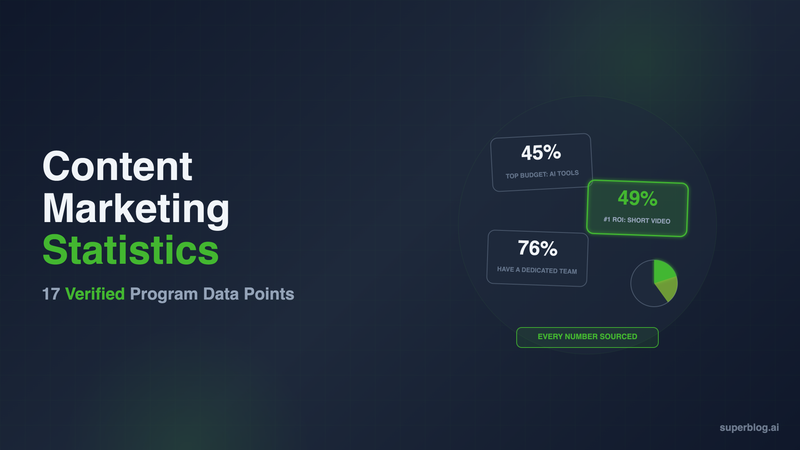
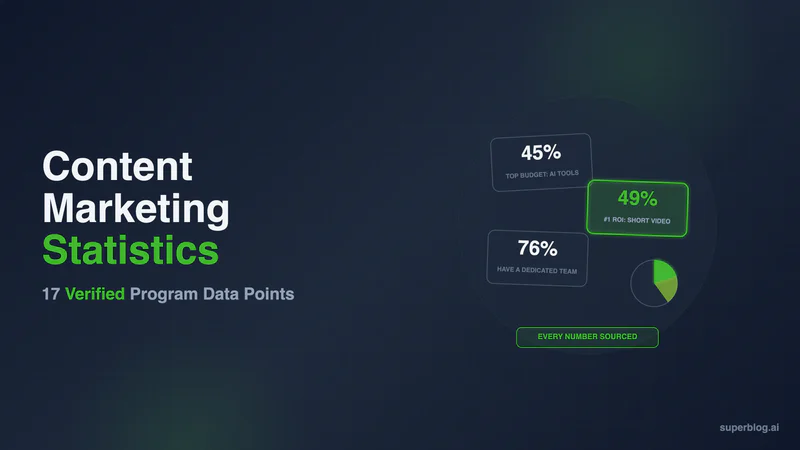
AI-powered marketing tools are now the single biggest content marketing budget priority for B2B teams at 45%, while spending on people ranks dead last at 9%, according to the Content Marketing Institute. Over the same period, short-form video overtook every other format to become the top ROI-driving content type at 49%, per HubSpot. Those two content marketing statistics frame the story of the year: budgets are shifting hard toward automation and video, and the teams executing those programs are staying small while their output expectations climb. This roundup covers the program side of content marketing, budgets, team size, distribution, channel mix, ROI, and B2B buying behavior. For SEO, writing, and AI-search numbers, see our companion blogging statistics roundup. Every figure below traces to a named primary source with a publication year, verified against the original report.
Content Marketing Statistics at a Glance
Content Marketing Statistics: The Numbers That Matter Most
- AI-powered marketing tools are the top B2B budget priority for 2026 at 45%, ahead of events, owned media, and paid media, while human resources sits last at 9% (Source: Content Marketing Institute / MarketingProfs 16th Annual B2B report, fielded June to August 2025, 1,015 B2B respondents).
- Short-form video is now the #1 ROI-driving content format at 49%, ahead of long-form video and blog posts (Source: HubSpot State of Marketing Report, 2026).
- 76% of B2B organizations have a dedicated content marketing team, but 54% of those teams are just 2 to 5 people (Source: CMI / MarketingProfs 15th Annual B2B report, fielded June to August 2024, 980 B2B respondents).
- Only 12% of B2B marketers rate their marketing as highly effective, with 47% calling it merely somewhat effective (Source: CMI / MarketingProfs 16th Annual B2B report, 2026).
- 56% of B2B marketers say attributing ROI to content is a real challenge, the measurement gap that keeps content budgets on shaky ground (Source: CMI / MarketingProfs 15th Annual B2B report, 2025).
Read together, these five numbers describe a discipline under pressure. Budgets tilt toward AI tooling and video while the people doing the work stay in small pods, most teams grade their results as average at best, and the majority cannot cleanly prove what their content returns. The rest of this post breaks the content marketing statistics down by budget, team, distribution, ROI, and AI adoption.
Content Marketing Budget Statistics
Budget data is where intent shows up before results do. These figures come from the two most recent editions of the CMI / MarketingProfs B2B benchmark, the longest-running budget dataset in the field.
- 46% of B2B marketers expected their content marketing budget to increase, up marginally from 45% the prior year, while 41% expected it to hold flat and only 8% braced for a cut (Source: CMI / MarketingProfs 15th Annual B2B report, 2025).
- AI-powered marketing tools are the top budget priority heading into 2026, named by 45% of B2B marketers, followed by events and experiential marketing at 33% and owned media at 32% (Source: CMI / MarketingProfs 16th Annual B2B report, 2026).
- Human resources ranks as the lowest budget priority at 9%, a striking gap that shows teams are funding automation faster than they are funding the people who run it (Source: CMI / MarketingProfs 16th Annual B2B report, 2026).
- 61% of B2B marketers said their organization would invest more in video, with thought leadership content next at 52% (Source: CMI / MarketingProfs 15th Annual B2B report, 2025).
The pattern holds across both survey years: money moves toward tools and video, not headcount. That makes owned media efficiency matter more than ever, since the same small team has to feed more channels. If you are stretching a lean budget, our guide to repurposing one piece of content into many covers how top teams get more mileage per asset.
Content Marketing Team Statistics
Program results depend as much on staffing as on spend, and the picture is remarkably lean.
- 76% of B2B organizations have a dedicated content marketing team or at least dedicated staff, so content is no longer an afterthought bolted onto other roles (Source: CMI / MarketingProfs 15th Annual B2B report, 2025).
- 54% of those dedicated teams are made up of just 2 to 5 people, and a meaningful share run on a single person (Source: CMI / MarketingProfs 15th Annual B2B report, 2025).
- 27% of B2B marketers expected their content team to grow, citing rising demand for content and pressure to reduce internal silos (Source: CMI / MarketingProfs 15th Annual B2B report, 2025).
- 39% of B2B marketers name resource constraints as a top challenge, and 40% struggle to create content that actually prompts action (Source: CMI / MarketingProfs 16th Annual B2B report, 2026).
Small teams carrying growing mandates is the defining tension in content marketing right now. When two to five people own the entire program, every hour spent on plugins, updates, or broken builds is an hour stolen from strategy and writing. A repeatable planning system is one of the highest-impact fixes here, which is why we built a free editorial calendar template around exactly this constraint.
Content Distribution and Channel Mix Statistics
Creating content is half the job. Distribution is the other half, and 2026 shows a decisive shift toward video and away from any single dominant platform.
- Short-form video was the most-used content format in 2025 at 60%, ahead of long-form video and blog posts, both at 38% (Source: HubSpot State of Marketing Report, 2026).
- 94% of marketers plan to use AI somewhere in their content creation process in 2026, including blog articles, up sharply year over year (Source: HubSpot State of Marketing Report, 2026).
- Instagram is now the most-used brand social platform at 70%, narrowly ahead of Facebook at 69.6%, with TikTok at 57% and LinkedIn at 42% (Source: HubSpot State of Marketing Report, 2026).
- 85% of B2B marketers say LinkedIn delivers the best value of any social platform, and short articles remain the most-used B2B format at 92% (Source: CMI / MarketingProfs 15th Annual B2B report, 2025).
There is a useful tension here. Consumer and mixed-audience marketers pour into short-form video and Instagram, while B2B programs still rate LinkedIn and written short articles as their highest-value channels. The takeaway is not to chase every format. It is to match format to audience, then make your owned blog the durable hub that social and AI channels point back to. Our SaaS content strategy guide shows how software teams sequence blog, product, and distribution work.
Content Marketing ROI and Measurement Statistics
ROI keeps content budgets alive, and it is also the number teams struggle most to produce.
- 56% of B2B marketers cite difficulty attributing ROI to their content efforts, the single most common reason content budgets get questioned (Source: CMI / MarketingProfs 15th Annual B2B report, 2025).
- Only 51% strongly or somewhat agree their organization measures content performance effectively, meaning roughly half of all B2B teams cannot confidently say what their content returns (Source: CMI / MarketingProfs 15th Annual B2B report, 2025).
- 33% of B2B marketers name measurement difficulty as a top challenge for 2026, keeping it in the top three barriers alongside resourcing and content that converts (Source: CMI / MarketingProfs 16th Annual B2B report, 2026).
The measurement gap is the quiet crisis in content marketing. Programs are judged on ROI, yet half of teams admit they cannot measure it well. That is a reporting and infrastructure problem more than a content problem. If leadership is asking what your blog actually returns, our framework for measuring blog ROI in a B2B funnel lays out a model you can defend.
AI in Content Marketing Statistics
AI moved from experiment to default in a single reporting cycle. Adoption is near-universal, but the value story is more nuanced than the hype suggests.
- 95% of B2B marketers now use AI-powered applications in some form, and 94% plan to use AI in content creation specifically (Sources: CMI / MarketingProfs 16th Annual B2B report, 2026; HubSpot State of Marketing Report, 2026).
- Among B2B marketers using AI for content creation, 87% report improved productivity and 80% report improved operational efficiency (Source: CMI / MarketingProfs 16th Annual B2B report, 2026).
- Only 39% say AI has improved content performance, and 58% say it improved content quality, so the productivity gains are outpacing the quality and results gains by a wide margin (Source: CMI / MarketingProfs 16th Annual B2B report, 2026).
The honest read on AI in content marketing is that it makes teams faster far more reliably than it makes their content better. Productivity is up almost across the board, while fewer than four in ten marketers see a genuine performance lift. That gap matters because AI has also changed how content gets discovered, a shift we cover in whether blogging still helps SEO.
What These Content Marketing Statistics Mean for Your Program
Zoom out and the through-line is clear. Content marketing is a mainstream, budgeted discipline run by small teams asked to do more with automation, video, and AI, all while half of them cannot prove ROI. The winners spend their limited hours on strategy and writing instead of maintenance, and publish on infrastructure both search engines and AI answer engines can read.
Our own data backs this up from the acquisition side. In the Superblog signup survey (4,280 responses all-time), the trailing-90-day cut shows Google at 50.7% of self-reported discovery and ChatGPT at 17.8%, roughly 68% combined of how new customers say they found us (Source: Superblog signup survey, 2026). Content, whether ranked in Google or cited by an AI assistant, is the dominant way growth-stage buyers discover tools. Customers who commit to it see it compound: Segwise grew unique blog traffic 415% on Superblog, and MonsterMath went from zero to roughly 3,000 monthly organic visits, both by publishing on fast, crawlable infrastructure rather than fighting their CMS.
Superblog is built for exactly the lean, budget-pressured team these content marketing statistics describe. Every post ships with automatic JSON-LD schema, auto-generated sitemaps, IndexNow pings on publish, and an LLMs.txt file. No plugins to maintain, no updates to install, and a 90-plus Lighthouse score on every page automatically. Plans run $29, $49, and $99 per month, with a 7-day free trial and no credit card required. Start a free Superblog trial to see the infrastructure behind these numbers.
FAQ
What is the most cited content marketing statistic for 2026?
The most consequential program-level figure is that AI-powered marketing tools became the top B2B content marketing budget priority at 45%, while human resources ranked last at 9% (Source: CMI / MarketingProfs 16th Annual B2B report, 2026). It captures the year's defining shift: money is moving toward automation faster than toward people.
How big is the average content marketing team?
Small. 76% of B2B organizations have a dedicated content marketing team, but 54% of those teams are made up of just 2 to 5 people (Source: CMI / MarketingProfs 15th Annual B2B report, 2025). A meaningful share operate with a single dedicated person carrying the entire program.
Are content marketing budgets going up in 2026?
For most teams, yes. 46% of B2B marketers expected their content budget to increase, 41% expected it to stay flat, and only 8% anticipated a cut (Source: CMI / MarketingProfs 15th Annual B2B report, 2025). The largest planned increases are going toward AI tools and video production.
Which content format has the best ROI right now?
Short-form video ranks as the #1 ROI-driving content format at 49%, ahead of long-form video and blog posts (Source: HubSpot State of Marketing Report, 2026). For B2B specifically, short written articles remain the most-used format at 92%, and LinkedIn is rated the best-value social platform by 85% of B2B marketers (Source: CMI / MarketingProfs 15th Annual B2B report, 2025).
Why do so many marketers struggle to prove content marketing ROI?
Attribution in a multi-touch funnel is genuinely hard. 56% of B2B marketers cite difficulty attributing ROI to content, and only 51% agree their organization measures content performance effectively (Source: CMI / MarketingProfs 15th Annual B2B report, 2025). The gap is usually an infrastructure and reporting problem rather than a content-quality problem.
Is AI actually improving content marketing results?
It improves speed far more reliably than results. Among B2B marketers using AI for content, 87% report improved productivity, but only 39% report improved content performance and 58% improved content quality (Source: CMI / MarketingProfs 16th Annual B2B report, 2026). AI is a strong efficiency tool and a weaker performance tool, at least so far.
How do buyers actually discover content-led products today?
Increasingly through a mix of search and AI answer engines. Superblog's own signup survey shows Google at 50.7% and ChatGPT at 17.8% of recent self-reported discovery, roughly 68% combined (Source: Superblog signup survey, 2026). Ranking in Google and being cited by AI assistants are now two doors into the same growth engine.
Your blog, without the maintenance
Fast pages, automatic SEO, no plugins to patch. Runs on yoursite.com/blog.
Sai Krishna is the Founder and CEO of Superblog. Having built multiple products that scaled to tens of millions of users with only SEO and ASO, Sai Krishna is now building a blogging platform to help others grow organically.
superblog
Superblog is a blazing fast blogging platform for beautiful reading and writing experiences. Superblog takes care of SEO audits and site optimizations automatically.