
Content Marketing Budget: How to Plan and Allocate Your Spend

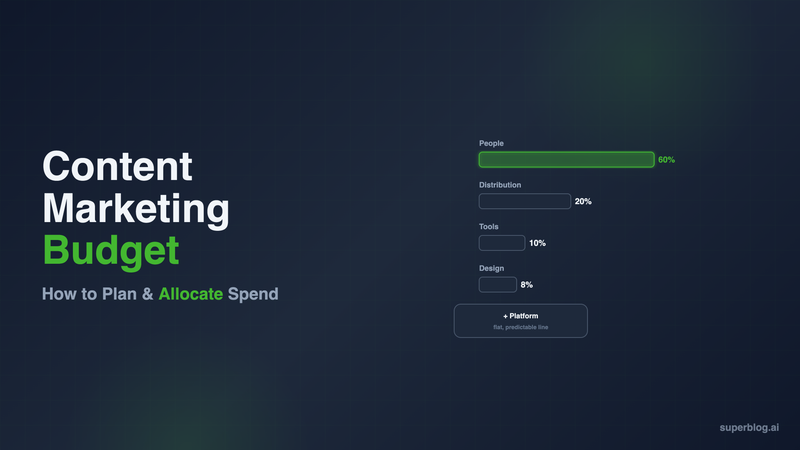
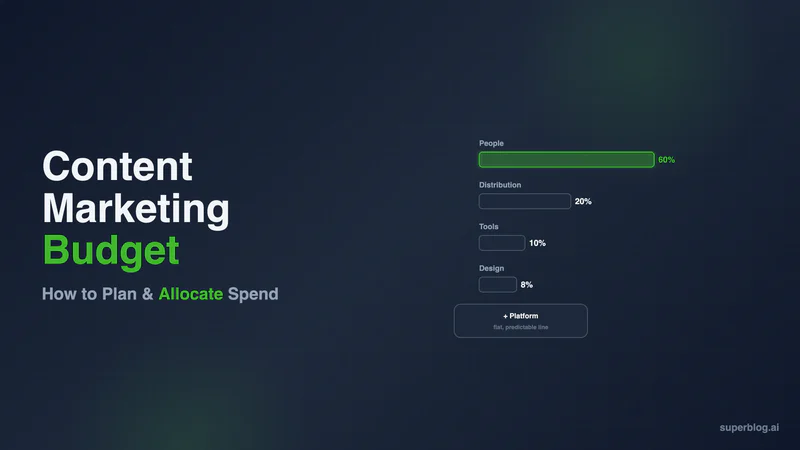
A content marketing budget is the sum of every recurring cost it takes to research, produce, publish, distribute, and host your content, plus the people who do the work. Build it as line items, not a single lump number. That way you can see exactly what you are paying for, cut the parts that do not drive return, and defend the spend to a finance team that wants numbers.
Most teams get this wrong in one of two directions. They underfund it, treating content as a side project squeezed in between other work, or they overfund the wrong parts, paying for volume that never ranks while the platform and distribution lines get ignored. This guide breaks a content marketing budget into its real components, gives you allocation ranges to sanity-check your split, and shows how to scale spend by stage so every dollar ties back to expected traffic and pipeline.
What a content marketing budget actually covers
Before you set a number, you need to know what belongs inside it. A complete content marketing budget has five line items, and skipping any one of them is how teams end up with a plan that looks funded on paper but stalls in practice.
1. People. Writers, editors, an SEO strategist, and whoever owns distribution. This is almost always the largest line, whether the people are on payroll, on retainer, or paid per project. It also includes the fractional cost of a marketing lead who plans and reviews.
2. Tools. Keyword research, rank tracking, analytics, a grammar or editing tool, and project management. A lean stack might be one all-in-one SEO tool plus a spreadsheet. A mature stack has separate tools for research, tracking, and reporting.
3. Distribution. The budget to get published content in front of people. Paid amplification, newsletter sponsorships, social ads, and any syndication. Content that nobody sees returns nothing, so this line is not optional once you are producing regularly.
4. Platform and hosting. Where the content lives and how fast it loads. This is the line most teams underestimate, because the sticker price of a blogging platform hides the real cost of maintenance, plugins, and developer time. More on this below.
5. Design and production. Cover images, in-post graphics, diagrams, and any video or audio. Some teams fold this into people; separating it shows how much visual work actually costs.
If a line is missing here, the work still happens. It just comes out of someone's unpaid overtime or gets skipped entirely. Naming all five keeps the plan honest.
How much should you spend on each line
Reliable public benchmarks for the internal split of a content budget are thin, so treat any single percentage you see online with suspicion. What we can anchor to are directional signals from named research and sensible ranges.
According to the Content Marketing Institute's B2B Content Marketing Benchmarks (published October 2024, measuring the 2025 outlook), 46% of B2B marketers expected their content marketing budget to increase year over year, 41% expected it to stay flat, and only 8% expected a cut. The same research shows where teams planned to put new money: 61% planned to increase spend on video, 52% on thought leadership content, 40% on paid advertising, and 39% on AI for content creation. Those figures tell you the direction of travel. Video and distribution are getting more expensive, and paid amplification is now a standard line rather than an afterthought.
For the internal split itself, there is no authoritative percentage breakdown, so use these as working ranges rather than rules:
- People: roughly half to two-thirds of the total. Content is a labor business. If people are less than half your budget, you are probably underpaying for quality or relying on unpaid time.
- Tools: a small but fixed slice, often 5 to 15%. This scales slowly. A five-person team does not need five times the tooling of a one-person team.
- Distribution: 10 to 30%, rising as you mature. Early on you can lean on organic. Once you have a content back catalog worth promoting, paid amplification earns its place.
- Platform and hosting: a single predictable line. On a managed platform this is a flat fee. On a self-managed stack it is a variable line that can quietly rival your tooling budget.
- Design: 5 to 15%, depending on how visual your format is.
These are starting points to pressure-test your own numbers, not benchmarks to cite. The real discipline is making sure every line has an owner and a reason.
In-house vs agency vs freelance
How you staff the people line changes both your cost and your control. Each model has a real tradeoff.
In-house gives you the deepest product knowledge and the tightest feedback loop. A writer who sits in your standups understands the roadmap and the customer. The cost is fixed and high: salary, benefits, ramp time, and the risk that a single hire leaves. In-house makes sense once content is a permanent channel and you have enough volume to keep a full-time person productive.
Agency buys you a whole function at once: strategy, writing, editing, and often distribution. You trade per-word cost for speed and coverage. Agencies work when you need to scale fast or lack the internal expertise. The risk is generic output and weak product understanding, so the strongest relationships include a real onboarding and a named editor who learns your voice.
Freelance is the most flexible and often the lowest fixed cost. You pay per project and scale with demand, and strong freelancers bring specialist knowledge you cannot afford to hire full-time. The cost is management overhead: you own the strategy, briefs, editing, and consistency. Freelance breaks down when nobody internal owns the standard.
Most growing teams run a hybrid. One in-house owner sets strategy and edits, freelancers or an agency handle volume, and the owner keeps quality consistent. If you are staffing lean, our guide to startup content marketing covers how to get real output from a small team, and the SaaS content strategy framework shows how to point that output at revenue rather than raw volume.
How budget scales by stage
Your budget should change shape as your program matures, not just grow in size.
Early stage (proving the channel). The goal is evidence that content can drive qualified traffic. Keep the budget small and weighted almost entirely toward people and a minimal tool stack. Skip heavy distribution spend until you have posts worth promoting. Publish consistently, target buyer-intent keywords, and measure whether the traffic converts. A lightweight editorial calendar template is enough process at this stage; you do not need a full content operations setup to publish two useful posts a week.
Growth stage (scaling what works). You have proof that certain topics rank and convert. Now the budget grows on the people and distribution lines. Add editing capacity so quality holds as volume rises, start paid amplification on your top-performing posts, and invest in content repurposing so one strong article becomes a newsletter, a social series, and a lead magnet. This is where distribution earns a real percentage of the total.
Scale stage (compounding the back catalog). You have a library of ranking content and a repeatable process. Budget shifts toward maintaining and updating existing winners, expanding into new clusters, and heavier distribution. Tooling and analytics get more sophisticated because you are managing dozens or hundreds of pages. The platform line matters more than ever, because slow or fragile infrastructure across a large catalog becomes a recurring tax.
The mistake is treating the early-stage budget as the permanent shape. A program that never rebalances toward distribution and maintenance keeps producing content that fewer and fewer people ever see.
The platform line most budgets get wrong
Here is the line item that quietly wrecks content budgets: the platform.
On the surface, a self-hosted blog looks cheap. Open-source software is free, entry hosting is inexpensive, and a theme is a one-time cost. Then the real bills arrive. Premium plugins carry annual license fees. Someone has to run updates, fix breakages, and patch security holes. Page speed problems need a developer. Our own breakdown of WordPress maintenance cost found that a moderate business blog often lands between $300 and $1,000 per month in direct spend before any internal labor is counted, and that total cost of ownership commonly reaches $300 to $3,500 per month once maintenance hours and developer time are added.
That variability is the problem. A budget line you cannot predict is a budget line you cannot defend. Worse, the maintenance work competes directly with the actual job, which is publishing. Every hour spent debugging a plugin conflict is an hour not spent on content that ranks.
A managed platform collapses that variable stack into one flat, predictable line. Hosting, SSL, CDN, SEO tooling, and performance come folded into a single monthly fee, with no plugins to license and no developer time to budget for. For a finance team, a flat line beats a range that swings by an order of magnitude. And speed is not a vanity metric: fast pages rank better and hold readers longer, which is the whole reason the content line exists. That link between technical quality and rankings is covered in our guides on blog SEO and whether blogging still helps SEO.
Tie every dollar to expected return
A budget is only as good as the return it can point to. The teams that keep their content funding through a tight quarter are the ones that can show what the spend produced.
Set the return expectation before you set the number. A buyer-intent article that targets someone comparing tools is worth far more than a high-volume awareness post that attracts readers who never buy. Ten pages that rank for purchase-intent queries will usually outperform fifty pages of broad traffic. Volume alone is a weak target: spend that chases raw pageviews inflates the top of the funnel and starves the parts that convert.
Track the metrics that connect content to pipeline: qualified organic clicks to money pages, signups or demos attributed to content, and the movement of target keywords into ranking positions. Our guide to content marketing KPIs breaks down which numbers actually predict growth and which are vanity.
The return can be real. Segwise grew unique traffic 415% after moving to a platform built for SEO, and MonsterMath went from zero to 3,000 monthly organic visitors. Those outcomes came from pointing a funded, consistent program at the right keywords, not from spending more for its own sake.
A sample monthly budget
Here is how a growth-stage B2B blog publishing eight to twelve posts a month might allocate spend. Treat the numbers as an illustration of shape, not a quote.
The exact dollars depend on whether your people are in-house, freelance, or agency, and on how aggressive your distribution is. What stays constant is the discipline: five named lines, each with an owner and a reason it exists.
Where Superblog fits the budget
The platform line is where Superblog turns a variable cost into a fixed one. Instead of stacking hosting, plugins, a CDN, an SSL certificate, SEO tools, and developer time into an unpredictable monthly total, Superblog folds all of it into one flat fee: $29, $49, or $99 per month depending on team size and features.
That single line includes managed hosting on a global CDN, automatic SEO (JSON-LD schemas, XML sitemaps, IndexNow, LLMs.txt, canonical tags), 90+ Lighthouse performance on every page, and free SSL. There are no plugins to license, no updates to run, and no security patches to schedule. The maintenance hours that inflate a self-hosted budget disappear, which means the people line can stay focused on content instead of infrastructure.
For a budget owner, the appeal is predictability. You can write the platform line once and know it will not swing by an order of magnitude next quarter. You can start on a 7-day free trial with no credit card required to see the flat-cost model before committing a single budget dollar.
FAQ
How much should a small business spend on content marketing?
There is no universal number, because it depends on how central content is to your growth. A useful way to set it is bottom-up: cost out the five line items (people, tools, distribution, platform, design) for the publishing pace you can sustain, then check that against expected return. A program you can fund consistently for a year beats a big budget that gets cut after two quarters.
What percentage of my marketing budget should go to content?
Public benchmarks vary and none is authoritative enough to treat as a rule. Rather than anchor to a single percentage, decide what content needs to produce (qualified traffic, signups, pipeline) and fund the plan that delivers it. Content Marketing Institute research found 46% of B2B marketers expected their content budget to grow into 2025, which tells you the direction most teams are moving, not the exact share you should set.
Is it cheaper to hire in-house or use an agency?
In-house has a higher fixed cost but gives you deeper product knowledge and control. Agencies cost more per project but deliver a full function fast. Freelance is the most flexible and often the lowest fixed cost, at the price of management overhead. Most growing teams run a hybrid: one in-house owner for strategy and editing, plus freelancers or an agency for volume.
Why is the platform a bigger cost than it looks?
A self-hosted blog hides its real cost in maintenance. Plugin licenses, updates, security patches, and developer time turn a cheap sticker price into a variable line reaching hundreds or thousands of dollars a month. A managed platform replaces that with one flat fee.
How do I justify content budget to finance?
Tie every line to an outcome and track it. Report qualified organic clicks to money pages, content-attributed signups or demos, and keyword rankings moving toward the top of the results. A budget with named lines and a measured return is far easier to defend than a lump sum with no attribution.
Should I spend on volume or on fewer, higher-intent pieces?
Favor intent. Ten pages that rank for purchase-intent queries usually drive more pipeline than fifty broad awareness posts. Volume inflates top-of-funnel traffic that may never convert. Fund the content closest to a buying decision first, then expand once those pages are working.
How does budget change as the program grows?
Early on, weight almost everything toward people and a minimal tool stack to prove the channel. At growth stage, add editing capacity and start paid distribution. At scale, shift toward maintaining winners, expanding clusters, and heavier amplification. The shape of the budget should evolve, not just the size.
Your blog, without the maintenance
Fast pages, automatic SEO, no plugins to patch. Runs on yoursite.com/blog.
Sai Krishna is the Founder and CEO of Superblog. Having built multiple products that scaled to tens of millions of users with only SEO and ASO, Sai Krishna is now building a blogging platform to help others grow organically.
superblog
Superblog is a blazing fast blogging platform for beautiful reading and writing experiences. Superblog takes care of SEO audits and site optimizations automatically.