
Blogging Statistics 2026: 26 Verified Data Points for Business Marketers

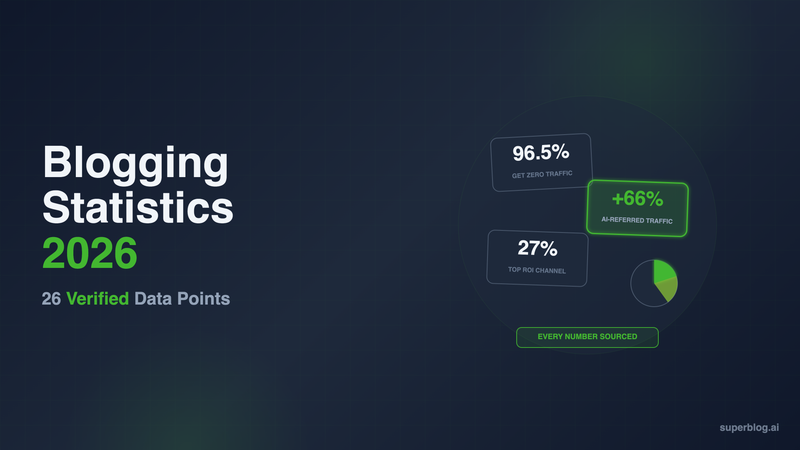
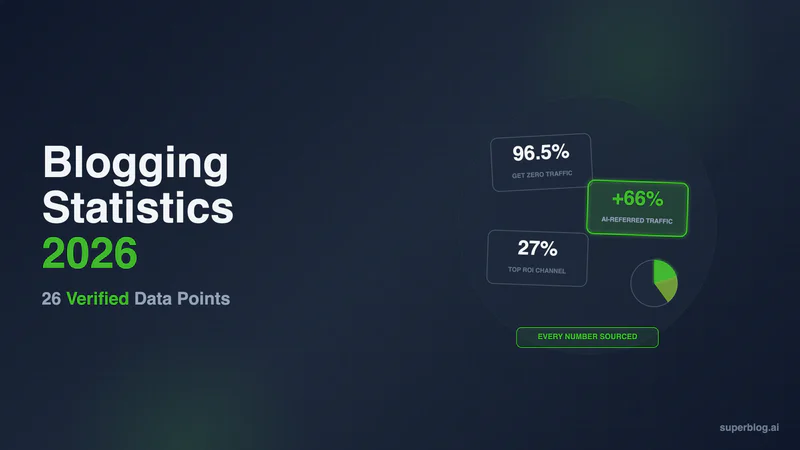
96.55% of blog pages get zero organic traffic from Google, and AI Overviews now correlate with a 58% drop in click-through rate for the top organic result. Those two blogging statistics alone explain most of what's changed in content marketing over the past year: it was already hard to rank, and the reward for ranking just got smaller. This roundup only includes numbers we traced to a named, dated, primary source, most from 2025 and 2026. Where a widely-repeated stat couldn't be verified against its original research, it was cut rather than included with a vague attribution.
Blogging Statistics at a Glance
Blogging Statistics: The 5 Numbers That Matter Most
- 96.55% of pages get zero organic traffic from Google, based on Ahrefs' analysis of roughly 14 billion pages in its Content Explorer index (Source: Ahrefs Content Explorer study, published December 2023). Most of that content was never linked to or never matched real search demand.
- Content over 3,000 words earns 77.2% more referring domain links than content under 1,000 words, from Backlinko's analysis of 912 million blog posts with data partner BuzzSumo (Source: Backlinko/BuzzSumo content study).
- 44.2% of ChatGPT citations come from the first 30% of a page, based on an analysis of roughly 3 million ChatGPT responses and 18,012 verified citations (Source: Kevin Indig, via Search Engine Land, 2026).
- AI Overviews correlate with a 58% lower average click-through rate for the position-one organic result, based on a December 2025 snapshot of 300,000 keywords (Source: Ahrefs, published February 2026).
- WordPress now powers 41.5% of all websites, down from a 2025 peak near 43.2%, marking its first sustained multi-month decline in roughly 20 years (Source: W3Techs, checked July 2026).
Those five numbers tell the whole story of blogging in 2026: most content still fails to earn traffic, length and depth remain the strongest backlink predictor, AI answer engines reward front-loaded structure, Google's own results page is keeping more clicks for itself, and the CMS market leader is shrinking for the first time in two decades. The rest of this post breaks down the blogging statistics behind SEO performance, business ROI, content production habits, the AI-search shift, and the platform landscape, section by section.
Blogging and SEO Statistics
These blogging statistics come from the largest available page- and link-level datasets and describe how search engines actually treat blog content, not how marketers wish they did.
- 96.55% of pages receive zero traffic from Google search, and only about 3.45% get any organic visits at all, from Ahrefs' study of roughly 14 billion pages (Source: Ahrefs, "96.55% of Content Gets No Traffic From Google," December 2023).
- 94% of blog posts contain zero external outbound links, according to the Backlinko/BuzzSumo study of 912 million blog posts, a sign of how little of the average post points readers anywhere else on the web, let alone earns links back (Source: Backlinko content study).
- Content longer than 3,000 words earns 77.2% more referring domain links on average than content under 1,000 words, from the same 912-million-post analysis (Source: Backlinko/BuzzSumo content study).
- Only 1.74% of newly published pages reach Google's top 10 for a competitive keyword within a year of going live (Source: Ahrefs, 2026 SEO statistics report).
- AI-cited content is 25.7% fresher on average than organic top-10 results, suggesting AI answer engines weight recency more heavily than classic Google ranking does (Source: Ahrefs, 2026 SEO statistics report).
Taken together, these numbers describe a landing zone that's crowded at the bottom and thin at the top: most pages never earn a single outbound citation or link, and even the ones that get published consistently rarely break into the top 10 within their first year.
If you want the mechanics behind why blogs outrank static pages in the first place, see our guide on whether blogging actually helps SEO and the companion deep dive on optimizing a blog for SEO.
Business Blogging ROI Statistics
Volume numbers are interesting; ROI numbers are what get budget approved. These blogging statistics focus on what a business blog returns, not just how much traffic it drives.
- Website, blog, and SEO is the #1 channel marketers cite for ROI, named by 27% of marketers as their top-performing channel, ahead of paid social at 26% (Source: HubSpot 2026 State of Marketing Report).
- Small businesses are 23% more likely than average to see ROI from blog posts, according to the same report (Source: HubSpot 2026 State of Marketing Report).
- 73% of B2B marketers now have a documented content marketing strategy (Source: Content Marketing Institute/MarketingProfs 16th Annual B2B Content Marketing Report, fielded June to August 2025, 1,015 B2B respondents).
- B2B buyers consume 13.4 pieces of content on average before contacting sales, with 67% of the buying journey happening before a sales conversation starts (Source: CMI/MarketingProfs 16th Annual B2B Report).
These four numbers alone justify a blog line item to most finance teams: it's the channel marketers trust most for ROI, small businesses see outsized returns from it, and B2B buyers are doing the majority of their research through content before a rep ever gets involved. The strategy-documentation figure matters because it's a leading indicator, not a lagging one, teams that write down what they're doing report more of the other wins in this list.
Because blog ROI is genuinely hard to attribute in a multi-touch B2B funnel, we've written a full framework for tracking it. See measuring blog ROI for B2B if leadership is asking what the content budget is actually returning.
Content Frequency and Length Statistics
These come primarily from Orbit Media's annual blogger survey, the longest-running dataset on how bloggers actually work, now spanning 12 years and over a decade of respondents.
- The average blog post is 1,333 words in the 2025 survey, based on responses from 808 content marketers collected in August 2025 (Source: Orbit Media 2025 Blogger Survey).
- 39% of bloggers publishing 2,000+ word posts report "strong results," compared with a 21% baseline across all respondents (Source: Orbit Media 2025 Blogger Survey).
- 37% of bloggers who publish multiple times per week report strong results, the highest rate of any frequency band in the survey, while roughly half of all marketers publish just 2 to 4 times per month (Source: Orbit Media 2025 Blogger Survey).
- The average blog post now takes 3 hours and 25 minutes to produce, per self-reported time-to-publish data in the same survey (Source: Orbit Media 2025 Blogger Survey).
- 88% of bloggers include images in their posts, and 60% include original statistics or data, while 45% include quotes from outside contributors (Source: Orbit Media 2025 Blogger Survey).
- How-to articles remain the most common format at 76%, followed by listicles at 54% and original research at 49% (Source: Orbit Media 2025 Blogger Survey).
- Bloggers who guest post on other sites report strong results at 30%, roughly double the 15% rate for bloggers who never guest post (Source: Orbit Media 2025 Blogger Survey).
- Marketers who always track analytics report strong results at 32%, versus 13% for those who rarely or never check (Source: Orbit Media 2025 Blogger Survey).
AI-Era Blogging Statistics
This is the fastest-moving category in the entire dataset, and the one most likely to be out of date within a year. We've verified each figure against a named 2025 or 2026 source.
- 44.2% of ChatGPT citations come from the first 30% of a page's content, based on an analysis of roughly 3 million ChatGPT responses and 18,012 manually verified citations using sentence-transformer embeddings to match answers to source text (Source: Kevin Indig, published in Search Engine Land, 2026).
- AI Overviews correlate with a 58% lower average click-through rate at position one, based on a December 2025 snapshot of 300,000 keywords, 150,000 with AI Overviews present and 150,000 without, using aggregated Search Console data. This updates Ahrefs' earlier finding of a 34.5% reduction (Source: Ahrefs, February 2026).
- AI-referred traffic grew 66% across 2025, rising from roughly 462 million to 767 million monthly visits, based on an analysis of 50,000+ websites across 17 industries, even though AI traffic still represents only 0.14% of total measured web visits (Source: Semrush 2025 traffic channel mix study).
- 95% of bloggers now use AI tools at least sometimes, up from 35% two years earlier, though only around 10% use AI to write complete articles rather than assist with ideas or edits (Source: Orbit Media 2025 Blogger Survey).
That last jump, from just over a third of bloggers experimenting with AI tools to 95% using them regularly in two years, is one of the fastest adoption curves in the entire dataset, faster than social media adoption among marketers a decade ago.
Our own signup data adds a proprietary data point to this picture that we haven't seen published anywhere else. In our signup survey (4,280 responses all-time), the trailing-90-day cut shows Google at 50.7% of self-reported discovery and ChatGPT at 17.8%, up from effectively 0% six quarters ago and now the clear #2 discovery channel ahead of LinkedIn and Twitter combined (Source: Superblog signup survey, n=4,280 all-time, self-reported "how did you discover us" data, last-90-day window, 2026). Google and ChatGPT combined now account for roughly 68% of how new customers say they found us, which is about as direct a confirmation as we've seen that answer-engine visibility is no longer optional for a blog's growth strategy. We wrote up what that split means for anyone asking whether SEO is dead in more detail, and the short answer is no, it's forking into two channels rather than disappearing.
CMS and Platform Statistics
Where blogs actually get built and hosted has shifted meaningfully over the past year.
- WordPress powers 41.5% of all websites as of July 2026, down from a 2025 peak of roughly 43.2%, its first sustained multi-month decline in about 20 years of market dominance (Source: W3Techs, July 2026).
- WordPress holds 59.2% share of the identifiable CMS market, meaning among sites running a known content management system, WordPress still runs about 3 in 5 of them (Source: W3Techs, July 2026).
- Shopify sits second among CMS platforms at 5.2% of all websites, with Wix third at roughly 4.3%, both far behind WordPress but growing (Source: W3Techs, July 2026).
- 74% of all newly published web content now contains AI-generated elements, according to Ahrefs' 2026 analysis, a figure with direct implications for any platform or CMS competing on content quality rather than content volume (Source: Ahrefs, 2026 SEO statistics report).
Methodology: How These Stats Were Verified
Every statistic in this post was checked against its original, named source (not a secondhand roundup) between late June and July 2026. Where a number is commonly cited but we could not trace it to a dated, methodologically-described primary study, we excluded it rather than publish it with a vague "studies show" attribution. That's why this list holds at 26 verified data points instead of the 40 we initially scoped, several widely-recirculated blogging statistics (including some decade-old lead-growth figures still copy-pasted across the web, and a handful of unattributed "Semrush says" numbers we couldn't trace to any published Semrush study) did not survive that check and were cut. Sample sizes, survey dates, and methodology notes are included inline wherever the original source disclosed them. If you find a stat here that has since been updated or superseded, we'd genuinely like to know, verified data is the entire point of this page.
Consistent, verifiable data only compounds if you keep publishing it. Superblog is built for teams that want a blog that both search engines and AI answer engines can crawl, parse, and cite easily: automatic JSON-LD schema on every post, auto-generated sitemaps, IndexNow pings on publish, and an LLMs.txt file. If your blog is the kind that should be showing up in roundups like this one, that infrastructure needs to be automatic, not a checklist you maintain by hand.
FAQ
How many blogging statistics are in this post, and why not 40?
This post includes 26 verified statistics. We scoped 40 but cut nearly a third of the candidates because we couldn't trace them to a dated, named primary source, including several stats attributed to Semrush that don't appear in any Semrush study we could locate. We'd rather publish fewer numbers you can trust than pad the count with recycled figures.
What percentage of blog content actually ranks on Google?
Based on Ahrefs' analysis of roughly 14 billion pages, only about 3.45% of content gets any organic traffic from Google, and just 1.74% of newly published pages reach the top 10 for a competitive keyword within a year of publishing (Source: Ahrefs). Ranking is the exception, not the default outcome of hitting publish.
Is blogging still worth it for businesses in 2026?
Yes. HubSpot's 2026 State of Marketing Report ranks website/blog/SEO as the #1 channel marketers cite for ROI, ahead of paid social, and small businesses are 23% more likely than average to see ROI from their blog posts (Source: HubSpot 2026 State of Marketing Report). Our own data shows Google alone still drives just over half of genuine customer discovery for Superblog, with ChatGPT adding a fast-growing second channel on top of that.
How long should a blog post be in 2026?
The average post in Orbit Media's 2025 survey was 1,333 words, but 39% of bloggers publishing 2,000+ word posts report strong results, nearly double the 21% baseline across all respondents. Separately, Backlinko's 912-million-post study found content over 3,000 words earns 77.2% more referring domain links than content under 1,000 words. Longer isn't automatically better, but it correlates strongly with both reported results and backlink acquisition.
Are AI answer engines like ChatGPT actually sending traffic to blogs?
It's real but still small in absolute terms, and growing fast. Semrush measured AI-referred traffic growing 66% across 2025, though it's still roughly 0.14% of total web visits industry-wide. Our own signup survey shows a much larger effect at the acquisition level: ChatGPT now accounts for 17.8% of recent signups, up from roughly 0% six quarters ago, with Google at 50.7% over the same trailing-90-day window (Source: Superblog signup survey, n=4,280 all-time). The traffic-share numbers and the discovery-share numbers are measuring different things, but both point the same direction.
Your blog, without the maintenance
Fast pages, automatic SEO, no plugins to patch. Runs on yoursite.com/blog.
Sai Krishna is the Founder and CEO of Superblog. Having built multiple products that scaled to tens of millions of users with only SEO and ASO, Sai Krishna is now building a blogging platform to help others grow organically.
superblog
Superblog is a blazing fast blogging platform for beautiful reading and writing experiences. Superblog takes care of SEO audits and site optimizations automatically.