
SEO Case Studies: 4 Real Blog Growth Stories and the Strategy Behind Each


Most SEO case studies are marketing brochures wearing a data hat: a screenshot of a traffic graph, a vague "3x growth" claim, and no explanation of what actually happened between month one and month twelve. The useful SEO case studies do something different. They show the starting point, name the specific strategy, report a documented outcome, and let you copy the mechanism instead of the number.
This post walks through four real blog growth stories from businesses running on Superblog, plus the pattern that connects them. Each one includes what the company started with, what's actually documented (the publishing cadence, the technical setup, and where the source discloses an editorial strategy, that too), and the metric that resulted. Then it covers what these stories, and most SEO case studies you'll read, tend to leave out.
If you're evaluating whether to trust a case study, whether the ones below or the roundups your competitors publish, the test is direct: does it name a starting point, a specific strategy, a dated outcome, and an honest timeframe? Most published case studies skip at least one of those four. This one doesn't.
Case study 1: Segwise grew unique blog traffic 415% with a consistent, automated publishing pipeline
Starting point: Segwise, a mobile analytics and attribution platform, ran its blog as a lean team with no dedicated SEO hire. The blog was established, but the team needed a way to keep publishing at a steady pace without adding headcount to manage the technical side of it.
The strategy: Segwise built its blog on a platform that handled schema generation, image compression, and the structured markup search engines rely on to crawl and rank a page, then ran a consistent, largely automated publishing pipeline on top of it. Instead of the team's time going toward technical maintenance, it went toward keeping the publishing cadence steady, month after month, for close to a year. The platform removed the failure modes that usually stall a blog, broken schema, slow pages, manual formatting work, so volume and consistency could actually compound.
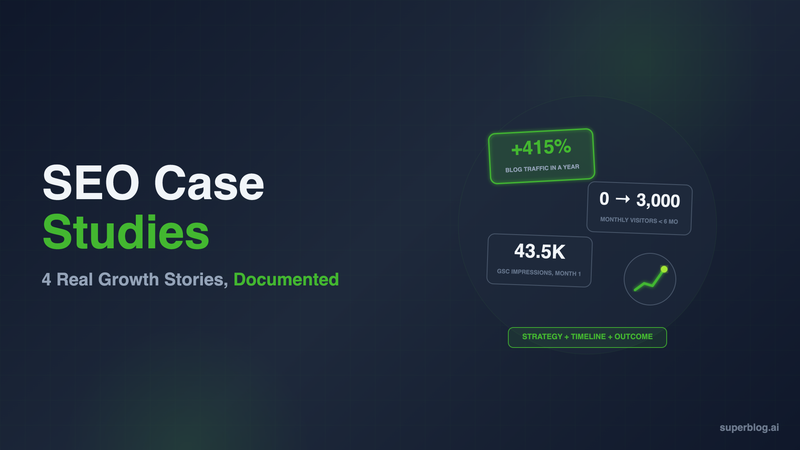
The outcome: Segwise used Superblog to grow unique blog traffic by 415%.
The transferable lesson: Growth like this rarely comes from a single clever tactic. It comes from a technically sound platform removing the busywork that normally slows a team down, so a lean team can publish consistently over a long stretch instead of stalling out on maintenance. Production consistency plus technical automation compound; sporadic publishing on a fragile stack does not.
Case study 2: MonsterMath went from 0 to 3,000 monthly organic visitors in under six months
Starting point: MonsterMath, a math learning app for kids, launched its blog from zero. No backlink history, no existing organic traffic, no domain authority to lean on.
The strategy: MonsterMath published consistently on a platform with strong SEO defaults built in, what the team described as "no-nonsense SEO", rather than spending time configuring the technical fundamentals themselves. The case study doesn't document a specific editorial strategy, topic list, or targeting approach, so we won't invent one. What it does document is a new domain publishing steadily on infrastructure that handled the technical layer by default.
The outcome: MonsterMath went from 0 to 3,000 monthly organic visitors in less than six months.
The transferable lesson: A brand-new domain with no backlink history can reach meaningful organic traffic inside two quarters when the technical layer is handled correctly and publishing stays consistent. That's a statement about infrastructure and cadence, not about a specific editorial playbook, because the source doesn't disclose one.
Case study 3: PrintStop moved off WordPress for speed and stopped losing time to maintenance
Starting point: PrintStop, an enterprise printing and stationery business, ran its blog on WordPress. Milap Shah, PrintStop's co-founder, needed a platform that didn't require constant plugin updates and security patches just to keep publishing.
The strategy: PrintStop moved its business blog to a managed platform built for speed and SEO by default, removing the maintenance overhead that comes with a self-hosted WordPress stack. As Shah put it: "A perfect and super easy platform for running your blogs. It has a very clean UI and is SEO friendly. Highly recommended."
The outcome: PrintStop got a faster publishing setup without the WordPress maintenance tax, documented in Superblog's PrintStop case study.
The transferable lesson: Technical foundation is not a separate workstream from content strategy. Every hour spent patching a CMS is an hour not spent writing, and a slow, plugin-heavy blog undercuts the same content strategy a team is trying to execute.
Case study 4: Sellerview.ai built measurable search visibility from a standing start
Starting point: Sellerview.ai, an AI product, started its blog with zero search presence. No indexed pages, no impressions, no history for Google to evaluate.
The strategy: Sellerview.ai published consistently on a technically sound blog foundation from day one: pages that were fast, structured, and indexable the moment they went live, rather than fighting a slow CMS while also trying to build a content library.
The outcome: Sellerview.ai went from 0 to 43.5K monthly Google Search Console impressions.
The transferable lesson: Early impressions growth is a leading indicator, not a vanity metric. It shows Google is crawling, indexing, and surfacing the content, which is the precondition for every ranking and traffic gain that follows. Getting the technical layer right before scaling content production shortens the time it takes to see that signal.
The pattern across these SEO case studies
Look at all four again and a pattern shows up that has nothing to do with luck or budget:
Production consistency beats sporadic bursts. Segwise's 415% growth came from keeping a publishing pipeline running steadily for close to a year, not from a single high-effort campaign. MonsterMath's growth came from consistent publishing on a new domain. Neither story is about a clever one-off; both are about showing up on a schedule long enough for it to compound. A blog built for SEO is built to sustain that cadence without the technical overhead derailing it.
Technical automation removes the common failure modes. Segwise's pipeline ran on schema generation, image compression, and structured markup handled automatically. PrintStop's story is really about what happens when the CMS itself stops being the bottleneck. Sellerview's is about what happens when a new site is fast and structured enough to get indexed and surfaced quickly. MonsterMath's "no-nonsense SEO" defaults did the same job for a brand-new domain. Schemas, sitemaps, and crawlability aren't optional extras, they're what let consistent publishing actually turn into rankings. If you want the underlying mechanics, see our blog SEO checklist and our breakdown of whether blogging helps SEO in the first place.
Consistency compounds over months, not weeks. MonsterMath's result took under six months. Segwise's took about a year. None of these are overnight stories, and the honest ones never are. If you're wondering what "consistent" actually means in practice, see how often you should blog.
Internal structure supports the growth. As a blog's post count grows, the posts need to link to each other so search engines understand which pages matter and readers can find related content. See our guide to internal linking for blogs for the model these sites use.
None of these companies treated the blog as a side project. A blog that gets updated in bursts, three posts in January, nothing until June, rarely builds the topical density these case studies describe. The companies above published on a schedule they could sustain, which is a lower bar than "publish constantly" and a much higher bar than "publish when someone remembers to."
What these SEO case studies don't tell you
Every case study, including the ones above, has limits that are worth naming instead of hiding.
Survivorship bias is real. You only read about the blogs that grew. Every SEO case study roundup, ours included, is built from companies willing to share a win. The businesses that published for a year and saw nothing don't write it up, which skews the entire genre toward success stories.
Timeframes vary and matter. MonsterMath's 3,000 visitors came in under six months. Segwise's 415% growth happened over about a year, a longer stretch. A case study that doesn't specify its timeframe is asking you to assume the fastest possible version of events, which is rarely the honest one.
Domain history matters more than most case studies admit. A brand-new blog with zero backlink history, like Sellerview.ai's or MonsterMath's, starts from a genuinely different position than a company migrating an established domain with years of authority, like PrintStop. The same strategy will not produce the same timeline on both.
A metric is not a methodology. "Grew traffic 415%" tells you an outcome happened. It does not tell you the twenty smaller decisions, which keywords, which internal links, which headlines, that produced it. Two of the four sources above (MonsterMath and PrintStop) don't disclose an editorial strategy at all, which is exactly why this post doesn't invent one on their behalf. Treat every SEO case study, including this one, as a starting hypothesis to test on your own blog, not a guarantee.
Unverifiable claims should be discarded, not repeated. If a case study can't show you the starting point, the timeframe, and a specific number, it's a testimonial, not a case study. Be skeptical of any post (including from competitors) that leads with a percentage and nothing else.
All four companies above run their blogs on Superblog, which handles the technical layer, schemas, sitemaps, IndexNow submission, image optimization, and CDN delivery, so their teams could put their time into writing and publishing instead of maintaining a CMS. None of that removes the need for a real content strategy. It just removes the maintenance work that competes with it.
FAQ
What makes a good SEO case study?
A good SEO case study names the starting point (traffic, domain age, prior rankings), the specific strategy used (not just "we published more"), a documented and dated outcome, and an honest account of the timeframe. If any of those four pieces is missing, treat the numbers with caution.
How long does blog SEO take to show results?
It varies by domain history and competition, but the case studies above show a range: MonsterMath saw 3,000 monthly visitors in under six months from zero, while Segwise's 415% traffic growth built over about a year. Expect months, not weeks, and expect the timeline to depend heavily on whether you're starting fresh or building on an established domain.
Do SEO case studies apply to every industry?
The mechanism, consistent publishing plus a technically sound platform, applies broadly. The specific keywords and content types differ by industry, which is why the case studies above span a consumer education app, a B2B analytics tool, and an enterprise printing business.
Why do so many SEO case studies feel inflated?
Because a percentage with no baseline is trivial to make impressive and hard to verify. "Grew traffic 415%" sounds different if the baseline was 10 visitors versus 10,000. Look for case studies that state the starting point and the timeframe alongside the percentage.
Is a B2B SaaS SEO case study different from an e-commerce or consumer one?
The specific content differs (a B2B SaaS blog and a consumer app blog aren't writing about the same topics) but the underlying pattern, consistent cadence on a technically sound platform, is the same across both.
Can a new blog with no history produce results like these?
Yes. MonsterMath and Sellerview.ai both started from zero and built measurable results without prior domain authority. It typically takes longer than growing an established domain, and the early months are about building indexed pages and impressions before rankings and traffic follow.
Superblog is built to remove the technical variables from your own SEO story: automatic schemas, sitemaps, IndexNow submission, and a 90+ Lighthouse score on every page, starting at $29/month with a 7-day free trial and no credit card required.
Your blog, without the maintenance
Fast pages, automatic SEO, no plugins to patch. Runs on yoursite.com/blog.
Sai Krishna is the Founder and CEO of Superblog. Having built multiple products that scaled to tens of millions of users with only SEO and ASO, Sai Krishna is now building a blogging platform to help others grow organically.
superblog
Superblog is a blazing fast blogging platform for beautiful reading and writing experiences. Superblog takes care of SEO audits and site optimizations automatically.