
Best Strapi Alternatives 2026: 12 Options Without the Server Upkeep

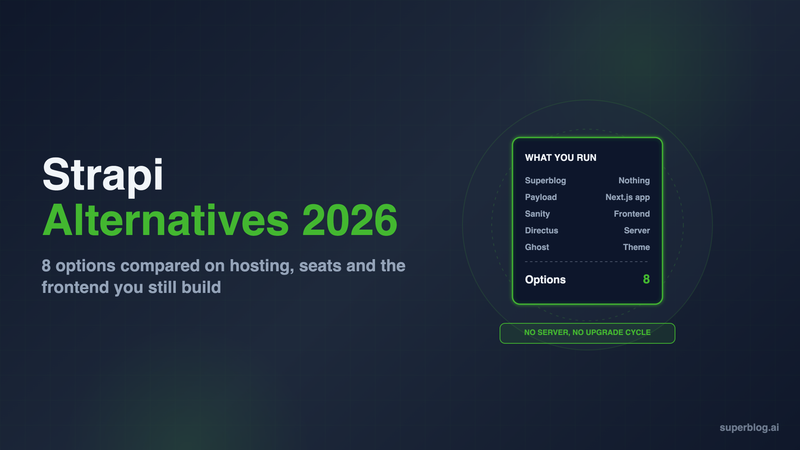
The strongest Strapi alternatives in 2026 depend on which part of Strapi is the burden. If you run Strapi only to power a company blog, move the blog to a managed platform such as Superblog and stop running the server. If you need a headless CMS for more than the blog, Payload, Directus and Sanity are the closest swaps, and Storyblok suits teams that want a visual editor.
Strapi is a capable open-source CMS. You get REST and GraphQL APIs, role-based access and a content type builder, free under the MIT license. The bill shows up in the work around it.
The real cost of running a Strapi blog

A self-hosted Strapi project is a Node.js server, a database and a file store that your team keeps running. For a marketing blog, that is a standing tax.
- Major upgrades are projects. Strapi v4 reached end of life on April 30, 2026. Release 4.26.2 (June 9, 2026) was the final v4 release. Moving to Strapi 5 means running the upgrade tool's codemods, handling the breaking changes it does not cover, and letting migration scripts rewrite the database on first start. Strapi's docs tell you to back up the database first, and there is no automated downgrade back to v4.
- The server is yours. Patching Node, the database and dependencies, plus backups and uptime, all sit with your team. The free Community plan comes with community support only.
- The useful editor features are paid. Live Preview, Releases and Content History are on self-hosted Growth: $45 a month with 3 users, plus $15 a month per extra user.
- The blog frontend is still a separate build. Strapi stores the posts. Your developers write the post template, archives, metadata, sitemap and JSON-LD, and maintain them.
Strapi Cloud removes the server, not the project pricing. Cloud is $35 (Starter), $90 (Pro) or $450 (Business) per project per month, with up to 17% off on yearly billing. Starter sleeps when idle and has no backups. Weekly backups and an always-on runtime start on Pro, so a production blog starts at $90 a month before anyone builds the frontend.
That is the gap Superblog fills. It moves the blog off the server: CMS, blog frontend, hosting and SEO are one managed product at yoursite.com/blog, while Strapi keeps serving anything else you use it for.
Strapi competitors side by side
Prices are monthly, in USD unless marked in euros.
1. Superblog
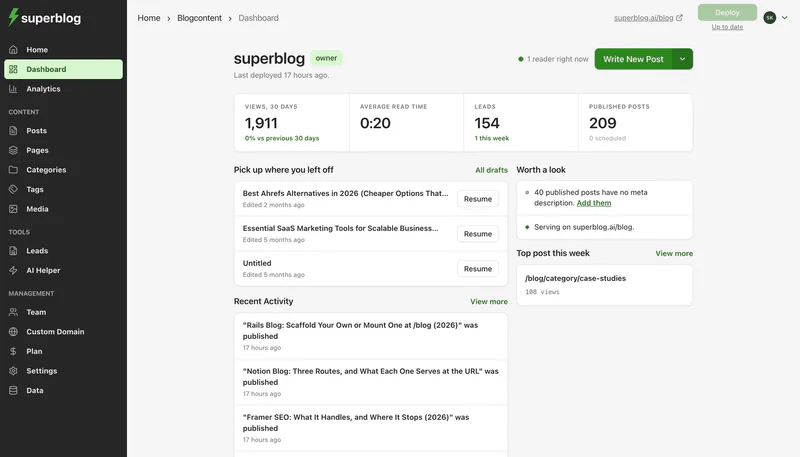
Type: Managed blog platform. Move the blog off the server.
Superblog is a complete blogging platform: the editor, the blog frontend, hosting on a global CDN and the SEO engine in one product. Your main site stays where it is, and the blog runs at yoursite.com/blog. On Next.js that is two rewrites in next.config.js, shown in the add a blog to Next.js guide. It also works on Vercel, Netlify, Cloudflare, Nginx and other stacks.
Pricing: $49/month (Pro) covers 1,000 posts and 5 team members. $99/month (Super) raises that to 10,000 posts and 10 team members and unlocks multilingual SEO, Zapier, MCP and the REST API. Billed yearly, they cost $530 and $1,070. Every paid plan includes subdirectory hosting. Start on a 7-day free trial, no credit card required.
Strengths for a team leaving Strapi:
- No upgrade cycle. There is no version to migrate, no database to back up before a major release, and no Node server to keep alive.
- Every post ships with its SEO. XML sitemaps, canonical URLs, Open Graph tags and JSON-LD (Article or BlogPosting, WebPage, Organization, ImageObject, FAQ) are generated automatically, IndexNow pings on publish, and an llms.txt index lists every post. A plain-markdown copy of each post lives at its URL plus
.md. - 90+ Lighthouse without a frontend sprint. Pre-built static pages are served from 200+ edge locations.
- Writers publish without a developer. One editor holds slash commands, markdown, FAQ blocks, internal link suggestions and a SERP preview. Pro adds scheduling and collaborative review.
Moving posts from Strapi: there is no Strapi importer, so the route is a JSON file. Fetch your posts from Strapi's REST API and save only the data array as the file, because Superblog's JSON importer needs a top-level array with one flat object per post. Strapi 5 returns flat fields; on v4 they sit inside attributes and must be lifted out first. A Rich Text (Blocks) body is JSON and must be converted to HTML. A Rich Text (Markdown) body imports as Markdown when each post carries an isMarkdown field set to true. Map title, content and date, plus slug to keep your URLs. Each run takes up to 300 posts. On a paid plan, front-mattered Markdown files can go through the ZIP importer instead. Strapi's REST API returns 25 entries per page by default, so raise pagination[pageSize] or page through the results.
Limits: Superblog's templates render the posts, not your React components. Customization covers templates, colors, fonts, menus and custom CSS. Product content stays in Strapi.
Choose it if: Strapi exists mainly to serve the blog and you want your developers off post templates and server patches. The setup for Next.js sites is on the blog for Next.js page.
2. Payload

Type: Open-source CMS that lives inside your Next.js app.
Payload suits developers who like Strapi's code-first model but want one less service. It installs directly in the Next.js /app folder, so the admin panel, the API and the site deploy together. You write the config in TypeScript and pick MongoDB, Postgres or SQLite for storage.
Pricing: the MIT license makes the software free. You pay for your own database, file storage and hosting.
Strengths: no separate CMS server, no per-seat fee, and the schema sits in the same repo as the frontend.
Limits: the database and its upgrades are still yours, and so is the blog frontend, the SEO tags and the sitemap. It cuts one server from the stack, not the maintenance.
Choose it if: your app is on Next.js and your developers want the CMS in the same codebase.
3. Directus

Type: Source-available data platform with a headless CMS layer.
Directus wraps a SQL database with REST and GraphQL APIs and an admin app called Directus Studio. Each collection maps to a database table, which appeals to teams that want the content schema to be their own database schema.
Pricing: self-hosting is available on every tier. On Directus Cloud, Core is $89/month billed yearly ($99 monthly) with 3 seats, a hard limit, and 25 collections. Team on Cloud is $588/month billed yearly ($698 monthly) with 10 SSO seats and extra seats at $50/seat/month. Self-hosted Team is $499/month with an annual commitment. Organizations under $5M in annual revenue with fewer than 50 employees qualify for the Open Innovation Grant, which makes self-hosting free.
Strengths: works on an existing database, with built-in automation through Flows.
Limits: the jump from 3 seats on Core to $499 on Team is steep for a growing writing team. Self-hosting brings back the same server and upgrade work as Strapi. There is no blog frontend.
Choose it if: the content sits next to other business data in SQL and the blog is one small part of it.
4. Sanity

Type: Hosted headless CMS with a code-defined schema.
Sanity hosts the content store for you, so there is no CMS server or database to patch. You define schemas in code, query with GROQ and customize Sanity Studio as a React app.
Pricing: the Free plan covers 20 seats and 10,000 documents. Growth costs $15 per seat each month and goes to 50 seats and 25,000 documents.
Strengths: no infrastructure, a generous free tier, and flexible content modeling.
Limits: the blog frontend, previews and SEO layer are still your code, and post bodies arrive as Portable Text that your frontend has to render. Seats add up as the team grows: 10 writers on Growth cost $150 a month. Our CMS for Next.js comparison puts the hosted options side by side.
Choose it if: you want to stop running servers but keep a developer-owned headless setup.
5. Storyblok

Type: Visual-editor headless CMS, hosted by Storyblok.
Storyblok fits Strapi teams whose marketers want to see the page while they edit. Writers work in a live visual preview instead of forms.
Pricing: Starter is free for one seat. Growth is $99/month ($90.75/month if paid yearly) with 5 seats, and seats 6 to 10 cost $15/month each. Growth Plus ($349/month) covers 11 to 15 seats.
Strengths: the most visual editing here, with hosting handled.
Limits: every block type needs a React component that developers register and maintain, so the frontend stays engineering work. Ten writers on Growth cost $99 plus 5 extra seats at $15, or $174 a month. The eleventh writer moves you to Growth Plus.
Choose it if: marketers build pages as well as posts and a developer owns the component library.
6. Prismic

Type: Hosted headless CMS built on page slices.
Writers in Prismic build pages out of slices, reusable sections that each need a React component from your developers.
Pricing: every plan is billed per repository, paid annually. Free covers 1 user. Three users cost $10/month on Starter, seven cost $25/month on Small, and 25 cost $150/month on Medium.
Strengths: the lowest paid entry among the headless options here, hosting handled, and many users per dollar.
Limits: the post template, slice library and SEO tags are still yours to build. A slice builder is more structure than a text-heavy blog needs.
Choose it if: your posts and marketing pages are built from the same sections and one hosted repository should hold both.
7. Contentful
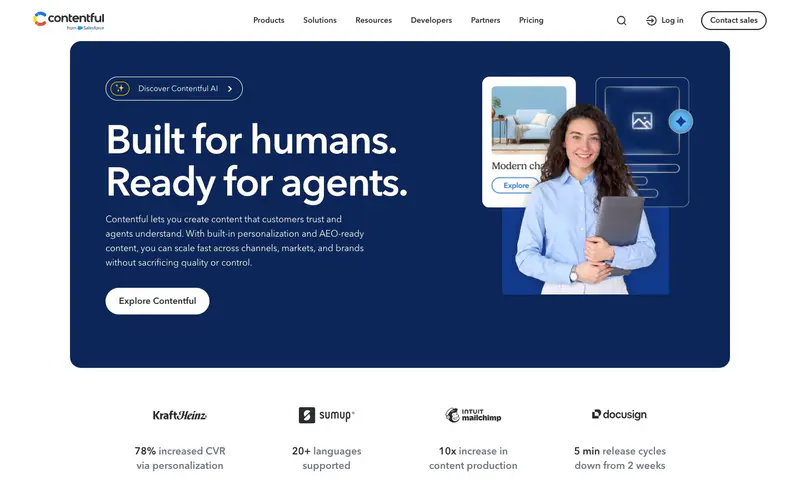
Type: Enterprise headless CMS.
Contentful sits in large organizations that publish across several brands, regions and channels from a single content model. Teams that outgrow Strapi's governance look here.
Pricing: plans are listed on contentful.com/pricing.
Strengths: mature roles, workflows and governance, with nothing to host.
Limits: the same headless shape as Strapi. The blog frontend, previews and SEO are code your team writes. For a single company blog it is far more platform than the job needs.
Choose it if: your company is moving every channel onto Contentful and the blog has to follow.
8. Hygraph

Type: Managed headless CMS built on GraphQL.
Hygraph fits Strapi teams that already query content through GraphQL and want someone else to host the API. Remote sources let it pull data from other back ends into the same schema.
Pricing: Hobby is $0 with 3 seats, 1,000 entries and 2 locales. Growth starts at $199 a month for 10 seats, 10,000 entries and 3 locales. Enterprise pricing is custom.
Strengths: no Node server to patch, and the first paid plan seats 10 people.
Limits: nothing sits between free and $199, and Hobby targets personal projects. The post template, sitemap and metadata stay in your codebase.
Choose it if: your frontend is built on GraphQL queries and you want the content API run for you.
9. DatoCMS
Type: Hosted headless CMS with GraphQL delivery.
DatoCMS answers reads through a GraphQL Content Delivery API and writes through a REST Content Management API. For a Strapi team, the change is that nobody runs the backend.
Pricing: the free tier allows 300 records, 10 GB of traffic and 100,000 API calls a month, with no overages. Professional is €149 a month billed annually or €199 billed monthly. It includes 10 collaborators per project, then €9 a month per extra person.
Strengths: hosting and upgrades are DatoCMS's job, and scheduled publishing is on every plan.
Limits: a blog archive passes 300 records quickly, so the free tier is a trial in practice. Billing is in euros. You still code the frontend.
Choose it if: you want Strapi's headless model with no server and a team of up to 10.
10. TinaCMS
Type: Open-source CMS that stores content in Git.
TinaCMS keeps posts as Markdown, MDX or JSON files in your repository instead of a database. Editors log in at /admin on your site, and React sites get visual editing that shows changes as they type.
Pricing: the code is Apache 2.0 and the backend can be self-hosted. On TinaCloud, the hosted backend, Free covers 2 users. Team is $24 per project per month billed yearly ($290 a year) or $29 paid monthly, with 3 users and room for 10 at $90 per extra seat per year. Business is $249 per project per month billed yearly ($299 monthly) with 20 users.
Strengths: no database at all, every edit is a Git commit, and a two-person team pays nothing.
Limits: the site still has to be built and deployed by developers, SEO tags included. Content in Git suits teams that already work in pull requests.
Choose it if: the blog is Markdown in a repo and writers need an editor on top of it.
11. Ghost

Type: Open-source blog and newsletter platform.
Ghost ships its own blog frontend, which puts it closest to Superblog in shape among the open-source options here. It runs self-hosted or on managed Ghost(Pro).
Pricing: Ghost(Pro) Starter is $15/month, Publisher $29/month and Business $199/month, billed yearly. Staff users are capped at 1, 3 and 15. Full numbers are in our Ghost pricing breakdown.
Strengths: a focused editor, native newsletters and memberships, and themes that render posts without a custom frontend. IndexNow is on by default, and llms.txt is on for new sites.
Limits: serving Ghost at yoursite.com/blog is a $50/month add-on on the $199 Business plan only, and you run the reverse proxy yourself. Self-hosting Ghost brings back the server work you are leaving Strapi to avoid.
Choose it if: the blog is really a newsletter or a paid publication.
12. WordPress
Type: Open-source CMS that renders its own pages, self-hosted or on WordPress.com.
WordPress is the opposite trade from Strapi. Themes render the blog, so there is no separate frontend to build. It is written in PHP, runs on MariaDB and is licensed under the GPLv2.
Pricing: the software costs nothing to self-host. On WordPress.com, Personal is $4 a month billed yearly ($9 monthly) and Business is $25 a month billed yearly ($40 monthly). Our WordPress pricing breakdown adds up hosting, plugins and developer time.
Strengths: themes cover the frontend, and the WordPress.com marketplace lists over 60,000 plugins.
Limits: self-hosting brings back a server to patch, now with core, theme and plugin updates on top. SEO features usually arrive as plugins you install and maintain.
Choose it if: you want a blog that renders itself and your team is happy to look after PHP hosting.
Strapi alternative or managed blog: which one you need
Most teams searching for a Strapi CMS alternative are solving one of three problems.
- You are tired of the blog needing developers at all. A managed blog like Superblog removes the server and the frontend work. Our headless CMS guide for business blogs lists the parts a headless stack makes you build.
- You are tired of running the server. Hosted headless tools (Sanity, Storyblok, Prismic, Contentful, Hygraph, DatoCMS) remove the infrastructure. Your developers still build and maintain the blog frontend, metadata and sitemap.
- You want content in Git instead. If the blog is already Markdown in a repo, TinaCMS adds an editor on top. Read git-based blogging before adding any CMS.
Keep the blog on your main domain either way. A headless blog setup and a managed platform both work at yoursite.com/blog.
Strapi alternatives FAQ
Is Strapi free?
Yes. The self-hosted Community plan is free under the MIT license.
How much does Strapi Cloud cost?
$35, $90 or $450 per project per month (Starter, Pro, Business).
Is Strapi v4 still supported?
No. It reached end of life on April 30, 2026.
Which Strapi alternatives are open source?
Payload and Ghost (MIT), TinaCMS (Apache 2.0) and WordPress (GPLv2). Directus is source-available.
Which Strapi alternative needs no server or frontend work?
Superblog.
Does Superblog import from Strapi?
No. Save the posts from Strapi's REST API as a JSON array and use the JSON importer.
Bottom line
Strapi earns its place when developers want an open-source API backend they control. It is an expensive way to run a marketing blog, because the server, the upgrades and the frontend all stay with your team. If you want another headless CMS, Payload suits Next.js teams, Directus suits SQL-first teams, and Sanity or Storyblok remove the hosting. If the blog is the only reason Strapi is running, move the blog off the server. Superblog runs it at yoursite.com/blog, with SEO built in, from $49 a month. Sign up for the 7-day free trial, no credit card required.
Your blog, without the maintenance
Fast pages, automatic SEO, no plugins to patch. Runs on yoursite.com/blog.
Sai Krishna is the Founder and CEO of Superblog. Having built multiple products that scaled to tens of millions of users with only SEO and ASO, Sai Krishna is now building a blogging platform to help others grow organically.
superblog
Superblog is a blazing fast blogging platform for beautiful reading and writing experiences. Superblog takes care of SEO audits and site optimizations automatically.