
Best Storyblok Alternatives 2026: 11 Options When Seats and Blocks Add Up

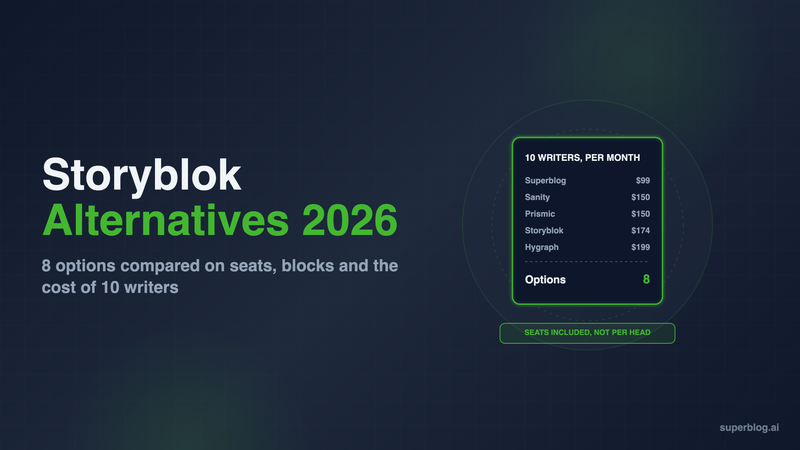
The strongest Storyblok alternatives in 2026 depend on what Storyblok is costing you. If the blog is the problem, move it to a managed blog platform such as Superblog and keep Storyblok for the rest of the site. If you want to stay headless, Sanity, Prismic and Payload are the closest swaps, and each still needs developers to build the blog.
Storyblok's Visual Editor is good. Editors change content on a rendered preview of the page, and each edit shows as they type. The friction for a blog team comes from three places: components, seats and scheduling.
Why marketing teams look for Storyblok alternatives

- Every new layout is a developer ticket. Storyblok renders nothing on its own. Every block your editors use needs a matching React component that a developer writes, registers and deploys. A new post layout, a comparison table block or a different author box waits until a developer builds and ships the component.
- Seats are capped by plan. Starter has 1 seat (2 at most). Growth includes 5 seats and adds more at $15 a month each, up to 10. Growth Plus has 15 seats and no way to add a sixteenth. Past that, you are on Premium, which is quoted.
- Scheduling is metered. Starter cannot schedule stories. Growth and Growth Plus allow 2 scheduled single stories. Premium allows 100. A blog that queues a week of posts runs out on Growth.
- Custom workflows start on Premium. Every plan has the Default workflow (Drafting, Reviewing, Ready to Publish). Adding a legal review or a second editor stage needs custom workflows: 2 on Premium, unlimited on Elite.
Run the numbers for ten writers. Storyblok Growth is $99 a month plus 5 extra seats at $15, so $174 a month, before any developer time on the frontend. Superblog changes that math. It is a blog platform with the frontend built in, and Super includes 10 team members for $99/month.
Storyblok alternatives at a glance
Figures are per month, in USD except DatoCMS (EUR). Superblog's figure is its monthly rate.
1. Superblog
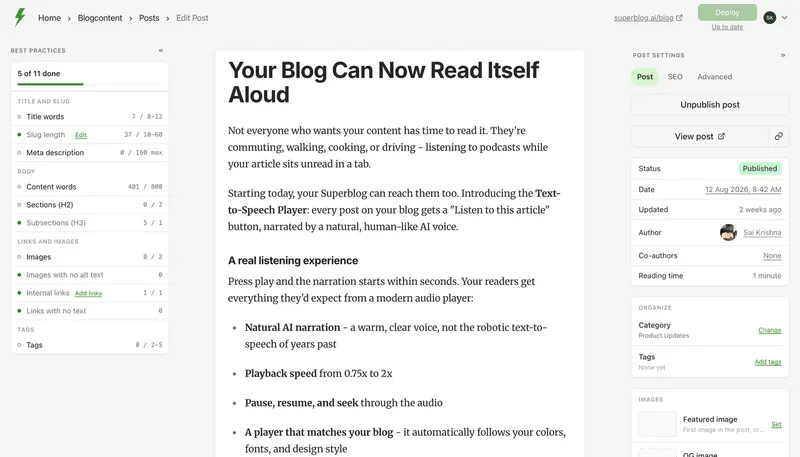
Type: Managed blog platform. Replaces the Storyblok blog, not the rest of your site.
Superblog is CMS, blog frontend, hosting and SEO in one product. There are no components to build. Your team picks a template, sets colors and fonts, and publishes. The blog runs at yoursite.com/blog next to your existing site. On Next.js that is a rewrite rule in your config, and the blog for Next.js page shows the setup.
Pricing: $49/month (Pro) or $99/month (Super), or $530 and $1,070 a year. Every paid plan includes subdirectory hosting. You can start with a 7-day free trial, no credit card required.
Strengths for a Storyblok team:
- No component backlog. The blog templates already exist. Custom CSS covers brand tweaks, and nobody files a ticket to change a post layout.
- Seats come with the plan. Pro covers 5 team members and Super covers 10, with Admin, Editor and Writer roles. Ten writers cost $99/month on Super, not $174.
- Scheduling and review on Pro. Scheduled posts and collaborative review, where team members leave comments on a draft before it goes live, start on Pro.
- SEO is automatic. JSON-LD schemas, XML sitemaps, IndexNow pings, canonical tags, Open Graph tags and llms.txt are generated on every deploy. Pages score 90+ on Lighthouse.
- No per-language charge. Multilingual SEO, on Super and above, covers 41 languages, and the tenth costs the same as the first.
Moving from Storyblok: There is no direct Storyblok importer. Pull your blog stories as JSON through Storyblok's API. A developer then writes a short script that flattens each story into one post record in a top-level array and converts its rich text field to HTML with Storyblok's @storyblok/richtext renderer. In Superblog's JSON import, match the title, content and date fields, and match slug too if the URLs should stay the same. One run handles up to 300 posts.
Limits: Superblog is a blog platform, not a page builder. Landing pages and product pages stay in Storyblok or your site builder. Post caps are 1,000 on Pro and 10,000 on Super.
Choose it if: marketing owns the blog and you want posts, layouts and SEO to stop depending on a developer.
2. Sanity

Type: Headless CMS with structured content.
Sanity stores content as structured documents and serves it over an API. Developers define the schema in code, and the Studio editor can run inside your Next.js app.
Pricing: The Free plan allows 20 seats and 10,000 documents at $0. Growth costs $15 per seat each month, with a 50-seat ceiling and 25,000 documents. Enterprise is quoted.
Strengths: The most generous free seat count in this list. Scheduled drafts, comments and tasks come with Growth. Live previews and visual editing are on every plan.
Limits: Like Storyblok, Sanity renders nothing. Templates, metadata, sitemaps and schema are code your team writes and maintains. Ten writers on Growth cost $150 a month, close to Storyblok's $174.
Choose it if: you are leaving Storyblok for more control over content modeling, not to stop building the frontend.
3. Contentful
Type: Enterprise headless CMS.
Large organizations choose Contentful when one content model feeds many sites, apps and locales.
Pricing: Plans are published at contentful.com/pricing.
Strengths: A mature content platform with deep integrations, built for many teams sharing one content model.
Limits: It is more platform than a single company blog needs. Every page type is a developer build, the same trade-off as Storyblok. Our headless CMS for business blogs guide explains where that trade-off pays off.
Choose it if: Contentful already runs your content operation and the blog is one output among many.
4. Contentstack
Type: Enterprise headless CMS with a visual editor product.
Contentstack is an API-first headless CMS aimed at enterprise teams. Its Visual Editor gives marketers a page preview to work in.
Pricing: Free is $0 for 3 users and 1,000 entries. Build is $29 monthly with 2,500 entries and the same 3 users. The pricing page lists extra users only on Growth. Growth costs $299 a month for 10 users and 20,000 entries, and further users are $25 a month each.
Strengths: any entry can be scheduled to publish or unpublish up to 12 months ahead. Growth adds 2 custom roles.
Limits: ten writers start at $299, well above Storyblok's $174. Every page type is still a frontend your developers build.
Choose it if: you need an enterprise vendor and per-entry scheduling more than a low seat price.
5. Prismic

Type: Headless CMS where pages are built from slices.
Prismic's model is close to Storyblok's. Developers write a component for each slice, and editors stack those slices into pages.
Pricing: Free covers 1 user. Each paid plan is charged per repository per month, paid annually: Starter $10 (3 users), Small $25 (7 users), Medium $150 (25 users).
Strengths: Scheduling and releases are on every plan, including Free. Seats are cheaper than Storyblok's: 7 users cost $25 a month on Small.
Limits: Slices are still components your developers build, so a new post layout is still a ticket. Official framework guides cover Next.js, Nuxt and SvelteKit.
Choose it if: you like Storyblok's block model but want lower seat costs and scheduling without a plan meter.
6. Hygraph

Type: Headless CMS built around GraphQL.
Hygraph serves content through a GraphQL API and can federate content from other sources into one schema.
Pricing: Hobby costs $0 for 3 seats and 1,000 entries. Growth is from $199 a month, covering 10 seats and 10,000 entries. Enterprise is quoted.
Strengths: Strong for teams that already work in GraphQL or need to pull content from several back ends into one API. Live preview and commenting are on the free plan.
Limits: Scheduled publishing and custom workflows are Enterprise only, a stricter gate than Storyblok's. Growth includes 3 locales.
Choose it if: your developers want GraphQL and content federation more than marketers want scheduling.
7. DatoCMS
Type: Headless CMS with modular content blocks and visual editing.
DatoCMS works much like Storyblok for editors: modular blocks make up the page, and visual editing lets them click a part of the page to change it. Developers fetch content through a GraphQL API.
Pricing: The free tier stops at 300 records, 10 GB of monthly traffic and 100,000 monthly API calls, with no overages. Paying annually, Professional costs €149 a month (€199 on monthly billing). It includes 10 collaborators and 5 locales per project. Collaborators past 10 cost €9 a month each, and a sixth locale costs €19 a month.
Strengths: Professional and Enterprise both include scheduled publishing, and the first paid tier seats 10.
Limits: euro billing, and a 300-record free tier that a blog archive outgrows. Blocks still need frontend components from your developers.
Choose it if: you like Storyblok's block editing but want 10 seats and unmetered scheduling in one plan.
8. Webflow

Type: Visual site builder with a CMS.
Webflow replaces both the CMS and the frontend. Designers build the templates visually, and marketers publish into CMS Collections.
Pricing: The CMS starts on Premium at $25 a month billed yearly ($39 monthly), with 20,000 CMS items. Writers need seats: a limited seat to edit content is $15 a month and a full seat $39, billed yearly. Reviewer seats are free. Publishing workflows are on Team at $2,500 a month with an annual contract.
Strengths: No React components to maintain. Designers change a blog layout without a developer.
Limits: Moving to Webflow means rebuilding the whole site there. Ten writers on limited seats add $150 a month to Premium, so $175 billed yearly.
Choose it if: you want to leave headless entirely and your team has a Webflow designer.
9. Strapi

Type: Open-source headless CMS, run on your own servers or on Strapi Cloud.
Strapi ships REST and GraphQL APIs plus an admin panel on infrastructure you own. The CMS is a standalone Node.js server, deployed apart from the site that renders your pages.
Pricing: Self-hosting the Community plan costs nothing, under the MIT license. The self-hosted Growth plan is $45 a month for 3 users, plus $15 per extra user. Strapi Cloud runs $35 (Starter), $90 (Pro) or $450 (Business) for each project, monthly.
Strengths: No license fee on Community and full ownership of data and hosting. Releases, which group content to publish together, come with Growth.
Limits: Review workflows are Enterprise only. You run, patch and monitor the server unless you pay for Cloud, and you still build the frontend.
Choose it if: open source and data ownership matter more than ops time.
10. Directus

Type: Source-available headless CMS on a SQL database.
Directus reads an existing SQL database and turns it into APIs plus an admin app for editors. The content model is the database schema itself.
Pricing: you can self-host on any tier. Directus Cloud's Core plan is $89 a month billed yearly ($99 monthly), capped at 3 seats and 25 collections. Team on Cloud costs $588 a month billed yearly, with 10 SSO seats and $50 a month per extra seat. Organizations under $5M in yearly revenue and with fewer than 50 employees can self-host free through the Open Innovation Grant.
Strengths: full ownership of the data, and automation through Flows.
Limits: visual editing works only after your developers wire it into the frontend they build and maintain. A fourth editor on Core means the Team plan.
Choose it if: your content shares a database with other business data and a small team edits it.
11. Payload

Type: Open-source CMS that runs inside a Next.js app.
Payload lives in the same Next.js /app folder as your site, so one repository and one deploy cover both. The license is MIT, and the data sits in MongoDB, Postgres or SQLite.
Pricing: No license fee. The costs are your own database, file storage and hosting bills.
Strengths: No seat meter and no scheduling meter. Everything is configured in TypeScript, so developers control every field and workflow.
Limits: Everything is code. Drafts, scheduling, roles and SEO output are things your developers configure and maintain. Marketers get an admin panel, not a visual editor like Storyblok's.
Choose it if: you run Next.js, want to stop paying a CMS vendor, and have developers who will own the CMS. Our CMS for Next.js comparison covers Payload against Sanity and Storyblok in more depth.
What ten writers cost per month

Storyblok and Contentstack at monthly billing; Prismic, Webflow, DatoCMS and Directus at annual billing.
How to choose a Storyblok alternative
- Decide whether you are leaving headless or only the blog. If the marketing site works on Storyblok and the blog is what waits on developers, move only the blog. Our headless blog guide lays out the build and maintenance work that comes with it.
- Count writers, not plans. Multiply your writer count by the seat price. That number decides more than the base plan.
- Check the scheduling limit. Storyblok Growth and Growth Plus hold 2 scheduled stories at a time. Hygraph schedules nothing below Enterprise. Prismic schedules on every plan, and DatoCMS on every paid plan.
- Host the blog under your main domain. A blog at yoursite.com/blog builds authority for the whole site. A subdomain splits it. Subdomain vs subdirectory has the evidence.
Storyblok alternatives FAQ
What is the cheapest Storyblok alternative for a team blog?
Sanity Free for a hosted CMS (20 seats at $0). Strapi Community and Payload are free to self-host.
Which Storyblok alternative needs no developer for the blog?
Superblog. Webflow too, if you rebuild the whole site there.
How many posts can Storyblok Growth schedule?
2 scheduled single stories. Premium allows 100.
How many seats does Storyblok Growth include?
5, with up to 5 more at $15 a month each.
Does Superblog import from Storyblok?
No. Flatten the Storyblok JSON into post records, then use the JSON import.
Which open-source Storyblok competitors are there?
Strapi and Payload, both MIT licensed. Directus is source-available.
Bottom line
Storyblok gives marketers a strong visual editor on top of a frontend your developers build. That works for the marketing site. It is a slow and metered home for a blog: each new layout needs a component, ten writers cost $174 a month on Growth, and Growth schedules only 2 stories. To stay headless, Sanity gives more free seats and Prismic schedules on every plan. To take the blog off the developer queue, Superblog puts it at yoursite.com/blog from $49/month (Pro), with seats, templates and SEO built in. Start with the 7-day free trial, no credit card required.
Your blog, without the maintenance
Fast pages, automatic SEO, no plugins to patch. Runs on yoursite.com/blog.
Sai Krishna is the Founder and CEO of Superblog. Having built multiple products that scaled to tens of millions of users with only SEO and ASO, Sai Krishna is now building a blogging platform to help others grow organically.
superblog
Superblog is a blazing fast blogging platform for beautiful reading and writing experiences. Superblog takes care of SEO audits and site optimizations automatically.