
Best Shopify Blog Apps in 2026: Bloggle, DropInBlog & More Compared

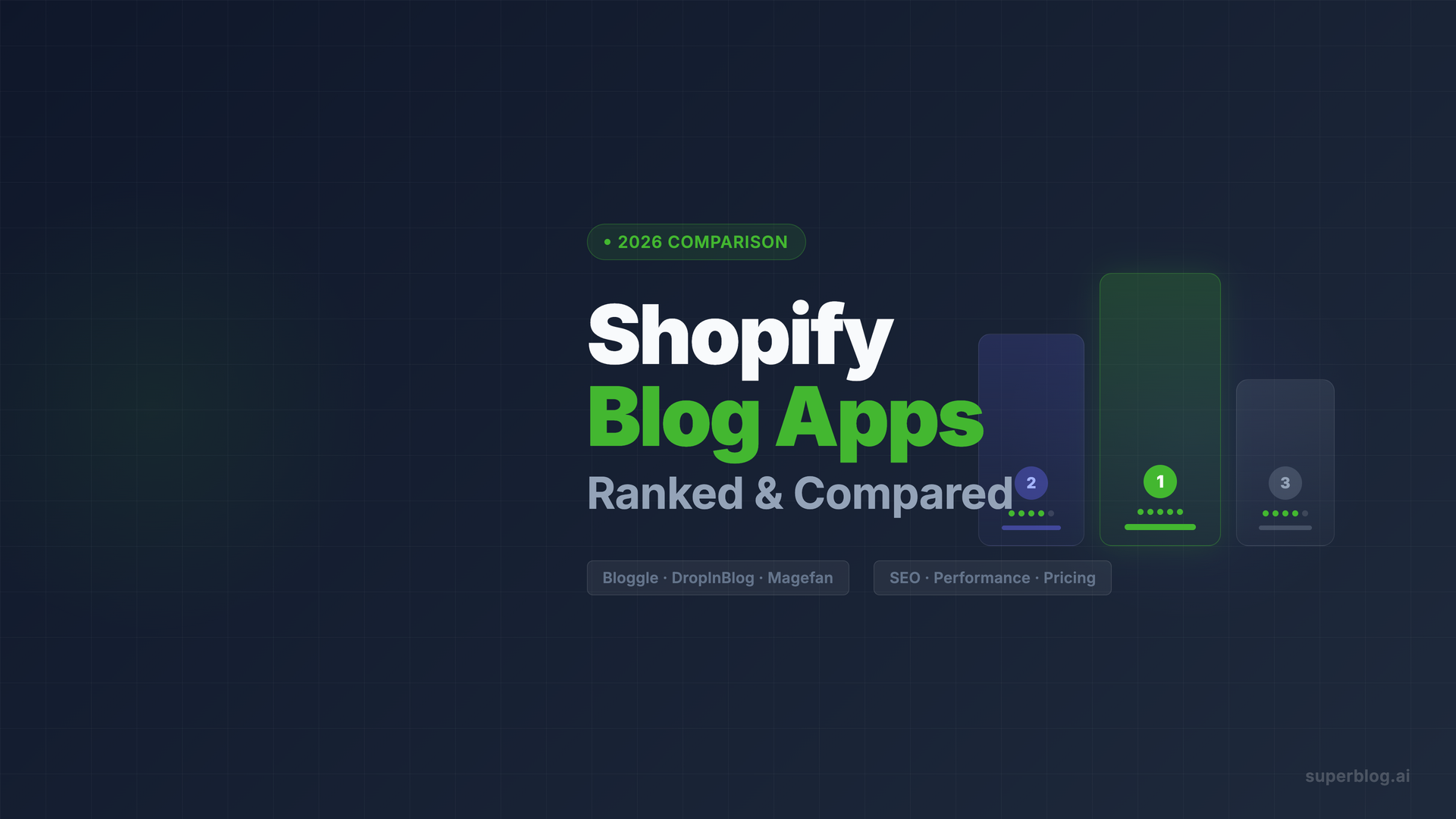
Shopify's built-in blog is functional enough to publish posts. It is not enough to rank them. No structured data schemas, no control over URL structure for SEO, limited formatting options, and no subdirectory SEO consolidation if you want posts to live at yourstore.com/blog. That is the gap Shopify blog apps exist to fill.
This guide covers the best Shopify blog apps available in 2026, what each one actually does for SEO, how they render content (which matters more than most comparisons admit), and which one fits which type of merchant.
Before picking an app, check Shopify blog limitations to see which gaps an app can actually close.
What a Shopify Blog App Actually Needs to Fix
Before picking an app, it helps to know exactly what the native Shopify blog is missing:
- No auto JSON-LD schemas. Google uses Article, FAQ, and Breadcrumb schemas to surface rich snippets. The native blog generates none of them.
- Limited SEO controls. Meta titles and descriptions are editable, but canonical URL control, hreflang for multilingual, and Open Graph tags are limited or missing.
- Basic editor. No table of contents blocks, no FAQ sections with structured data, no product embedding without workarounds.
- Blog lives at yourstore.com/blogs/news by default. The
/blogs/newspath cannot be changed without an app or custom domain work. - No performance optimization pipeline. Images are not automatically converted to WebP or served from a global CDN the way a dedicated blog platform would handle it.
A good Shopify blog app addresses at least several of these. The best ones address all of them, and some go further by taking the blog off Shopify's rendering stack entirely.
Quick Comparison: Best Shopify Blog Apps in 2026
1. Superblog: Full SEO Engine at yourstore.com/blog
Superblog is not a Shopify App Store app. It is a fully-managed blog platform that connects to your Shopify store as a subdirectory at yourstore.com/blog using a reverse proxy. That distinction matters for SEO in a way no in-Shopify app can match.
Every post publishes as a pre-built static page served from a global CDN. Your store's domain authority accumulates at /blog instead of leaking to a subdomain or a JavaScript-rendered embed. Lighthouse scores come in at 90+ automatically, without you doing anything.
For Shopify merchants serious about organic growth, this is the setup that compound interest looks like.
What Superblog does that in-Shopify apps cannot:
- Generates Article, FAQ, and Organization JSON-LD schemas automatically on every post, with no configuration required.
- Sends IndexNow pings to Bing and Yandex the moment you publish, so your content is indexed within hours rather than waiting for a crawl.
- Produces an LLMs.txt file at
/blog/llms.txt. - Supports 41-language multilingual SEO with proper hreflang tags, per-language sitemaps, and subdirectory URL structure (
/es/,/de/,/fr/), which is Google's recommended approach. This is on the Super plan. - Keeps your blog content in a purpose-built CMS with scheduled publishing, internal link suggestions, bulk operations, and a SERP preview before you hit publish.
Pricing:
- Basic: $29/mo (up to 300 posts, 1 team member)
- Pro: $49/mo (up to 1,000 posts, 5 team members, scheduled posts, analytics)
- Super: $99/mo (unlimited posts, 10 team members, AI Helper, multilingual, Zapier, API)
All plans include subdirectory hosting, auto SEO schemas, IndexNow, free SSL, and CDN. 7-day free trial, no credit card required.
When to choose Superblog: You want blog posts to rank on Google, not just exist. You are building organic traffic as a channel, not publishing occasional product updates. Your store has enough content investment to warrant a purpose-built platform rather than a Shopify editor extension.
When an in-Shopify app fits better: You need tight product embedding in every post, you have a very small blog (under 20 posts), or you want everything managed inside Shopify admin without any external platform.
See the full integration guide: how to add a blog to Shopify and Superblog for Shopify.
2. Bloggle: The Best In-Shopify Page Builder for Blogs
Bloggle is the app most Shopify merchants find when searching "bloggle shopify" and it earns the attention. With 330 reviews and a 4.8 rating on the Shopify App Store, it is the strongest option if you want a better blogging experience without leaving Shopify admin.
The core product is a drag-and-drop block editor layered on top of Shopify's blog infrastructure. You get 20-plus pre-built sections including tables of contents, FAQ blocks, author bios, and product galleries. The live SEO scoring tool shows keyword density, meta tag quality, and readability as you write. Posts live within your Shopify store's theme, so the design stays consistent with your brand automatically.
Verified pricing (Shopify App Store, July 2026):
- Starter: $19.90/mo (unlimited blogs, drag-and-drop editor, live SEO scoring)
- Pro: $49.90/mo (adds blog search and navigation, FAQ sections, unlimited saved sections)
- Business: $79.90/mo (adds Klaviyo embedding, UX scoring tool, priority support)
14-day free trial on all plans.
Strengths:
- Cleanest drag-and-drop editor of any in-Shopify blog app
- Live SEO and UX scoring gives writers immediate feedback
- Product gallery sections for embedding Shopify products into posts without workarounds
- Theme-compatible by default, so no design headaches
- Strong e-commerce focus: internal product linking, Klaviyo forms, conversion-focused templates
Honest limitations:
- Posts stay at
yourstore.com/blogs/..., not at a clean/blogsubdirectory - Rendering is Shopify's standard Liquid, not static JAMStack, so Lighthouse scores depend on your theme
- Auto JSON-LD schemas are partial, relying on Shopify's theme layer rather than generating them per-post
- No multilingual SEO with hreflang tags
When Bloggle fits best: You want a significantly better in-Shopify blogging experience, your products are central to your content strategy, and you do not need the blog at a different URL path.
3. DropInBlog: Strong SEO Tools, Expensive Entry Point
DropInBlog is the most direct competitor to Superblog in the "replace your basic blog with something SEO-serious" category. It earns its reputation: 4.6 stars on the Shopify App Store (186 reviews, 89% five-star, as of July 2026), and its SEO Post Analyzer tool provides real-time keyword tracking, alt text checking, and internal link recommendations as you write.
The integration approach for most setups uses a JavaScript embed: a <script> tag loads blog content into your existing page. DropInBlog offers a "SEO Supercharger" Cloudflare add-on that pre-renders pages as static HTML and provides cleaner URLs, IndexNow support, and a live sitemap. This is a solid solution for teams already on Cloudflare, but it adds an infrastructure dependency that Superblog does not require.
Pricing (verified July 2026):
- Solo: $49/mo (1 user, 1 author, unlimited posts)
- Team: $99/mo (5 users, 15 authors)
- Business: $499/mo (10 users, unlimited authors, staging, white-glove migration)
- Business Plus: $750/mo billed annually (25 users, enterprise plan)
7-day free trial.
Genuine strengths:
- Blog Voice AI: text-to-speech that auto-generates audio versions of posts in 20-plus voices
- Mention Boost: AI visibility optimizer that scores content for ChatGPT and Google AI Overviews citation potential
- Smart Snippets: reusable content blocks that update across all posts when edited
- SEO Post Analyzer is genuinely useful for writers who want in-editor guidance
- Strong Shopify product embedding for e-commerce-focused posts
Honest limitations:
- $49/mo entry price for a single user. Team collaboration requires the $99/mo plan.
- No multilingual SEO: no hreflang tags, no per-language sitemaps, no auto-translation
- No LLMs.txt support for AI tool discovery
- No internal link suggestion engine
- The Cloudflare-based SEO Supercharger is an add-on, not standard on all plans
When DropInBlog fits: You need Blog Voice AI or the Mention Boost AI visibility tools specifically, you are already on Cloudflare infrastructure, or you want the most polished in-editor SEO scoring experience.
For a detailed comparison, see DropInBlog alternative.
4. Magefan Blog: Best Free and Low-Cost Option
Magefan Blog is a solid in-Shopify option for merchants who want more than the native editor without committing to a paid platform. The free tier supports up to 50 entities (posts, categories, tags, and authors combined) with core SEO features including XML sitemap, SEO-friendly URLs, meta tag control, and post scheduling. That is meaningfully more than Shopify's native blog.
The Standard plan at $19/mo unlocks unlimited posts, author pages with bios and social links, structured data for rich snippets, and related products functionality. The Pro plan at $39/mo adds 22-plus templates, blog translation features, a table of contents block, and video support.
Rating: 4.2 stars, 31 reviews on the Shopify App Store.
Strengths:
- Generous free tier, well-suited to stores just starting content marketing
- Lower cost than Bloggle or DropInBlog at comparable feature levels
- Blog translation on Pro plan
- Good structured data support for rich snippets
Honest limitations:
- Smaller install base and review count than Bloggle or DropInBlog
- Template quality and design flexibility lag behind Bloggle's drag-and-drop system
- No IndexNow, no LLMs.txt, no multilingual hreflang SEO
When Magefan fits: Small Shopify stores, early-stage content programs, or merchants who want a step up from the native blog without paying for Bloggle or DropInBlog.
5. Native Shopify Blog: The Baseline
Every Shopify store includes a built-in blog at no extra cost. It covers the basics: write a post, add a featured image, set a meta title and description, assign tags, publish. For stores that publish occasional updates and have no SEO ambitions for their blog, it is sufficient.
The native blog falls short when you want to rank. There are no JSON-LD schemas, no control over URL paths (posts live at /blogs/news/ unless you change the handle), no internal link automation, no IndexNow, and no performance optimization beyond what your theme provides.
When to use the native blog: You publish fewer than 10 posts per year, your blog is informational rather than a traffic channel, and you are not investing in content marketing.
Decision Guide: Which Shopify Blog App to Choose
You want blog posts to rank on Google and drive organic traffic over time:
Use Superblog. Static rendering, subdirectory hosting at /blog, full SEO schema automation, and IndexNow are not features you can bolt on later. The compounding benefit of a proper setup from day one is real.
You want a much better in-Shopify blogging experience with a great editor:
Use Bloggle. The drag-and-drop editor, live SEO scoring, and product embedding make it the strongest option for merchants who want to stay within Shopify admin.
You need Blog Voice AI, Mention Boost, or the deepest in-editor SEO guidance available in-app:
DropInBlog covers these. Be prepared for the $49/mo entry price for a single user.
You are on a tight budget or just starting out:
Magefan Blog's free tier or $19/mo Standard plan gives you more than Shopify's native blog without a significant cost commitment.
You publish fewer than 10 posts per year:
The native Shopify blog is fine. Spend the budget on content production instead.
FAQ
Does Shopify have a blog?
Yes. Every Shopify store includes a built-in blog at no extra cost. It supports basic post publishing, tags, featured images, and meta field editing. What it lacks is SEO automation (no schemas, no IndexNow), a modern block editor, and the ability to serve blog content as a proper subdirectory at /blog. For merchants serious about organic growth, a dedicated Shopify blog app addresses these gaps.
What is the best blog app for Shopify?
It depends on your goal. For SEO and organic growth, Superblog delivers the strongest technical setup through subdirectory hosting, static rendering, and full schema automation. For a better in-Shopify editor experience, Bloggle leads the field with its drag-and-drop builder and live SEO scoring. For teams that need audio posts or AI visibility optimization, DropInBlog has unique features. For budget-conscious stores, Magefan Blog's free tier is a solid start.
Is Bloggle good for Shopify SEO?
Bloggle is better than the native Shopify blog for SEO. The live SEO scoring tool, FAQ sections, author bios, and structured content blocks all help. The limitation is that Bloggle stays within Shopify's Liquid rendering stack and URL structure, so your posts stay at yourstore.com/blogs/... and Lighthouse performance depends on your theme. If you need static rendering, auto JSON-LD schemas on every post, and IndexNow, a platform like Superblog is built for that outcome.
How do I improve my Shopify blog's SEO?
Start with the technical foundation: make sure your posts have unique meta titles and descriptions, add structured data schemas (use an app that auto-generates them), get your blog on a subdirectory at /blog if possible, and submit an XML sitemap. Then focus on content: target keywords with real search volume, use header structure that matches search intent, and build internal links between posts. For a full breakdown, see our guide on Shopify blog SEO.
Can I move my blog from Shopify to an external platform without losing SEO?
Yes, if the URL slugs stay the same. Superblog preserves your existing post slugs during migration, so a post at /blogs/news/my-post-title can be mapped to /blog/my-post-title with a redirect in place. Your rankings are not impacted. Migration takes 5-10 minutes for most stores.
What is the difference between an in-Shopify blog app and an external blog platform?
An in-Shopify blog app (Bloggle, Magefan, DropInBlog's standard embed) extends Shopify's editor and keeps posts within your Shopify admin. An external platform like Superblog runs your blog on separate infrastructure, served at yourstore.com/blog through a reverse proxy. The external approach allows for static JAMStack rendering (90+ Lighthouse scores), full SEO schema automation without relying on Shopify's theme layer, and purpose-built CMS features. The tradeoff is that content management happens in a separate dashboard. For stores that treat content marketing as a growth channel, the SEO and performance benefits of the external approach are significant.
If you are adding a blog to your Shopify store and want to understand the full setup options, including when a subdirectory approach makes sense versus an embedded app, see how to add a blog to Shopify (publishing Jul 12).
Your blog, without the maintenance
Fast pages, automatic SEO, no plugins to patch. Runs on yoursite.com/blog.
Sai Krishna is the Founder and CEO of Superblog. Having built multiple products that scaled to tens of millions of users with only SEO and ASO, Sai Krishna is now building a blogging platform to help others grow organically.
superblog
Superblog is a blazing fast blogging platform for beautiful reading and writing experiences. Superblog takes care of SEO audits and site optimizations automatically.