
Best Contentful Alternatives 2026: 12 Options for Teams That Just Need a Blog

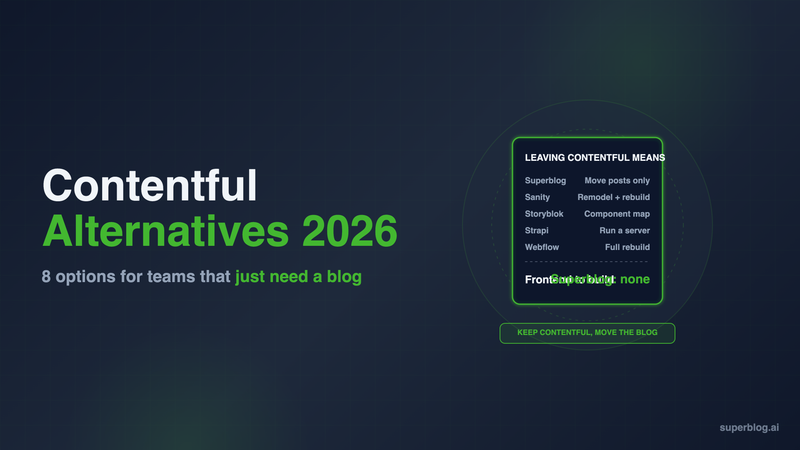
The strongest Contentful alternatives in 2026 depend on why you are leaving. If the blog is the problem, keep Contentful for the site and hand /blog to a managed blogging platform such as Superblog. If the whole stack is the problem, Sanity, Storyblok, Contentstack, Strapi, Prismic, Payload, Hygraph, DatoCMS and Directus are the headless options to compare. Webflow and Ghost fit teams that want to drop headless entirely.
This list is for two readers. The first is a marketing team that adopted Contentful for the whole site and now finds every blog template change waits on an engineer. The second is an engineering team comparing headless CMSs before a rebuild.
Why teams look for alternatives to Contentful
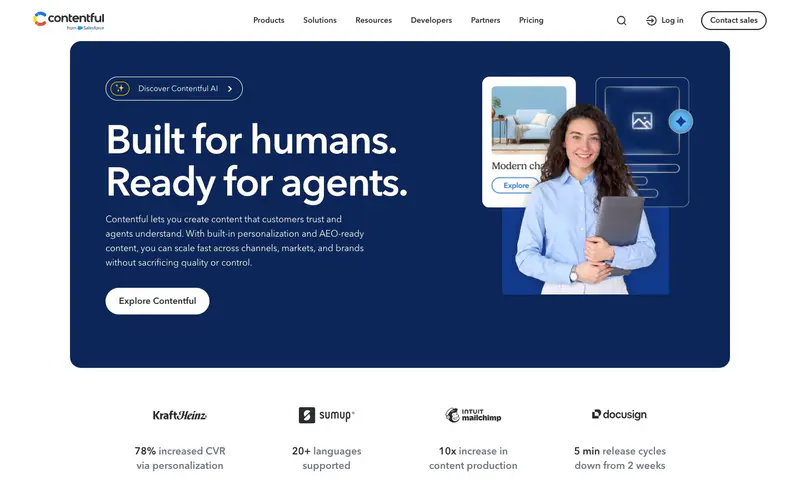
Contentful is a capable headless CMS. You model content as content types, each with up to 50 fields you define, and your frontend pulls entries through an API. Large organizations with many channels, locales and content teams get real value from that structure.
A company blog asks for less, and the headless model makes the small things slow:
- There is no blog frontend. Contentful stores fields. Your developers build the post template, category pages, metadata, sitemap, schema and RSS route, and they maintain all of it.
- Preview is a setup task. To preview entries, someone creates a content preview entity and configures a preview URL per content type. Until a developer does that, writers publish blind.
The pattern is the same in most teams: the blog is one section of a site that works, and every change to it lands in the engineering backlog.
That is where a managed blog fits. Superblog runs the blog at yoursite.com/blog while the rest of the site stays on Contentful, with SEO and the blog frontend built in.
Contentful alternatives at a glance
1. Superblog
Type: managed blog platform. Keep Contentful for the site, move the blog.
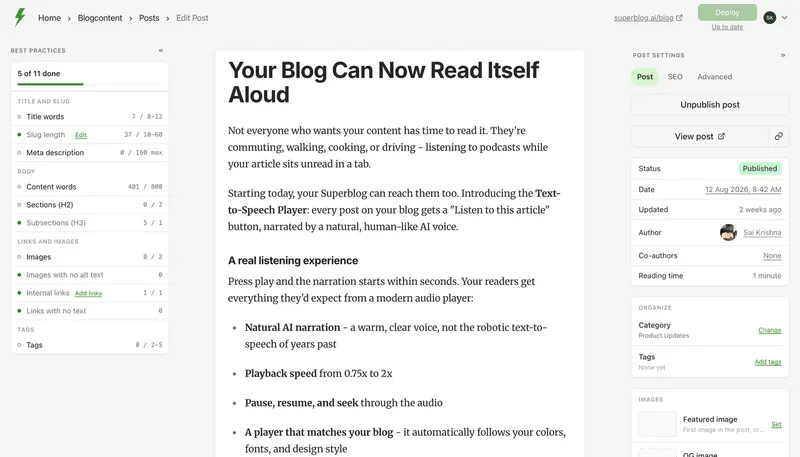
Superblog gives you the blog as a finished product: editor, post pages, hosting and SEO in one subscription. Nothing in Contentful gets remodeled. Only the posts move. Your current frontend keeps serving the homepage and product pages, and /blog routes to Superblog.
If your Contentful site runs on Next.js, that route is two beforeFiles rewrites in next.config.js, generated by the Superblog dashboard. The Next.js setup guide shows the exact config. Other stacks use a reverse proxy or a Cloudflare Worker on the /blog path.
Pricing: $49/month (Pro) or $99/month (Super). Yearly is $530 and $1,070. Subdirectory hosting is included on every paid plan. There is a 7-day free trial, no credit card required.
Strengths for a Contentful team:
- Marketers own the blog. Writers get a WYSIWYG editor (slash commands, markdown), a SERP preview, FAQ blocks, internal link suggestions and lead forms, with no preview URL for anyone to configure.
- SEO ships with every post. XML sitemaps, IndexNow pings, canonical URLs, Open Graph tags, llms.txt, and JSON-LD for Article or BlogPosting, WebPage, Organization, ImageObject, and FAQ on posts with an FAQ block. Pages score 90+ on Lighthouse.
- Seats are in the plan. Pro includes 5 team members, Super 10.
- Languages are not metered. Multilingual SEO is on Super and above, with no per-language charge.
- Developers can still reach it. Super adds the REST API, MCP and Zapier.
Moving posts from Contentful: there is no direct Contentful importer. Export your space with Contentful's contentful-export tool. Then a developer runs a short script that turns each blog entry into one flat post record and converts its rich text body to HTML with Contentful's own rich text HTML renderer. Load that file through Superblog's JSON import and map title, content and date, plus slug if you want to keep your URLs. Each import takes up to 300 posts.
Limits: posts use Superblog's templates, not your frontend's React components. Templates, colors, fonts, menus and custom CSS control the look. Pro holds up to 1,000 posts and Super up to 10,000.
Choose it if: Contentful runs the site well and the blog is the only part that lags. The blog for Next.js page covers the setup for Contentful sites built on Next.js.
2. Sanity

Type: hosted headless CMS, schema defined in code.
Sanity is the closest like-for-like swap for an engineering team. You define the schema in code, query with GROQ, and customize the Studio editor in JavaScript.
Pricing: the Free plan covers 10,000 documents and up to 20 seats. Growth costs $15 per seat per month, up to 50 seats and 25,000 documents, so a 5-person team pays $75 a month.
Strengths: precise content modeling, a generous free tier, and a Studio developers can shape to the team's workflow.
Limits: like Contentful, it has no blog frontend. The template, metadata and sitemap are still your code.
Choose it if: your engineers are happy with headless and want a more flexible content model with per-seat pricing.
3. Storyblok

Type: hosted headless CMS with a visual editor.
Storyblok is the pick for marketers who found Contentful's entry forms too abstract. Editors click on the rendered page and change it in place.
Pricing: the free Starter plan has 1 seat. Growth costs $99/month, or $90.75/month on annual billing, and includes 5 seats, with extra seats at $15/month up to 10. Growth Plus costs $349/month for 15 seats.
Strengths: in-context editing that writers pick up in an afternoon.
Limits: a developer registers every block type and maps it to a frontend component before editors can use it. Editors get freedom inside the library developers build. A new layout still starts as a ticket.
Choose it if: your marketers build landing pages as often as they publish posts, and an engineer owns the component library.
4. Strapi

Type: open-source headless CMS, self-hosted or on Strapi Cloud.
Strapi is the exit for teams that want to own the CMS outright. You run the admin panel and the REST or GraphQL APIs on your own infrastructure.
Pricing: the self-hosted Community Edition costs nothing and ships under the MIT license. Self-hosted Growth is $45/month with 3 users, and each extra user is $15/month. On Strapi Cloud a project costs $35/month on Starter, $90 on Pro or $450 on Business.
Strengths: no vendor contract and a large plugin library.
Limits: self-hosting adds a server to patch and back up, and the blog frontend is still yours to build.
Choose it if: an open-source license matters more than a managed service, and someone on the team will run it.
5. Prismic

Type: hosted headless CMS built around page sections.
Prismic organizes pages into slices: reusable sections that writers stack in order. Each slice is a React component a developer writes.
Pricing: the Free plan has 1 user. Paid plans are priced per repository and shown billed annually: Starter $10/month for 3 users, Small $25/month for 7 users, Medium $150/month for 25 users.
Strengths: the cheapest paid tier of the hosted CMSs here, and a slice library that keeps pages on-brand.
Limits: writers cannot add a layout that no slice covers. That request goes to a developer.
Choose it if: your blog and landing pages share sections and you want one tool for both on a small budget.
6. Payload

Type: open-source CMS that installs inside your Next.js app.
Payload runs inside the Next.js app itself, in the /app folder. Content, admin panel and site ship from one repository in one deploy.
Pricing: the code is MIT licensed and costs nothing. The bills are for the database (MongoDB, Postgres or SQLite), file storage and hosting.
Strengths: no external CMS vendor, TypeScript configuration, and content in your own database.
Limits: the blog frontend and all its SEO are yours to build, and the database is yours to run.
Choose it if: your engineers want the CMS in the repo and are leaving Contentful to cut vendor dependence.
7. Hygraph

Type: hosted headless CMS with a GraphQL API.
Hygraph is the alternative for teams that want GraphQL at the center of the stack.
Pricing: Hobby is free forever with 3 seats, 2 locales and 1,000 entries. Growth starts at $199 a month with 10 seats, 3 locales and 10,000 entries. Enterprise is custom.
Strengths: a GraphQL-first API and 10 seats included on Growth.
Limits: the free plan is for personal projects and testing. A business blog lands on Growth, from $199 a month, and still needs its own frontend.
Choose it if: your team is committed to GraphQL and wants it at the center of the stack.
8. Webflow

Type: visual site builder; the blog lives in its CMS.
Webflow replaces the headless stack entirely. Designers and marketers build pages visually, and the blog lives in a CMS Collection with no frontend code.
Pricing: the CMS starts at Premium: $25 a month billed yearly, or $39 monthly, with 20,000 CMS items. Basic ($15 a month billed yearly) has no CMS. Writer seats are extra: $15 a month per limited seat, $39 per full seat, billed yearly.
Strengths: marketers change layouts without a developer, and hosting is included.
Limits: leaving Contentful for Webflow means rebuilding the whole site. Writer seats are metered, and CMS items are a site-wide budget.
Choose it if: the headless architecture itself is the problem and marketing should own the full site.
9. Contentstack
Type: hosted enterprise headless CMS.
Contentstack chases the same enterprise buyer as Contentful. The CMS is API-first and cloud-native, and the same vendor sells a Visual Editor, personalization and AI agents on top of it.
Pricing: Free costs $0 for 3 users, 1,000 entries and 2 locales. Build is $29 a month for 3 users and 2,500 entries. Neither plan lets you buy a fourth user. Growth is $299 a month with 10 users and 20,000 entries, and each extra user costs $25 a month. Enterprise is quoted.
Strengths: an enterprise platform you can try on a $29 plan, with 2 custom roles on Growth.
Limits: a fourth writer takes the bill from $29 to $299. Post templates, metadata and sitemaps remain your developers' code.
Choose it if: leadership wants an enterprise headless vendor, and you want to pilot it with three editors first.
10. DatoCMS
Type: hosted headless CMS queried through GraphQL.
DatoCMS delivers content over a GraphQL API and adds localization, modular content blocks and visual editing for editors.
Pricing: the Free plan holds 300 records, 100,000 API calls and 10 GB of traffic each month, and it blocks overages. Professional runs €149 a month on annual billing or €199 month to month. Each project gets 10 collaborators and 5 locales, and another collaborator is €9 a month.
Strengths: scheduled publishing on both plans, and Professional's limits are soft: going over bills pay-as-you-go.
Limits: prices are in euros. A blog with a real archive outgrows 300 records fast, so plan on Professional. Your developers still build the frontend.
Choose it if: your engineers want GraphQL and your content runs in several languages.
11. Directus

Type: source-available headless CMS layered over your own SQL database.
Directus generates APIs and an admin app from a SQL database. Each content type is a real table, so blog posts can sit beside product or customer data.
Pricing: Core on Directus Cloud costs $89 a month on yearly billing, or $99 monthly, for 3 seats and 25 collections. Those 3 seats are a hard cap. Team on Cloud is $588 a month billed yearly and includes 10 SSO seats. Companies with under $5M in revenue and fewer than 50 employees can self-host for free under the Open Innovation Grant.
Strengths: you keep the database and its schema, and self-hosting is allowed on every tier.
Limits: on Core, writer number four forces the Team plan unless you qualify for the grant. Directus renders no pages, so the blog is a frontend project.
Choose it if: content belongs in a SQL database you control and three editors are enough.
12. Ghost

Type: publishing platform for blogs and newsletters, on Ghost(Pro) or self-hosted.
Ghost ships a finished blog. Themes render the posts, and newsletters and paid memberships come built in. Next to Superblog and Webflow, it is the third option here with no frontend to code.
Pricing: Ghost(Pro) Starter is $15 a month billed yearly ($18 monthly) for 1,000 members. Custom themes start on Publisher at $29 a month, which adds 3 staff users. Business is $199 a month with 15 staff users.
Strengths: a clean writing editor, native email newsletters, and IndexNow and llms.txt switched on for new sites.
Limits: to put Ghost under yoursite.com/blog, you pay a $50 monthly add-on that only Business can buy, then run the reverse proxy yourself. On Ghost(Pro), five writers already need Business, because Publisher stops at 3 staff users.
Choose it if: the blog doubles as a newsletter and blog.yoursite.com is acceptable.
What five writers cost outside Contentful
Superblog Pro is the lowest monthly cost for five writers that includes a finished blog frontend.
On every headless row, the monthly price leaves out engineering time: someone builds the post template, metadata, sitemap, schema and preview and keeps them working. What a headless CMS costs a business blog itemizes those hours, and headless blog covers when it is worth it.
How to choose a Contentful alternative
- Decide whether the site or the blog is the problem. If the site works and the blog waits on engineers, keep Contentful and move the blog. If the whole content model is wrong, compare Sanity, Storyblok, Contentstack and Payload.
- Ask who owns the blog in a year. A headless blog with no engineering owner falls behind on SEO fixes first.
- Count writers before comparing prices. Per-seat plans look cheap at one seat and reorder the list at five.
- Keep the blog on
/blog. Posts on/blogbuild authority for your main domain. Subdomain vs subdirectory lays out the evidence. - Compare against your frontend. If you run Next.js, our best CMS for Next.js guide ranks the options by build time and code you maintain.
Contentful alternatives FAQ
Which Contentful alternative has a free plan for a team?
Sanity: its Free plan allows 20 seats.
Can I keep Contentful and move only the blog?
Yes. Route /blog to Superblog and keep every other page on Contentful.
Can Superblog import posts from Contentful?
No. Export to JSON, flatten the posts, then use the JSON import.
Which Contentful competitors are open source?
Strapi, Payload and Ghost, all MIT licensed. Directus is source-available.
Which Contentful alternative needs no frontend code for the blog?
Superblog, Webflow and Ghost.
The verdict on leaving Contentful
Contentful earns its place in organizations that run many channels from one content model. A company blog is a smaller job, and a headless CMS turns every template change into engineering work. If your team wants to stay headless, Sanity and Payload suit engineers, Storyblok suits visual editing, Contentstack suits enterprise buyers, and Prismic has the lowest paid entry price. If only the blog is the problem, keep Contentful for the site and move the blog to Superblog, from $49 a month with SEO built in. Start with the 7-day free trial, no credit card required.
Your blog, without the maintenance
Fast pages, automatic SEO, no plugins to patch. Runs on yoursite.com/blog.
Sai Krishna is the Founder and CEO of Superblog. Having built multiple products that scaled to tens of millions of users with only SEO and ASO, Sai Krishna is now building a blogging platform to help others grow organically.
superblog
Superblog is a blazing fast blogging platform for beautiful reading and writing experiences. Superblog takes care of SEO audits and site optimizations automatically.