
B2B Blogging Platform 2026: Which of 11 Options Actually Builds Pipeline?

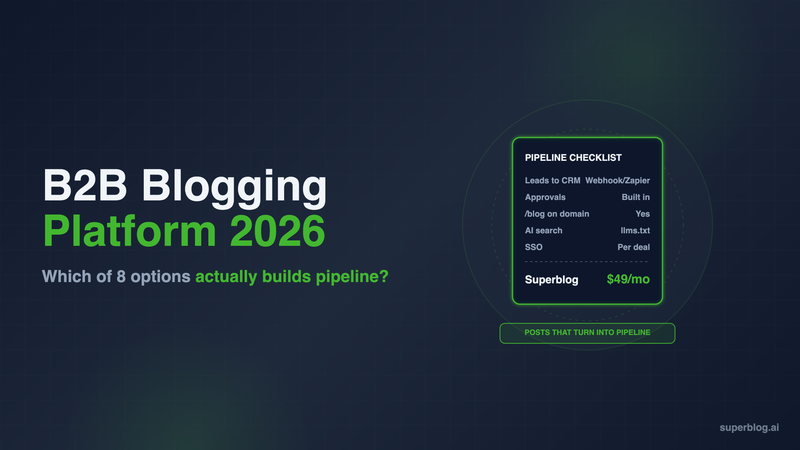
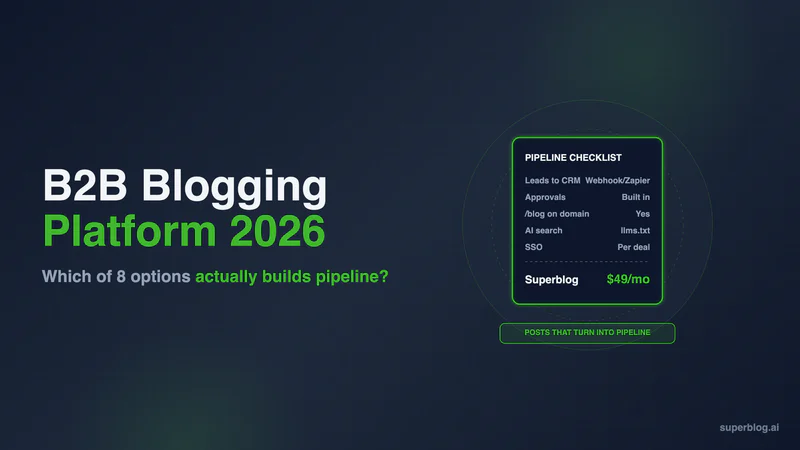
A B2B blogging platform is worth what it puts into your pipeline: leads that reach the CRM, posts that clear review, and rankings that build on your main domain. Superblog does that from $49/month (Pro), with leads pushed to your CRM by webhook or Zapier on Super ($99/month), and no engineering time. HubSpot Content Hub wins when HubSpot already runs your funnel and the budget covers $450 a month or more.
We compared 11 platforms on the six things a B2B marketing team gets judged on. Every competitor price and plan limit below was checked on the vendor's own page in November 2026.
What a B2B blog platform has to prove
A B2B blog is read by buyers who take weeks to decide, and by a marketing team that reports on sourced and influenced pipeline. If you still need the editorial plan, start with our B2B blog strategy. For the platform, test these six things.
- Leads reach the CRM. A demo request or newsletter signup on a post should land in HubSpot, Salesforce or your sales inbox without anyone exporting a CSV.
- Approvals before publish. Writers, freelancers, product marketing and sometimes legal touch a post. The platform should separate who drafts from who publishes.
- /blog on the main domain. Posts at yoursite.com/blog build authority for your product and pricing pages. Our subdomain vs subdirectory guide explains why.
- SEO and AI-search readiness. Schema, sitemaps, canonical tags, IndexNow and llms.txt should happen on publish. B2B buyers now ask ChatGPT and Claude for vendor shortlists, and those assistants cite pages they can read cleanly.
- Analytics tied to leads. You need to see which posts produce signups, not only pageviews. Our guides to measuring blog ROI in B2B and blog attribution models cover the reporting side.
- Procurement. Larger buyers ask for SSO, invoicing and an SLA before IT signs off.
B2B blogging platforms at a glance
1. Superblog
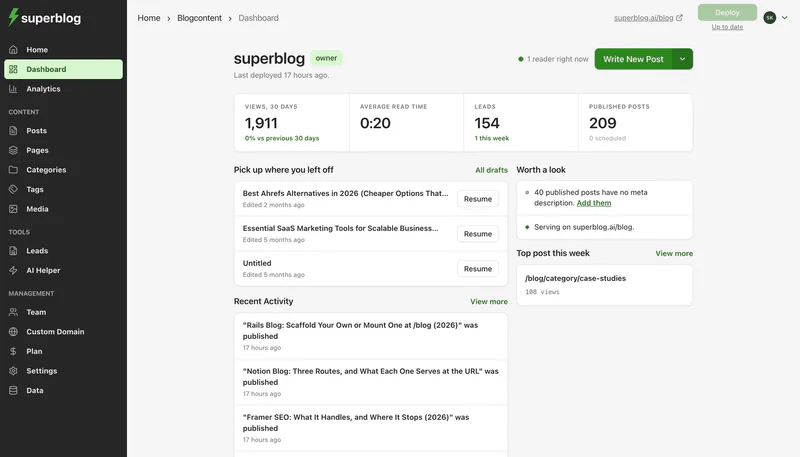
Superblog is a managed blog platform: CMS, hosted frontend, CDN and SEO engine in one product. It runs the blog next to the marketing site you already have, whatever that site is built on.
Pipeline features. Lead forms sit below posts, in the sidebar or as pop-ups, with no third-party tool. On Super, custom form fields, a real-time lead webhook and Zapier (5,000+ apps) push each lead into your CRM the moment it is submitted. Privacy-friendly analytics (Pirsch, no cookie banner) come with Pro, and Google Analytics is supported.
Team workflow. Roles are Admin, Editor and Writer. Posts can be assigned and reassigned, carry co-authors, and go through collaborative review before publishing on Pro. Pro includes 5 team members, Super 10, and the Business plan 25.
/blog setup. Subdirectory hosting is on every paid plan. Next.js gets a rewrite rule, WordPress gets the Superblog Proxy plugin, and Webflow, Wix and Squarespace sites get a free Cloudflare Worker that sends /blog to Superblog and every other path to the builder. The setup takes about 10 minutes.
SEO and AI search. Every page scores 90+ on Lighthouse. JSON-LD schema (Article, FAQ, Organization), XML sitemaps, IndexNow pings, canonical URLs and Open Graph tags are generated on publish. Each post is also served as plain markdown, indexed by an llms.txt file, so AI assistants can read and cite it. Internal link suggestions run in the editor.
Enterprise. The Enterprise plan adds SSO (set up per deal, not a dashboard toggle), invoice and PO billing, white-glove migration with a migration SLA, an uptime SLA, priority support with a dedicated contact and 1M+ pageviews a month. It is quoted on a call.
Limits: It is a blog platform, not a website builder or a CRM. Design is template-based with color, font and custom CSS controls. Each plan lists up to 100,000 pageviews a month. Going over does not cap or slow the blog, and a blog that keeps growing moves to a larger plan. HubSpot has no direct importer: export your posts from HubSpot as CSV and bring them in with spreadsheet import (Super and above, up to 300 posts per import).
Pricing: $49/month (Pro, up to 1,000 posts) or $99/month (Super, up to 10,000 posts). Yearly is $530 and $1,070. There is a 7-day free trial, no credit card required.
Choose it if the blog's job is qualified leads on yoursite.com/blog and you do not want to fund a suite or a developer to get there.
2. HubSpot Content Hub

HubSpot is the default for B2B teams whose funnel already runs in HubSpot. The blog, forms and contact records share one database, so a post's influence on a deal shows up without stitching tools together.
Strengths: native forms and CRM, closed-loop reporting, up to 100 blogs on Professional, and SSO on Professional and Enterprise.
Limits for B2B: Content approvals for blog posts need Content Hub Enterprise, per HubSpot's own knowledge base. If your main site is not hosted on HubSpot, serving the blog at /blog needs a reverse proxy through a CDN, and HubSpot support does not set it up. Seats add up: Professional includes 3 Core Seats, and extra seats start at $45 a month.
Pricing: Free for up to 2 users. Starter is $20/seat/month, or from $7/seat/month with HubSpot's new-customer discount. Professional starts at $450/month (HubSpot also lists $500/month). Enterprise starts at $1,500/month with 5 Core Seats. If the blog is the main reason you pay for HubSpot, compare it against a HubSpot blog alternative.
Choose it if HubSpot is your CRM, the team lives in it, and approvals justify the Enterprise tier.
3. WordPress (run by an agency)
Many B2B companies run WordPress with an agency on retainer. It can do anything, and the agency carries the maintenance.
Strengths: the largest plugin ecosystem, full control of templates, and core user roles. The Contributor role can write and manage posts but cannot publish them, which gives you a basic approval step with no plugin.
Limits for B2B: Forms, CRM sync, SEO, caching and security each come from a plugin the agency installs and updates. Every change to a template or form waits in the agency's queue. A default theme is fast; real B2B sites slow down as page builders, tracking tags and plugins stack up.
Pricing: The software is free. Managed hosting such as Kinsta starts at $35/month, or $30/month paid annually. WPForms Pro is $399 a year at full price. Freelance WordPress experts on Codeable bill $80 to $120 an hour. Our platform comparison for business blogs adds up the full cost of ownership.
Choose it if your whole website is WordPress, an agency already owns it, and you need custom functionality no blog platform offers.
4. Drupal
Drupal is open source content management software. Drupal.org names the BBC, NBC and the University of Oxford among the organizations that run on it. In B2B it shows up on large corporate sites with many content types, languages and editors.
Strengths: no license cost at all. Core ships Content Moderation and Workflows, with Draft, Published and Archived states, so a writer saves a draft and an editor publishes it. Drupal CMS, the packaged edition aimed at marketers, adds SEO tools, lead generation forms and automated sitemaps.
Limits for B2B: Drupal is a developer platform. Hosting, core updates, security releases and theme changes all need a Drupal team or an agency, and that team is the real budget line.
Pricing: The software is free under the GPL. Hosting and development are billed separately.
Choose it if your corporate site already runs on Drupal and a team maintains it.
5. Webflow

Webflow runs a lot of B2B marketing sites, and its CMS handles a blog well when the whole site is Webflow.
Strengths: design control, a visual CMS marketers can edit, and native forms. When the site is Webflow, the blog is already on your domain.
Limits for B2B: Governance sits on the expensive plans. Publishing workflows and page branching start on Team at $2,500/month with an annual contract. SSO, SCIM and design approvals are on Enterprise. Form submissions stay in Webflow unless you connect a CRM. If your product or docs live elsewhere, Webflow offers reverse proxy setup as a service in its enterprise packages.
Pricing: Premium is $25/month billed yearly and includes the CMS. Team is $2,500/month. Enterprise is quoted.
Choose it if the site is Webflow, the blog stays small, and the designers who run the site also run the blog.
6. Framer
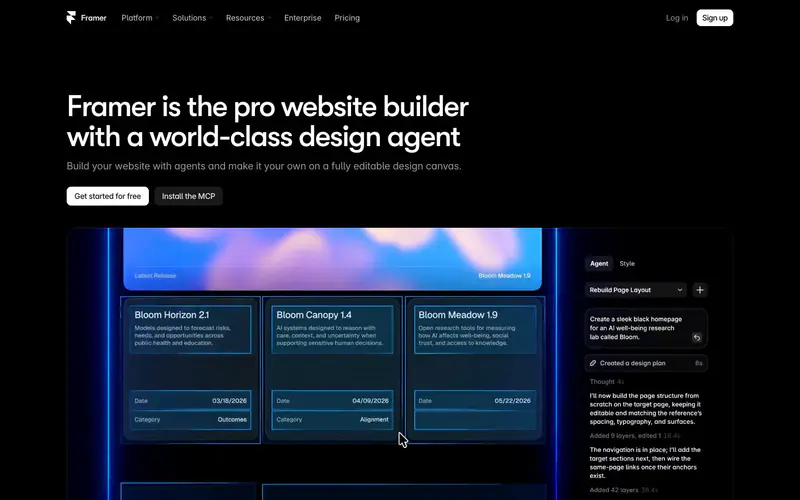
Framer is a design-first site builder, and a common pick for startup and B2B marketing sites. Its CMS can run the blog when the whole site lives in Framer.
Strengths: pages that look designed without a developer, a staging environment and branching with previews on Pro, and content-editor seats at $10 a month next to $20 full editor seats.
Limits for B2B: CMS item limits are tight for a content program: Basic stops at 1,000 items and Pro at 2,500 unless you pay for add-ons. SSO and SCIM are on Enterprise. When Framer hosts your site, a separate blog at /blog requires an Enterprise contract, or Framer Pro with its Advanced Hosting add-on, $200/month billed yearly. A blog.yoursite.com subdomain works on any Framer plan.
Pricing: Free to start. Basic is $10/month and Pro $30/month on yearly billing. Enterprise is quoted.
Choose it if designers own a Framer site and the blog publishes a few posts a month.
7. Contentful and Sanity (headless)
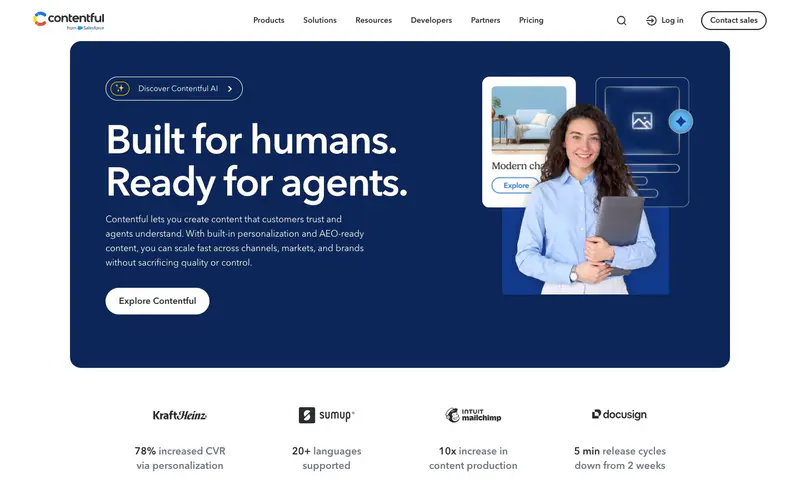
Headless CMSs store content and serve it through an API. Your engineers build the blog inside your own app or site. Contentful and Sanity are the common picks for B2B companies with a platform team.
Strengths: structured content that can feed the blog, docs, case studies and product pages from one model. /blog is just another route in your app.
Limits for B2B: A headless CMS renders nothing. Templates, schema, sitemaps, canonical tags, image handling, previews and lead forms are code your team writes and maintains. On Sanity, SSO with SAML and custom roles are Enterprise features.
Pricing: Sanity is free for up to 20 seats, then $15 per seat per month on Growth. Enterprise is quoted.
Choose it if you have frontend engineers with roadmap time to own the blog as a product.
8. Contentstack
Contentstack is an enterprise headless CMS that digital and marketing teams shortlist next to Contentful. Every tier, including Free, bundles a visual editor, AI agents (Agent OS) and Launch hosting.
Strengths: self-serve prices listed on its own pricing page, with a free tier to try it. Growth adds custom workflows and 2 custom roles. Enterprise adds 50+ users, 500 custom roles, a 99.5%+ uptime SLA and a choice of AWS, Azure or GCP data centers.
Limits for B2B: the blog is still a build. Templates, SEO tags, sitemaps and lead forms are your team's code. Free and Build stop at 3 users, so a real content team lands on Growth.
Pricing: Free, then Build at $29/month and Growth at $299/month with 10 users (extra users $25/month each). Enterprise is custom.
Choose it if your platform team already runs the website on Contentstack and wants the blog in the same stack.
9. DropInBlog
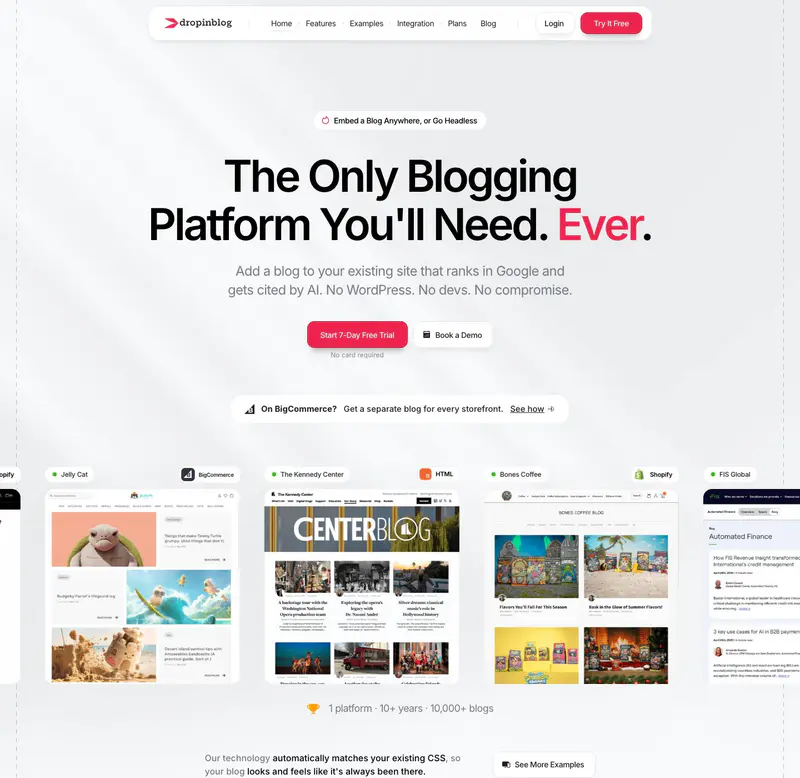
DropInBlog adds a blog to a site you already have, by embed or through a headless API. It is the closest model to Superblog's.
Strengths: unlimited posts on every plan, Zapier automations on every plan, and invoice and PO support with white-glove migration on Business.
Limits for B2B: pricing climbs with users. Solo is 1 user. Team gives 5 users with fixed roles. Granular permissions start on Business, and SSO is only on Business Plus.
Pricing: Solo $79/month, Team $159/month, Business $399/month, all billed yearly. Business Plus is $999/month billed yearly, invoiced at $11,988 a year.
Choose it if you want an embedded blog and can budget for the tier that matches your team size.
10. Ghost

Ghost is a fast publishing platform built around newsletters and memberships. Its SEO defaults are strong: IndexNow and llms.txt are on by default for new sites.
Strengths: an excellent editor, native email newsletters, and staff roles where Contributors draft and Editors publish.
Limits for B2B: Ghost's built-in forms collect newsletter members, not demo requests. A subdirectory needs the $199/month Business plan, a $50/month add-on and a reverse proxy you run yourself.
Pricing: Starter is $15/month and Business $199/month (15 staff users), billed yearly.
Choose it if your B2B blog is mainly a newsletter and a subdomain is acceptable.
11. Storyblok

Storyblok is a headless CMS with a visual editor. Marketers edit a live preview of the page your developers built.
Strengths: visual editing that marketers like, plus component-based content that suits large sites.
Limits for B2B: each block type is registered and mapped to a React component in code, so the blog is still a build. Custom workflows, custom roles and SSO are only on Premium and Elite, which are quoted.
Pricing: Starter is free. Growth is $99/month ($90.75 billed annually) and Growth Plus $349/month ($319.91 billed annually).
Choose it if your web team already builds on Storyblok and wants the blog in the same component system.
How to pick by who owns pipeline
Start from the tool that holds your leads, then the team that will run the blog.
- Leads go to any CRM, no engineer to spare: Superblog. Forms are built in, and Super sends each lead out by webhook or Zapier.
- HubSpot is the CRM and the budget is there: HubSpot Content Hub. Plan for Enterprise if approvals are a hard rule.
- An agency already runs your WordPress or Drupal site: keep the blog there and budget for plugin, module and agency hours. A small blog on a Framer site can stay in Framer's CMS.
- Engineers want one content model for the whole site: Contentful, Sanity, Contentstack or Storyblok, with the build cost counted.
- IT requires SSO and an SLA before signing: ask Superblog Enterprise, HubSpot Professional, DropInBlog Business Plus, or the enterprise tier of Webflow, Framer, Sanity or Storyblok for a quote. Our enterprise blog platform guide lists the questions to ask.
FAQ
What is the top B2B blogging platform in 2026?
Superblog for a managed blog at /blog; HubSpot Content Hub if HubSpot is already your CRM.
Should a B2B blog live on a subdomain or a subdirectory?
A subdirectory, such as yoursite.com/blog.
Can blog leads go straight into my CRM?
Yes. On Superblog Super, through lead webhooks or Zapier.
Which B2B blog platforms offer SSO?
HubSpot Professional and up, Webflow Enterprise, Framer Enterprise, Sanity Enterprise, Storyblok Premium, DropInBlog Business Plus, Ghost Custom and Superblog Enterprise.
How much does a B2B blog platform cost?
From $0 (Sanity Free) to $2,500 a month (Webflow Team), before quoted enterprise tiers and headless build time.
Does Superblog have a free trial?
Yes: a 7-day free trial, no credit card required.
Your blog, without the maintenance
Fast pages, automatic SEO, no plugins to patch. Runs on yoursite.com/blog.
Sai Krishna is the Founder and CEO of Superblog. Having built multiple products that scaled to tens of millions of users with only SEO and ASO, Sai Krishna is now building a blogging platform to help others grow organically.
superblog
Superblog is a blazing fast blogging platform for beautiful reading and writing experiences. Superblog takes care of SEO audits and site optimizations automatically.