
Best AI Blog Writing Tools 2026: 13 Tools Compared for Business Blogs That Rank

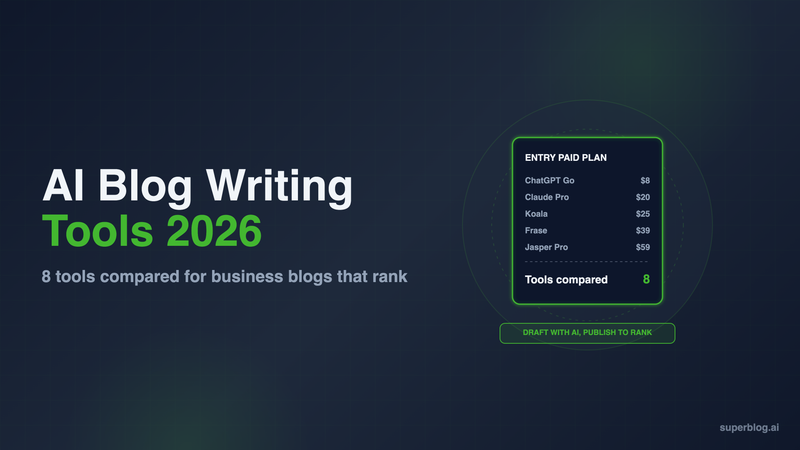
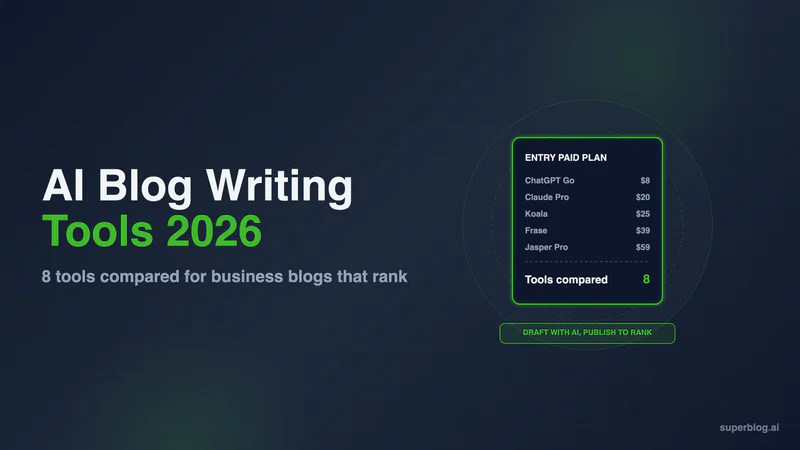
The AI blog writing tools that work for a business blog are a general model for drafting (Claude or ChatGPT, $20/month), an SEO tool that grounds the draft in search data (Surfer or Frase), and a blog platform where a human edits and publishes the result. All-in-one writers like Jasper, Writesonic and Koala fold some of those steps together, at a price. Which mix fits depends on who checks the facts and where the post goes live.
We compared 13 tools on five criteria a company blog cares about. Every third-party price was checked on the vendor's own pricing page in November 2026.
What a business blog needs from an AI writing tool
A business blog is not a content farm. One wrong number in a post about your own product or a competitor costs more trust than ten good posts earn. So the AI drafts, and a person who knows the subject edits for accuracy before anything ships. Our AI content workflow guide covers that process step by step. This post covers the tools.
We judged each tool on:
- Draft quality on facts. Can it pull from live sources or your own documents, or does it write from memory? Google's own guidance warns that "generative AI outputs may contain inaccuracies," so a tool that cites sources saves editing time.
- Brand voice controls. Can you give it a style guide, product facts and audience once, instead of pasting them into every prompt?
- SEO research. Does it know what ranks for the keyword: headings, questions, terms, gaps?
- Publishing integration. Can the draft reach your CMS through an integration, an API or MCP, or does someone copy and paste it?
- Price. What a team actually pays per month, and per seat.
On Google: AI-assisted posts are not penalized for being AI-assisted. Google's Search team wrote in 2023 that its "focus on the quality of content, rather than how content is produced" still applies, and that appropriate use of AI is not against its guidelines. The same guidance says that generating many pages without adding value can violate its scaled content abuse policy. The human edit is what keeps a post on the right side of that line. Our E-E-A-T guide for blogs covers what that edit should add.
One more distinction before the list. Twelve of these tools write. Superblog does not write your posts; it is the blog platform where AI drafts land, get reviewed by your team and go live. We include it because the publishing step is where most AI workflows stall.
AI blog writing tools at a glance
1. Claude
Claude is Anthropic's general model. It is strong at long-form drafting from a detailed brief, and it can work from your own documents and live sources.
Strengths:
- Grounded drafts. Research mode and web search are on Pro, so a draft can work from current sources instead of memory. You can also load your own product docs into a Project.
- Brand voice. Projects hold your style guide and reference posts. Skills and user preferences are on every plan, so formatting rules carry across chats.
- Publishing. Claude Code connects to tools through MCP. Point it at your blog platform's MCP server and the draft goes straight in as a draft, with no copy-paste. Our guide to automating a blog with Claude, Codex and MCP shows the full loop.
Limits: It has no built-in keyword data. SEO research comes from what you give it or from an SEO tool connected through MCP. It will still state wrong facts confidently at times, so the human edit stays.
Pricing: Free with limited usage. Pro is $20/month, or $17/month billed annually ($200 up front), and includes Claude Code. Max is $100/month. Team Standard seats are $20/seat/month billed annually or $25 monthly.
Choose it if you want the strongest general drafting tool and someone on the team can run a short MCP setup.
2. Superblog (where AI drafts get published and reviewed)
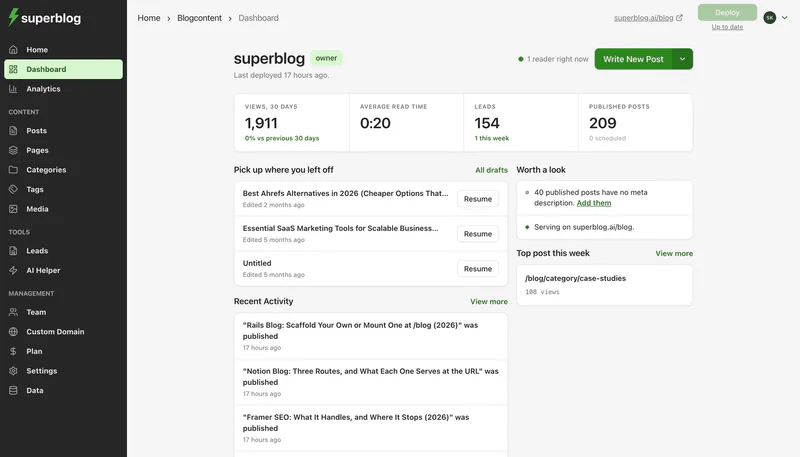
Superblog is a fully managed blog platform: CMS, hosted frontend, CDN and SEO engine in one product. It is not an AI writer. It is where drafts from Claude, ChatGPT or a person get edited, reviewed and published at yoursite.com/blog.
How it fits an AI workflow.
- MCP and API on Super. Claude Code, Claude Desktop, Codex CLI and Codex Desktop connect to Superblog's MCP server with one URL and a browser sign-in. The agent can check which slugs you already have, create a post as a draft with its meta title and description, attach FAQs, pull internal link suggestions, upload images and, when you say so, publish and deploy. The REST API covers the same ground for scripts.
- Human review stays in the loop. Drafts land in the editor, not on the live site. Team roles, collaborative review and scheduled posts are on Pro and up, so an editor can fact-check before anything goes live.
- SEO runs on publish. JSON-LD schema (Article, FAQ, Organization), XML sitemaps, IndexNow, canonical URLs, Open Graph tags and llms.txt are generated automatically. Pages score 90+ on Lighthouse. Internal link suggestions sit in the editor.
- AI Helper on Business. Type a target keyword and AI Helper drafts a post title plus an H2/H3 outline, using your site's description for context. Business also adds dashboard keyword research and AI featured images, drawn from 199 monthly credits.
Limits: It does not draft full posts for you. Pair it with a writer from this list. Design is template-based with color, font and custom CSS controls.
Pricing: $49/month (Pro) or $99/month (Super, with MCP integration, API access and multilingual SEO). Yearly is $530 and $1,070. AI Helper, keyword research and AI featured images are on the Business plan. There is a 7-day free trial, no credit card required.
Choose it if your drafts come from AI and you want them reviewed and published on yoursite.com/blog without copy-paste, plugins or a developer.
3. ChatGPT

ChatGPT is OpenAI's general assistant. It handles outlines, drafts and rewrites well across most topics.
Strengths:
- Research. Plus includes expanded deep research for gathering sources before you draft.
- Brand voice. Projects and custom GPTs (on Plus) hold your instructions, examples and files.
- Publishing. Codex, included in ChatGPT plans, supports MCP servers, so it can push drafts into a CMS that has one.
Limits: Like Claude, it has no native keyword data and needs a fact-check on every claim. Lower tiers have tighter message limits.
Pricing: Go is $8/month. Plus is $20/month. Pro starts at $100/month, with $200 and $500 tiers. Business is $20/user/month billed annually for 2 or more users, or $25 monthly.
Choose it if your team already works in ChatGPT and wants one tool for drafting and everyday tasks.
4. Gemini

Gemini is Google's general assistant.
Strengths: the free plan includes Deep Research, Canvas for editing a draft, and Gems, which hold standing instructions such as a style guide. Google AI Pro puts Gemini inside Google Docs, where many teams already draft.
Limits: no built-in keyword data, and every claim needs a fact-check. Gemini in Docs needs Google AI Pro; AI Plus covers Gmail and Vids, not Docs.
Pricing: Free. Google AI Plus is $4.99/month and Google AI Pro is $19.99/month. Ultra starts at $99.99/month. For companies, Gemini Enterprise Business starts at $21 per seat per month.
Choose it if your team already writes in Google Workspace and wants the assistant inside Docs.
5. Jasper

Jasper is a marketing AI suite built for teams that produce content for several brands or product lines.
Strengths: brand controls are the core of the product. Pro includes 2 Brand Voices, 3 Audiences and 5 knowledge assets, so outputs follow your style and product facts. Business adds unlimited Brand Voices and agents for GEO, research and translation.
Limits: SEO features are not broken out per plan on the pricing page, and the GEO agent is Business only. CMS publishing runs through its integrations marketplace (Webflow is listed) or Zapier. Annual plans carry a 12-month commitment.
Pricing: Pro is $59/seat/month billed yearly or $69 monthly. Business is custom. There is a 7-day free trial of Pro.
Choose it if keeping several writers on one brand voice matters more than SEO research.
6. Surfer

Surfer is an SEO content optimizer. Its job is to tell you what a page needs to compete for a keyword, and it now covers AI search visibility too.
Strengths: SERP-based content guidelines are its core strength. Plans include a set number of documents to create or optimize each month. Integrations cover WordPress, Google Docs, Contentful and Zapier. Pro adds Templates and Custom Voices, internal linking and MCP.
Limits: Custom Voices start on Pro ($182/month billed yearly); Standard has Brand Knowledge only. The writing is built to match ranking pages, so a subject expert still has to add what those pages lack.
Pricing: Discovery $49/month (120 documents), Standard $99/month (360 documents, integrations), Pro $182/month, Peace of Mind $299/month with API access. All billed yearly.
Choose it if you write with a general model and want Surfer to check each draft against what ranks.
7. Frase

Frase combines SERP research, briefs and an AI writer, and it can publish directly to your CMS.
Strengths: research and briefs come first, so drafts start from what ranks. Every plan publishes to WordPress, Webflow, Sanity or Wix, or to Frase's own hosted CMS, and includes API, MCP and CLI requests. Professional adds a content calendar and internal linking suggestions.
Limits: Frase can publish on its own when you allow it. For a business blog, keep that setting off so an editor reviews each draft. Article counts are capped per plan.
Pricing: Starter $39/month billed yearly ($468/year, 1 seat, 10 articles). Professional $103/month billed yearly (3 seats, 40 articles). Scale $239/month billed yearly. There is a 7-day free trial, no credit card required.
Choose it if you want SEO research and drafting in one tool and your CMS is on its integration list.
8. NeuronWriter

NeuronWriter is an SEO content editor that scores a draft against the pages ranking for its keyword, like Surfer, at a lower entry price.
Strengths: the editor shows which terms and topics a draft still lacks. Every plan includes AI credits for drafting and a content planner. Gold adds custom AI templates, unlimited team members, WordPress, Shopify and Search Console integrations, and API and MCP access.
Limits: Bronze allows 2 projects and 25 documents. CMS integrations start on Gold.
Pricing: Bronze $23/month or $230/year. Silver $45/month. Gold $69/month or $690/year.
Choose it if you want SERP-based scoring for every draft and Surfer's entry plan is more than you need.
9. Clearscope

Clearscope is a content optimization tool built for content teams.
Strengths: recommendations are based on search intent and the language ranking pages use. Every plan tracks chosen queries in ChatGPT and Gemini and shows where your brand is mentioned. It works inside Google Docs, Word and WordPress. Every plan has unlimited users.
Limits: it has the highest entry price of the optimizers here. Drafts are capped at 20 a month on Essentials and Business, so it suits teams that write most of the text themselves.
Pricing: Essentials $129/month (50 tracked queries, 50 pages, 20 drafts). Business $399/month. Enterprise is custom. There is a 14-day free trial, and monthly plans have no minimum contract.
Choose it if a content team with several editors needs one shared optimizer for every draft.
10. Scalenut

Scalenut is an SEO writing platform built around keyword clusters, and its pricing page now leads with AI search visibility.
Strengths: plans bundle keyword clusters, new GEO articles, optimization of existing articles, and prompt tracking in ChatGPT and Google AI Overviews. Plus adds a content audit, internal linking, unlimited tone of voice, up to 4 team members and auto-publishing to WordPress and Shopify.
Limits: Starter covers 5 new articles a month for 1 domain. Auto-publishing and internal linking start on Plus.
Pricing: Starter lists at $59/month with a 7-day free trial. Plus is $89/month and Professional is $199/month.
Choose it if you want clusters and drafts planned together and your blog runs on WordPress or Shopify.
11. Writesonic

Writesonic started as an AI writer. Its pricing page now presents it as an AI search visibility platform, with article writing as a supporting feature.
Strengths: it tracks how your brand appears in ChatGPT, Gemini and Google AI Overviews, then helps you write or fix content to close the gaps. Starter includes 15 AI articles a month, content strategy, site audits and a WordPress integration.
Limits: Starter allows 1 writing style (brand voice). If you only need drafting, you pay for tracking you may not use.
Pricing: Starter $79/month billed annually. Basic $199/month billed annually (25 articles, 5 writing styles).
Choose it if AI search visibility is your main question and articles are how you plan to answer it.
12. Koala
Koala (KoalaWriter) is built to generate long-form SEO articles, and it is the lowest-priced dedicated blog writer on this list.
Strengths: Starter includes real-time factual data, SEO optimization and Brand DNA, which reads your site so articles mention your own services and pages. Drafts publish to WordPress, Shopify, Webflow or Ghost, or through webhooks, the API or Koala's MCP server. Professional adds KoalaLinks for internal linking and Deep Research.
Limits: Brand DNA covers 1 brand on the standard plans. Bulk generation makes it fast to publish more pages than your team can check, which is the pattern Google's scaled content policy describes.
Pricing: Starter $25/month (45,000 words), Professional $49/month (100,000 words), Boost $99/month. Annual billing saves 20%. You can start free with no credit card.
Choose it if you want a dedicated SEO article writer at a low monthly cost and will edit every draft before it publishes.
13. Byword

Byword generates SEO articles in bulk from a keyword list, for teams running programmatic SEO.
Strengths: it researches keywords, writes in your brand voice, and drafts with GPT, Claude or Gemini models. Finished articles publish to WordPress, Webflow and four other CMSs.
Limits: output is sized for volume, so review capacity, not generation, sets the safe pace.
Pricing: Starter $99/month (25 articles). Standard $299/month (80 articles). Scale $999/month (300 articles). You can start free with 5 articles.
Choose it if you have a long list of templated topics and an editor who reviews each article before it goes live.
How to choose AI tools for blog writing
Start with who edits, then pick the drafting tool and the place the post lives.
- A founder or marketer drafting a few posts a month: Claude, ChatGPT or Gemini at about $20/month. Grow into Surfer, Frase or NeuronWriter when you need keyword data.
- A content team with a style guide to protect: Jasper for brand controls, or Claude Projects with your guide loaded.
- SEO-led teams: Frase for research plus drafting, Surfer or NeuronWriter to optimize drafts from a general model, or Clearscope when many editors share one account.
- Tracking brand mentions in AI answers: Writesonic, Clearscope or Scalenut, or Surfer's AI Search Analytics plan.
- Templated pages at volume: Byword, with an editor checking every article before it publishes.
- Agent workflows end to end: Claude Code or Codex connected over MCP to an SEO data source and to your blog platform. On Superblog that is the Super plan at $99/month.
- Whatever writes the draft: publish where a human reviews it first. A 90+ Lighthouse blog on yoursite.com/blog with schema on every post does more for rankings than a faster generator.
For the rest of the stack (analytics, images, SEO research), see our blogging tools guide. If your team drafts by hand and wants a better writing surface, compare the blog editors built for business blogs.
FAQ
Does Google penalize AI-written blog posts?
No. Google ranks on quality, not on how content is produced.
Which AI tool is most accurate for blog writing?
None is accurate enough to skip a human fact-check.
Can an AI tool publish directly to my blog?
Yes, through an integration, an API or MCP: Frase, Koala, Byword, Surfer, Claude Code and Codex all can.
How much do AI blog writing tools cost?
Entry paid plans run from $4.99/month (Google AI Plus) to $129/month (Clearscope Essentials).
Is Superblog an AI blog post generator?
No. It is the blog platform where AI drafts are reviewed and published.
Which Superblog plan includes MCP and API access?
Super, at $99/month.
Your blog, without the maintenance
Fast pages, automatic SEO, no plugins to patch. Runs on yoursite.com/blog.
Sai Krishna is the Founder and CEO of Superblog. Having built multiple products that scaled to tens of millions of users with only SEO and ASO, Sai Krishna is now building a blogging platform to help others grow organically.
superblog
Superblog is a blazing fast blogging platform for beautiful reading and writing experiences. Superblog takes care of SEO audits and site optimizations automatically.