
Answer Engine Optimization (AEO): The Business Marketer's Guide (2026)

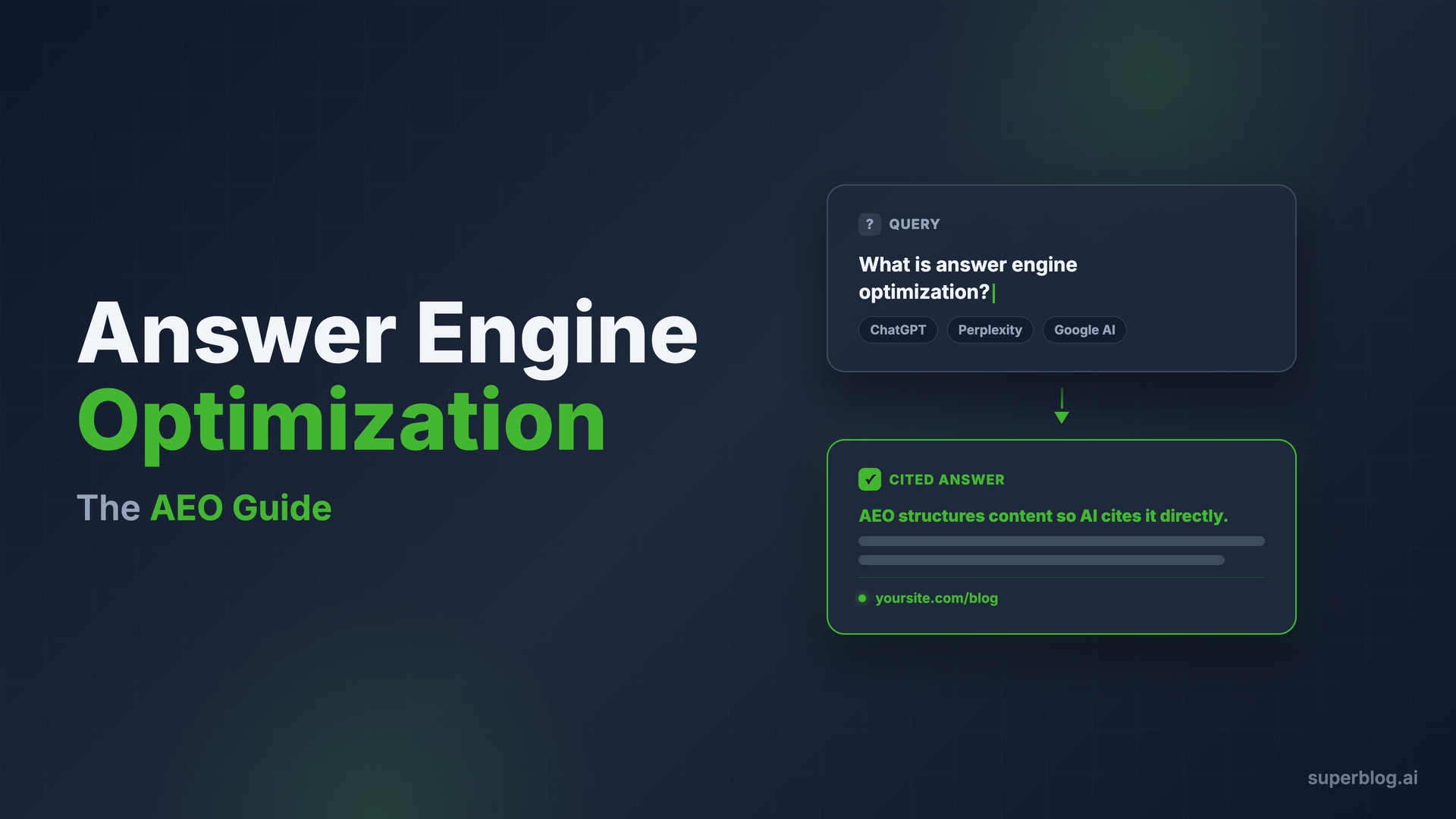
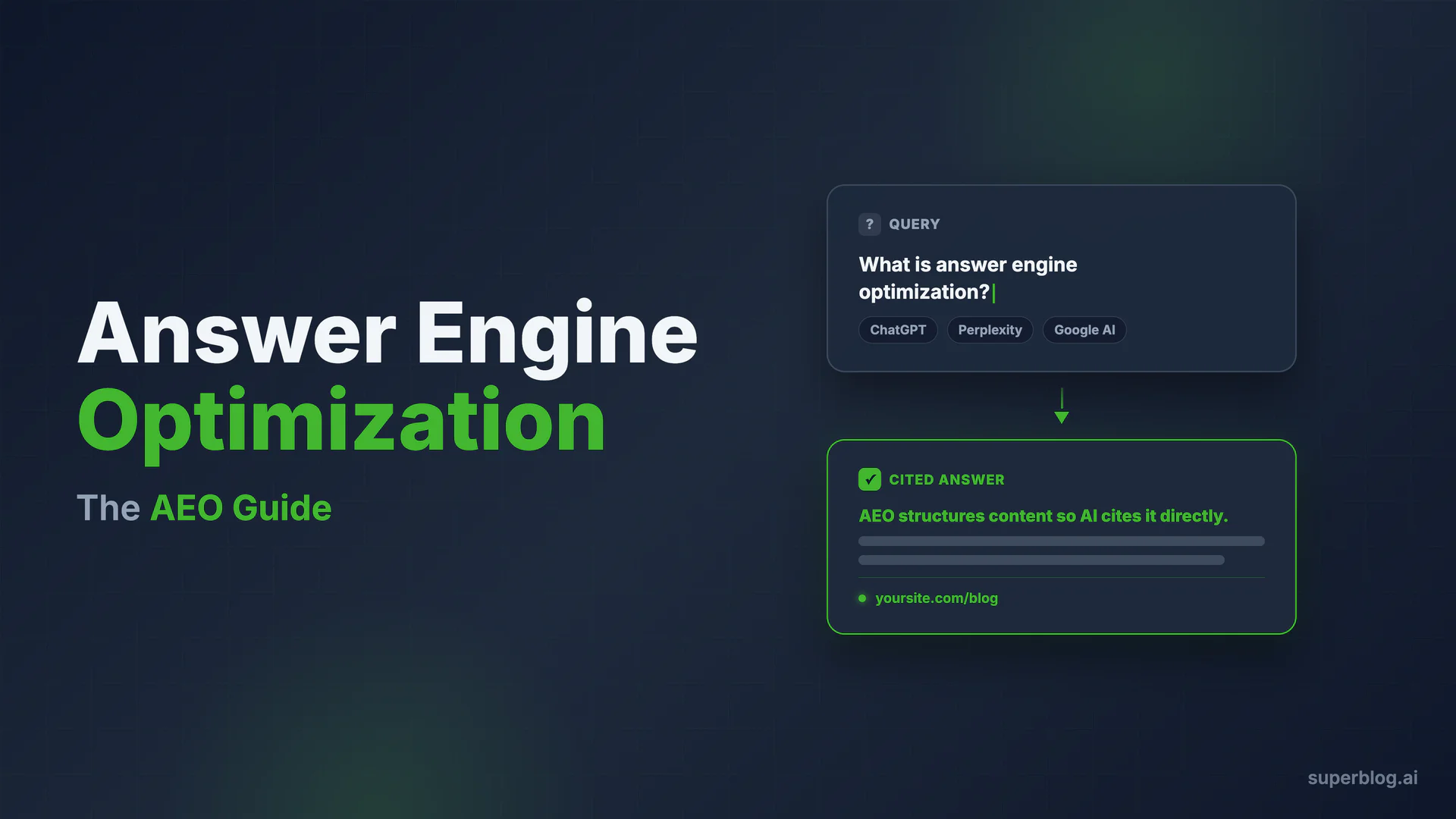
Answer engine optimization is the practice of structuring your blog content so that AI-powered platforms, including ChatGPT, Perplexity, Google AI Overviews, and Claude, select it as the source of a direct answer rather than listing it as a link to click.
Quick answer: Answer engine optimization (AEO) means writing content that AI systems can extract, quote, and cite verbatim, prioritizing clarity, structure, and entity authority over keyword density.
If you have invested in traditional SEO, you already have most of the foundation for AEO. The gap that remains, structure that AI systems can extract and cite verbatim, is where most business blogs are losing ground as AI-driven search continues to grow.
AEO vs GEO vs SEO: The Terminology Finally Explained
Buyers evaluating AI search strategies run into three acronyms constantly. Here is how they actually relate:
The confusion is understandable. All three share the same inputs: authoritative content, structured data, clear writing, and a crawlable site. The difference is in the output they optimize for.
GEO is the dominant and most widely used label today, with academic backing from Princeton and Columbia research coining the term. AEO is an earlier, adjacent label for functionally the same practice. The two terms are often used interchangeably and GEO has become the standard label in the industry. The distinction, where one exists, is mainly in emphasis: AEO carries more association with featured snippets, voice assistants, and direct answer boxes, while GEO encompasses the full range of generative AI platforms including Google AI Overviews, ChatGPT, Perplexity, and Claude.
Both labels cover Google AI Overviews. That platform is a generative engine in every meaningful sense and is grouped under GEO in our generative engine optimization pillar.
In practice, the tactics for GEO and AEO are the same. Both require:
- Answer-first content structure (lead with the answer, then explain)
- Schema markup to signal content type and entity relationships
- Strong entity authority (Google and LLMs need to know who you are)
- Consistent factual accuracy (AI systems penalize contradictory claims)
- Crawl access (if bots cannot reach your content, they cannot cite it)
GEO places higher weight on citation signals like external backlinks, named authors, and training corpus placement. The traditional AEO emphasis on concise definitions, numbered lists, and comparison tables still applies and overlaps completely with GEO best practice.
For business marketers, the practical takeaway is this: the label matters less than the playbook. The tactics below work regardless of which term your team uses.
For a deeper comparison, see GEO vs SEO: What's Actually Different (And What Isn't).
How Answer Engines Choose What to Surface
Understanding the selection process changes how you write. Answer engines are not running a popularity contest. They are solving a retrieval problem: given a user query, which content can be extracted, trusted, and presented as a complete answer without requiring the user to click?
Five factors govern that decision.
1. Structure and scannability
Answer engines process content at scale. Pages with clear H2/H3 headings, short paragraphs, and explicit question-and-answer blocks get parsed more reliably than prose-heavy walls of text. Research by Kevin Indig, published in Search Engine Land and based on analysis of approximately 1.2 million ChatGPT responses, found that 44% of ChatGPT citations come from the first 30% of content. One likely reason: answer extraction rewards pages that state their conclusion up front. Getting to the point fast is not a style preference; it is a retrieval signal.
2. Schema markup
FAQ schema, Article schema, and Organization schema give AI systems structured metadata they can parse without inferring. A FAQPage markup block tells the engine exactly what the question is and exactly what the answer is, in machine-readable JSON-LD. That removes ambiguity, which is what answer engines want eliminated. Blog schema markup is one of the highest-ROI technical investments a business blog can make.
3. Entity clarity
Who wrote this? What company published it? What is this page about? Answer engines build entity graphs to answer these questions. A blog that consistently names its authors, links to the organization it represents, and publishes on a branded domain accumulates entity authority. Blogs that look anonymous or live on generic subdomains (e.g., wordpress.com/yoursite) score lower on entity trust.
4. Crawl access and freshness
AI systems cannot cite content they cannot read. That means no JavaScript-only rendering that search bots cannot execute, no login walls, no aggressive robots.txt blocks on content you want cited. Freshness matters too: answers to evolving topics (pricing, regulations, platform features) are more likely to be sourced from content that signals a recent publish or update date.
5. LLMs.txt
The emerging llms.txt standard lets site owners publish a curated index of their most important pages in a format optimized for AI agents. Adoption is early but growing. See the full guide to LLMs.txt for AI search for implementation details.
The AEO Playbook for Business Blogs (7 Tactics)
These are not abstract principles. Each one is a concrete change you can make to your blog, and for most of them, there is a way to automate the implementation entirely.
Tactic 1: Write answer-first definitions
Every post targeting an informational query should open with a 1-3 sentence definition that answers the query directly. No preamble, no "in this article we'll explore." The definition should be liftable as a standalone answer.
Bad: "Many marketers are wondering how to get their content found in AI search results. In this post, we'll walk through everything you need to know."
Good: "Answer engine optimization is the practice of structuring blog content so AI platforms select it as the source of a direct answer. It combines schema markup, clear writing, and entity authority to replace link clicks with direct citations."
The good version can be extracted verbatim. The bad version cannot.
Tactic 2: Add FAQ blocks with schema
FAQ sections do double duty. They target the "People Also Ask" box in traditional search and trigger FAQPage schema that answer engines parse. Each FAQ block should contain a question searchers actually type (check Google's suggested queries, your own GSC data, or PAA boxes) and a tight answer of 40-80 words.
Structure the FAQ at the end of your post, after the main content has established authority. This is where getting cited by ChatGPT is often won or lost: a well-structured FAQ in schema markup is one of the most reliable citation triggers available.
Tactic 3: Use structured headings that mirror real queries
H2 and H3 headings are content dividers for human readers, but they are also query signals for answer engines. "How does X work?" and "What is the difference between X and Y?" phrased as headings map directly to natural language queries. Pages where headings mirror the questions people ask rank and get cited more consistently than pages with creative but vague section titles.
Tactic 4: Add Article and Organization schema
Article schema tells answer engines the author, publisher, publish date, and content type. Organization schema establishes the entity behind the blog: name, URL, logo, social profiles. Together, they reduce ambiguity and build trust signals.
For business blogs, this means your blog should not just be a collection of pages; it should be a verified entity in the knowledge graph. That requires consistent NAP (name, address, phone) signals where applicable, consistent author attribution, and schema that connects post-level content to the organization publishing it.
Tactic 5: Publish with an LLMs.txt file
An llms.txt file at your blog root curates a reading list of your most important content. Include your highest-authority posts, your product pages, and your core definitions. Exclude low-value utility pages. The file is updated with every deployment and requires no ongoing manual work once configured. See how Superblog handles this automatically on the LLMs.txt feature page.
Use the LLMs.txt Generator tool to create one from your existing content in minutes.
Tactic 6: Optimize for Google AI Overviews specifically
Google AI Overviews tend to pull from pages ranking in the top 10 for a query. That means traditional SEO ranking still gates AI Overview inclusion. But ranking alone is not enough: Google selects the content from within the top results that is most structured, most concise, and most directly answers the query.
The practical implication: if your page already ranks in positions 3-10 for a target query, refreshing the intro with a tight definition block and adding FAQ schema can push it into the AI Overview box without a significant ranking change. AI Overviews optimization has more detail on the exact targeting process.
Tactic 7: Maintain crawl access for AI bots
Several major AI crawlers request content by default unless explicitly blocked. GPTBot (OpenAI's training crawler) and ClaudeBot (Anthropic) are the primary ones to know. For ChatGPT search citations specifically, the relevant crawler is OAI-SearchBot, which is distinct from GPTBot. Google-Extended governs AI training data only and does not affect AI Overview eligibility. Your robots.txt should allow these crawlers unless you have a specific reason to block them. A site that blocks AI crawlers is invisible to the systems it needs to reach.
For content that you want AI systems to cite, blocking indexing is counterproductive. Audit your robots.txt and verify AI crawler access before investing in any other AEO tactic.
How Superblog Automates the AEO Stack
At approximately this point in most AEO guides, the reader faces a list of implementation tasks that require developer involvement, plugin configuration, and ongoing maintenance. That is the actual barrier for most business marketing teams, not understanding what to do.
Superblog is a fully-managed blog platform built to automate the technical layer of AEO and generative engine optimization so your team can focus on the content itself.
Here is what Superblog handles automatically, matched to the tactics above:
Auto JSON-LD schemas (Tactics 2, 4): Every post on Superblog generates Article and Organization schema automatically. FAQ blocks in the editor generate FAQPage schema automatically. There is no schema plugin to configure, no template to customize, and no code to maintain. Rich snippets appear in search results from day one.
LLMs.txt generation (Tactic 5): Superblog generates an llms.txt file at your blog's root path on every deployment. It is updated automatically when you publish or update posts. Toggle it on in Settings > SEO. For subdirectory blogs (yoursite.com/blog), it lives at the correct path automatically.
IndexNow protocol (supports Tactic 6): When you publish a post, Superblog immediately notifies Bing, Yandex, and other IndexNow-supporting engines. This accelerates crawl and index for new content, which helps freshness signals that answer engines weight.
Static HTML served from CDN (Tactic 7): Superblog's JAMStack architecture pre-builds pages as static HTML. There is no JavaScript rendering required for AI crawlers to read your content. GPTBot, ClaudeBot, and GoogleBot all receive a fully-rendered page on first request. This is a significant advantage over WordPress and many headless CMS setups, where AI crawlers may only see an HTML shell.
SERP preview and metadata control (supports all tactics): Every post has a dedicated metadata editor for title, description, canonical URL, and Open Graph tags. Seeing your snippet before you publish lets you optimize for the answer-first format before the page goes live.
Internal link suggestions (supports entity authority): Superblog analyzes your post content and surfaces related posts for internal linking, with suggested anchor text. Strong internal linking builds topical authority, which is one of the entity trust signals that answer engines weight.
90+ Lighthouse score, automatically: Page speed is a ranking signal. Higher rankings improve the probability of appearing in AI Overviews. Superblog delivers 90+ Lighthouse performance scores on every page without requiring any frontend optimization from your team.
Superblog starts at $29/month with a 7-day free trial. No credit card required.
Measuring AEO Performance
Traditional SEO measurement tracks rankings and organic traffic. AEO requires additional signals.
Google Search Console: AI Overviews impressions
Google Search Console now surfaces AI Overview impressions as a separate filter in the Performance report. Look for queries where your page appears in AI Overviews and compare CTR with and without the AI Overview inclusion. In many cases, pages cited in AI Overviews see both higher impression counts and lower CTR (because the answer was delivered without a click). Understanding this tradeoff is important for projecting the business value of AEO investment.
Citation monitoring in Perplexity and ChatGPT
Manual citation checks involve querying your target topics in Perplexity, ChatGPT, and Claude and noting whether your domain appears as a cited source. Tools like Brandwatch, SE Ranking, and Semrush (in beta) are beginning to surface AI citation tracking as a feature. The space is early, but the direction is clear: share of AI citations will become a trackable metric alongside share of voice in traditional search.
Referral traffic from AI platforms
Google Analytics and most analytics platforms now report direct referral traffic from ChatGPT, Perplexity, and other AI tools. Track these as a separate acquisition channel. Early patterns suggest AI-referred visitors convert well, likely because they arrive via a specific answer session rather than a broad query browse. For Superblog specifically, AI assistants are the second-largest discovery channel in our signup survey, which points to meaningful intent in that traffic.
Content performance after AEO updates
When you add FAQ schema or refresh a post with an answer-first definition, compare GSC data 14-28 days before and after the change. Look for increases in featured snippet appearances, AI Overview impressions, and clicks from informational queries. This attribution is imperfect but directionally reliable.
Superblog and Your AEO Strategy
Business marketers who invest in answer engine optimization are building for the medium-term shift already underway: AI-first discovery is becoming the default for a growing share of queries, particularly in B2B, SaaS, and research-heavy buying journeys.
The foundation is a blog that AI systems can read, trust, and cite. That means clean HTML, schema markup, author attribution, and consistent entity signals. On a managed platform like Superblog, all of that is built in and maintained without developer involvement.
The content strategy layer, deciding which queries to target, how to structure answers, and how to maintain topical depth, is where your team's judgment adds irreplaceable value. Superblog handles the infrastructure so you can focus there.
Start your free trial at superblog.ai.
Frequently Asked Questions
What is answer engine optimization?
Answer engine optimization is the practice of structuring content so that AI-powered platforms (ChatGPT, Perplexity, Google AI Overviews, voice assistants) select it as the source of a direct answer to a user's query. It involves writing with an answer-first format, adding FAQ schema, maintaining entity clarity, and ensuring AI crawlers have full access to your content.
How is answer engine optimization different from SEO?
Traditional SEO optimizes for ranked link placement in search results pages. Answer engine optimization (AEO) optimizes for direct answer extraction, where the content is displayed as the answer itself rather than as a link to click. AEO shares most of SEO's technical foundations but emphasizes schema markup, concise definitions, and FAQ structure over keyword density and link acquisition.
What is the difference between AEO and GEO?
Functionally, yes, they are the same practice. GEO (generative engine optimization) is the dominant and most widely used label today, with academic backing and broader industry adoption. AEO (answer engine optimization) is an earlier label for the same discipline, with slightly more emphasis on featured snippets, voice assistants, and Google-specific answer boxes. Both terms cover Google AI Overviews and conversational AI platforms like ChatGPT, Perplexity, and Claude. The two terms are often used interchangeably and the tactics are identical. See GEO vs SEO for the full comparison.
How do I optimize my blog for AI answers?
The core AEO playbook: (1) Write answer-first definitions that open each post. (2) Add FAQ schema to question-and-answer sections. (3) Use H2/H3 headings that mirror actual search queries. (4) Implement Article and Organization schema. (5) Create an LLMs.txt file. (6) Ensure AI crawlers are not blocked in robots.txt. (7) Maintain a fast, static-HTML site that bots can fully render. Platforms like Superblog automate the schema, LLMs.txt, and page speed components automatically.
Is answer engine optimization worth it for business blogs?
Yes, particularly for informational and research-intent queries where your buyers are in discovery mode. Early patterns from marketers tracking this channel suggest AI-referred visitors arrive with high intent, having already received a specific answer before clicking through. The investment in AEO compounds with existing SEO: pages that already rank in the top 10 can gain AI Overview inclusion with targeted structural improvements rather than full rewrites.
Does AEO require a developer?
Not if you are on a platform that handles schema markup, static HTML generation, and LLMs.txt automatically. Manual implementation on WordPress requires plugin configuration (RankMath, Yoast, or custom JSON-LD), theme-level performance optimization, and ongoing maintenance as schema standards evolve. Managed platforms like Superblog generate all required schema automatically on every deploy.
What is an LLMs.txt file and does it help AEO?
An llms.txt file is a machine-readable index of your site's most important content, published at your domain root for AI agents to discover. It is the AI-era equivalent of a curated sitemap. Superblog generates and updates this file automatically. Use the LLMs.txt Generator to create one for your current site.
How does Google AI Overviews selection work?
Google AI Overviews primarily pull from pages already ranking in the top 10 for a given query. Within that set, Google selects the content that is most structured, most directly answers the query, and has the strongest entity and authority signals. Ranking is the entry condition; answer structure is the selection condition. Refreshing top-10 pages with tight definitions, FAQ schema, and answer-first formatting is the most efficient path to AI Overview inclusion. For a full breakdown, see AI Overviews optimization.
Your blog, without the maintenance
Fast pages, automatic SEO, no plugins to patch. Runs on yoursite.com/blog.
Sai Krishna is the Founder and CEO of Superblog. Having built multiple products that scaled to tens of millions of users with only SEO and ASO, Sai Krishna is now building a blogging platform to help others grow organically.
superblog
Superblog is a blazing fast blogging platform for beautiful reading and writing experiences. Superblog takes care of SEO audits and site optimizations automatically.