
AI Visibility: How to Measure and Improve Where AI Engines Mention Your Brand (2026)

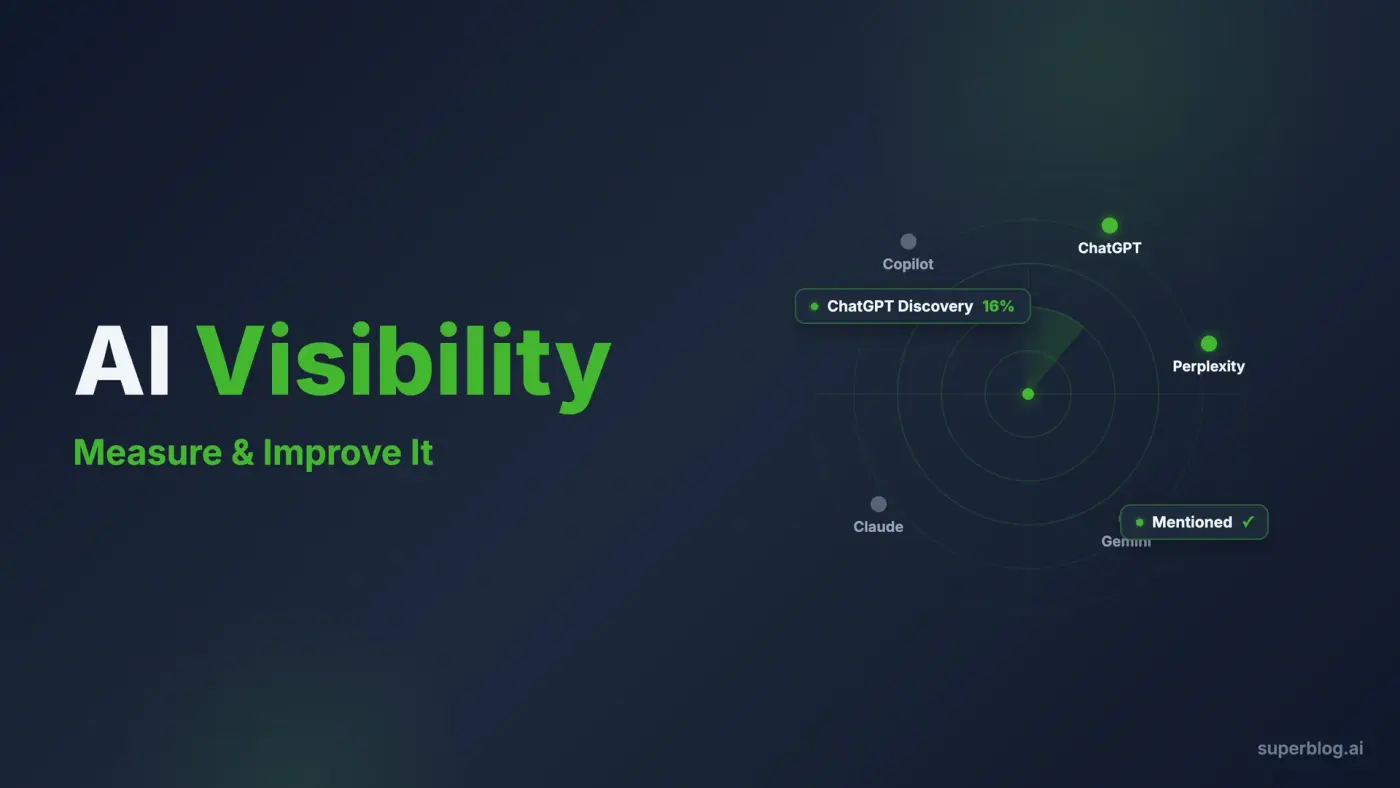
AI visibility is the measure of how often and how accurately your brand appears in responses generated by AI assistants such as ChatGPT, Perplexity, Gemini, and Microsoft Copilot. A brand with strong AI visibility gets mentioned when buyers ask AI engines for recommendations. A brand with low AI visibility is invisible to those buyers, even if it ranks on page one of Google.
Why AI Visibility Is Now a KPI
Buyers are changing how they research. When someone asks "what's the best blog platform for a SaaS company" or "which CRM should I use for a 50-person team," they are increasingly asking ChatGPT or Perplexity first. They collect a shortlist from AI, then validate it with Google or review sites. If your brand is not in the AI answer, you never make the shortlist.
The scale of this shift is real. In Superblog's own signup attribution data, ChatGPT accounts for 16% of new customer discovery, second only to Google, and the share keeps rising every quarter we measure it. AI assistants are now a top discovery channel for B2B buyers, sitting alongside Google organic and word-of-mouth.
The implication is direct: if you track organic traffic, conversion rate, and email signups as KPIs, AI visibility belongs on the same dashboard. It controls whether you are in the consideration set before a buyer ever opens a browser tab.
Related reading: What Is GEO? Generative Engine Optimization for Business Blogs
How to Measure AI Visibility Today
AI visibility measurement is not yet standardized the way Google rank tracking is. You have four practical methods, ranging from free-and-manual to paid-and-automated.
1. Manual Prompt Panels
This is the most accessible method and gives you full transparency into what AI engines actually say.
How to run it:
Build a list of 10 to 20 buyer intent prompts that your target customers would genuinely type into an AI assistant. Examples:
- "What blog platform should I use for a SaaS company?"
- "Best way to add a blog to my existing website"
- "Compare Ghost vs WordPress for a business blog"
- "What tools do content marketers use to publish blog posts?"
Run each prompt across ChatGPT, Perplexity, Gemini, and Microsoft Copilot. Log whether your brand appears, whether it is cited positively or negatively, and which competitors appear alongside or instead of you.
Do this on a monthly cadence. Build a spreadsheet: prompt in column A, then one column per AI engine, marked with "Mentioned," "Not mentioned," or "Competitor only." Month over month, that sheet becomes a visibility trend line.
What to track per prompt:
- Was your brand mentioned? (yes/no)
- Was it cited with a link?
- What context was given (feature mention, recommendation, comparison)?
- Which 3 competitors appeared most?
This takes about 90 minutes a month and costs nothing. It is the baseline every team should run before buying a tool.
2. Google Search Console: AI Overview Impressions
Google now offers a dedicated Generative AI features performance report in Search Console, rolling out from June 2026 to a subset of site owners. In its first version it reports impressions only: no clicks, CTR, position, or query breakdown. Google has also confirmed AI appearances were always folded into your overall performance totals, which means the practical read remains the same whether or not you have the new report yet: pull your top queries quarter over quarter and flag the ones where impressions hold steady or climb while clicks and CTR sink. Those are frequently queries where an AI Overview now answers the question above the results.
This does not tell you if ChatGPT mentions you. It tells you if Google's own AI surfaces your content. Given that Google still drives the majority of search traffic, this is a high-value signal. If your blog posts are cited in AI Overviews, they are likely to be well-structured enough to be cited by other AI engines too.
Watch for: impressions rising while clicks stay flat. That pattern means AI is consuming your content without passing traffic through: confirmation that visibility matters as its own metric, separate from clicks.
Related reading: AI Overviews Optimization: How Blogs Get Cited by Google AI
3. Referral Traffic Patterns
Perplexity sends referral traffic. So does You.com and a handful of newer AI search engines. Check your analytics for referral sources matching perplexity.ai, you.com, and similar AI engine domains. A spike in referrals from these sources is a direct signal that your content is being cited.
ChatGPT and Gemini send far less referral traffic because their interfaces typically present answers inline without requiring a click. Do not use referral traffic alone as a proxy for AI visibility. It undercounts significantly. Use it as a corroborating signal alongside the manual prompt panel.
4. Tracking Tools: Profound and Otterly.ai
Two tools are purpose-built for this:
Otterly.ai monitors your brand across ChatGPT, Perplexity, Google AI Overviews, Google AI Mode, Gemini, and Microsoft Copilot from a single dashboard. You give it a set of prompts, it runs them automatically at a regular cadence, and logs brand mention rates, citation URLs, and competitor share of voice. It is designed as a GEO monitoring platform for teams that want ongoing automated tracking rather than monthly manual checks.
Profound focuses on enterprise AI visibility, with tools for monitoring brand representation in AI responses, analyzing the context of mentions, and identifying which third-party sources are influencing what AI engines say about you. It runs prompts across multiple AI engines and surfaces patterns at scale.
Both tools automate what the manual prompt panel does by hand. If your team is running more than 50 prompts a month or needs to track competitor share of voice systematically, one of these tools earns its cost. If you are just getting started, the manual panel is the right first step.
What Actually Moves AI Visibility
Improving your AI visibility is not one tactic. It is a set of signals that, together, tell AI engines your brand is credible, relevant, and accurately described.
Be in the Comparison and Listicle Corpus
AI engines learn from published content. If your brand appears in a meaningful number of "best X" articles, comparison posts, and roundups written by third parties, AI models pick up those associations. A brand that appears in five comparison articles is more likely to appear in AI responses than one with a great product and no third-party coverage.
This is why review sites, roundup posts, and guest mentions matter more in the AI era than they did before. They train the model.
Related reading: ChatGPT SEO: How to Get Your Blog Cited by ChatGPT
Entity Clarity
AI engines need to know exactly what your brand is. That means consistent naming, consistent descriptions, and consistent categorization across every surface: your own website, your About page, your social profiles, your press coverage, and your review site listings.
If your website calls you "a blogging platform," your G2 profile says "content management system," and your LinkedIn description says "blog software," you are sending conflicting entity signals. Pick one positioning, use it consistently, and propagate it everywhere you can control.
Schema Markup
JSON-LD schema tells AI crawlers the structured facts about your business: what it is, who founded it, what it does, where it operates, what products it offers. Article schema on your blog posts signals that the content is a credible published source. FAQ schema makes Q&A content directly parseable. Organization schema anchors your brand identity.
Schema does not guarantee AI citations, but it reduces ambiguity. An AI engine that can parse your organization schema has better inputs than one left to guess from raw prose.
Related reading: Blog Schema Markup Guide
llms.txt
llms.txt is a markdown file at the root of your domain that lists what content exists on your site. It serves a similar purpose to robots.txt, but for AI agents rather than traditional crawlers.
If you run a blog at yourdomain.com/blog, your llms.txt at yourdomain.com/blog/llms.txt lists your posts and describes your site's purpose.
Related reading: LLMs.txt: Preparing Your Blog for AI Search
Crawl Access
AI engines send their own crawlers: GPTBot (OpenAI), ClaudeBot (Anthropic), PerplexityBot (Perplexity), and Google-Extended (Google's AI training control). If your robots.txt blocks these bots, your content cannot be indexed by the corresponding AI systems. Check your robots.txt and confirm you are not accidentally blocking AI crawlers alongside bad actors.
If you use a CDN or a security layer that blocks unknown bots by default, verify that GPTBot and ClaudeBot are on the allowlist.
Content Freshness
AI models weight recent content. A blog that publishes once a month gives AI engines fresh signals; a blog that last published in 2023 does not. Publishing cadence is a proxy for site health and relevance. The businesses that rank in AI responses tend to have active, recently-updated content libraries.
This is where a consistent publishing schedule, not just one-off posts, creates compounding AI visibility over time.
Third-Party Mentions and Reviews
Get listed on the review sites your buyers use: G2, Capterra, ProductHunt, TrustPilot, or whatever is relevant to your category. Encourage customers to leave reviews. Reach out to bloggers and journalists who cover your space. Offer to be a source for roundup articles.
Each third-party mention is a training signal. Enough of them, with consistent brand framing, builds a strong AI visibility footprint that no amount of on-site optimization can replicate alone.
Related reading: AI SEO: The Complete Guide to Ranking in AI-Powered Search
A 30-Day AI Visibility Improvement Plan
This plan is designed for a business marketer who can invest a few hours a week. It covers the highest-impact actions in the right order.
Week 1: Audit and Baseline
Run your manual prompt panel. Pick 15 buyer intent prompts, run them across ChatGPT, Perplexity, and Gemini, and log the results in a spreadsheet. This is your baseline: the number to beat in 30 days.
At the same time, audit your crawl access. Check your robots.txt for GPTBot and ClaudeBot blocks. Confirm that your llms.txt file exists and is current. If you do not have one, this is the week to create it.
Also run a quick entity audit: Google your brand name, check your G2/Capterra profile, read your LinkedIn description and your About page. Are they saying the same thing? If not, standardize the positioning.
Week 2: Fix the Technical Foundation
This week is execution:
- If robots.txt is blocking AI crawlers, remove those blocks
- If llms.txt does not exist, create it (or confirm your blogging platform generates it automatically)
- If your blog posts lack Article schema and FAQ schema, add them
- Verify Organization schema on your homepage
- Fix any entity inconsistencies you found in Week 1 across your own properties (website, social profiles, Google Business Profile)
These are one-time fixes. They do not require ongoing maintenance after this week.
Week 3: Content and Third-Party Coverage
This week focuses on the corpus signals that train AI engines:
- Identify 5 comparison or listicle posts in your category where you are not mentioned. Reach out to the authors or site owners and ask to be considered for inclusion.
- Publish one blog post that directly answers a common buyer question in your category. Write it with a clear answer in the first paragraph, followed by supporting detail. AI engines favor answer-first structure.
- If you have satisfied customers, ask two or three for a G2 or Capterra review this week.
Week 4: Measure and Repeat
Re-run the manual prompt panel from Week 1. Use the exact same 15 prompts and the same AI engines. Compare the results to your baseline. Note which prompts now include your brand, which competitors still dominate, and what the AI engines are saying about you.
Document the delta. If mention rate improved, identify which change drove it. If it did not, look at whether the Week 2 technical fixes have had time to propagate (AI engine reindexing can take 2 to 4 weeks after a change).
Set a monthly calendar event for the prompt panel going forward. AI visibility measurement is not a one-time audit; it is a recurring KPI.
How Superblog Ships the Technical Half Automatically
The technical foundation for AI visibility (llms.txt, schema markup, crawl access, and content freshness) requires setup and maintenance. For most businesses running a WordPress or custom blog, these are separate tasks that require developer time or plugin configuration.
Superblog handles the technical half automatically on every blog it powers.
llms.txt: Superblog generates a machine-readable llms.txt file at your blog's root path automatically. When you publish a new post, the file updates on the next deploy. You do not configure it; it is on by default. For blogs hosted at yoursite.com/blog, the file lives at yoursite.com/blog/llms.txt.
Schema markup: Every post published through Superblog gets Article JSON-LD automatically. Posts with FAQ blocks get FAQ schema. Organization schema is generated from your site settings. You write the content; Superblog generates the structured data that makes it parseable by AI crawlers.
Crawl access: Superblog's JAMStack architecture serves pre-built static pages from a global CDN. There are no server-side blocks or security layers that accidentally lock out AI crawlers. GPTBot and ClaudeBot can reach your content.
Content freshness: Superblog integrates IndexNow, which notifies Bing, Yandex, and other supporting search engines the moment you publish. For AI engines that crawl frequently, fresh content is discoverable faster.
Publishing cadence: The Superblog editor, scheduling tools, and team collaboration features are built to support a consistent publishing rhythm. A blog that publishes three posts a week through Superblog gives AI engines three fresh signals a week. The cadence compounds over time into a stronger AI visibility footprint.
The result is that when you write a well-structured post on Superblog, the technical signals AI engines need to cite it are already in place. The content work is yours. The infrastructure is handled.
Try Superblog free for 7 days at superblog.ai.
You can also generate your llms.txt file right now with our free tool: LLMs.txt Generator
FAQ
What is AI visibility?
AI visibility is how often and how accurately your brand appears in AI-generated responses from engines like ChatGPT, Perplexity, Gemini, and Microsoft Copilot. It is distinct from traditional search visibility: a brand can rank #1 on Google and still be absent from AI responses, because the two systems draw on different signals.
How do I check if ChatGPT mentions my brand?
Open ChatGPT and ask a buyer-intent question in your category, such as "what's the best [your product type] for [your customer type]?" Repeat with variations. If your brand does not appear across 10 to 15 relevant prompts, your AI visibility is low. For a more systematic check, run a prompt panel across ChatGPT, Perplexity, and Gemini, log the results, and repeat monthly. Tools like Otterly.ai automate this at scale.
How do I improve AI search visibility?
Start with the technical foundation: add llms.txt, add Article and FAQ schema to your blog posts, and confirm AI crawlers are not blocked in your robots.txt. Then address the corpus: get your brand mentioned in third-party comparison articles, roundups, and review sites. Publish fresh content on a regular cadence. Entity clarity matters too: make sure your brand is described consistently across every public surface. Technical changes typically need a few weeks to propagate before they show up in prompt panels.
What is the difference between AI visibility and SEO visibility?
SEO visibility measures how often your pages appear in traditional search engine results pages (Google, Bing). AI visibility measures how often your brand appears in AI-generated answers. The two overlap but diverge significantly: Google's ranking algorithm weights backlinks and on-page signals heavily; AI engines weight how the brand appears in published content across the web, how consistently it is described, and how well-structured the technical signals are. A page that ranks #5 for a keyword may or may not appear in AI responses about that topic. Both KPIs matter.
Does having a blog improve AI visibility?
Yes, significantly. A blog gives AI engines a stream of fresh, structured content associated with your brand. Posts that answer common buyer questions directly become citable sources. FAQ content with proper schema generates parseable Q&A data. And a consistent publishing cadence signals that your domain is active and current. A blog that publishes regularly on topics relevant to your category is one of the highest-impact investments for improving AI visibility over time.
How long does it take to improve AI visibility?
Technical fixes (llms.txt, schema, crawl access) typically take 2 to 4 weeks to propagate through AI engine reindexing. Content and corpus changes (new posts, third-party mentions, reviews) take longer, typically 4 to 8 weeks before the signal shows up in prompt panels. The 30-day plan in this article is realistic for seeing early movement. Sustained improvement requires a 3 to 6 month horizon.
Do I need a paid tool to track AI visibility?
No. A manual prompt panel costs nothing and takes 90 minutes a month. It is the right starting point for most businesses. Paid tools like Otterly.ai and Profound are worth evaluating once you need automated tracking across many prompts, competitor share-of-voice comparisons, or team reporting. Start manual, move to tools when the manual process creates a bottleneck.
Your blog, without the maintenance
Fast pages, automatic SEO, no plugins to patch. Runs on yoursite.com/blog.
Sai Krishna is the Founder and CEO of Superblog. Having built multiple products that scaled to tens of millions of users with only SEO and ASO, Sai Krishna is now building a blogging platform to help others grow organically.
superblog
Superblog is a blazing fast blogging platform for beautiful reading and writing experiences. Superblog takes care of SEO audits and site optimizations automatically.