
AI SEO: The Complete Guide for Business Blogs (2026)

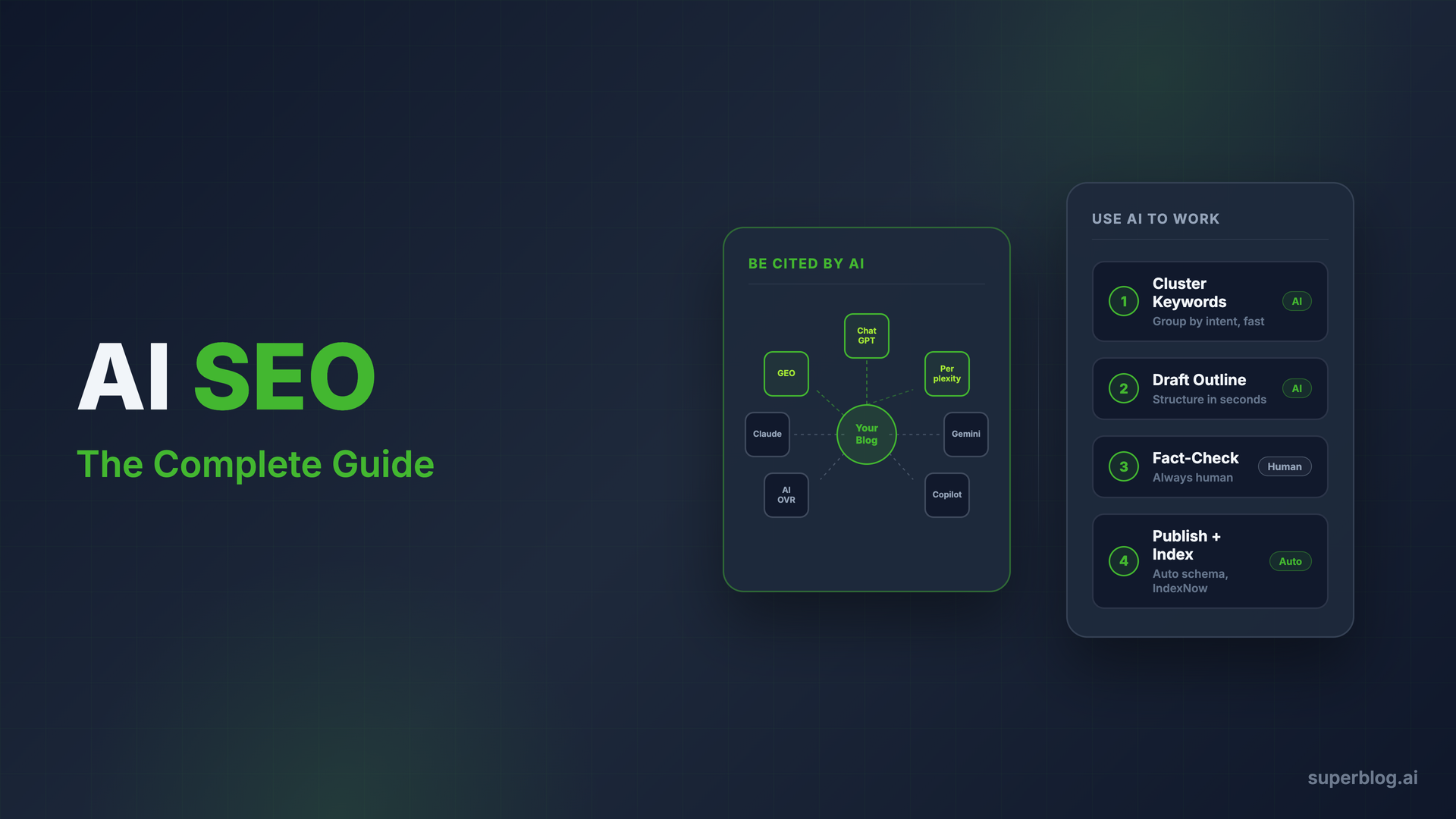
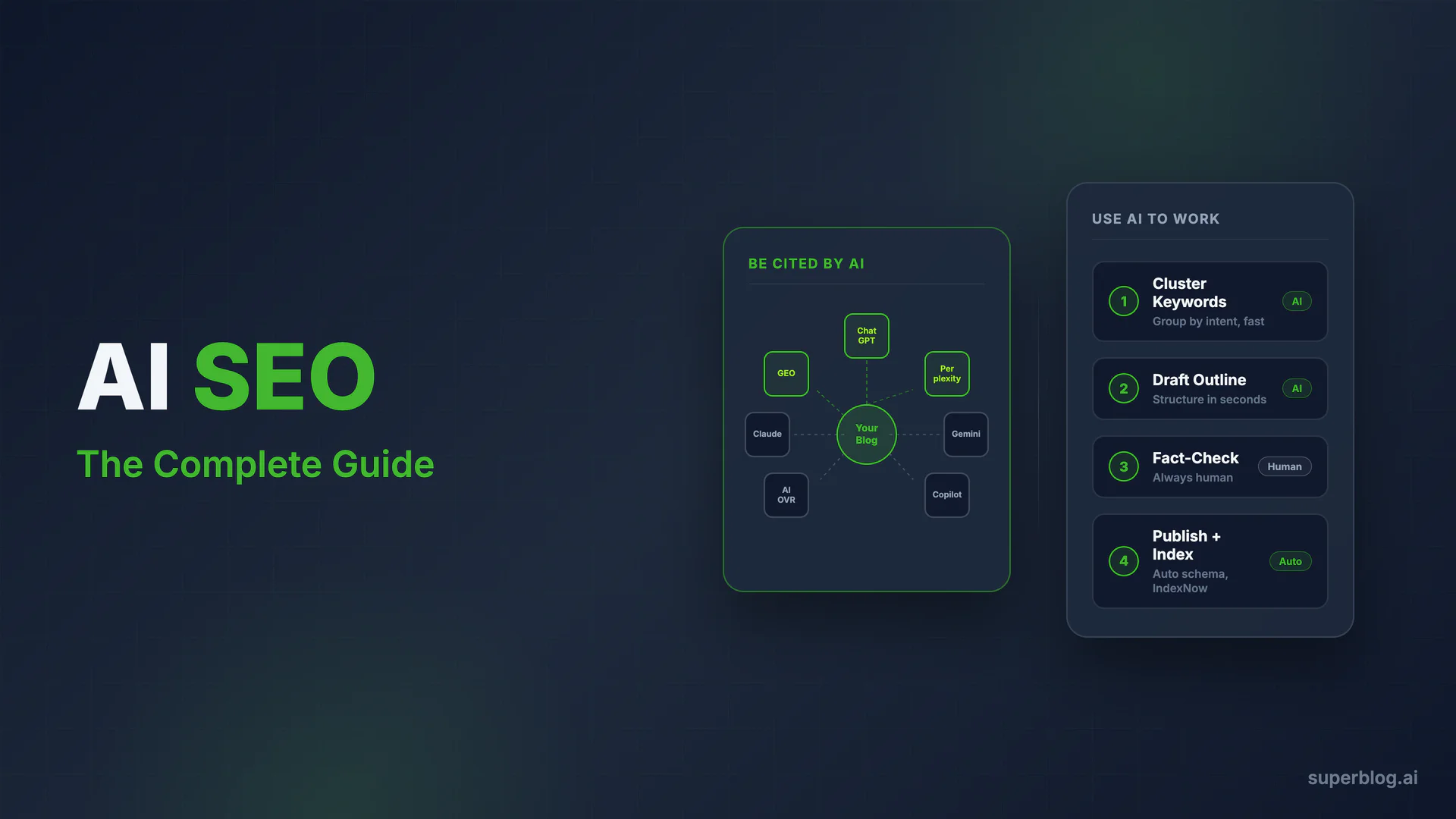
AI SEO means two different things, and confusing them leads to bad strategy.
Meaning one: optimizing your content so AI-powered search engines, chatbots, and answer engines cite it. ChatGPT, Perplexity, Google AI Overviews, Claude, Gemini. You want your blog to show up when these systems answer questions in your niche.
Meaning two: using AI tools to do your SEO work faster. AI writing assistants, keyword clustering tools, automated meta descriptions, AI-generated outlines.
Both are real. Both matter. But they require different tactics, and they deliver different results. This guide covers both, starting with the one that is changing how businesses get discovered right now.
The optimize-for-AI-engines half has a settled industry label: GEO (Generative Engine Optimization). Read our full GEO guide for a deep dive into the mechanics.
Why AI SEO Matters for Business Blogs in 2026
Search behavior has split into two parallel channels.
The first channel is traditional Google: ten blue links, users click, users land on your site. This still drives the majority of search traffic, and it still requires the same fundamentals: well-structured content, clean technical SEO, authoritative backlinks.
The second channel is AI-generated answers: a user types a question into ChatGPT, Perplexity, or Google's AI Overviews, and gets a synthesized response that may cite two or three sources. No ten results. One answer, with citations.
That second channel is growing fast, and it changes who gets traffic and who does not.
Superblog's own signup data tells a clear story: ChatGPT is already the second-largest discovery channel for the platform, accounting for roughly 1 in 6 new signups. Visitors referred by AI assistants arrive knowing the product, understanding the problem it solves, and ready to evaluate it seriously. That is not a coincidence. It is what happens when an AI engine cites your content accurately and in context.
For business blogs, AI SEO is now a revenue question, not just a marketing question.
Part 1: Optimizing Your Blog for AI Engines
This is where the leverage is highest for most business blogs. If AI engines cannot find, read, and cite your content, you are invisible to a growing slice of your potential customers.
How AI Engines Select Sources to Cite
Large language models like GPT and Claude do not crawl the web the way Google does. They learn from training data (a snapshot of the web) and, for real-time tools like ChatGPT Search and Perplexity, they also run live retrieval against indexed sources.
When an AI engine decides which sources to cite in a response, several factors influence the selection:
Crawl access. AI crawlers must be able to access your pages. Many blogs block these crawlers in robots.txt without realizing it. If they cannot read your content, they cannot cite it. The crawlers serve distinct purposes: OAI-SearchBot governs ChatGPT search citations; GPTBot is OpenAI's training crawler only and does not affect ChatGPT search. ClaudeBot is Anthropic. PerplexityBot is Perplexity. Google-Extended covers Google AI training only and has no effect on AI Overviews eligibility, which draws from normal Googlebot ranking. Separate from these training and search crawlers, user-initiated fetchers such as ChatGPT-User and Claude-User power agentic browsing, where the assistant visits a page live on a user's behalf instead of citing from an index. See our guide to AI crawlers for a full breakdown of which bots to allow and how to configure access.
Content clarity and structure. AI models extract answers from text. Long, dense paragraphs with buried answers are harder to extract from than content with clear question-answer structure, defined sections, and explicit definitions. The opening paragraph of a piece often determines whether it gets cited verbatim.
Entity clarity. AI engines operate on entities, not just keywords. Your blog should clearly state who you are, what your company does, what industry you operate in, and what specific topics your content covers. Ambiguity works against you.
Schema markup. Structured data tells machines what your content is about before they parse a single sentence. Article schema, FAQ schema, BreadcrumbList, and Organization schema all increase the interpretability of your pages. Without schema, AI engines have to guess, and they often guess wrong.
Freshness signals. AI-powered tools prioritize recent, updated content. A post with a 2024 publish date and no updates signals staleness. Refreshing high-value posts with new data, updated statistics, and a current review date is a direct lever for AI citation rates.
Domain authority and citation history. AI engines learn which sources are reliable in part by how often those sources are cited by other authoritative content. A blog that is already being linked to and referenced across the web has a head start.
LLMs.txt. This is a relatively new but increasingly important signal. LLMs.txt is a machine-readable file at /llms.txt on your domain that provides a structured summary of your content, site purpose, and key topics, formatted specifically for AI consumption. Think of it as a sitemap for AI engines. Superblog generates and updates your LLMs.txt automatically on every deploy. You can also build one for any domain using the LLMs.txt Generator.
For a deeper look at how generative engines work and what makes content citable, read our GEO guide and the GEO vs SEO comparison.
Answer-First Content Structure
The single highest-leverage change most business blogs can make is restructuring content to lead with the answer.
Traditional SEO content often buries the answer after context-setting paragraphs, background sections, and qualifications. This made sense when users would scroll through a page. It works against you when an AI engine is scanning for a citable sentence.
Answer-first structure means:
- The definition or direct answer appears in the first 1-2 sentences of each section
- H2 headings are written as questions or clear descriptive statements, not clever wordplay
- Key claims are stated plainly, then supported with evidence
- Definitions appear at the top of the piece, not after a long wind-up
This article opens with a direct definition of AI SEO for exactly this reason. That opening paragraph is written to be cited by a language model answering "what is AI SEO."
Optimizing for Specific AI Engines
Different AI engines have different retrieval behaviors. A brief breakdown:
ChatGPT Search (OpenAI). Uses Bing's index as its retrieval layer. Being indexed and ranking in Bing is a prerequisite. High-quality, frequently updated content on clearly defined topics performs well. For a step-by-step approach, read how to get your blog cited by ChatGPT.
Google AI Overviews. Draws heavily from Google's existing index. Pages that already rank in positions 1-10 for a query have the highest probability of being selected for the AI Overview. Schema markup, clear definitions, and FAQ blocks all improve selection rates. Full breakdown in our AI Overviews optimization guide.
Perplexity. Runs its own crawler (PerplexityBot) and retrieves content in near-real-time. Perplexity favors concise, well-structured content with clear citations and data. Pages that cite primary sources and include specific statistics tend to perform better.
Claude and Gemini. Training data and tool-use retrieval. For Claude-powered tools using web retrieval, the same principles apply: clean structure, crawl access, schema. Claude particularly favors content with clear entity relationships and explicit factual claims.
What is LLMO? You may also see the term LLMO (Large Language Model Optimization) used interchangeably with GEO. For a full definition, read what LLMO means.
Part 2: Using AI in Your SEO Workflow
This is the other meaning of AI SEO, and it is where most blog teams spend most of their time. AI tools have genuinely changed what a small content team can produce. But the productivity gains are unevenly distributed.
Where AI Delivers Real Value
Keyword clustering and research. AI tools are good at grouping large keyword lists by intent, identifying semantic relationships between terms, and flagging cannibalization risks. A task that once took hours now takes minutes. The clusters still need human judgment to prioritize, but the raw grouping work is largely automatable.
Outline generation. Given a target keyword and some context about your audience, AI can produce a usable content outline in seconds. The outline needs editing. The section order needs thinking. But having a starting structure accelerates the writing process significantly.
Meta title and description drafting. Writing 50 variations of a meta title to A/B test is a task AI handles well. It is repetitive, constrained by character limits, and does not require original insight.
Content refreshes. Identifying which sections of an existing post are outdated, flagging statistics that need updating, and rewriting specific paragraphs with fresh data is a high-leverage use of AI. It is much faster than rewriting from scratch.
Internal link suggestions. AI can scan a new piece, identify the topics covered, and surface related posts on your blog that should be linked. This is genuinely useful because internal linking gets inconsistent fast when you are publishing frequently. (Superblog's internal link suggestions tool does this natively, without requiring a separate AI subscription.)
Where AI Falls Short
Original research and data. AI cannot conduct user interviews, run surveys, or pull proprietary analytics. Content that cites original data is what gets cited by other content and by AI engines. This is work only humans can do.
Competitive differentiation. If every blog in your niche is using the same AI tool with the same prompts, the output converges toward the same structure and the same talking points. AI-generated content without editorial intervention is quickly becoming the average quality floor, not the ceiling.
Brand voice. AI tools produce competent prose. Competent is not distinctive. The voice that builds an audience, earns repeat readers, and makes your content recognizable requires human editorial judgment.
Accuracy on specialized topics. AI models hallucinate facts, cite outdated statistics, and confidently state things that are wrong. Any AI-drafted content on technical or specialized topics needs verification before publishing. Publishing an error damages your credibility with both readers and AI engines that use your site as a training source.
The practical takeaway: use AI to accelerate structure, research triage, and drafting velocity. Do not outsource accuracy, differentiation, or voice to it.
The AI SEO Stack: What to Automate vs. Do Manually
The pattern is consistent: structural and technical SEO tasks are good candidates for automation. Anything that requires accuracy, judgment, or originality stays with humans.
How Superblog Handles AI SEO Automatically
Most of the technical AI SEO work described in Part 1 is infrastructure work. It needs to be done correctly, it needs to stay current, and it needs to be consistent across every page on your blog. That is exactly the kind of work that falls apart when it depends on a developer remembering to do it.
Superblog is built to handle this layer automatically, so your team focuses on content.
LLMs.txt, generated and maintained. Every Superblog blog gets a /llms.txt file generated automatically and updated on every deploy. You can toggle it on or off in Settings, but most customers leave it on. It is one of the few signals that directly targets AI discovery rather than traditional search.
Auto JSON-LD schemas on every page. Article schema, FAQ schema, Organization schema. All generated automatically for every post. No plugin configuration, no manual insertion. This matters for both traditional SEO and AI engine interpretability. Machines reading your pages get structured context about what the content is and who produced it.
IndexNow on every publish. When you publish or update a post, Superblog automatically sends an IndexNow notification to Bing, Yandex, and other participating search engines. Faster indexing means fresher content gets into retrieval pools sooner. For a content team publishing frequently, this adds up.
90+ Lighthouse score, automatically. Page speed is a ranking factor for traditional search and a trust signal for crawlers. Slow pages get deprioritized. Superblog's JAMStack architecture delivers pre-built static pages from a global CDN with 200+ edge locations, with sub-1-second first contentful paint on every page. No optimization work required.
Internal link suggestions. Superblog analyzes your post content and surfaces related posts from your blog with suggested anchor text. Publishing frequently makes internal linking hard to do consistently. The suggestions tool handles the discovery work so editors just make the final call.
Crawl access by default. Superblog blogs do not block AI crawlers. OAI-SearchBot (ChatGPT search citations), GPTBot (OpenAI training), ClaudeBot, PerplexityBot, and Google-Extended (Google AI training) can all access your pages. This is table stakes for AI SEO, and it is configured correctly from day one without any manual robots.txt editing.
Multilingual SEO (Super plan). Content in 41 languages, with proper hreflang tags, subdirectory URL structure, and per-language sitemaps. AI engines increasingly serve multilingual queries. Being indexed in the languages your customers use is a direct expansion of your AI SEO surface area.
Marie Ng, founder of Llama Life, put it clearly: "Was looking for a tool which could optimize SEO from a technical standpoint, so we could focus our efforts on writing good content. Superblog is perfect for this."
That is the intended split. Superblog handles the technical layer. Your team handles the content.
Plans start at $29/month. All plans include LLMs.txt, auto-schema, IndexNow, sitemap generation, CDN hosting, and custom domain. Start a free 7-day trial without a credit card.
Related Reading
- What Is GEO? Generative Engine Optimization for Business Blogs
- GEO vs SEO: What's Actually Different
- How to Get Your Blog Cited by ChatGPT
- AI Overviews Optimization
- What Does LLMO Mean?
- AI Crawlers Guide: GPTBot, ClaudeBot, and More
- LLMs.txt and AI Search
- Blog Schema Markup Guide
- LLMs.txt Generator
Frequently Asked Questions
What is AI SEO?
AI SEO refers to two related practices. The first is optimizing your content so AI-powered search engines and chatbots (ChatGPT, Perplexity, Google AI Overviews, Claude) cite it in their responses. The second is using AI tools to do SEO work faster, such as keyword research, content outlines, and meta descriptions. Both fall under the "AI SEO" label, but they require different tactics. Optimizing for AI engines is about structure, schema, crawl access, and answer-first content. Using AI for SEO is about workflow acceleration with human oversight on accuracy and voice.
Does AI actually help SEO?
Yes, for specific tasks. AI tools accelerate keyword clustering, outline drafting, meta title generation, and content refresh identification. These are real time savings. However, AI cannot conduct original research, verify facts reliably, or produce content that is meaningfully differentiated from competitors using the same tools. The most effective approach treats AI as a workflow accelerator for structured tasks, while keeping research, fact-checking, and editorial judgment with humans.
How do I optimize my blog for ChatGPT and AI search?
The core requirements are: allow AI crawlers in your robots.txt, including OAI-SearchBot for ChatGPT search citations (GPTBot is OpenAI's training crawler and does not govern citation eligibility), ClaudeBot, and PerplexityBot. Add LLMs.txt to your domain, implement Article and FAQ schema on every post, structure content with clear definitions and answer-first openings, and keep content fresh with updated dates and current data. For ChatGPT specifically, Bing indexing matters because ChatGPT Search uses Bing's retrieval layer. Our full guide on getting cited by ChatGPT covers each step.
Is SEO dead because of AI?
No. Traditional search still drives the majority of web traffic, and the same fundamentals that have always driven rankings still apply: clear content, authoritative sources, fast pages, structured data. What has changed is that a meaningful and growing slice of discovery now happens through AI-generated answers rather than ten blue links. Businesses that ignore this channel leave citations and signups on the table. The practical answer is that SEO now has two tracks, not one.
What is the difference between AI SEO and traditional SEO?
Traditional SEO targets Google's ranking algorithm: keyword relevance, backlinks, page speed, user experience signals. AI SEO targets the retrieval and citation mechanisms of generative AI systems: crawl access for AI bots, LLMs.txt, structured schema, answer-first content structure, entity clarity. The technical foundations overlap heavily. The differences are at the edges: traditional SEO cares about keyword density and anchor text; AI SEO cares about citability, entity relationships, and machine-readable structure. Running both tracks in parallel is the current standard.
How do I know if AI engines are sending me traffic?
Check your analytics for referrers containing chat.openai.com, perplexity.ai, bing.com/chat, and gemini.google.com. Many platforms also show "AI assistant" or "chatbot" as a traffic source category. Set up UTM tracking on your key landing pages so you can distinguish AI-referred visits from direct traffic. Superblog's analytics integration supports Google Analytics and privacy-friendly Pirsch, both of which capture referrer data.
What is LLMs.txt and why does it matter for AI SEO?
LLMs.txt is a machine-readable file hosted at /llms.txt on your domain. It provides a structured markdown summary of your site, content, and key topics, formatted for AI consumption rather than human readers. Think of it as a sitemap for AI engines. Superblog generates and updates LLMs.txt automatically. For any other platform, use the LLMs.txt Generator.
What is "AI search optimization" vs "SEO for AI"?
These terms are used interchangeably with AI SEO and GEO (Generative Engine Optimization). "AI search optimization" usually refers to optimizing content for AI-powered search interfaces. "SEO for AI" sometimes means the same thing, but also sometimes refers to optimizing for AI Overview inclusion specifically. All three phrases describe variations of the same core practice: making your content more citable and visible to AI-powered discovery channels.
Your blog, without the maintenance
Fast pages, automatic SEO, no plugins to patch. Runs on yoursite.com/blog.
Sai Krishna is the Founder and CEO of Superblog. Having built multiple products that scaled to tens of millions of users with only SEO and ASO, Sai Krishna is now building a blogging platform to help others grow organically.
superblog
Superblog is a blazing fast blogging platform for beautiful reading and writing experiences. Superblog takes care of SEO audits and site optimizations automatically.