
AI Overviews Optimization: How Blogs Get Cited by Google AI

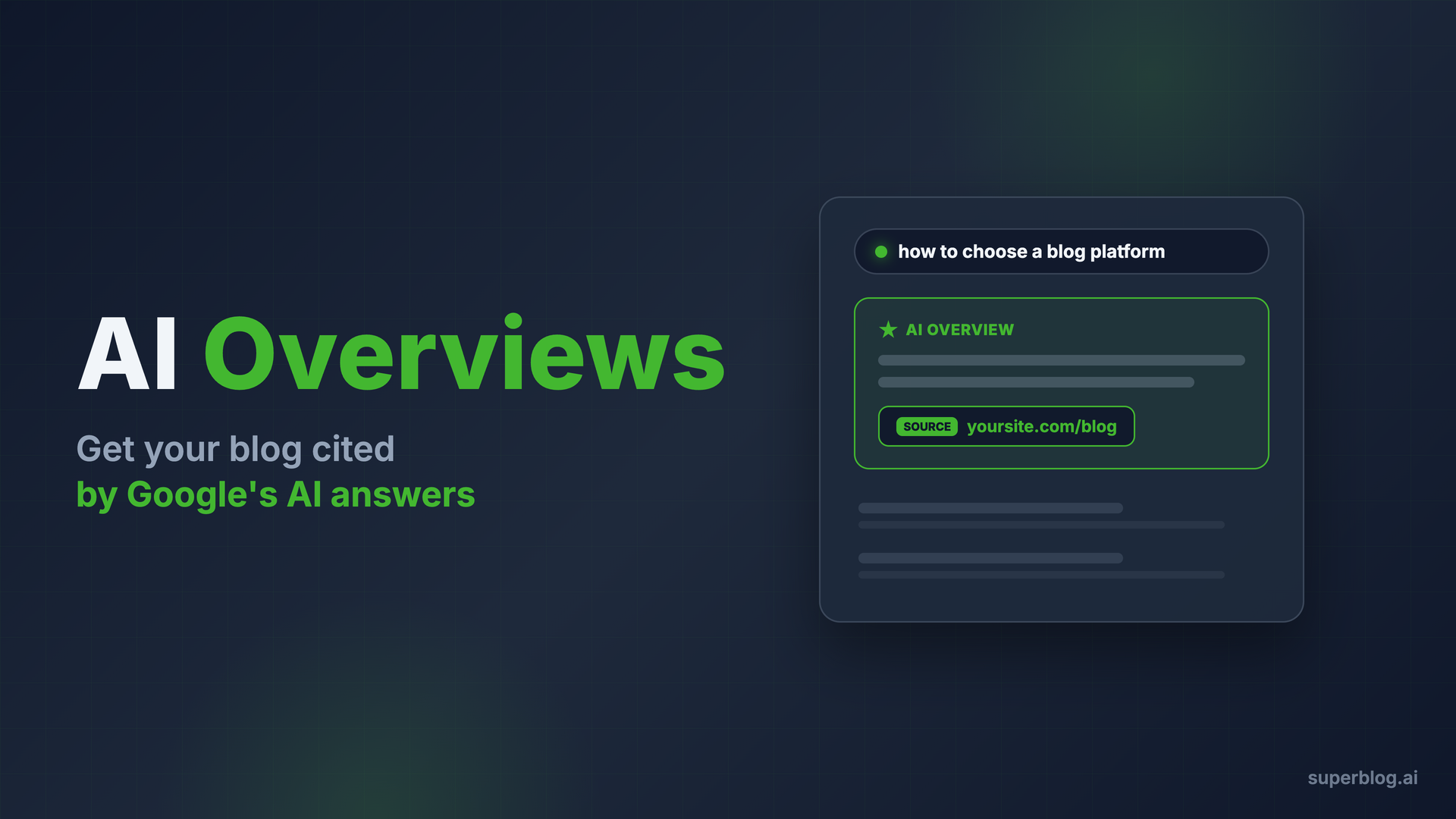
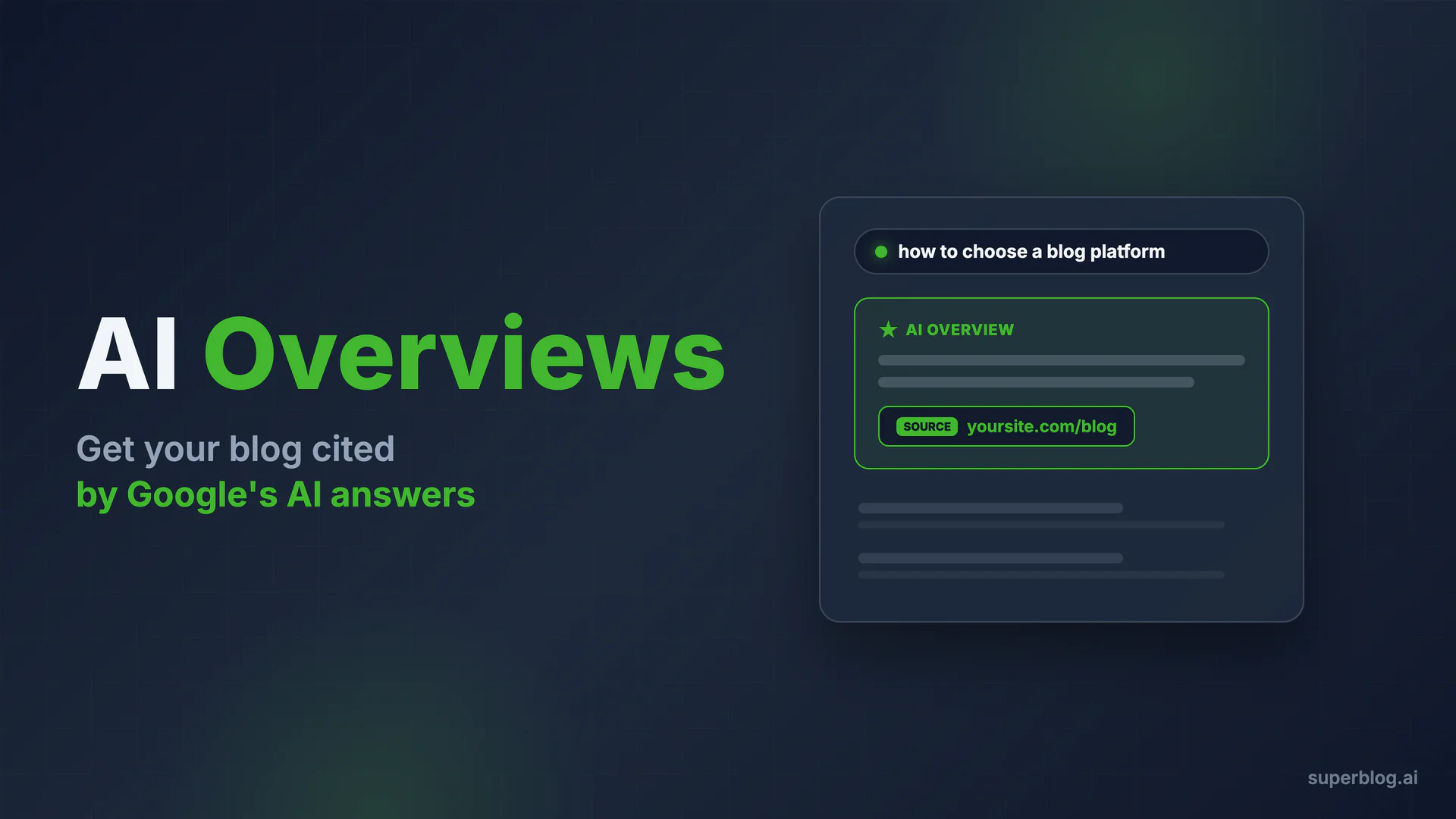
Google's AI Overviews cite pages that do two things at once: rank in the classic results for the query, and contain a passage that directly answers it. There is no separate AI index to optimize for. AI Overviews optimization is ranking plus extractability: strong fundamentals, question-shaped headings with direct answers underneath, schema that labels what everything is, and content fresh enough to trust.
This post covers what triggers AI Overviews, how Google selects the cited sources, and what to change on your blog. It completes our GEO cluster alongside the generative engine optimization pillar and the ChatGPT SEO guide.
What AI Overviews are and when they appear
An AI Overview is the generated answer block Google places above the organic results: a few paragraphs synthesized from multiple sources, with citation links alongside or inside the text.
They appear most on informational queries: definitions, how-tos, "why" and "what" questions, and research-stage comparisons. They appear least on navigational queries, local queries, and transactional queries where Google makes ad revenue from clicks. Your blog lives almost entirely in the first category, which is why blogs feel this shift before any other page type.
The mechanism behind them matters for optimization. Google grounds the overview in its existing search systems: it retrieves ranking documents for the query, extracts relevant passages, and composes the answer from those passages. This is the successor to the featured snippet pipeline, generating a paragraph from several sources instead of quoting one. Everything that won snippets still applies. It is just no longer sufficient on its own.
The CTR problem, measured
AI Overviews absorb clicks from the results below them. We have watched this in our own Search Console data: pages holding steady at positions 8 through 11 with thousands of impressions and a click-through rate under 0.1 percent. The ranking did not decay. The clicks went to an answer assembled above the results.
That is the trade the whole industry is absorbing: impressions hold, clicks compress, and the value concentrates into either being the cited source or being invisible. There is no longer a comfortable middle where position 8 quietly collects traffic.
So the goal splits in two: become the source AI Overviews cite, and rebalance your content portfolio toward queries where readers still click through.
How Google picks the cited sources
Google has not published a specification, but observed behavior across studies and our own tracking is consistent:
- Cited pages usually rank. Most citations come from pages in the top organic results for the query or a close variant. AI Overviews optimization without rankings is not a real strategy.
- Passages get selected, not pages. The overview is stitched from extractable passages. A page that buries its answer in paragraph twelve loses to a page that answers under the heading, even at a lower position.
- Structure labels win extraction. Schema tells Google what a page is, who published it, and when it changed. Tables and lists give it pre-organized facts. Both raise the odds a passage is used and attributed. Our schema markup guide covers the exact markup.
- Corroboration counts. The generated answer synthesizes several sources. Claims that align with the consensus get woven in with a citation. A unique angle supported by specific data gets cited as the source for that specific point.
- Fresh content is preferred. Overviews on evolving topics favor recently updated pages with honest dateModified values.
Optimizing your blog for AI Overviews
Write question-shaped headings with direct answers
Turn your H2s into the questions people actually ask, and put a 40 to 60 word direct answer immediately below each one before elaborating. This single pattern does the most work per hour invested: it is the shape passage retrieval selects for, and it improves the reading experience for humans skimming the page.
Give Google structured facts
Comparative claims go in tables. Sequential instructions go in numbered lists. Terms get defined in clean two-sentence blocks. The overview generator assembles answers from parts, and content that arrives pre-assembled gets used.
Ship complete schema
Article schema with author, publisher, datePublished, and dateModified. FAQ schema where you answer common questions. Breadcrumb and Organization schema so the entity behind the content is unambiguous. This is identical to the ChatGPT playbook because every answer engine needs the same thing: machine-readable certainty about what it is reading and who wrote it.
Keep winning pages current
An AI Overview citation is not permanent. Sources rotate as content ages. Put your cited and near-cited pages on a refresh schedule: update the data, revise the answer blocks, and let dateModified reflect real changes.
Stay fast and crawlable
Overview sources come from the index, and the index rewards pages that render complete HTML instantly. A static page served from a CDN gets crawled more often, indexed faster, and re-checked more reliably than a page assembling itself with JavaScript on a shared host.
Surviving the click compression
Optimization gets you cited. Portfolio strategy keeps your traffic alive. Three moves:
Shift weight toward decision queries. "What is a blog CMS" now ends in an AI Overview. "Superblog vs WordPress pricing" still earns the click, because readers verify decisions with sources before spending money. Audit your content plan for the informational-to-decision ratio and rebalance new production toward comparisons, alternatives, and evaluation content.
Build the brand the answer engines mention. When an AI Overview names your product, a share of readers search your brand directly afterward. Branded queries are AI-proof: those searchers want you, not an answer. Citations are a brand awareness channel even when nobody clicks the link.
Cover the whole AI answer layer, not just Google. The same structural work that wins AI Overviews wins ChatGPT, Perplexity, and Claude citations. Publish an llms.txt file so those engines index your content cleanly. You can generate one free from your sitemap in about a minute.
Where the platform does the work
Half of this playbook is editorial: question-shaped headings, direct answers, tables, original data. No platform writes that for you.
The other half is infrastructure, and Superblog ships it as the default:
- Core schema types, generated automatically on every post: Article, FAQ, Organization
- FAQ blocks in the editor that produce FAQ schema without touching code
- Static pages with 90+ Lighthouse scores served from a global CDN, crawled and re-indexed without friction
- IndexNow on every publish and llms.txt regenerated on every deploy, covering Bing and other supporting search engines
- Subdirectory hosting at
yoursite.com/blog, so every citation and every ranking compounds one domain's authority
Teams on WordPress assemble this from five plugins and hope the schema plugin survives the next update. Teams on Superblog write the answer blocks and publish.
Measuring AI Overview impact
Search Console does not label AI Overview traffic, but the signature is readable:
- Position stable, CTR falling on informational queries: an overview is now absorbing clicks above you. Check the SERP manually to confirm.
- Impressions rising, clicks flat on question queries: you may be appearing as an overview citation, which registers impressions without proportional clicks.
- Branded queries climbing while non-branded clicks stagnate: readers are meeting you inside AI answers and searching for you afterward.
Track your ten most valuable informational queries monthly: SERP screenshot, overview present or not, your citation status, position, CTR. Fifteen minutes a month tells you more than any tool currently sold for this.
The blogs that win this transition
AI Overviews reward the same thing ChatGPT rewards: content structured for extraction, published by identifiable entities, on infrastructure machines can read without effort. The blogs losing traffic right now are mostly losing on the infrastructure half, and that half is entirely automatable.
Fix the editorial patterns in this post, and let Superblog handle every machine-facing requirement underneath them. Start with the GEO pillar if you want the full discipline, or start the one-minute trial and publish your first answer-first post today.
Your blog, without the maintenance
Fast pages, automatic SEO, no plugins to patch. Runs on yoursite.com/blog.
Sai Krishna is the Founder and CEO of Superblog. Having built multiple products that scaled to tens of millions of users with only SEO and ASO, Sai Krishna is now building a blogging platform to help others grow organically.
superblog
Superblog is a blazing fast blogging platform for beautiful reading and writing experiences. Superblog takes care of SEO audits and site optimizations automatically.