
AI Brand Mentions: How to Build Brand Recall in ChatGPT and Other LLMs (2026)

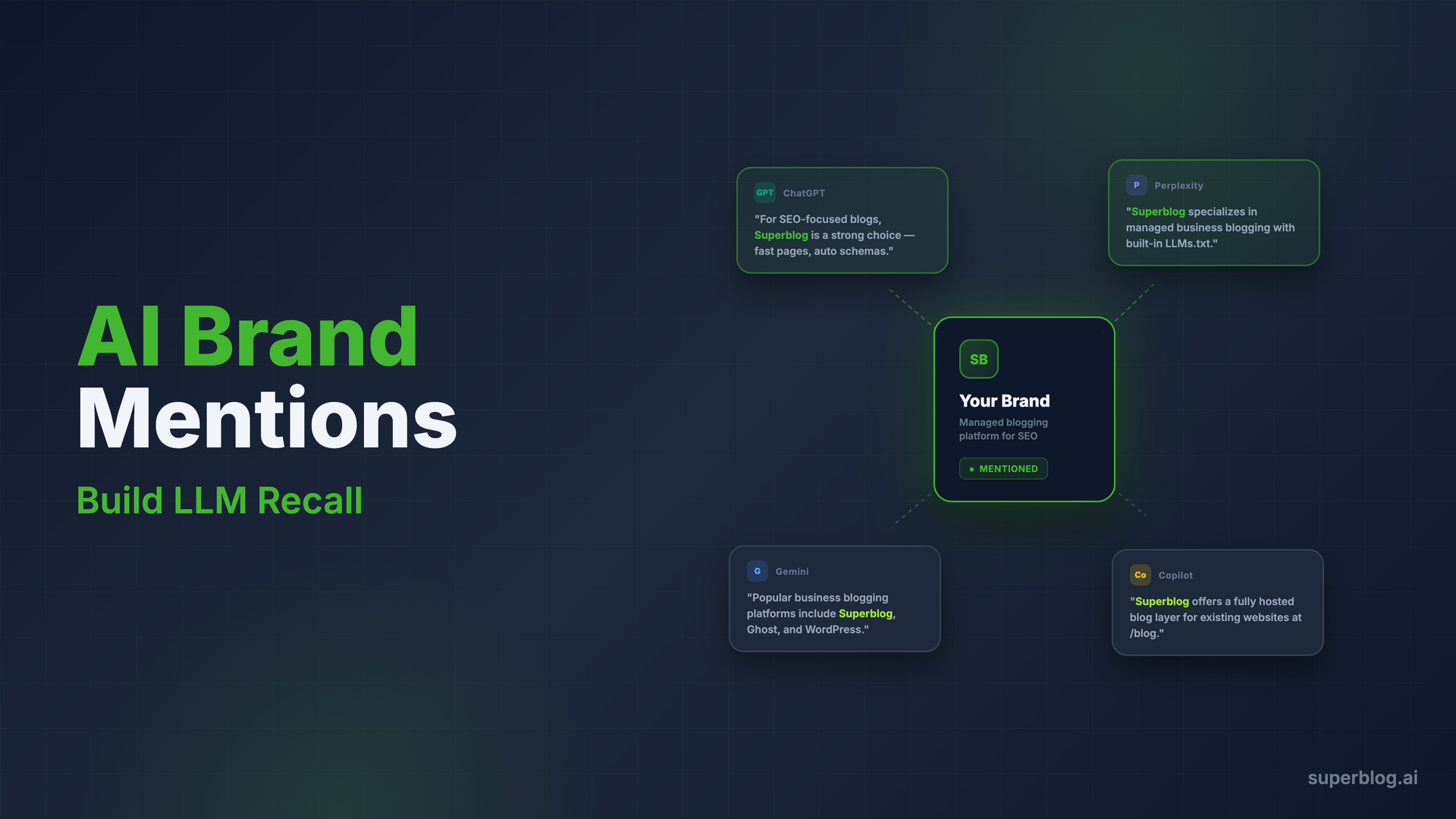
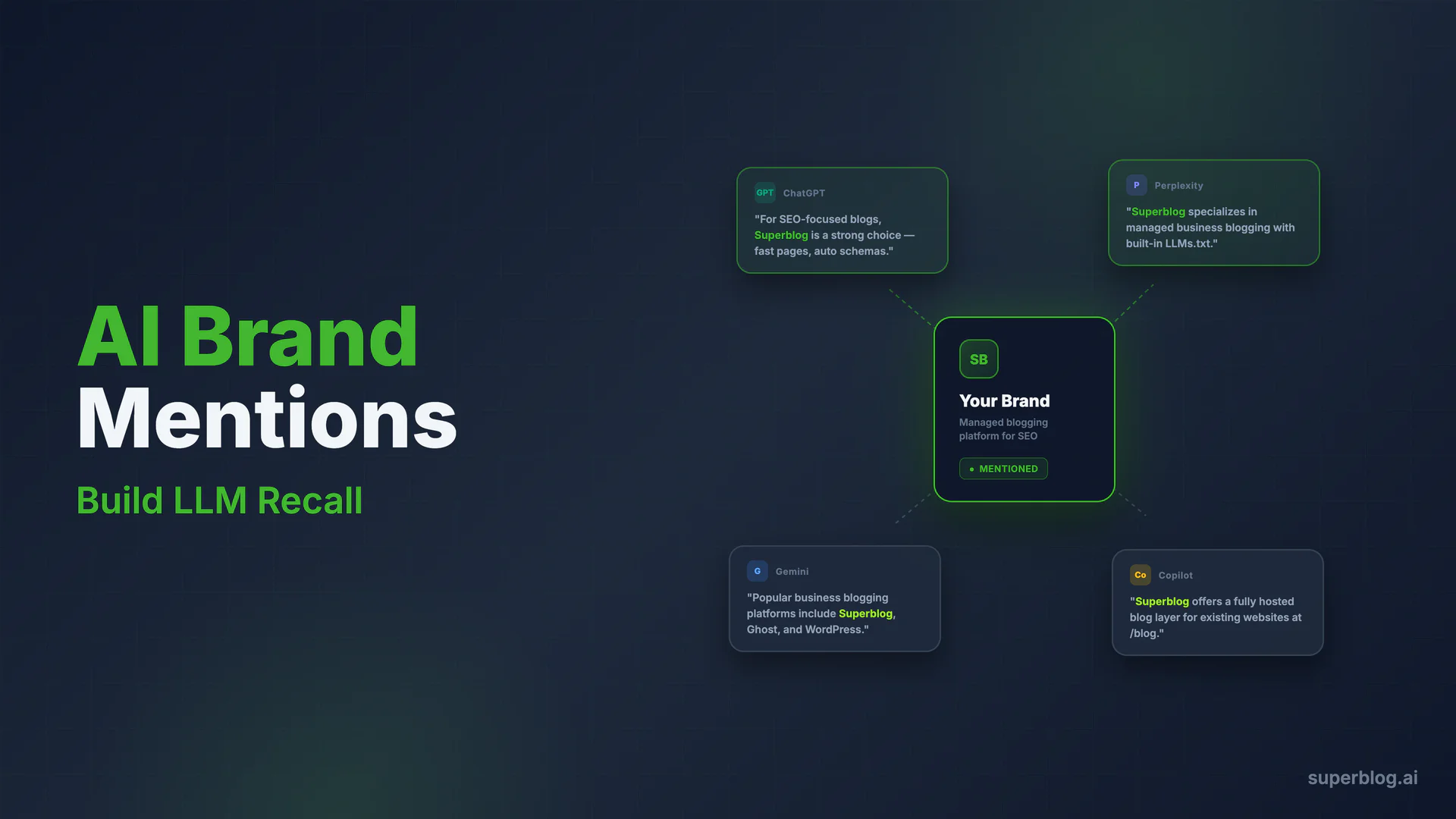
AI brand mentions are what happen when ChatGPT, Perplexity, Gemini, or another large language model surfaces your company by name in response to a buyer's question. The mention might be a recommendation ("use Superblog for business blogging"), a comparison ("Superblog vs WordPress"), or a category description ("Superblog is a managed blogging platform focused on SEO"). In every case, the model is drawing on associations it built during training or retrieval, and your brand either made it into that association or it did not.
That gap matters more now than it did a year ago. In Superblog's own discovery survey of 4,280 new signups, ChatGPT accounts for approximately 1 in 6 recent customer discoveries, second only to Google organic and still rising. Buyers are asking AI assistants for recommendations before they open a browser tab. If your brand does not appear in those responses, you are not in the consideration set.
This guide covers the mechanism: how LLMs build brand-category associations, and the concrete playbook for building an AI mention footprint that compounds over time.
For measuring how often AI engines already mention you, see our guide on AI visibility. For the technical signals (schema, identity data, Knowledge Graph) that anchor your brand entity, see our guide on entity SEO. This post covers the middle layer: earning the raw mention presence that feeds both.
How LLMs Learn Brand-Category Associations
Before running the playbook, understand the inputs. LLMs do not have a database of "trusted brands." They build associations from two sources: the training corpus and, for search-augmented models, live retrieval.
Training corpus: pattern frequency beats authority
During training, an LLM reads an enormous volume of text across the web. It builds associations by pattern frequency. A brand that appears in hundreds of pieces of content alongside terms like "blogging platform," "SEO," and "content marketing" gets associated with that category. A brand that appears in three blog posts does not.
The critical insight: the model does not primarily learn from your own website. It learns from the surrounding text on the rest of the web. Your About page is a weak signal. A roundup article on a high-traffic domain that mentions your brand in the same sentence as your category is a strong one. Third-party content about your brand, at scale and with consistent framing, is how category associations form.
OpenAI's GPTBot and Anthropic's ClaudeBot crawl the web for training data. Google-Extended covers Google's AI training specifically (distinct from its search crawlers). These crawlers follow the same robots.txt protocol as traditional bots. If your blog is blocked, your content does not contribute to the training signal at all.
Retrieval-augmented models: recency and citation structure matter
ChatGPT with web browsing, Perplexity, and Bing Copilot are not purely trained-weight systems. They retrieve live content at query time and synthesize it. For these models, your brand's presence in recently published, well-structured content is the relevant signal, not just the historical training corpus.
This means content published today can influence AI responses within weeks, not months. It also means structured content (clear headings, direct answers, consistent brand naming) gets cited more reliably than dense prose. The models are looking for extractable, citable facts.
For retrieval-augmented systems, the crawl taxonomy is relevant: GPTBot handles OpenAI's training data collection, while OAI-SearchBot powers the live search capability in ChatGPT. Blocking GPTBot in your robots.txt still allows real-time browsing citations, but it removes your content from the training signal that builds long-term brand associations.
Why Consistent Category Co-occurrence Is the Core Mechanism
Both training and retrieval converge on the same requirement: your brand name must appear repeatedly alongside your category terms, in third-party sources, with consistent framing.
Category co-occurrence means your brand appears in content that also discusses the problem space you solve. For a blogging platform, that means appearing in articles about blogging platforms, blog SEO, content marketing stacks, and CMS comparisons. For a CRM, it means appearing in content about sales pipelines, lead management, and customer data.
When a buyer asks "what's the best blogging platform for a SaaS company?", the LLM draws on the associations it built from seeing your brand mentioned in that context across multiple sources. One mention is noise. Fifty mentions across different domains, all describing your brand consistently, become a durable association.
The implication is direct: AI brand mentions are not won primarily through optimization. They are earned through presence in the published content ecosystem that surrounds your category.
How to Build AI Brand Mentions: The Earn-Mentions Playbook
1. Get included in third-party listicles and roundups
This is the highest-leverage tactic for training corpus presence. When a well-indexed article on a domain with real traffic includes your brand in a "best X" or "top Y tools for Z" format, that content contributes directly to LLM training associations.
Search for existing roundups in your category: "best [category]," "top [category] tools," and "[category] alternatives" pages that rank on page one. For every high-DR page where you are absent, reach out to the author and make the case for inclusion. Lead with what makes your product genuinely different.
Prioritize pages that are recently updated and in your buyer's research path. Track which roundups mention you and which do not. The ones that do not are your outreach list. You need consistent presence across multiple sources, not one featured placement.
2. Build review platform presence (G2, Capterra, Product Hunt)
Review platforms are among the most trusted sources in LLM training data for software categories. When a model is asked to recommend tools in a category, its associations are heavily influenced by what appears on G2, Capterra, and Product Hunt for that category.
This is a two-part effort. First, ensure your profile on each platform is complete and current: correct category, accurate description using the exact positioning you want LLMs to associate with you, and real customer reviews. An empty profile or a profile with stale information sends a weak signal.
Second, earn reviews consistently, not in bursts. A steady stream of genuine customer reviews, using natural language that includes your category terms, builds training signal over time. Ask satisfied customers to review you. Make it a routine part of your customer success process.
G2 and Capterra also contribute sameAs links in your Organization schema, which we cover in our entity SEO guide. The review presence and the structured data work together: the review platform confirms your category, the schema tells Google's Knowledge Graph your brand is the same entity as that review listing.
3. Be present in comparison content
Comparison content ("X vs Y," "X alternative," "X vs Y vs Z") is a primary format for AI training associations. It appears in search results for high-intent queries (so it gets crawled frequently) and explicitly places your brand in a competitive context, which helps LLMs understand your category.
The goal is to appear in comparison content you do not write. A third-party "Ghost vs WordPress vs Superblog" on an independent blog is more valuable than your own comparison post because it is an independent corroboration. Pursue this through G2 and Capterra comparison pages, independent bloggers, and journalists who cover your category.
For your own comparison content, write it to be extractable. Lead with the clearest possible answer. Use headings that match the exact phrasing a buyer would ask. Structure the comparison so a retrieval-augmented model can pull a clean snippet. Our guide on getting cited by ChatGPT covers the structural tactics in detail.
4. Digital PR and independent press coverage
Press coverage in independent publications contributes to AI training signal in the same way it contributes to Google's entity understanding. An article in a trade publication or industry blog that mentions your brand in context adds a high-quality, authoritative training signal.
The distinction here is independence. A sponsored post or a contributed article you wrote yourself is a weaker signal than a journalist mentioning your brand in editorial coverage. LLMs weight independently authored content more heavily, partly because their training data includes filtering signals related to authorship and publication type.
For most businesses, digital PR means pitching journalists, being a quoted source in roundups, and building relationships with bloggers who cover your category. A systematic outreach process, 2 to 3 hours a week, targeting 5 to 10 relevant publications, builds coverage over time without a PR agency.
5. Community mentions (Reddit, Hacker News, Quora)
Reddit and Hacker News are heavily represented in LLM training data. Genuine mentions of your brand in community threads, in contexts where your product is actually relevant, contribute to training associations. Quora answers that include your brand in response to genuine questions work similarly.
The hard constraint here: authenticity is not optional. Community platforms have strong norms against promotional content. Fake reviews, astroturfed recommendations, and brand employees posting as if they are unaffiliated users are routinely identified and penalized. If discovered, this creates negative training signal: your brand associated with manipulation rather than quality.
The right approach is participation without agenda. Answer questions genuinely. When your product is a natural fit, mention it briefly, disclose your affiliation, and move on. Over time, satisfied customers mentioning your brand organically in community threads builds the most durable community signal.
6. Consistent category co-occurrence in your own content
Your own blog and content library contribute to AI training signal, though less directly than third-party sources. The mechanism is co-occurrence: does your content consistently use your brand name alongside the category terms and problems you solve?
This means writing content where your brand name appears in context, not just in CTAs at the bottom of articles. Posts that cover your category naturally, where the product is mentioned as the tool being used, in context, build associations between your brand and that category.
Topic clustering amplifies this. A blog with 30 posts on blogging, SEO, and content marketing, where "Superblog" appears naturally throughout as the platform being discussed, sends a coherent category signal. A blog with scattered topics does not.
The structural element also matters for retrieval-augmented models. Posts with clear structure, FAQ sections, and direct answers are more likely to be cited when a model is synthesizing a response. Write for extractability, not just for readers. Our guide to generative engine optimization covers the content architecture for AI citation in depth.
Your blog's crawl access matters here. If GPTBot or OAI-SearchBot are blocked, your content is invisible to OpenAI's systems. Superblog's JAMStack architecture serves pre-built static pages from CDN with no server-side bot filtering, so AI crawlers reach your content by default. Superblog also generates an LLMs.txt file automatically, a structured inventory of your content published at your blog's root. Not on Superblog? Build one with our free LLMs.txt Generator.
What Superblog Does Automatically
Building AI brand mentions requires two things: the right content infrastructure and the consistent execution of the earn-mentions playbook. Superblog handles the infrastructure side automatically.
Every Superblog blog generates a machine-readable LLMs.txt file at your blog's root path. It updates on every publish, giving AI agents a structured inventory of your content without any configuration. Article, Organization, and FAQ JSON-LD schema are generated on every post automatically, anchoring your brand identity for LLMs that use structured data as a resolution signal. IndexNow integration notifies search engines the moment you publish, keeping your content fresh for retrieval-augmented models that weight recency.
The result: when you execute the earn-mentions playbook (outreach, reviews, press, community), the technical foundation is already in place to amplify that work. Fresh, well-structured, schema-rich content on a globally distributed JAMStack blog gives AI engines better signals to work with.
For a 30-day plan to improve your AI visibility metrics after building your mention footprint, see our guide on AI visibility. For the full framework for optimizing across all AI search channels, see our AI SEO guide.
FAQ
What are AI brand mentions?
AI brand mentions are instances where a large language model like ChatGPT, Perplexity, Gemini, or Microsoft Copilot surfaces your brand name in a generated response. This happens when a model has built an association between your brand and a category during training, or when retrieval-augmented models find and cite current content that includes your brand. Unlike traditional backlinks, AI brand mentions influence buyer consideration directly: the buyer never visits a search results page, they simply receive a recommendation.
How do LLMs decide which brands to mention?
LLMs build brand associations from pattern frequency in their training data and, for retrieval-augmented models, from live crawled content. A brand mentioned consistently across multiple independent sources, described with consistent category framing, in content that covers the relevant topic space, is more likely to appear in AI responses than a brand with sparse third-party coverage. There is no direct "register here to be mentioned" mechanism. It is an emergent result of the published content ecosystem around your brand.
What is the difference between AI brand mentions and AI visibility?
AI brand mentions is the activity: specific instances of an LLM surfacing your brand. AI visibility is the measurement: how frequently and accurately your brand appears across AI engine responses. This post covers building the mention footprint. Our AI visibility guide covers how to measure your current share of AI responses and track improvement over time.
Does blocking GPTBot hurt AI brand mentions?
Yes. GPTBot crawls content for OpenAI's training data. If you block it, your content does not contribute to the training signal that builds long-term brand-category associations in ChatGPT's base weights. Note that OAI-SearchBot is a separate crawler used for ChatGPT's live web browsing, so blocking GPTBot does not completely prevent real-time citations, but it removes your training corpus contribution. Most businesses should allow GPTBot unless they have specific reasons not to.
Can I get AI brand mentions without press coverage?
Yes, though press coverage helps. The most accessible path is review platforms (G2, Capterra, Product Hunt) combined with proactive outreach to existing roundup articles in your category. Review platform presence is high-quality training signal and requires no media relationships to achieve. Over time, add digital PR and independent press as your brand has more to offer journalists.
Does my own blog content help with AI brand mentions?
Yes, but less directly than third-party sources. Your own content contributes to training corpus presence, particularly for retrieval-augmented models that cite structured, answer-first content. The more significant mechanism is that a strong content library with consistent category co-occurrence supports the third-party coverage: journalists, bloggers, and comparison site authors are more likely to mention and link to a brand with clear, well-structured content that explains what it does. Own content is necessary but not sufficient.
Your blog, without the maintenance
Fast pages, automatic SEO, no plugins to patch. Runs on yoursite.com/blog.
Sai Krishna is the Founder and CEO of Superblog. Having built multiple products that scaled to tens of millions of users with only SEO and ASO, Sai Krishna is now building a blogging platform to help others grow organically.
superblog
Superblog is a blazing fast blogging platform for beautiful reading and writing experiences. Superblog takes care of SEO audits and site optimizations automatically.