
Hugo Blog: When a Static Site Outgrows Its Own Blog (2026)

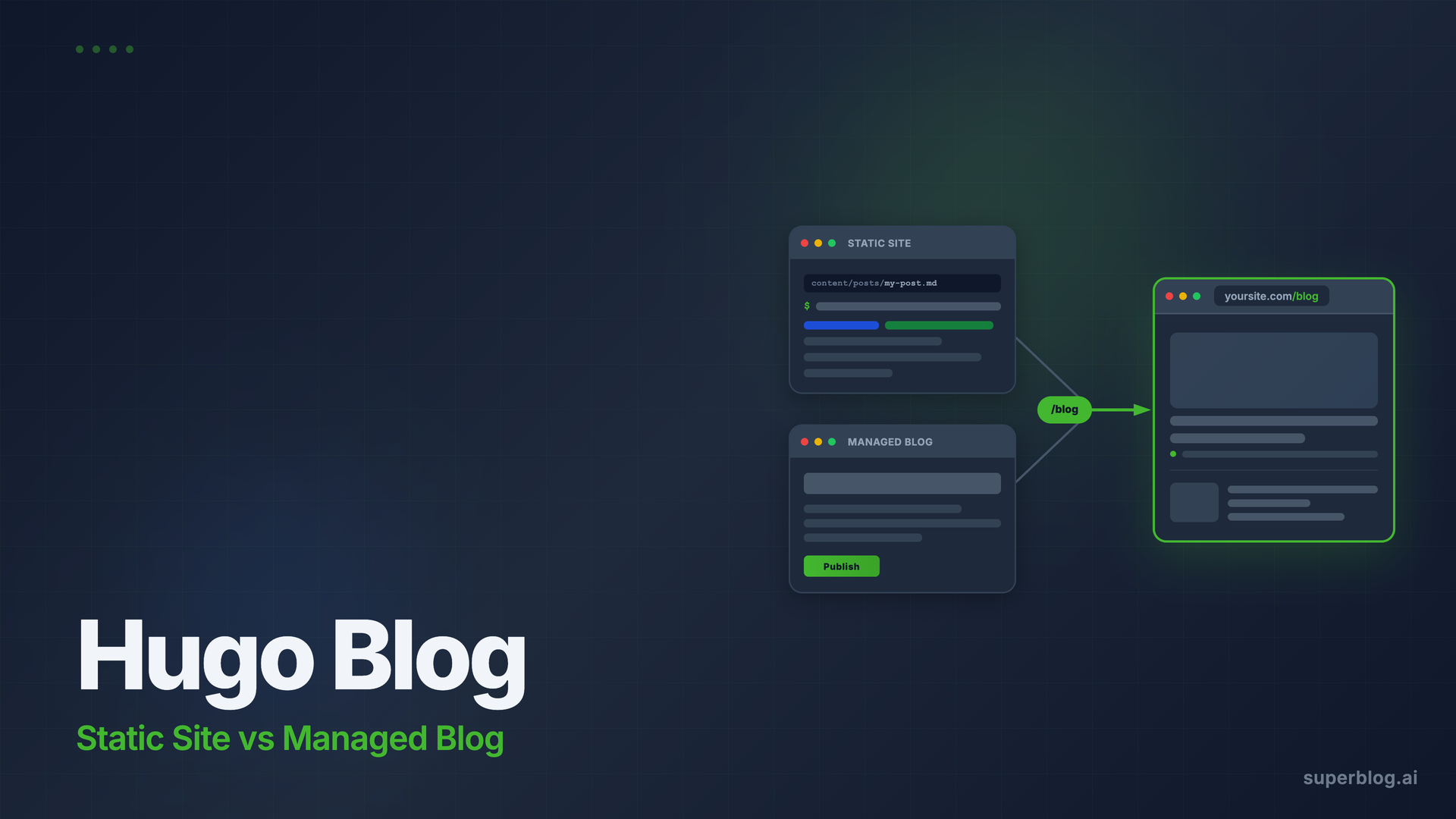
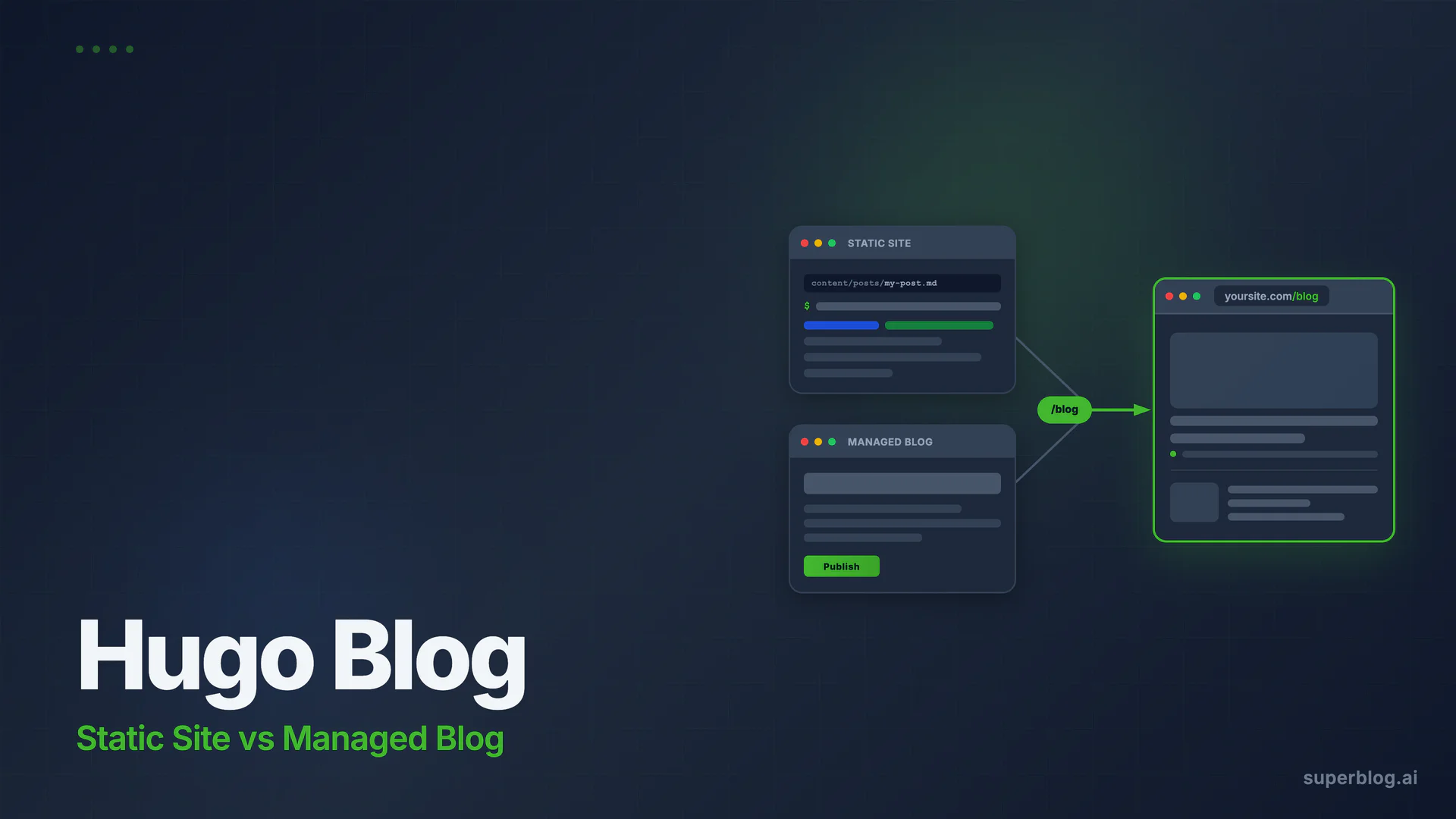
If your marketing site runs on Hugo, you have two real options for a Hugo blog:
- Markdown in your repo: every post is a file in
content/posts/, version-controlled with your codebase, deployed as part of your Hugo build. - A managed blog layer at
/blog: a separate, purpose-built blogging platform mounted via reverse proxy, running independently of your Hugo site.
Neither is the wrong answer. They solve different problems. The gap between them is who owns the blog day-to-day and what that costs your team every time a post needs to go live or get a typo fixed.
This guide covers both paths honestly: what each one actually does well, where each one breaks for business teams, and how to wire up the reverse proxy option on Netlify, Vercel, and Cloudflare so your blog lives at yoursite.com/blog without touching your Hugo codebase.
What Hugo's content model actually does well
Hugo's content system is one of the fastest and most disciplined approaches to static site content management. Here is what it genuinely delivers:
Speed at build time. Hugo is fast. A site with thousands of pages builds in seconds. For documentation-heavy sites or large content archives, this is a real advantage over frameworks that add runtime or build overhead as content volume grows.
Structured content without a database. Front matter in TOML, YAML, or JSON gives every post typed metadata at build time. You define archetypes that template new content files, enforce consistent structure, and reduce manual errors. For a dev blog where authors know the repo, this is a clean system.
Taxonomy built in. Hugo handles categories, tags, and custom taxonomies through configuration. Related content, series, and term pages generate automatically. For sites with a large content archive, this beats hand-coding taxonomies in most frameworks.
Zero runtime dependencies. The output is static HTML. No server, no database, no CMS API call on the critical path. Global CDN delivery, zero moving parts at request time.
Git-native workflow. Authors who live in GitHub can write posts as pull requests. Review, version history, rollback: all handled by git. For technical teams writing for technical audiences, this fits naturally.
These strengths are real. If your Hugo blog is written by engineers for engineers, and your publishing cadence is occasional and deliberate, this is a defensible setup.
Where a Hugo blog breaks for business teams
The model above shares one assumption: the person publishing content is comfortable working in a code repository. For most business marketing teams, that assumption breaks on day one.
Every post is a commit, a build, and a deploy. Your content manager wants to update a headline in a published post. To do that, they need to either edit a markdown file directly in GitHub, wait for the build to finish, and watch the deploy pipeline, or ask an engineer to handle it. Neither option works at publishing velocity. The engineering tax compounds fast: one "quick fix" pulled from a sprint costs twenty minutes of context switching.
There is no editor interface for marketers. Hugo's content files are markdown. There is no WYSIWYG, no image upload dialog, no preview that does not require running hugo server locally. You can add a git-based CMS like Decap (formerly Netlify CMS) or CloudCannon on top of Hugo, but now you are maintaining a CMS integration alongside your Hugo setup, and you have essentially crossed into option 2 territory while keeping the complexity of both.
Every post that touches shortcodes or custom templates becomes a developer task. Hugo is powerful precisely because of its shortcode and templating system. That power cuts the other way: any content that uses custom shortcodes, figure tags, or layout partials requires someone who knows Hugo's template language to create or maintain them. Marketing teams cannot self-serve on layout changes. They file a request and wait.
No SEO automation. Hugo does not automatically generate JSON-LD schemas, submit URLs to IndexNow on publish, create per-language hreflang tags, or produce the LLMs.txt file. You can build all of this in Hugo partials, but it takes developer time, and it never gets done consistently. Structured data gets added to one post template and not carried through when the template changes.
Content velocity gets bottlenecked on whoever knows Hugo. At two or three posts per week, the entire publishing pipeline touches the repo. Category management, author profiles, scheduling, internal link decisions: all of it requires either developer involvement or custom scripting. For a growth team running a real content calendar, this kills output.
A note before the full comparison: platforms like Superblog exist to solve exactly this problem for Hugo sites. They mount at yoursite.com/blog via reverse proxy and run completely independently from your Hugo codebase. More detail below.
The three options side by side
Option 1: Markdown in the Hugo repo
Best for: developer-authored technical blogs, documentation sites, and release notes where authors are already inside the codebase. Not recommended once marketing takes ownership of the blog or publishing frequency rises above once a week.
Option 2: Headless CMS wired to Hugo
Adding Sanity, Contentful, or Hygraph gives your marketing team a real editor interface. But your Hugo site still rebuilds on every content change. Depending on build times and deploy configuration, a writer publishing a correction at 2 PM waits several minutes to see it live. You also maintain the CMS content model, the Hugo integration layer, and any webhooks that trigger deploys. It solves the editor problem but adds infrastructure overhead and still puts a build pipeline between your writers and published content.
Option 3: Managed blog layer
A managed platform like Superblog runs at yoursite.com/blog via reverse proxy, completely independently of your Hugo codebase. Your Hugo site has no awareness that the blog exists; it passes /blog requests through to the Superblog CDN. Writers log in to a separate dashboard, publish posts instantly, and your engineering team never touches the blog pipeline.
Setting up the reverse proxy for Hugo sites
This configuration routes yoursite.com/blog to your managed blog layer, regardless of where your Hugo site is hosted. The configuration lives in your hosting platform's routing layer. Your Hugo code does not change.
Netlify
Hugo sites on Netlify can use a _redirects file placed in the static/ directory (it gets copied to the publish root):
/blog/* https://your-blog-name.superblog.click/blog/:splat 200
Or in netlify.toml:
[[redirects]]
  from = "/blog/*"
  to = "https://your-blog-name.superblog.click/blog/:splat"
  status = 200
  force = true
The 200 status code is a transparent proxy rewrite. Visitors see yoursite.com/blog in the address bar throughout.
Vercel
If your Hugo site deploys to Vercel, add a vercel.json to your project root:
{
  "rewrites": [
    {
      "source": "/blog/:path*",
      "destination": "https://your-blog-name.superblog.click/blog/:path*"
    }
  ]
}
Vercel evaluates rewrites before checking the Hugo build output, so /blog paths route to the external service transparently without any Hugo changes.
Cloudflare (Workers or Transform Rules)
If your Hugo site sits behind Cloudflare, a lightweight Worker handles the proxy cleanly:
// Worker for /blog/* proxy
export default {
  async fetch(request) {
    const url = new URL(request.url);
    if (url.pathname.startsWith('/blog')) {
      const target = new URL(url.pathname + url.search, 'https://your-blog-name.superblog.click');
      return fetch(target, request);
    }
    return fetch(request);
  }
}
For all three setups, once the route is live, the blog runs independently. No Hugo rebuild fires when a post publishes. No codebase changes to add a category. No engineer involvement for routine content operations.
For the SEO case for keeping your blog on a subdirectory versus a subdomain, the subdomain vs subdirectory guide covers the domain authority implications in detail.
Superblog: the managed blog layer built for teams
Superblog is a complete, fully-managed blogging platform: CMS, frontend UI, hosting, and SEO engine in one product. When you mount it at yoursite.com/blog via the reverse proxy setup above, your Hugo site gains a production-grade blog without a single line added to your codebase or your Hugo config.
The editor your marketers will actually use
The TipTap v3 editor works like a document tool: slash commands, inline formatting, image uploads, drag-and-drop content blocks. Writers do not need to know what front matter is or how Hugo taxonomies work. Publishing is a button. Draft previews are built in. Scheduling is built in. There is no build pipeline between "click publish" and "post is live on the site."
This is the moment where the markdown-in-repo model reaches its limit for most businesses. A writer cannot fix a headline in a published post without a developer. On Superblog, anyone with Editor permissions can fix it in under 30 seconds.
For a broader look at how this fits into the general question of connecting a blog to an existing site, the add a blog to your website guide covers the full landscape.
Hugo CMS limitations Superblog replaces
Hugo is not a CMS in the traditional sense. It has no admin interface, no role-based access for non-technical contributors, and no built-in editorial workflow. Teams that need those things either bolt on a third-party CMS (and maintain the integration) or route every content change through a developer. Superblog replaces that entire layer. Admins, Editors, and Writers each get role-appropriate access. Collaborative review is available on Pro and above: writers submit posts, and a designated reviewer approves before anything goes live. For a content team running a weekly calendar, this replaces the Notion-based approval workflow you currently have bolted on the side.
SEO that runs without developer configuration
Every post on Superblog automatically gets:
- JSON-LD schemas: Article, FAQ, and Organization, generated from your post data on every deploy. These power rich snippets in Google without any Hugo partial to write or maintain.
- IndexNow submission: On publish, Superblog sends an authenticated POST to the IndexNow API, notifying Bing and other supporting search engines immediately. No configuration, no webhook setup.
- Auto XML sitemaps: Generated and updated on every deploy. Always current, always submitted.
- LLMs.txt: A machine-readable file at
yoursite.com/blog/llms.txt. Most Hugo blog setups do not generate this file. It is a genuine differentiator for teams focused on AI search visibility.
None of this requires engineering time. It works on day one. For a business blog that depends on organic traffic, that is weeks of SEO implementation work that never needs to happen.
For teams comparing a managed platform against building their own pipeline, the headless CMS for business blogs guide covers what you are taking on when you choose to build.
Performance that holds at scale
Superblog runs on JAMStack architecture: pre-built static pages served from a global CDN with 200+ edge locations. Every post renders at 90+ Lighthouse score, automatically. No Hugo caching partial to configure, no image optimization pipeline to wire up, no performance regression when the template changes.
First Contentful Paint under 1 second. Images automatically converted to WebP. Google's Core Web Vitals are a confirmed ranking factor. A fast blog at yoursite.com/blog lifts the domain's overall performance signals.
Internal link suggestions
As you write, Superblog analyzes your post content and finds related published posts, matching on categories, tags, and keyword overlap, then suggests anchor text phrases and lets you insert links in one click. For teams running a content cluster strategy, this matters. Internal linking is how cluster authority flows from supporting posts to pillar pages, and doing it manually at scale is slow.
The Astro and Vercel sibling posts
If your team runs multiple marketing properties, the same reverse proxy approach works across frameworks. The add blog to Astro post covers the Astro-specific setup with the same Netlify, Vercel, and Cloudflare patterns above. For teams running Hugo alongside S3-based infrastructure, the blog for S3 static site use case covers the CDN-layer proxy setup.
Pricing
All plans include auto SEO, CDN, SSL, subdirectory hosting, and custom domain support. The 7-day free trial requires no credit card, and you can cancel anytime.
FAQ
Does Hugo have a CMS?
Hugo does not include a visual CMS interface. It processes markdown and data files at build time and outputs static HTML. To give non-developers a way to edit content, you need to layer on a git-based CMS (Decap, CloudCannon) or an external headless CMS (Contentful, Sanity). Both add infrastructure to maintain alongside your Hugo config. A managed blog layer like Superblog is a third option: it runs at /blog independently and requires no Hugo integration at all.
How do I add a blog to a Hugo site without touching the codebase?
Use a reverse proxy to mount a managed blog platform at yoursite.com/blog. Your Hugo site handles everything except /blog paths, which route transparently to the external platform. The proxy config lives in your hosting layer (Netlify _redirects, Vercel vercel.json, or a Cloudflare Worker). From the visitor's perspective, everything is on one domain. From the engineering perspective, the two systems are completely separate.
Can non-developers publish posts on a Hugo site?
Not without additional tooling. Hugo's content model requires editing markdown files in a code repository and triggering a new build to see changes live. To give marketers a visual editor, you need a git-based CMS or an external headless CMS integrated with Hugo. Alternatively, a managed blog layer like Superblog runs at /blog independently and gives non-developers a full editing interface with no Hugo involvement.
What is the difference between a Hugo CMS integration and a managed blog platform?
A Hugo CMS integration (connecting Contentful or Sanity to Hugo) gives you a visual editor for content, but your Hugo site still needs to rebuild and redeploy for every content change. You also maintain the integration, the content model, and any webhooks that trigger builds. A managed blog platform like Superblog provides the CMS, the frontend UI, the hosting, and the SEO layer as one product, and it runs at /blog without any Hugo rebuild when content changes. For teams that want to publish independently without engineering involvement, the managed layer removes the entire pipeline from the equation.
Does proxying /blog to an external platform hurt SEO?
No. When configured as a transparent proxy rewrite (not a redirect), the blog content serves at yoursite.com/blog. Search engines see a unified domain, canonical URLs point to yoursite.com/blog/*, and domain authority from your Hugo main site applies to the blog. This is the subdirectory hosting model that Google explicitly recommends for keeping blog authority on the main domain. The subdomain vs subdirectory guide explains the technical distinction and the ranking implications.
How do I migrate existing Hugo blog posts to Superblog?
Superblog supports import from JSON, CSV, and RSS feeds. You can export your Hugo content by generating an RSS feed (Hugo does this by default at /index.xml) or by exporting posts to JSON. Most migrations complete in 5 to 10 minutes. URL slugs can be preserved exactly, which means existing search rankings are not affected. After migration, posts live at the same /blog/post-slug/ paths visitors and search engines already know.
The decision in one sentence
If your Hugo blog is written by developers for developers and publishes occasionally, the markdown-in-repo model is the right architecture. If marketing owns the blog and needs to publish without filing a ticket or waiting on a build, mount a managed blog layer at /blog via reverse proxy and spend your engineering time on the product.
Start a free trial at write.superblog.ai. No credit card required.
Your blog, without the maintenance
Fast pages, automatic SEO, no plugins to patch. Runs on yoursite.com/blog.
Sai Krishna is the Founder and CEO of Superblog. Having built multiple products that scaled to tens of millions of users with only SEO and ASO, Sai Krishna is now building a blogging platform to help others grow organically.
superblog
Superblog is a blazing fast blogging platform for beautiful reading and writing experiences. Superblog takes care of SEO audits and site optimizations automatically.